
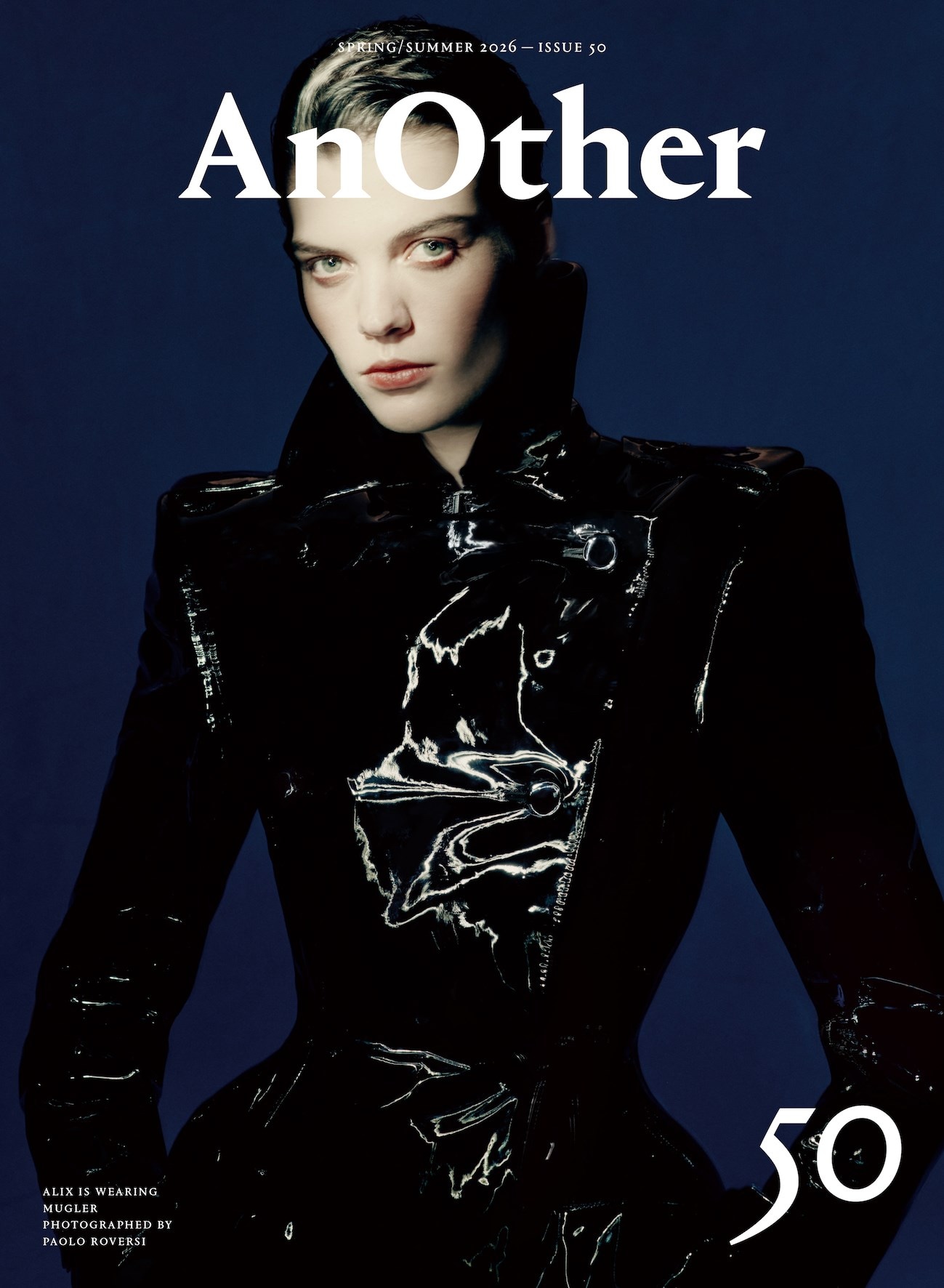
This story is taken from the Spring/Summer 2026 issue of AnOther Magazine:
Power-suited femmes fatales. Ostrich-feathered and spangled showgirls. Latex-wrapped dominatrices and the pumped, plumped, pneumatic body of a superhuman. The aesthetic universe of Mugler is one filled with inescapable, seemingly inexhaustible cliché. But that isn’t necessarily a bad thing. “I’m obsessed with clichés,” says Miguel Castro Freitas, who became Mugler’s creative director just under a year ago. “Because for me they are the equivalent of universal recognisable codes.” He loves the notion of them so much he even subtitled his debut collection for the house A Trilogy of Glorified Clichés, envisaging it as the first of a three-parter – like a movie franchise – in which he explores archetypes of Mugler. “It was important to call it that as a way of assuming the word,” Castro Freitas says. “It’s about tapping into cliché.”
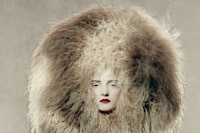
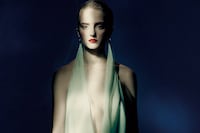
It’s certainly a way to deal with the potentially crippling legacy of its founder, Thierry Mugler, who reshaped fashion in the 1980s – and his own body in the 2000s, returning to his birth name of Manfred. He’d retired from his house by then, but Manfred’s myth remained strong. His was the imagination that defined Eighties power dressing with nipped-in waists and boldly authoritative shoulders, arch retro-futurist takes on the costumes of 1940s cinema and pulpy comic-book illustrations. In the 1990s his shows became ever more extravagant, some of the first to fuse fashion with pop culture, which included him ticketing the public to allow access to his 1995 anniversary extravaganza and co-directing the video for the 1992 George Michael single Too Funky. It’s true to say that at that point these excursions served primarily as promotion for his phenomenally successful perfume Angel, also introduced in 1992, as opposed to selling very many clothes. Nineties minimalism wasn’t very Mugler.

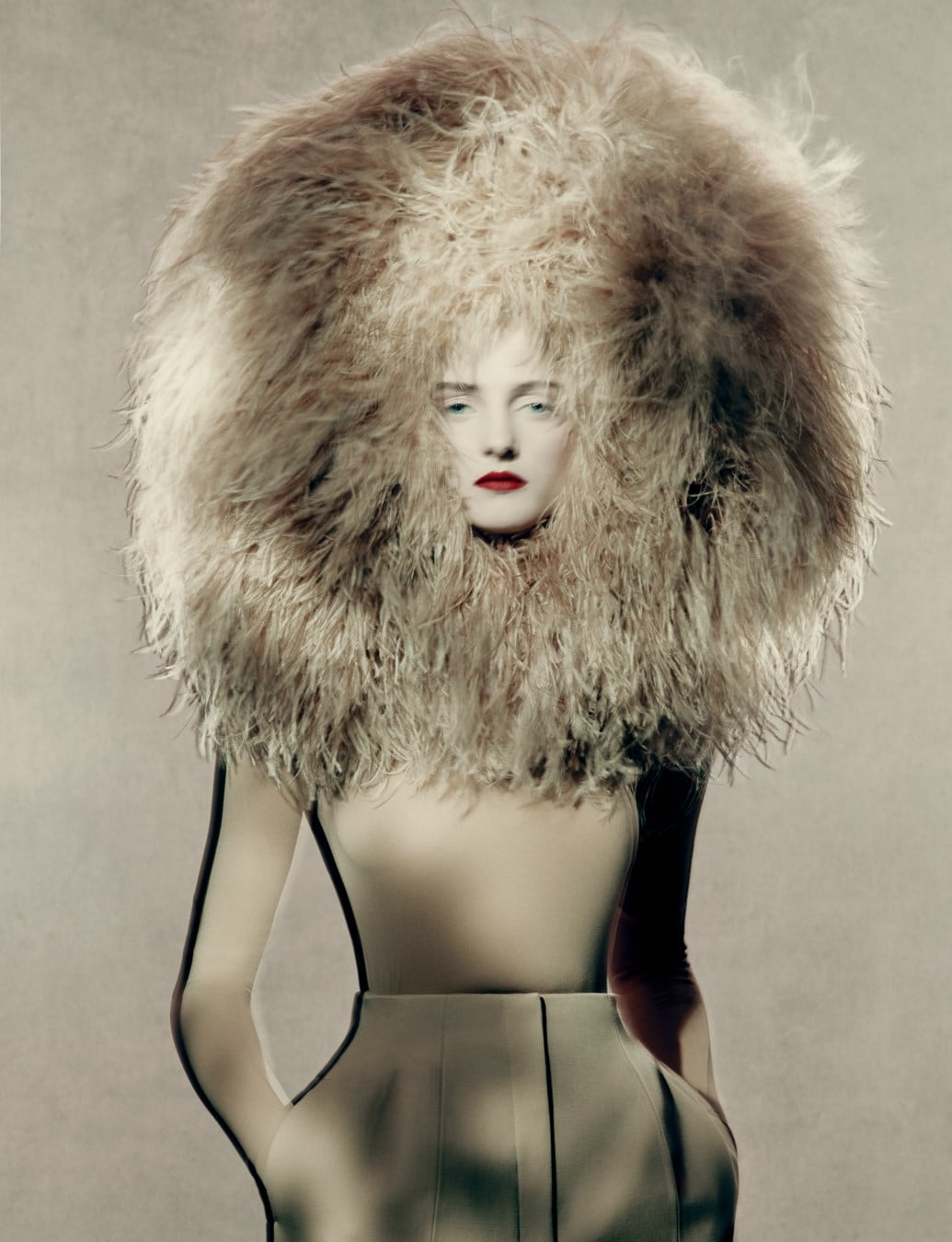
 in crepe georgette by MUGLER)
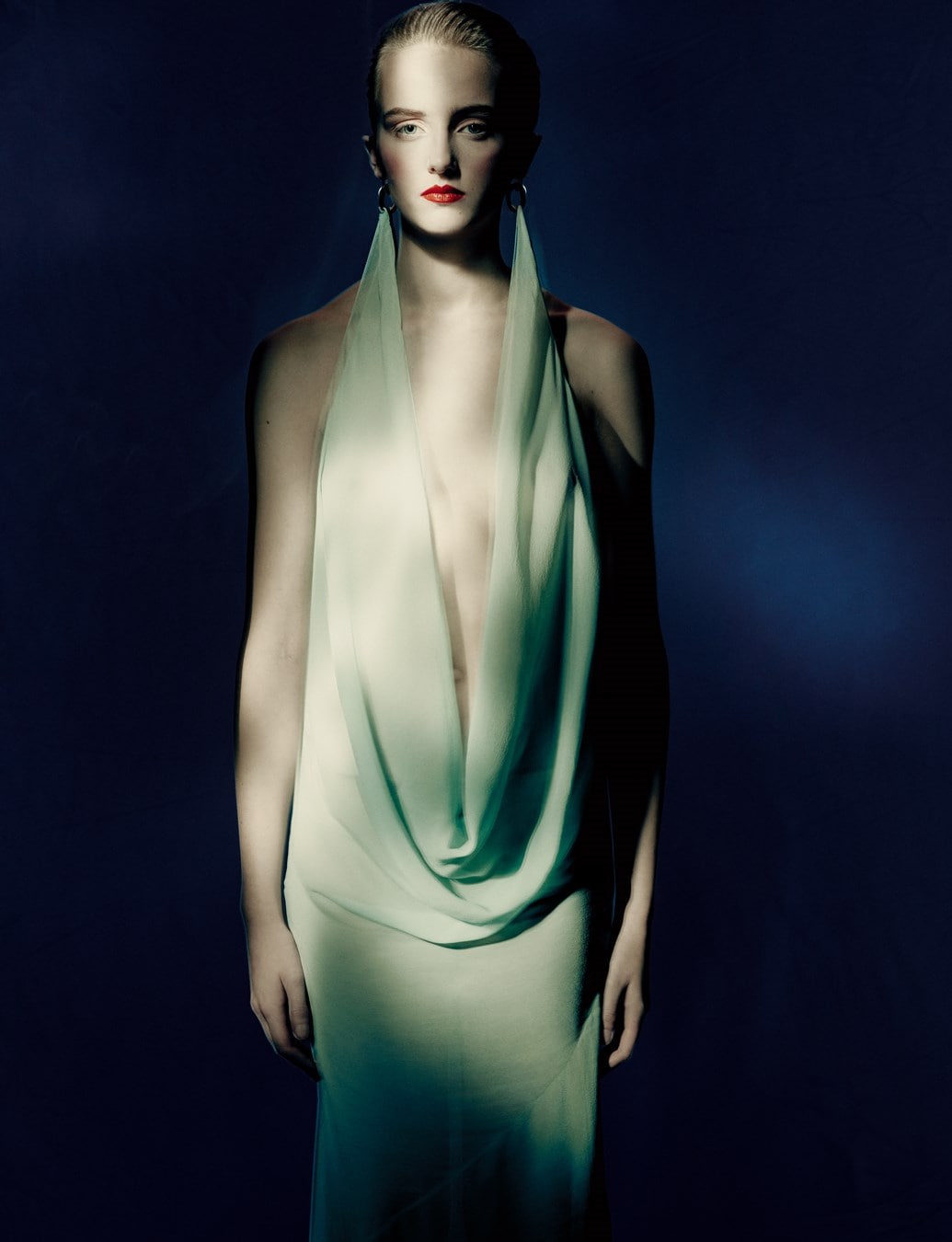
But that is something Castro Freitas wants to do – to clothe people, in extraordinary garments that still have an actuality to them. “I believe that we will be most successful if we manage to bring those two worlds together, to merge the fantasy with the reality,” he says. “Mugler is synonymous with fantasy, but we are in a very different world from where we were back in the day. We are in the now. I think it’s very, very important to tap into the now.”
And, actually, equally important to chafe at our expectations and stereotypes of what Mugler could and may be. Castro Freitas’s debut show, staged in October, embraced the glorified Mugler cliché of glamour. “Part two, I can tell you already, is going to be the cliché of power,” he says with a smile. Yet the glamour exuding from these clothes was one that felt somewhat alien – the name of another Mugler perfume, as it happens. “Brutalist glamour,” was Castro Freitas’s qualification for that. “Working on the collection, I kept these two words, which are quite antagonistic, always in my head.” In satins, stretch jerseys and slithery shiny latex in a spectrum of skinlike flesh tones, sometimes even stretched over extreme, body-reshaping couture corsets hidden from view, the clothes had the feel of idealised nudity. “But she’s fully dressed,” he says. It sometimes even extended to gloves cloaking the hands. In the same manner, Folies Bergère showgirls were a reference. “I love excessive camp,” Castro Freitas admits, and it was present in headdresses of plumes that sometimes evolved to become animalistic feathers covering the body, as if the model were midway through transformation between human and beast. Castro Freitas collaborated for those with Maison Février, a plumassier that, since 1929, has created costumes for Parisian cabaret performers. “They actually belong to the Moulin Rouge,” he says. “Their laboratory is in the back.” Thierry himself didn’t work with them, somewhat unbelievably. It feels like a wrong righted.

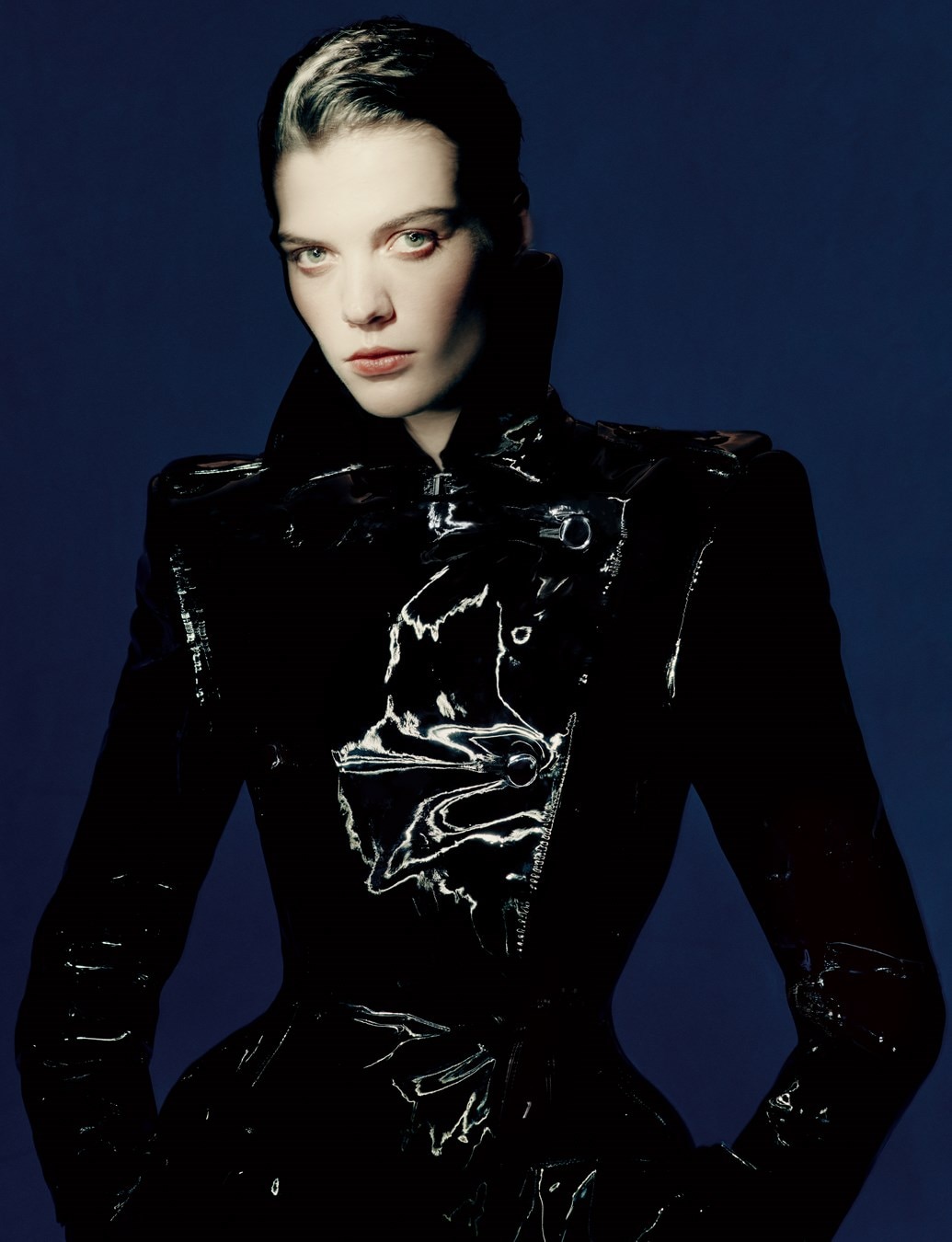

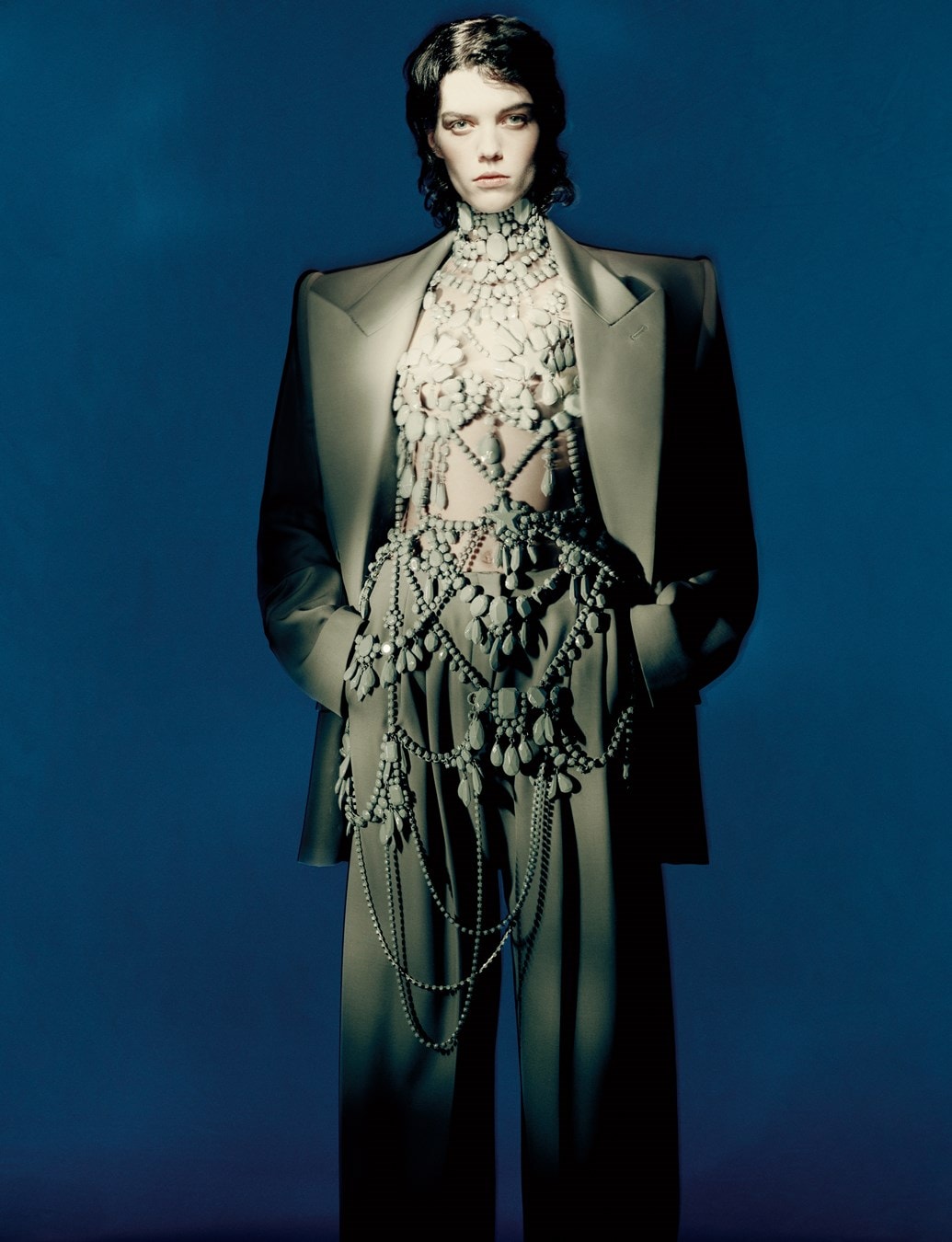
Castro Freitas is an avid cinephile, which is perhaps why his take on the showgirl cliché runs the gamut from Fellini folly to Lynchean surrealism to even a touch of Cronenberg body horror. And also to Mugler himself as an image-maker: there’s a “direct homage” to Linda Evangelista in the Too Funky video, an aureole of feathers surrounding her face as she preens in its parody of a catwalk show. Camp, see. Well, sort of. “There’s this duality,” Castro Freitas says. “Mugler is synonymous with iconography as well as iconoclasm. That’s a beautiful duality to be dealing with, from the perspective of embracing clichés and at the same time always finding a way to be disruptive.”
“Mugler is synonymous with fantasy, but we are in a very different world from where we were back in the day” – Miguel Castro Freitas
Castro Freitas is a Gemini, which to a degree explains that duality. His clothes are both hard and soft, their sculpted carapaces melting in motion. “I love the idea of bringing worlds that are as far apart as possible together, as a way to create some kind of a short circuit between them,” he says. He’s also a long-term Mugler fan, first falling in love with that designer’s clothes as a child growing up in Santarém, Portugal, a small city outside Lisbon, in the mid-1980s. He came of age in the 1990s – “and I’m a creature of then. I grew up with these multiple references that are so distinct and contrasting,” he says. “That really informs the way I approach my work – I don’t need to choose sides. I don’t need to be a minimalist or a maximalist. Maybe I’m a purist maximalist or an excessive minimalist.” It is also reflected in the diversity of his CV – after he graduated from Central Saint Martins in 2004, Castro Freitas went on to work for designers including John Galliano, Stefano Pilati, Alber Elbaz, Raf Simons and Dries Van Noten. It’s an awe-inspiring roster of some of the greatest names of the past quarter-century.

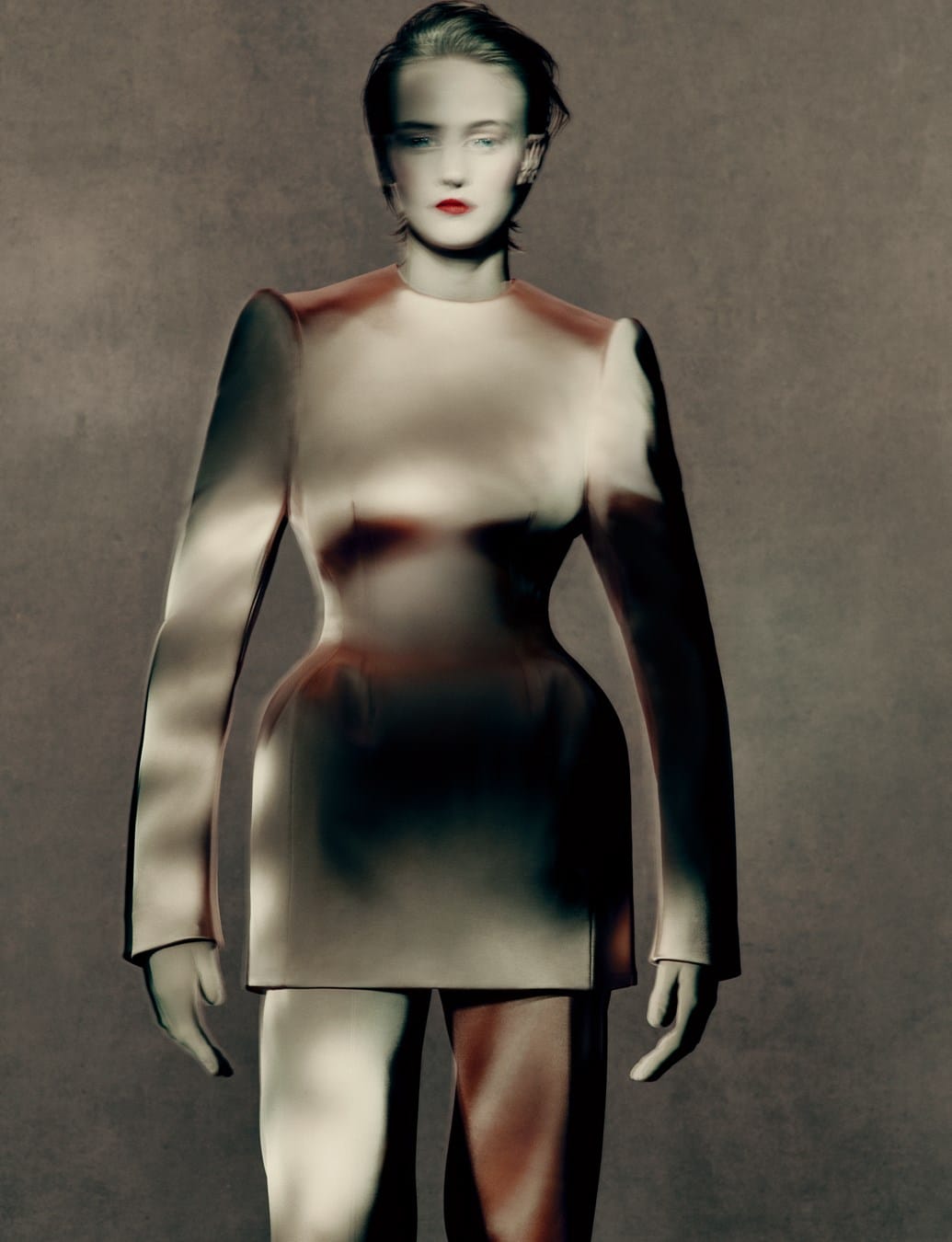

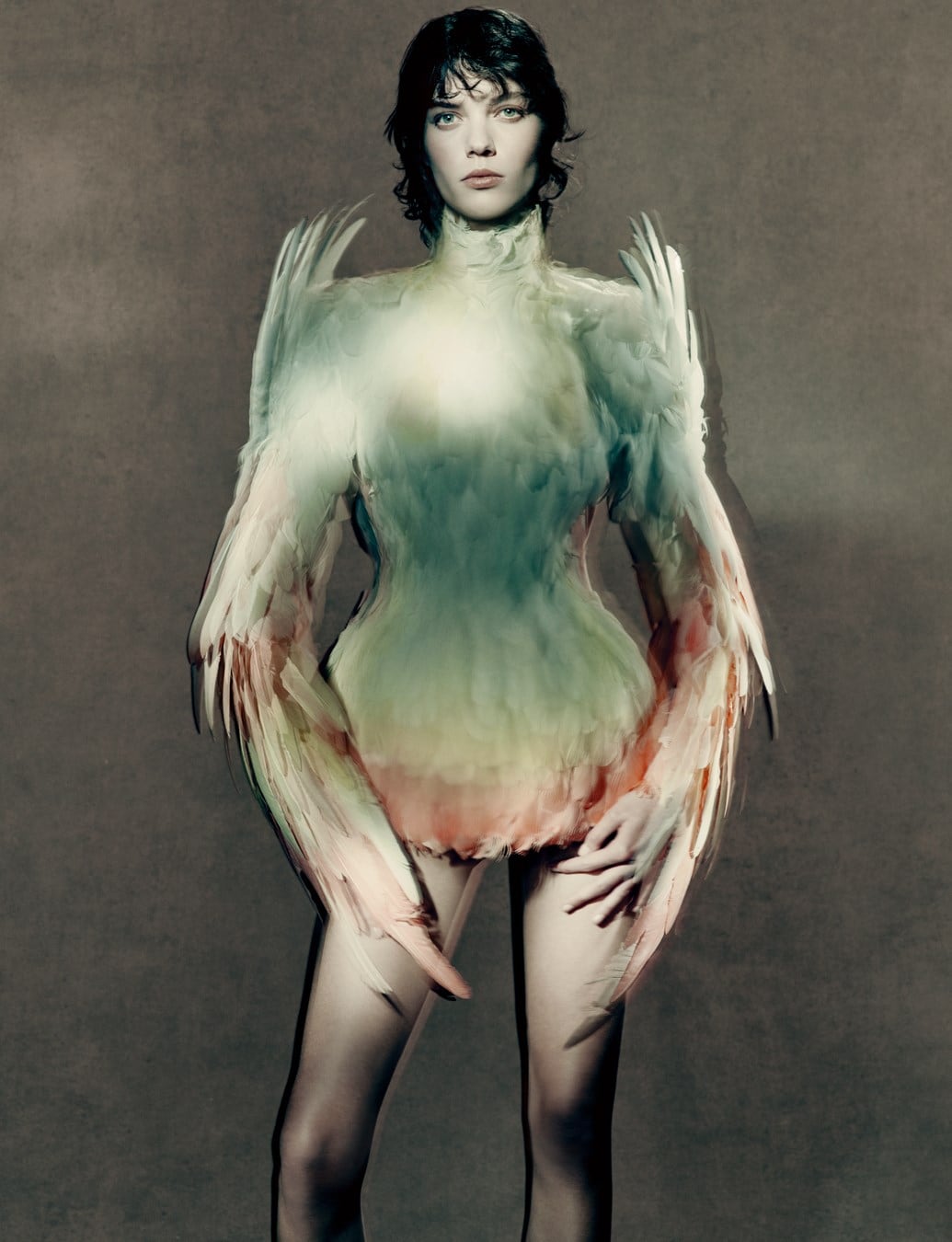
Mugler is another. Castro Freitas has a dream of an archive to reference at the house – both in scope and scale (he estimates some 10,000 pieces). For that, he is volubly grateful. “But I don’t want to fall into reverence,” he says. “Archives should give us the possibility to expand rather than suffocate, the possibility of moving forward. I think the best way to honour the spirit of the house and Thierry Mugler himself is to be in that mode of looking forward. I think that’s what he did. That’s the best way of honouring.”
Hair: Olivier Schawalder at Art + Commerce using ORIBE. Make-up: Aurore Gibrien at Bryant Artists using CHARLOTTE TILBURY. Manicure: Hanaé Goumri at Walter Schupfer Management. Set design: Léonard Bougault at We Are the Agent. Casting: Rachel Chandler for Midland at Art Partner. Models: Alix Bouthors at Apparence and George Anderson at Viva London. Digital tech: Paul Allister at Dtouch. Photographic assistants: Clara Belleville, Chiara Vittorini and Marine Grandpierre. Styling assistants: Isabella Damazio and Sabīne Groza. Hair assistant: Cloé Hobi. Make-up assistant: Natsuki Oneyama. Set-design assistant: Tom Chatenet. Production: Studio Demi. Executive producer: Camila Mendez. Producer: Ariane Coudé du Foresto. Production manager: Baptiste Crepatte. Production assistant: Théo Sillas. Post-production: Retouch Grading Bureau
This story features in the Spring/Summer 2026 issue, marking 25 years of AnOther Magazine, on sale internationally on 12 March 2026.
