
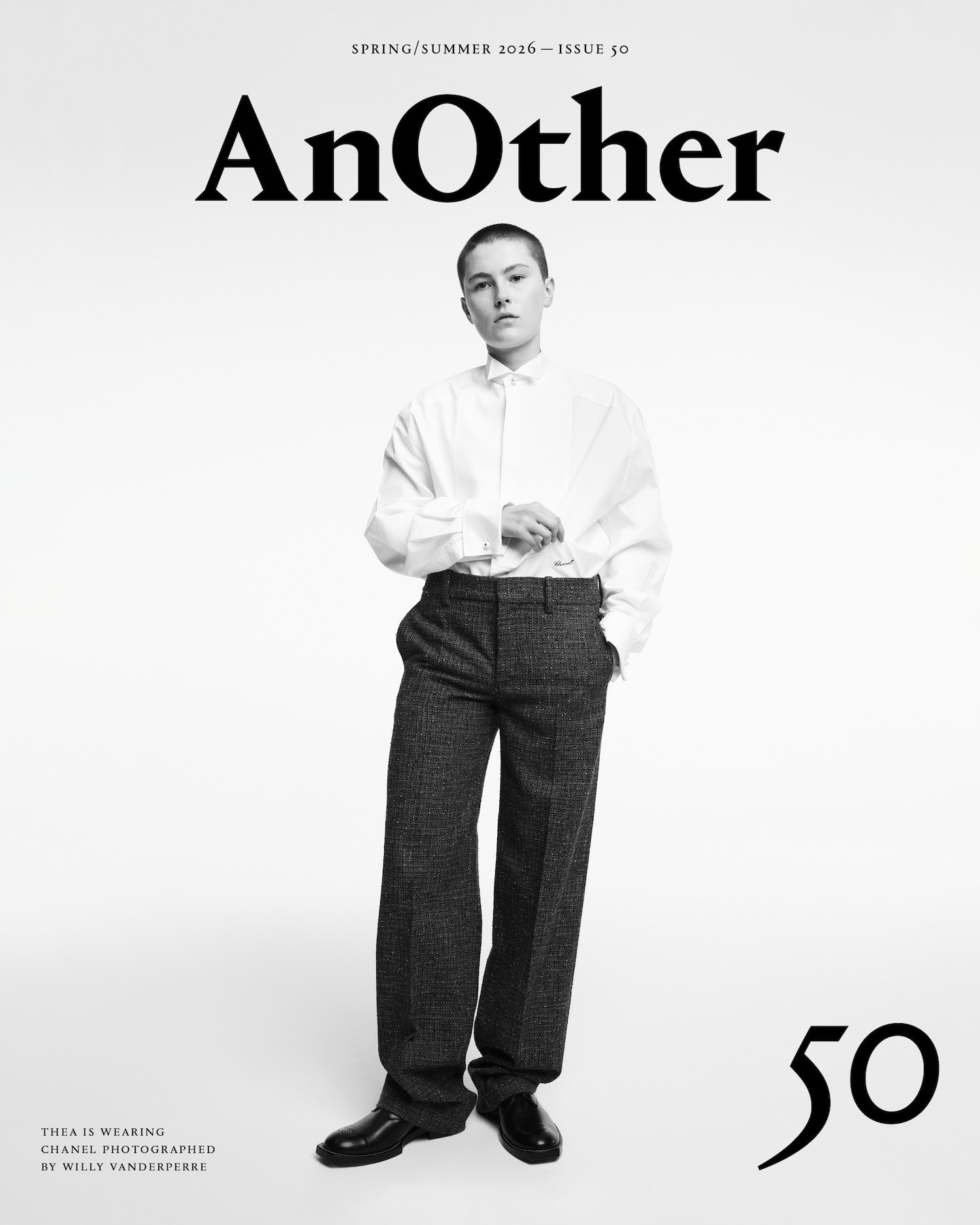
This story is taken from the Spring/Summer 2026 issue of AnOther Magazine:
People have a lot of ideas of what Chanel is, or rather what it should be. One word that doesn’t come up much, though, is rebellious – yet that’s exactly what Chanel the woman was and what Chanel the house remains.
Rather than rebellion, “paradox” was the word used by Matthieu Blazy, Chanel’s artistic director of fashion collections, backstage after his debut show for the maison in October. He was describing Gabrielle Chanel herself and her way of dressing, the clothes on her back and those made by her house. Is he a rebel too? Maybe. Because his collection certainly rebelled against many of those notions of what people perceive Chanel to be, upending predictions, confounding expectations. It was indeed a paradox, both Chanel as you’ve never seen it before and Chanel exactly as it should be. “It wasn’t easy, I can tell you,” Blazy says, in hindsight. “The pressure is so nerve-wracking. But if you don’t enjoy what you do, why do it?”






Blazy evidently loves it. And he should. To helm Chanel is, to many, the greatest job in fashion. There is a priceless history, a ceaseless mine of inspiration and unparalleled influence. The rebellion of its namesake founder led to fashionable women dressing in proletariat garb, ‘poor’ fabrics entering the arena of couture, menswear moving into women’s wardrobes for the first time. She transformed the way the world still dresses. The tenure of her follow-up act, Karl Lagerfeld, was marked by rebellion against perceived rules of fashion, by audacious revival of Chanel styles with impunity and impudence. Even before he designed a stitch, the radical appointment of a ready-to-wear designer to a monstre sacré of haute couture signified the rebellious nature of Chanel as a house, its willingness to take risks, the succès fou that that could afford. Part of that risk-taking means that Chanel’s creative heads today have the distinct luxury of working with some of the greatest craftspeople in fashion: over the past four decades, Chanel has amassed a roster of specialist artisan companies – embroiderers, feather specialists, shoemakers, jewellers, pleaters and more – financially and creatively supported by the house. They work not only on the haute couture collection but – again, rebelliously – the most esoteric and fantastic pieces of Chanel ready-to-wear. The sky is the limit, for imagination and everything else.
Following his appointment in December 2024, Blazy was given an even rarer luxury: time. He officially entered the building as artistic director of fashion collections in April last year but only showed his first collection in October. Snip out the holiday month of August and that’s a satisfying five-month stint at Chanel to build the house anew. It’s almost uniquely generous in 21st-century fashion terms. “I think a lot of designers – and it was really problematic over the last season – they were expected to set a vision within a year, or a year and a half,” Blazy says a few weeks after his debut. He’s smoking as we talk and takes a drag. “To get to the culture of the company, bring them with you. It’s not just the vision. It takes time. There are so many designers that prove to you that time does good.”

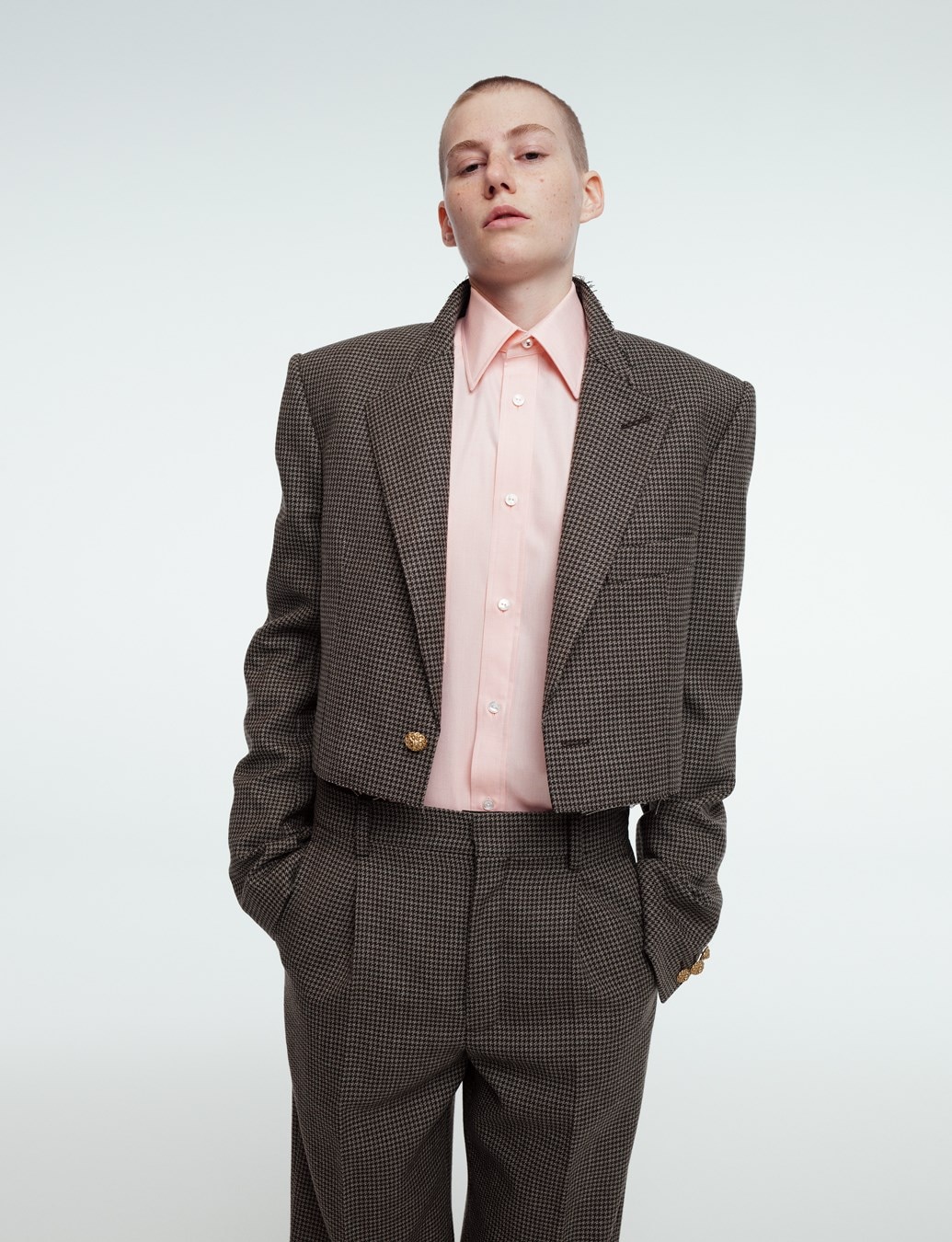

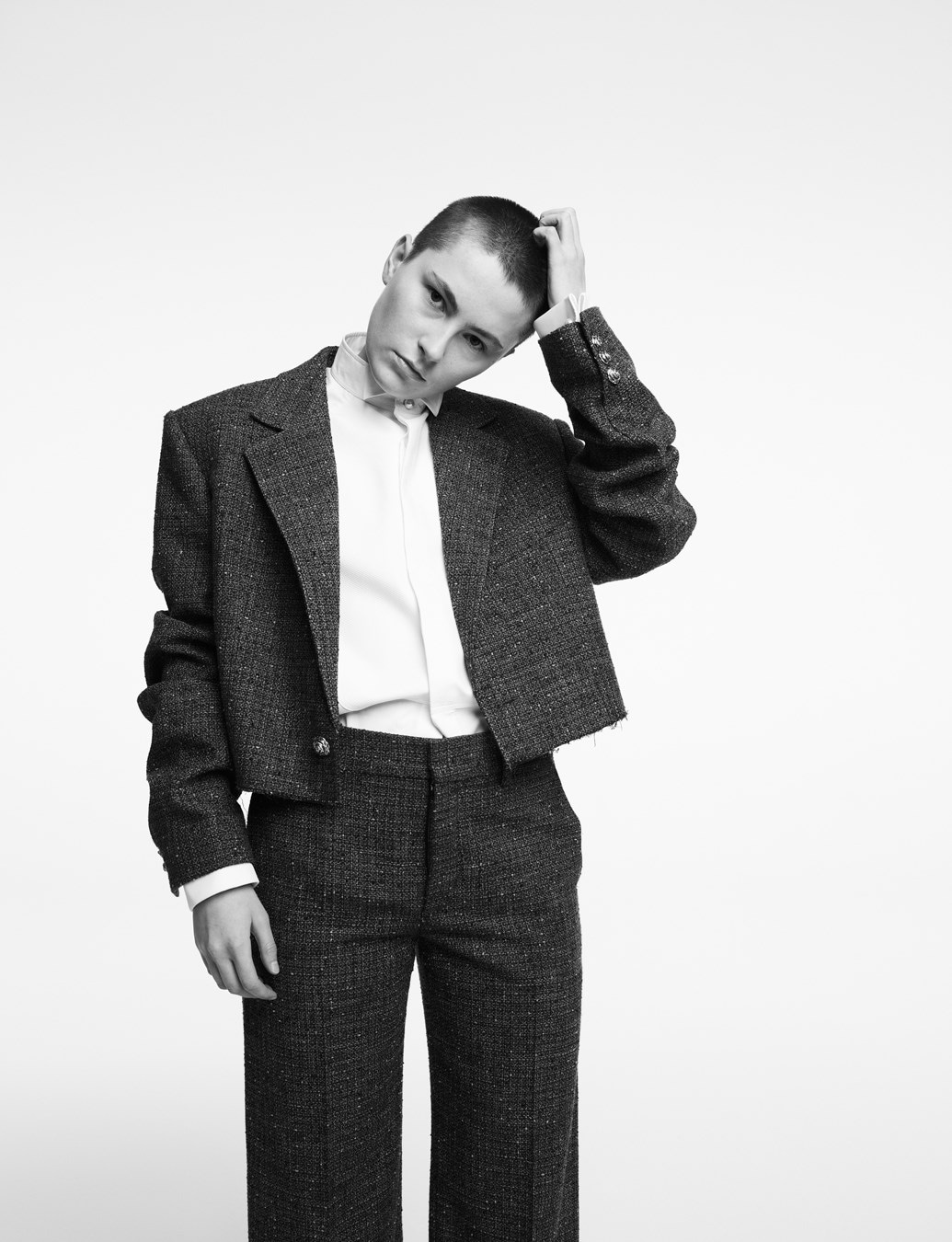
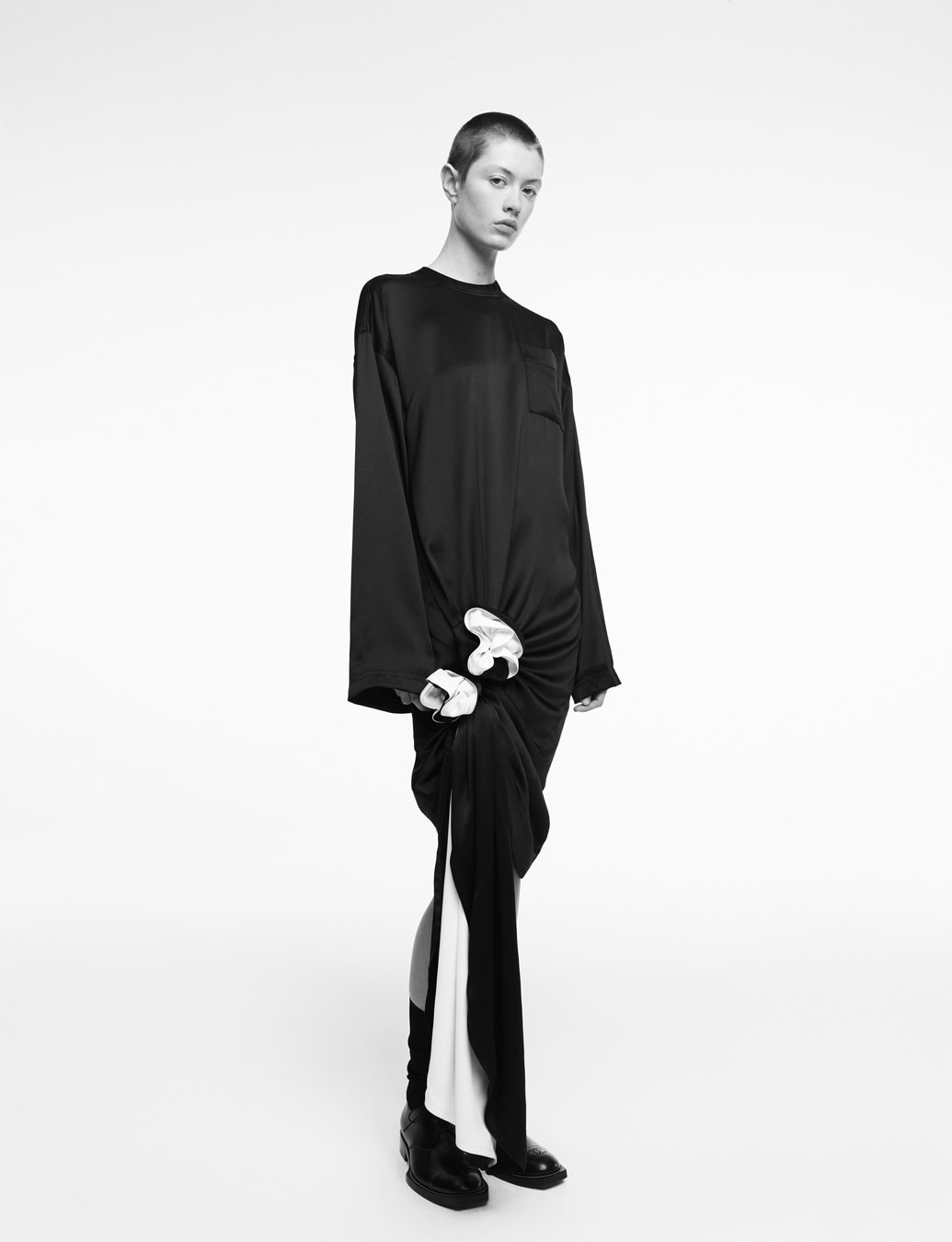
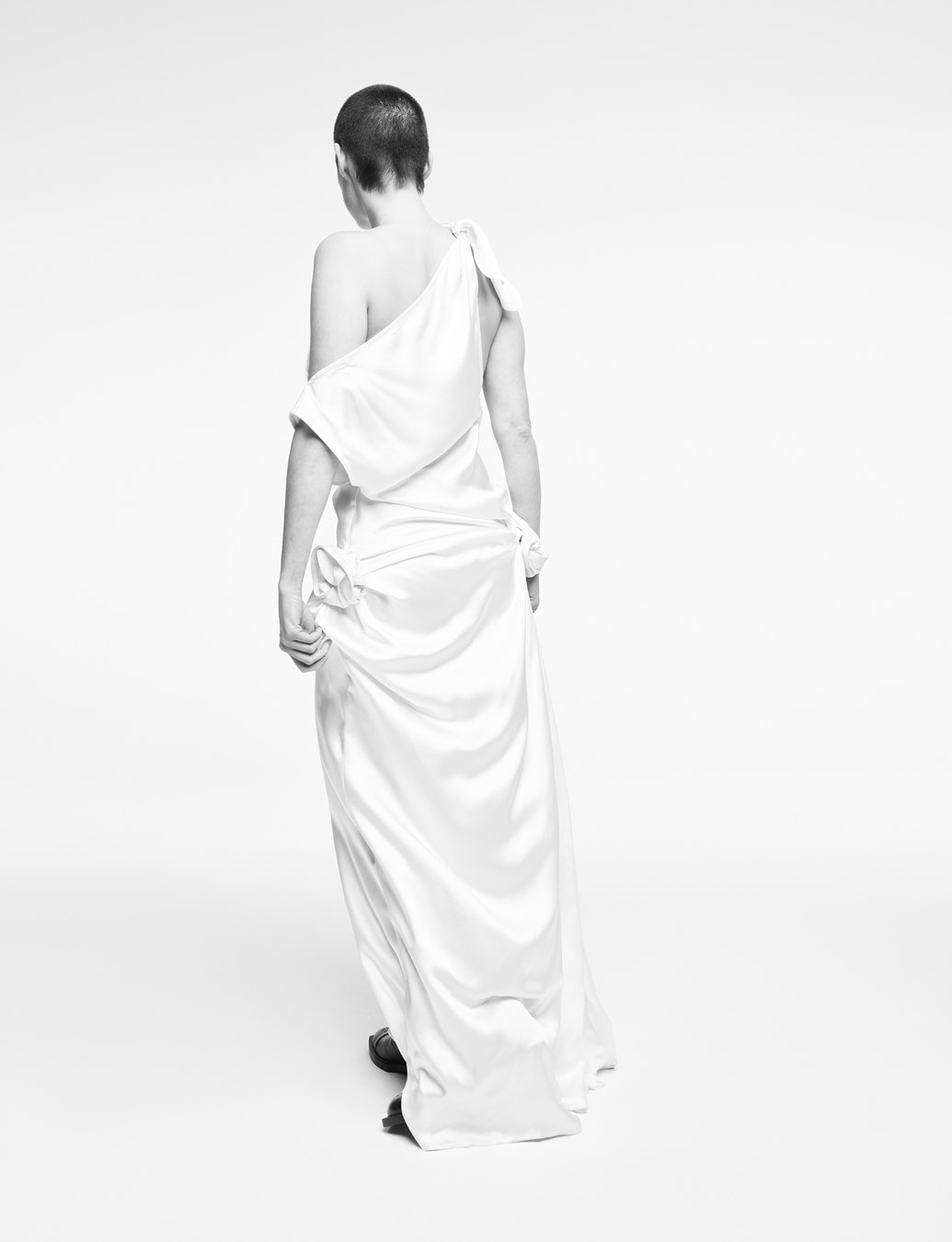
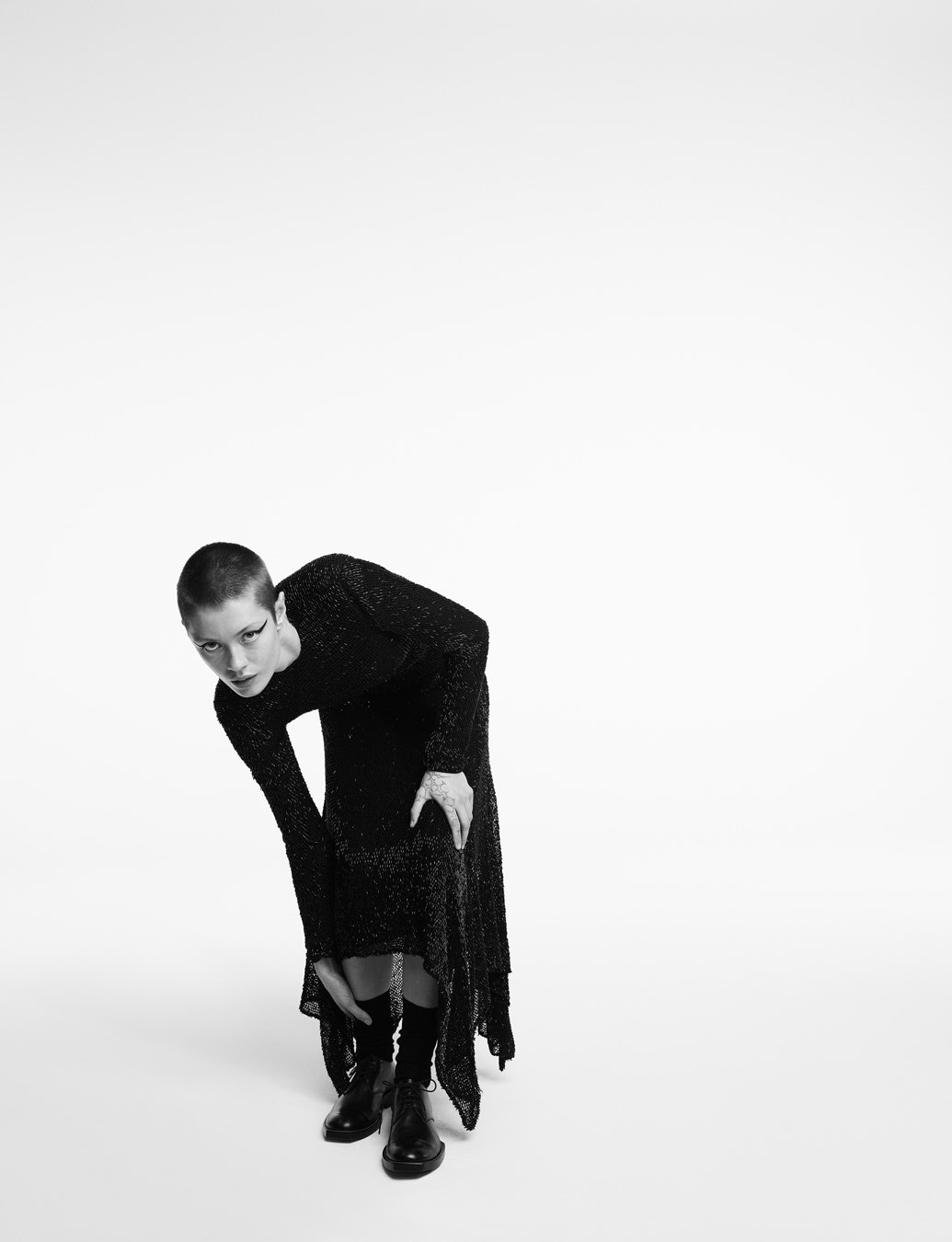
It did for Blazy. After that almost unbearable build-up, his first Chanel show was a bravura performance grappling with another house paradox – what Chanel was, is and could be. It had tweed, of course, and quilted handbags, and suits, and two-toned shoes, and camellias – ideas and ideals of Chanel grouped together into another on-brand bunch of fives. But as Blazy himself says, “the good thing with the codes of Chanel is that you can reduce them and they still look like Chanel”. So the quilted bags were twisted and crushed, with wire threaded through their edges as if they had been mangled in some kind of industrial accident – or, indeed, were age-worn and had been well loved over the 70-year passage from their birth in 1955 to today. The two-tone shoes, their proportions inspired by original styles worn by Gabrielle Chanel herself, had their toe-caps not stitched but, rather, nubbed in glossy pigment. Blazy compares them to pralines dipped in chocolate. Chanel’s archetypical, stereotypical little black dresses were actually long, plastered with beads gleaming like wet asphalt and dancing around the models’ legs as they walked. Alongside black came, naturally, white, in strikingly simple dresses – 1920s in cut, boxed out like the packaging of Chanel No 5 with graphic lines, or twisted at hip or shoulder into flourishes that, if you squint, resemble Chanel’s trademark camellia.
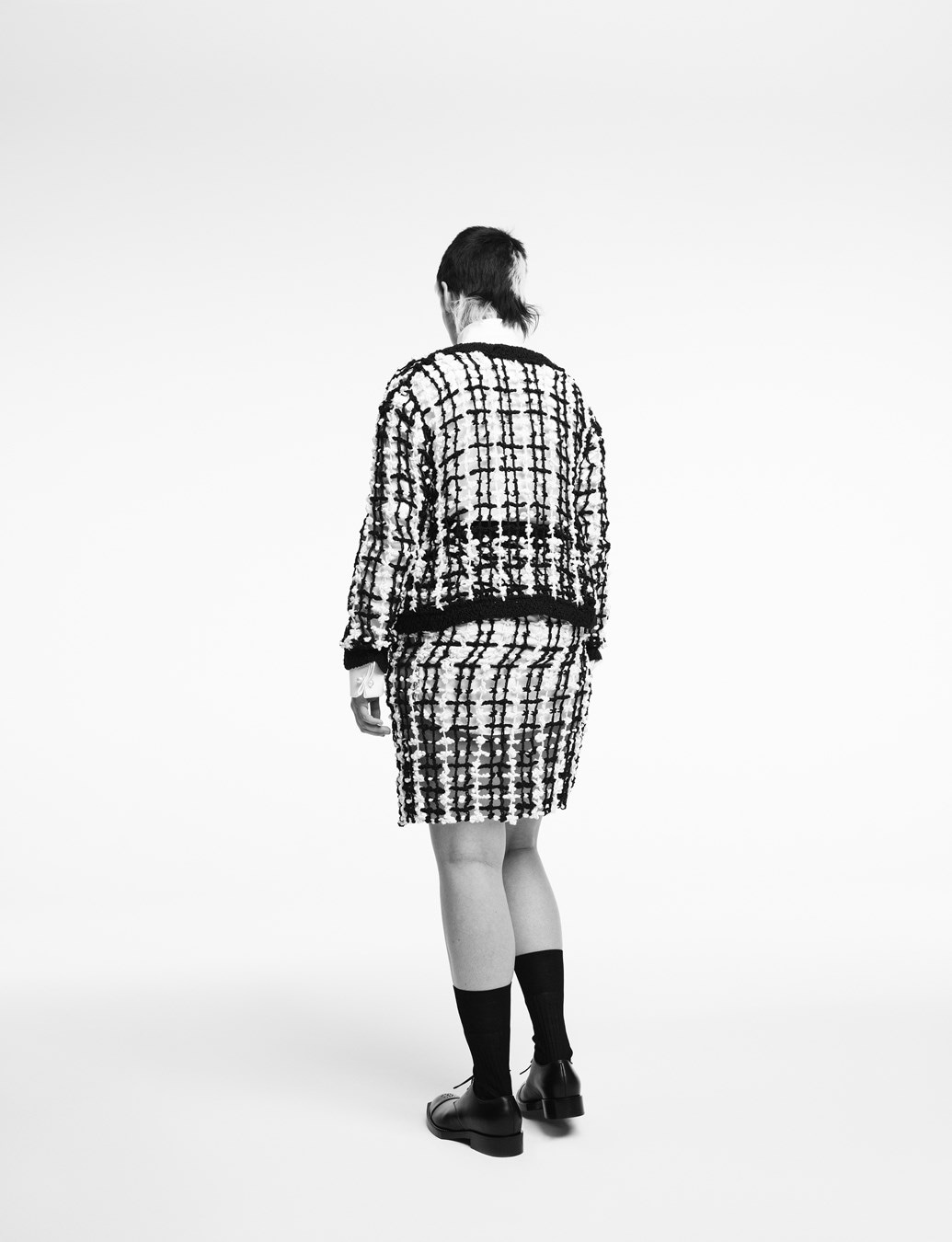
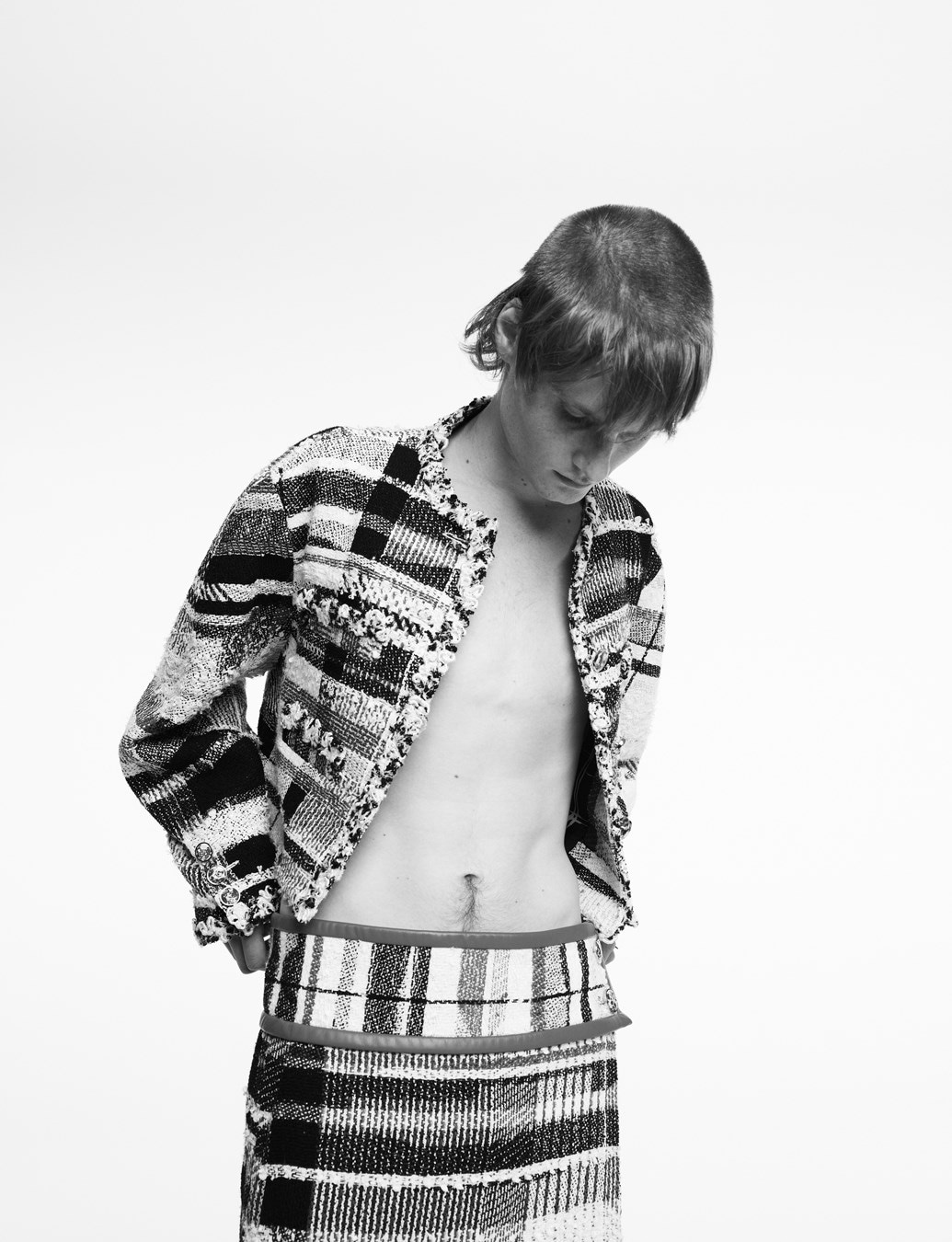
Naturally, there were suits – not Chanel suits but suits by Chanel – in compact brown tweeds, “this kind of very traditional English fabric that she loved”, with low-riding trousers. There were also true Chanel suits, with cardigan jackets and little below-the-knee skirts in ersatz tweed, glorious materials made entirely of macramé, or bugle-bead embroidery, opening on the skin. “There is no fabric beneath,” says Aska Yamashita, the artistic director of the embroidery workshop Montex, owned by Chanel, which crafted the exceptional pieces. “I love textiles – we went full-on in experimentation,” Blazy says of these embroidery-only tweeds. “Extremely light tweeds, semi-transparent, almost like lingerie. It’s a new fabric, new tweeds. Everything is new – we restarted from zero.”
Zero makes sense. For Blazy, that first show was all about restraint – about pulling back, thinking but not overthinking. “I reduced a lot,” he says. “The show could have been way more. At one point there was way more. And then I stripped down. I took out a lot of embroidery. I made things way more simple. For example, the first ten looks, I took out all the embroidery except on one or two dresses. We pushed it further and then at some point I was like, ‘Whoa, it doesn’t look like the original idea we had. Let’s go back.’” He smiles. “In a lot of companies you think that you have to add embroideries in order to make something bombastic, more ‘wow’. But I always saw the opposite. In the show we had this dress embroidered with wheat, hanging. At the beginning, there was way more. I just kept reducing. It was not poor, but almost poor.”

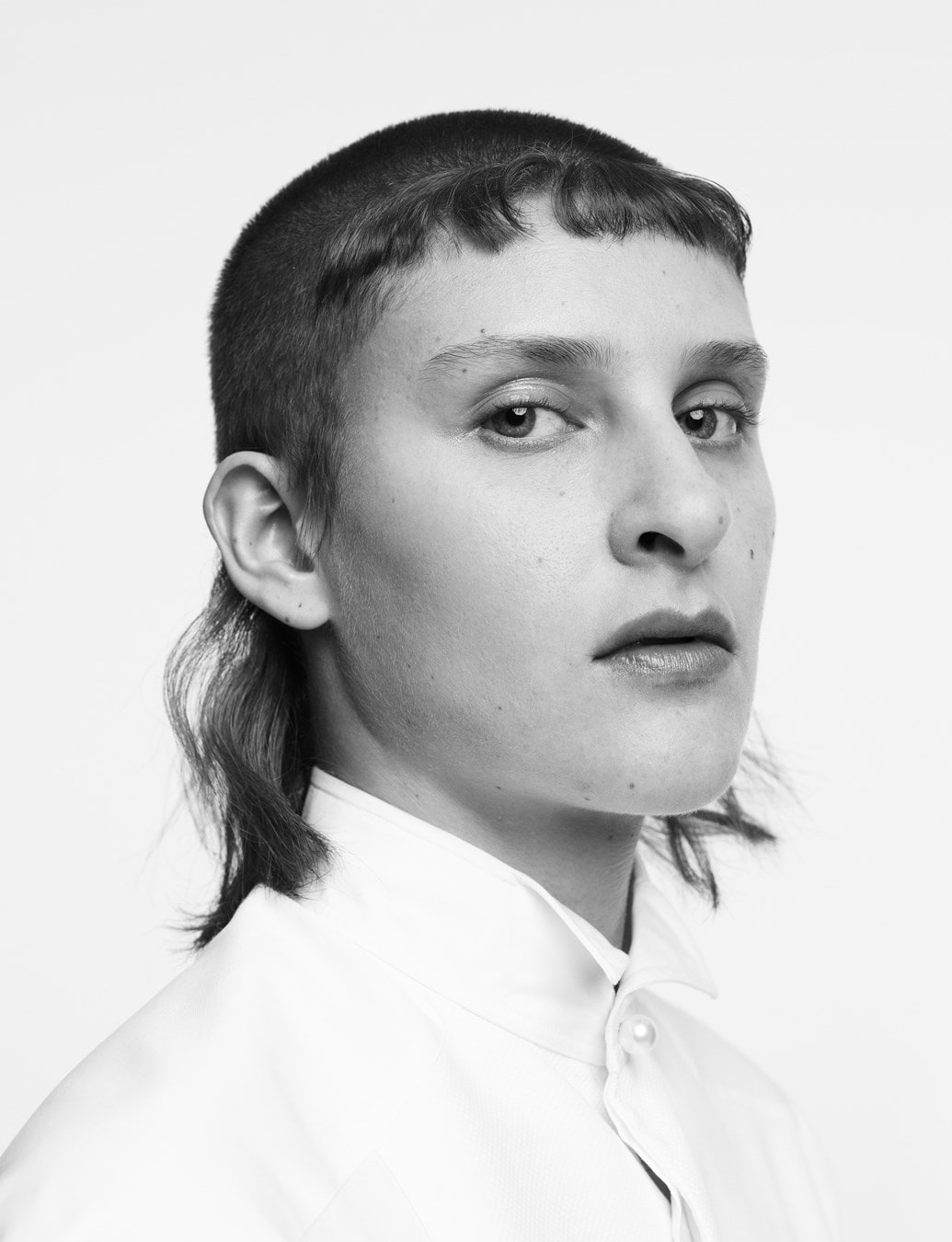

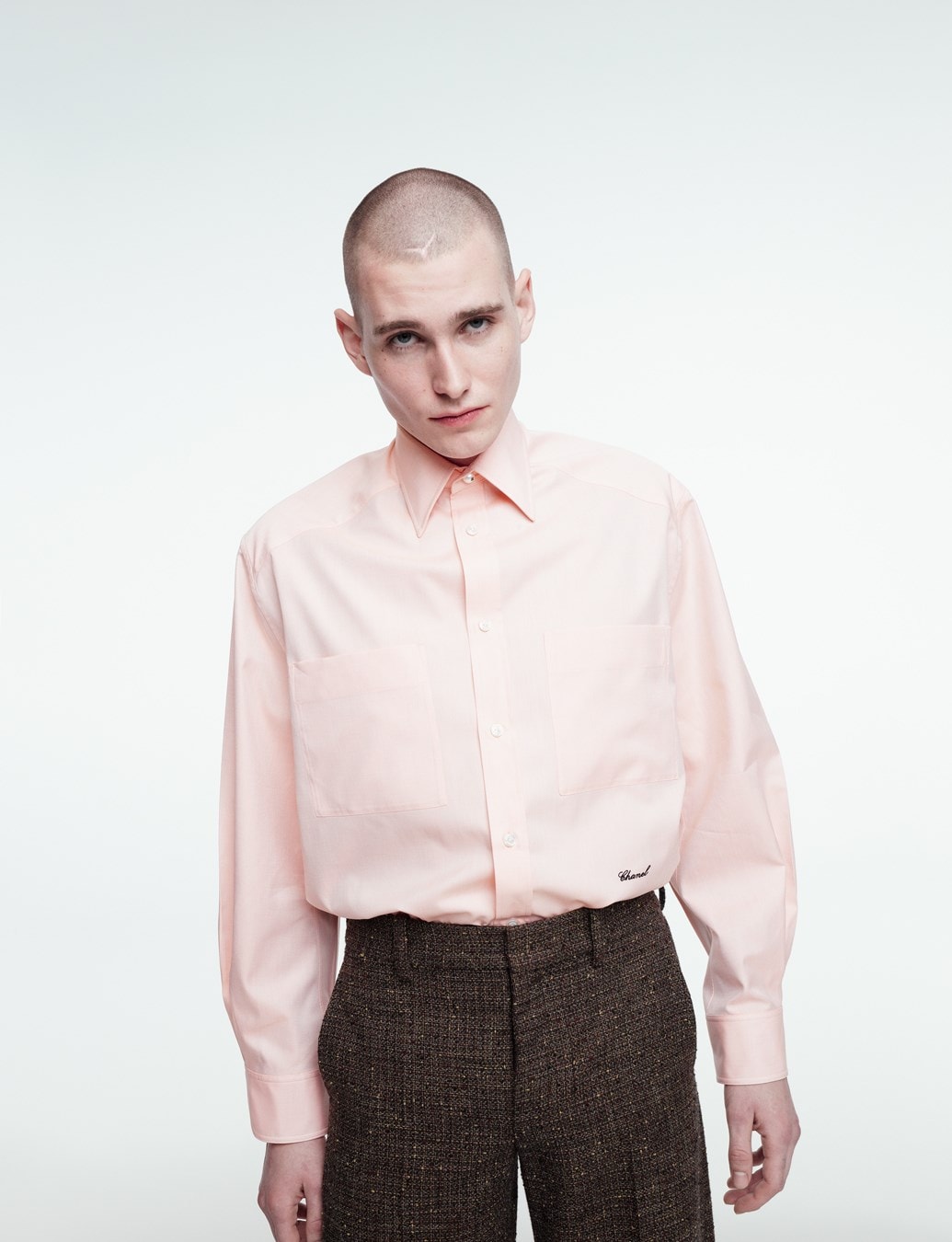
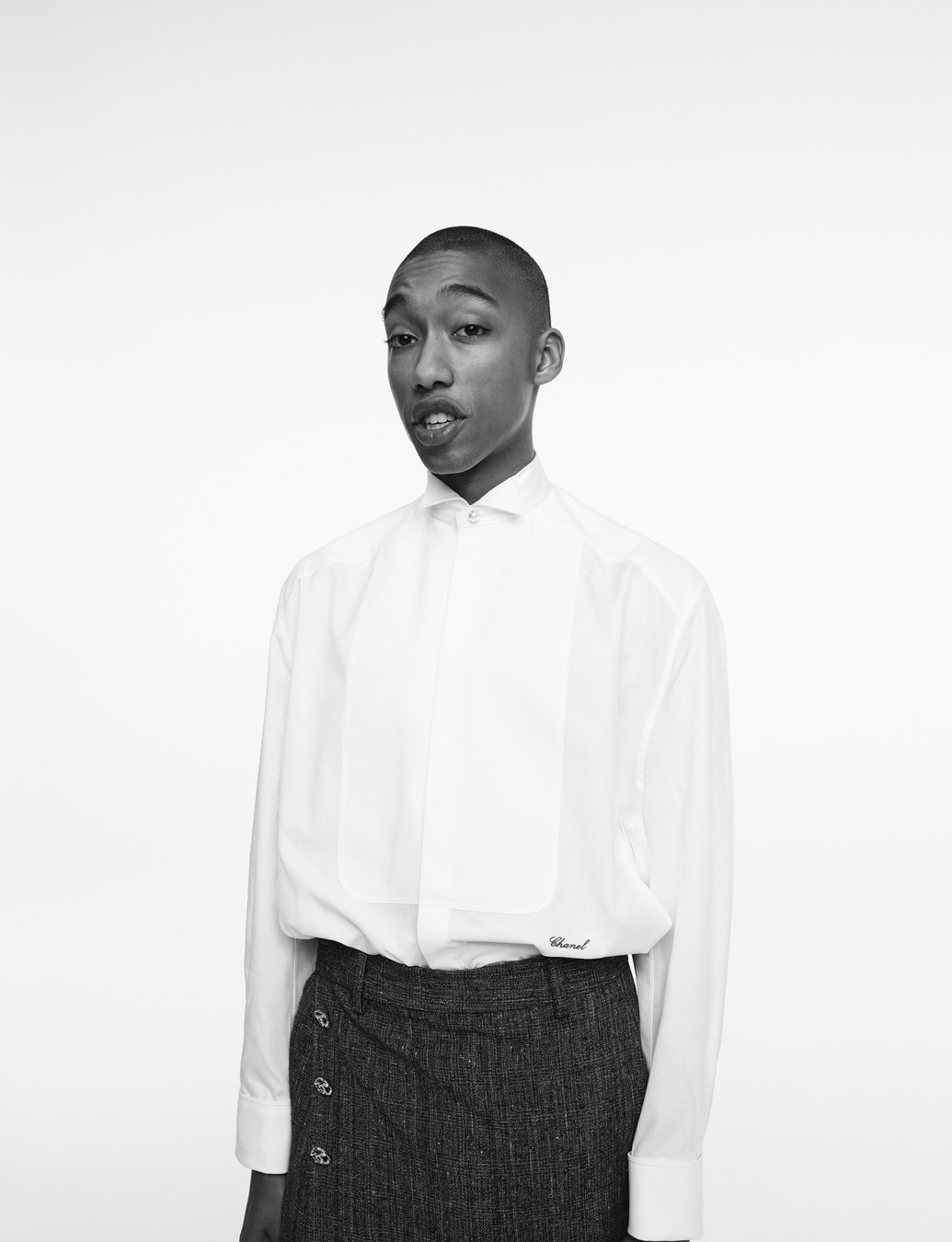
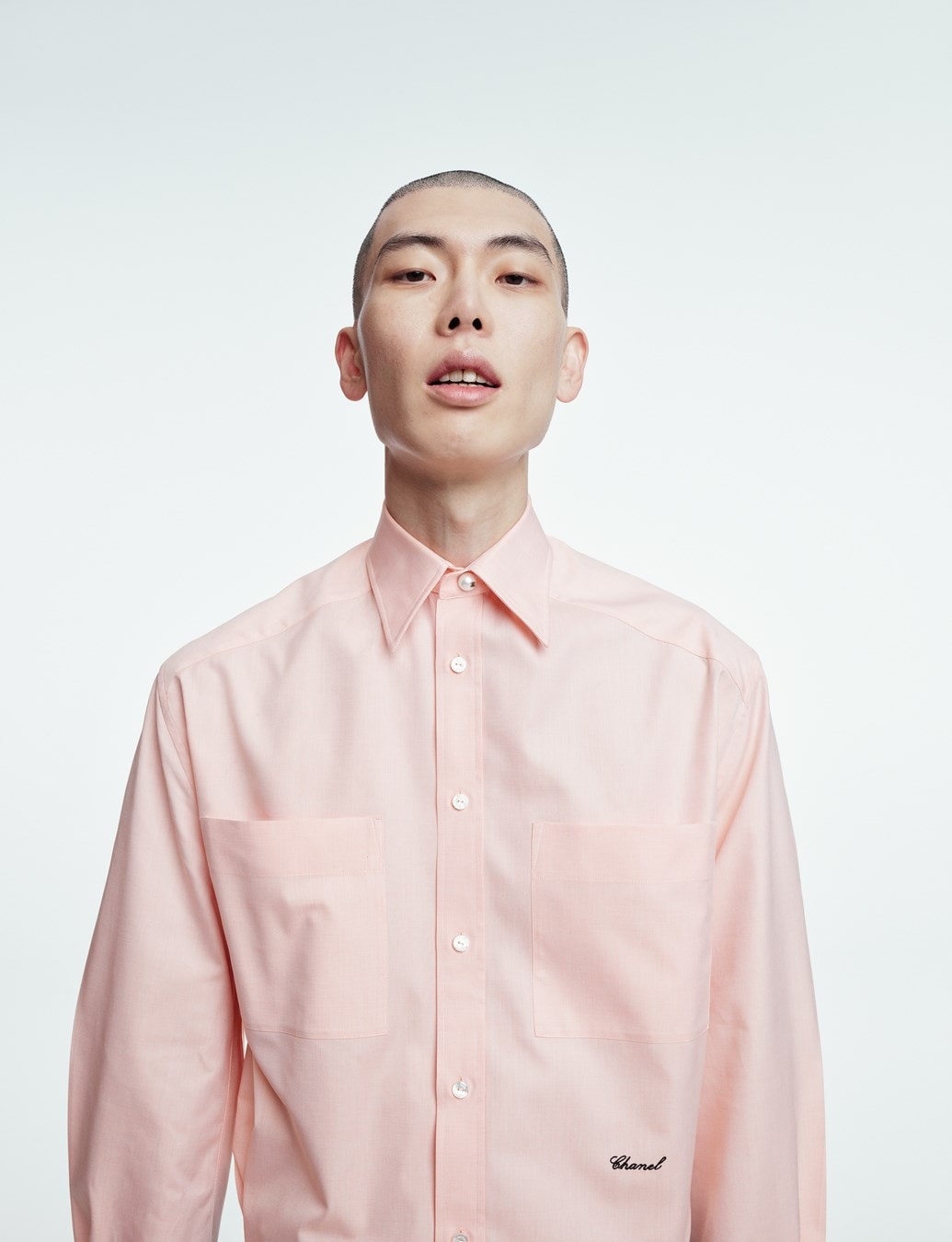
There was also ‘poor’ cotton, Chanel’s favourite fabric, cut into strict shirts, in white piqué for evening, blue or pink poplin for day, cuffed with pearl links, embroidered with a Chanel cursive monogram and made by Charvet. That was decidedly not a collaboration, rather an expression of expertise, labels stitched on the outside crediting the esteemed 188-year-old French shirtmaker with tissu et technique. Gabrielle Chanel and her lover Arthur ‘Boy’ Capel, who died in 1919, were both clients for that brand’s menswear pieces. The Chanel par Charvet shirts were sewn with metal chains that were, like those in Chanel’s original 1950s cardigan jackets, stitched on the inside of their hems. Not intended for decoration, these chains weighed the garments to the form, serving the same function today. The chains also continued to appear on the inside of jackets, and on the outside of skirts too, tracing a hemline that fell slightly below the knee, anchoring them to the body. “Everything is weighted by chains,” Blazy says. “That’s what I love about it being in the shirt – it serves its purpose. It looks amazing, but it does what it’s supposed to do. And when we put it on the skirt … it makes sense.” Sense is a Chanel attitude. “Clothing must be logical,” Gabrielle Chanel once said.
“The first day I arrived at Chanel I went to the archive and I felt very overwhelmed. It was too much beauty almost. I didn’t know where to take it” – Matthieu Blazy
Those are the expected and anticipated elements of Chanel – the tests of a designer’s knowledge of and research into Chanel’s all-enduring greatest hits. What’s your Chanel bag going to look like? Your suit? Your shoe? But then … what comes next? “Why reduce Chanel to five codes? It doesn’t make sense. Because it’s not what she did.” Blazy recants, a little. “I love the codes, but I think they can be nourished on the other side, and then you build up new codes. For example, I found a picture and fell off my chair, because it was a picture from the Thirties, an ensemble. A top and a full skirt, almost like American [prairie] skirts or what people said Dior did after, or what Saint Laurent is known for, this kind of daywear. But she did it in cotton, checked cotton, in the Thirties.” This was Chanel’s “dégagé gypsy” period, to quote Diana Vreeland, with full-skirted, tiered dresses and easy blouses proposed as alternatives to eveningwear, especially in her Spring 1939 collection. “When I saw them, I was like, ‘This could be anyone, but not her – but she was the one doing it first.’” That’s just in case you wondered where Blazy got those explosive full skirts he teamed with simple satin T-shirts and those Charvet shirts in his debut. “She tried ideas,” he says – and he’s trying them too. Which in itself is a brave thing to do. “Everybody knows or thinks they know what Chanel means,” Blazy says, “but it’s way more complex.”


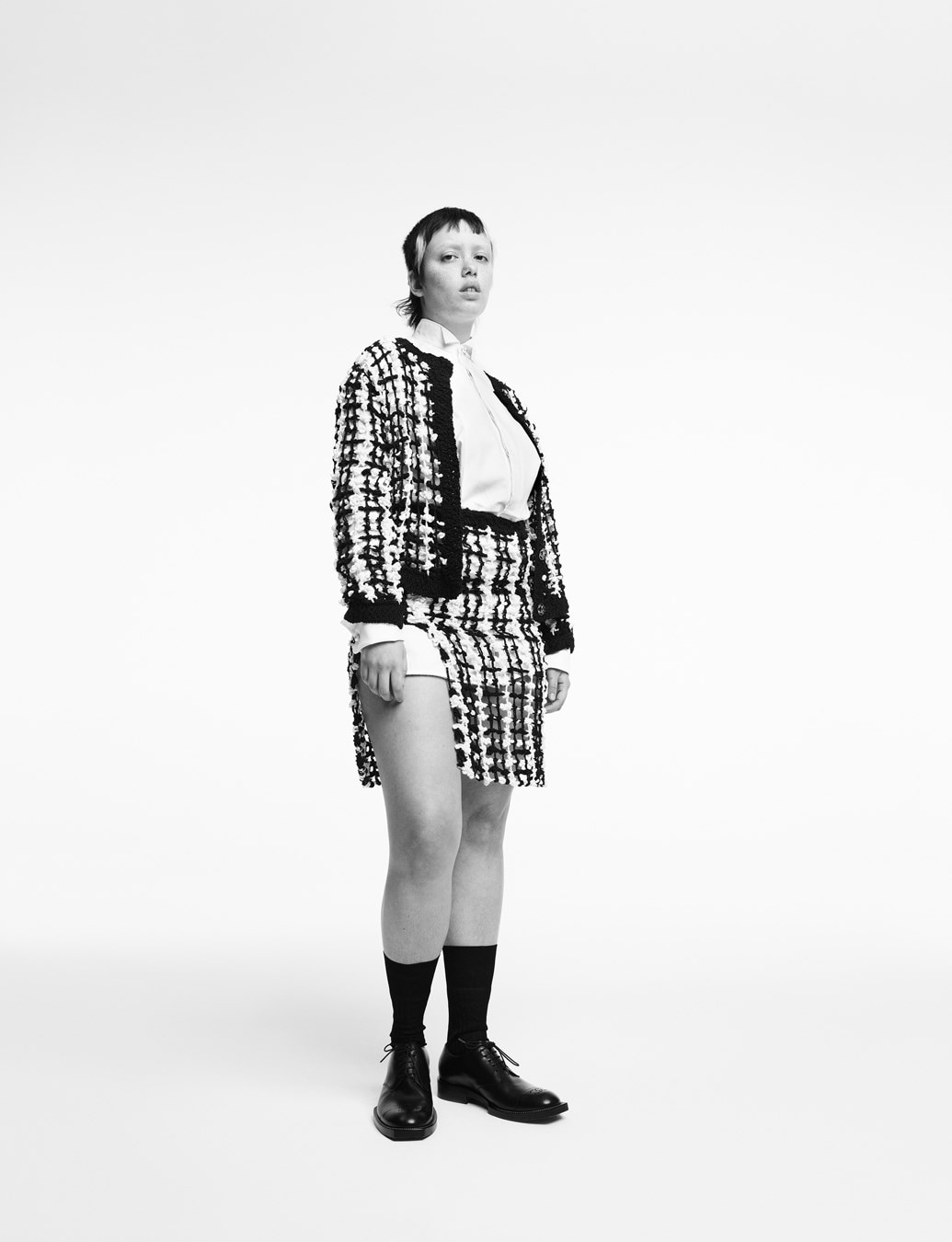
What does Blazy think Chanel should be? That is the most compelling question, mainly because he’s the man now holding the reins. He added a dynamic energy, a touch of viscose (which he loves) to make knitwear bounce, afforded fabrics a weightlessness. “I kept saying to my team, ‘Light, light, light, light,’” he says. Yet the fact that Chanel is shifting under his leadership was evident from the very first exit: a chopped-off, single-breasted jacket, fastened up high on the chest with a knotted gilt button like the ones Gabrielle herself used in the 1950s, atop low-slung trousers. Blazy recounts that that first look was a result of his first day and first action at the maison: he took off his own blazer, chopped off the hem to the proportions of Chanel’s cropped cardigan jacket, cut off the collar and turned up the lapels. “Those jackets that were cut, we didn’t add anything,” Blazy says. “Keep it raw edge, keep it the way it is.” It still spoke volumes: masculinity subjugated to femininity, the everyday fashioned to something new, a single garment encompassing a legend of Chanel and the founder’s approach to dress. There was one change, he allows – they sewed in that gilt chain, to pull the hem down to earth.
It’s a great story – and one that fits right into the house’s history of narratives. Gabrielle Chanel and Karl Lagerfeld each did swift business in mythmaking, shifting their respective birthplaces and dates constantly, inventing themselves anew. Blazy, incidentally, is honest about his: he was born in 1984, two years after Lagerfeld’s spectacular revamp of the house that Coco built began. Many people forget, in the house of Chanel’s own rewriting of its legend, that Lagerfeld wasn’t the first to revive the label following the death of the woman always referred to as Mademoiselle in January 1971. There was a truckload of designers – first Gaston Berthelot, formerly of Dior in Paris and New York; Ramón Esparza, who designed hats for Balenciaga; a duo of former Chanel assistants named Jean Cazabon and Yvonne Dudel; and another old Dior hand, Philippe Guibourgé. They all tried their luck and nothing stuck, except them in the mud, reproducing tried and tired iterations of Chanel’s greatest hits. Following Lagerfeld’s own death in 2019, his right-hand woman Virginie Viard and then an internal creative team ont continué tout droit in the Lagerfeldian vein. Blazy’s entrance marks only the house’s fourth act in 116 years, counting Gabrielle Chanel’s own ‘comeback’ in 1954.
“What’s interesting with Gabrielle is that basically you realise very quickly, when you start to dig in, that the stories we know about her are the ones that are officially told,” Blazy says. “And the ones that Karl told. But then, when you deep dive, you see a lot of things that, because they don’t work in the narrative of a museum, are not there. They’re a step aside. But me, I’m interested in those.” He shrugs. “People will tell me it’s not Chanel and I’m like, ‘Let’s work on it.’ Because it’s actually very, very rooted in what she did.”


Matthieu Blazy ticks the boxes for perceived requirements to helm one of the most desirable jobs in all of fashion. He has laudable experience with accessories, devising runaway hits during his brief but meaningful three-year tenure as creative director at the Italian label Bottega Veneta that bucked an industry-wide luxury malaise. Perhaps even more seductively, those Bottega bags were evidence not only of a commercial instinct, but the ability to fix something that wasn’t broke, to remake and remodel a brand classic in new and exciting ways, make the old seem new. He also has a background in haute couture, rare today. He helmed Maison Martin Margiela’s Artisanal arm from 2011 to 2014 – although couture, it was less about Chanel’s precious Lesage embroideries, more about cobbling together fabulous things from unlikely source materials, like scraps of antique Fortuny fabrics or a few thousand metal bottle-top lids. And he’s French, which, despite Lagerfeld’s Teutonic roots, many somewhat chauvinistically saw as a business need. That’s something Blazy challenges – his father is French but his mother is Belgian. He was brought up between the two countries, educated in fashion at La Cambre in Brussels, while Antwerp, working for Raf Simons, is where his earliest experience lies.
Nevertheless, unlike Lagerfeld, or even Gabrielle Chanel herself, Blazy is a born Parisian, which counts for something. Granted, he grew up in the 14th arrondissement in the south of the city, a reach for anyone to try to connect meaningfully with the house of Chanel, or even fashion more broadly. However, Blazy’s family were both educated and creative – his father is an art expert with a specialism in pre-Columbian art, who worked with the Parisian auction house Drouot; his mother is a historian and researcher. But fashion was far removed – at least theoretically. “My neighbour was an agent for models,” Blazy says. “We lived in a house of artists, so you had a lot of people living there and the garden in the middle. And there was a recycling bin for newspapers … you would have the magazines, Harper’s Bazaar, i-D, all of them.” As a teenager, Blazy fished them out, fascinated. “My brother was interested more in the girls. My sister was not. Me? I was really, really obsessed.” He laughs. “I call it the trash education.”


But actually, it started way before that. “I think I was never not interested in fashion,” Blazy says now. “The very simple pleasure of dressing.” Growing up in Paris made a difference, of course, but for Blazy the root actually came from that Belgian side. “My grandmother was a very stylish woman. My mum would buy here and there an incredible Mugler piece or, one season, something from Saint Laurent. The chic was always there, but it was never tyrannical. And we never had clothes in which we couldn’t play, for example. We could do whatever we wanted with our clothes.” Which, at its essence, is very Chanel.
Blazy didn’t originally intend to be a fashion designer. After his baccalauréat, until just two months before he began his studies at La Cambre, he intended to become an archaeologist. He studied in the field in the south of France, and visited the Universidad de Salamanca in Spain, whose archaeology department is internationally renowned. Despite his interest, Blazy resisted inquiring into La Cambre – “I was scared to do the entrance and not be taken, and therefore not be taken seriously” – but eventually applied, was accepted and … wasn’t great. “I was not very good for the first three years. I was learning,” he recalls. He was also the youngest in his class.
A sign of a fashion obsessive is that, when speaking about collections, they talk not in terms of seasons but the actual content of the shows. And anticipate that other fashion obsessives can recall those clothes too. Barely 21, Blazy began to intern with different fashion houses, working on their collections. First with Balenciaga, then under Nicolas Ghesquière – “I did the 2005 show with the lace. And the striped suits,” Blazy remembers. “And then I did a show after with John.” Galliano, of course. “Which is the show where you have the huge hats in the finale and they have dresses with Roy Lichtenstein [prints].”


Between the two, Blazy graduated from La Cambre with a collection inspired by Claudie Haigneré, the first Frenchwoman to go to space. That is a neat connective thread to the decor of gargantuan, presumably polystyrene planets that hung overhead at his first Chanel show. He presented his graduation collection twice, once in Brussels and again that July in Trieste, as a finalist in the International Talent Support contest. Simons was a judge and was sufficiently impressed to invite Blazy to his January show in Paris and, ultimately, offer him a job. Blazy started there in 2007, aged 23. He met designer Pieter Mulier, with whom he began a 17-year relationship. “With Raf, what I loved the most is that anything could be an inspiration,” he says. “I never felt judged by Raf because everything was possible. And then you are happy to explore other fields. You can show him an artist you like, architecture.” He pauses. “The extreme things with Raf, and I think the beauty he had, not just as a designer, but as my boss, is that Raf would come back to the studio, if he didn’t like something, two days after. He’d say, “Attends, we should look at it again. There was always this ping-pong of ideas.”
“With Raf, what I loved the most is that anything could be an inspiration … You can show him an artist you like, architecture” – Matthieu Blazy
Simons was actually Blazy’s boss twice: when appointed chief creative officer of Calvin Klein in 2016, he employed him as design director of women’s ready-to-wear alongside Mulier as creative director. In the interim, Blazy had roamed through fashion. His six Margiela collections garnered universal praise – in house tradition Blazy was an anonymous, white-coated presence until he was ‘outed’ by Simons to the fashion journalist Suzy Menkes backstage at his Autumn/Winter 2014 show, shortly before John Galliano was appointed creative director. Blazy then went to work for Phoebe Philo at Celine from 2014 to 2016. After leaving Calvin Klein he helped Sterling Ruby establish his design label, SR STUDIO LA CA. He worked silent and unseen from that artist’s compound-like studio in Vernon, California, in the spring of 2019, before moving to another backroom job, as design director of ready-to-wear at Bottega Veneta. When that label’s creative director Daniel Lee departed in November 2021, Blazy was given his job, thrust into the spotlight like never before. No Margiela blouse blanche to hide behind.


Blazy’s much-raved-about interpretation of Bottega Veneta placed craft at the core of the label. I interviewed Blazy back in summer 2024 – in retrospect, as his negotiations with Chanel had just begun. A line leaps out: “The idea of craft, something well made that lasts and that travels in time and in emotions. You can pass it on. It’s something precious.” An easily transferable idea from BV to double C. That said, the shift between Blazy’s leadership of these labels is significant – from Milan to Paris, from an accessories label established in 1966 under the ethos “when your own initials are enough” to a house rooted in the sensibilities of its founder and marked ceaselessly with that double-C insignia. Moreover, Bottega Veneta is a young house with very little history – Chanel, by contrast, is mired in it, occasionally weighed down by its legacy. Or rather, legacies – there are two. Gabrielle Chanel was the only fashion designer who featured in Time magazine’s list of the 100 most influential figures of the 20th century, of which she undoubtedly was one. Blazy also has the talent of Lagerfeld preceding him, a legend within his own lifetime. If Lagerfeld didn’t change the way people dress, he certainly transformed how the industry operates and the wider public perception of what a fashion designer is.
Blazy, however, bears that load easily. It helps that he has a healthy fascination with the past – and not just in terms of that could-be background in archaeology. His father took him to auction sales as a child; today, he scours auction sites constantly for art, objects, furniture and, of course, clothes. At Margiela, his final collection, for Autumn/Winter 2014, included an original coat created by Paul Poiret in 1911, a piece Blazy found himself, as well as 1940s brooches used to fasten a white shirt in place of buttons by the designer Line Vautrin. Her jewellery later became fetish objects for Mary-Kate and Ashley Olsen of The Row, used in their own fashion shows – which demonstrates, to a degree, the wider influence of Blazy’s aesthetic, where an artful refinement meets an everything-and-the-kitchen-sink approach. Now, and next, it’s Blazy’s task, and presumably pleasure, to rewrite an already well-rewritten history.
Considering that, I wonder about Blazy’s relationship with the Patrimoine, the lovingly preserved repository of Chanel pieces held on the outskirts of Paris. “I don’t go,” he says. “I went twice and then I stopped.” You can understand why. “The first day I arrived at Chanel I went to the archive and I felt very overwhelmed. It was too much beauty almost. I didn’t know where to take it.” If he isn’t looking directly at Chanel’s archival pieces, how does Blazy connect with that history then? “I read, I look in books that are not the ones so much made around Chanel, but more like historic books. And then you find stuff,” he says. “Then I call Odile from the archive.” Head of Chanel heritage fashion collections, jewellery and beauty, Odile Prémel has worked at Chanel for some 26 years and is an encyclopaedia on the house. “I say, ‘Odile, I think I found something.’ And then we start to talk, talk, talk. I’d rather have the story than the imagery.” That’s fitting for a house like Chanel, built on narrative and stories, true and false. “I think also, with Chanel, it’s interesting to try to find these unknown histories within a history that is so well known,” he says.


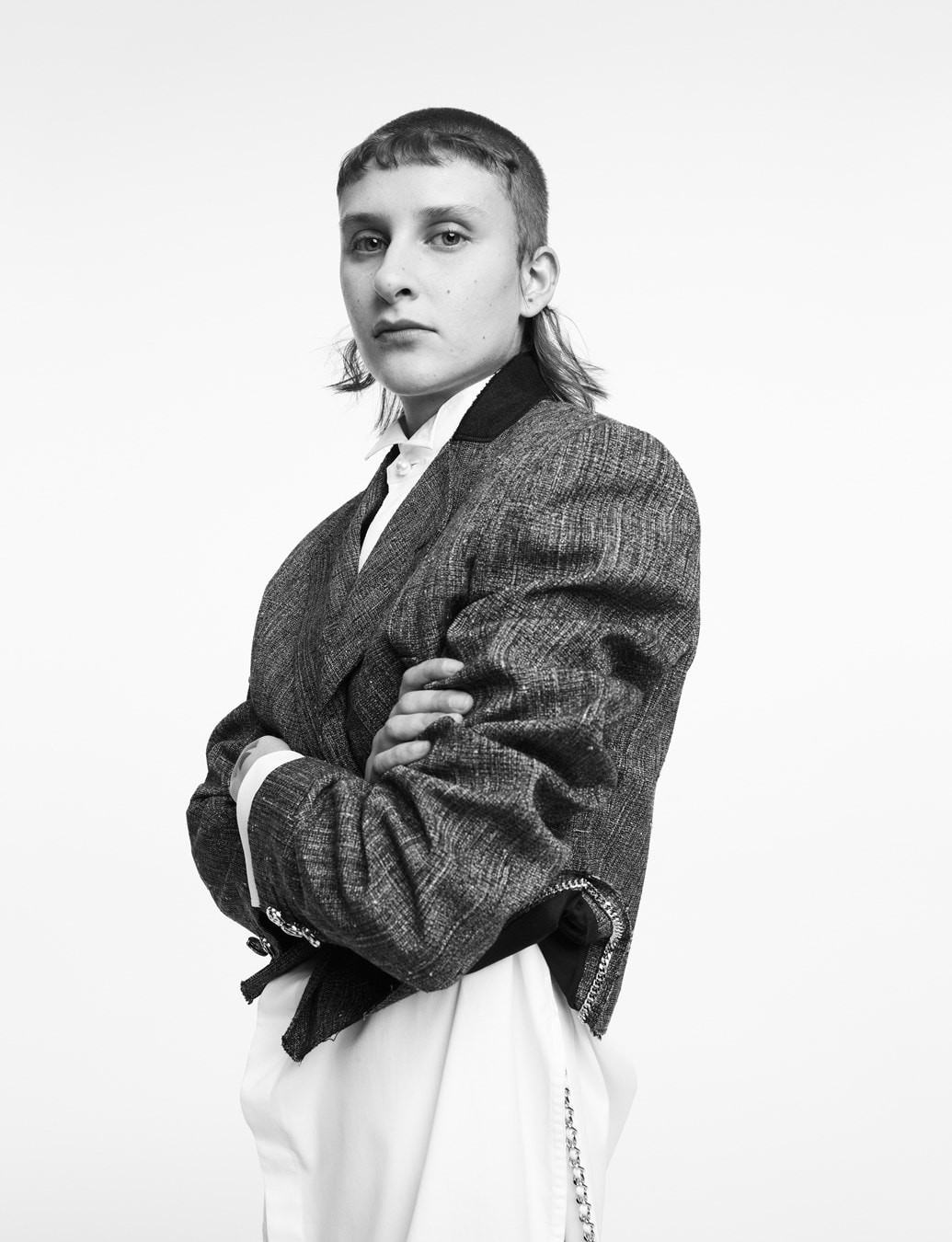
Eight weeks after his Chanel debut, Blazy was doing that again, in New York, for the house’s Métiers d’art show. At Chanel, Blazy is responsible for no fewer than ten collections a year: two haute couture, two ready-to-wear, one cruise, two pre-collections (in house nomenclature they’re called Act I, with the catwalk collections Act II), one summer collection named Coco Beach and a wintry, skiwear-inclusive range called Coco Neige. The tenth is this, Chanel’s equivalent of a pre-fall collection, traditionally a money-spinner of commercially salient items that shore up a brand’s bottom line. In another act of rebellion, in the early 21st century, Chanel perversely transformed the season into an annual showcase for insanely labour-intense and hernia-inducing expensive technique – as the name suggests, the art of craft. In preparation for its 2026 show, the house has moved its ateliers from Paris to the US, taking over a building that is, ironically, just off Canal Street, where counterfeit Chanel items have been flogged for decades. That, in a sense, is why Blazy wanted to do the show here. “Coco came here,” he recounts of NYC. “She went downtown and she saw a lot of people who adopted her style without it necessarily being Chanel. The allure of it. And she thought it was wonderful.” As Gabrielle Chanel said, “Along with plagiarism go admiration and love.”
But the Métiers d’art collection is dedicated to the kind of craft that simply cannot be imitated. In ateliers in the north of Paris, those aforementioned artisans stitch embroideries and pleat silk and mould leather to make magic. In this Métiers d’art collection, there is another immaterial suit by Montex, made of a newly invented form of macramé, threaded with tiny beads of rock crystal and malachite, like precious art deco jewellery. There are more physical tweeds, hand-loomed by Lesage into leopard patterns – “Did you know Gabrielle wore a lot of leopard prints?” Blazy asks rhetorically. “No one knows.” There are dresses trimmed in feathers, a suit of chiffon embroidered to look like denim, another encrusted with raffia that resembles popcorn. “Only Chanel can do this,” Blazy says, slightly awestruck, gesturing at the final look of the collection, a deceptively simple silk shift dress, dripped with crystal, that breaks into complex godets of tulle pleats at the hem. It is the result of the work of several ateliers – Chanel’s own flou specialists, the pleating workshop Lognon and the embroidery house Lesage. For a designer who has always adored craft, Blazy is a bit like a kid in a candy store, to borrow an overused American idiom.

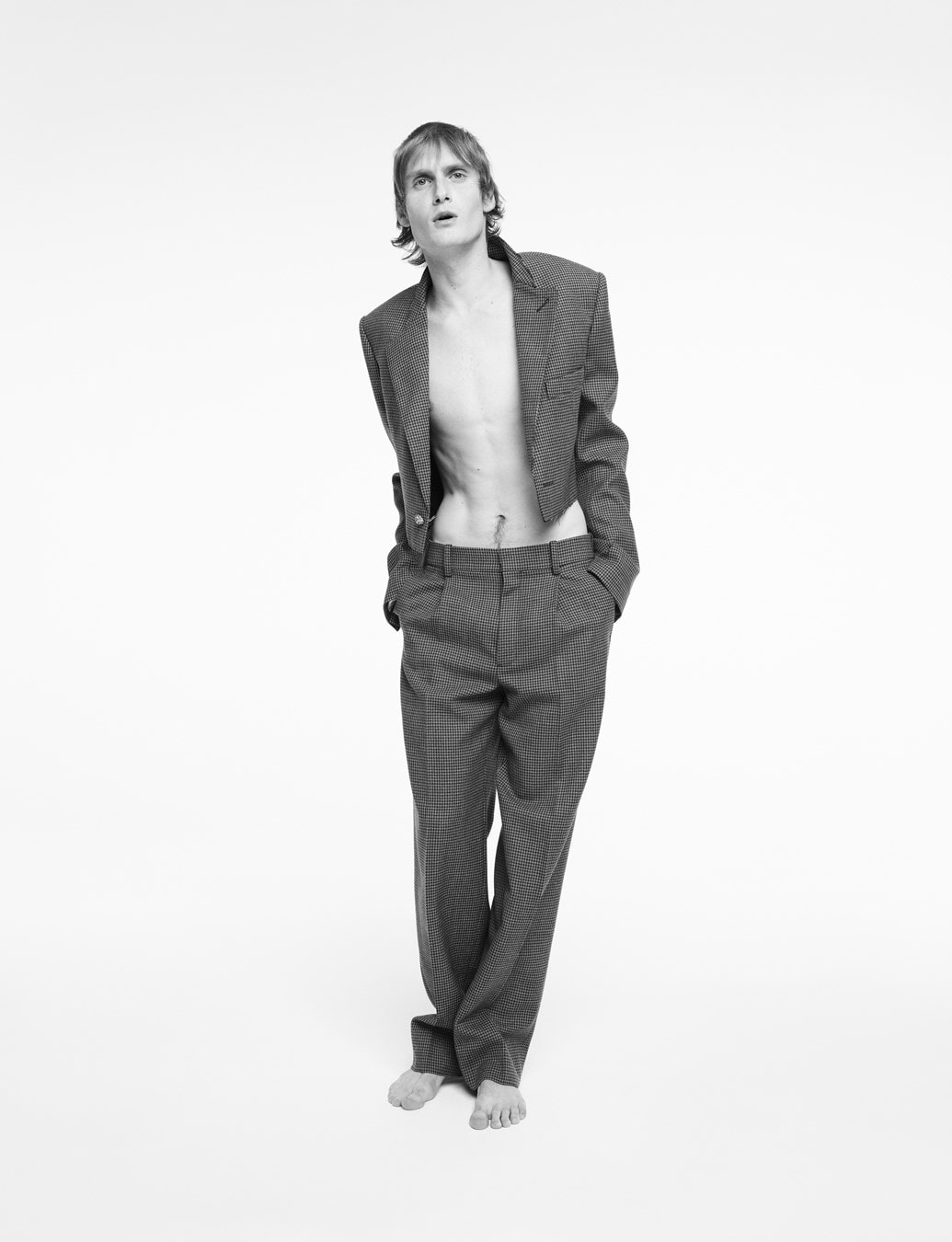
 and trousers in houndstooth broadcloth by CHANEL)
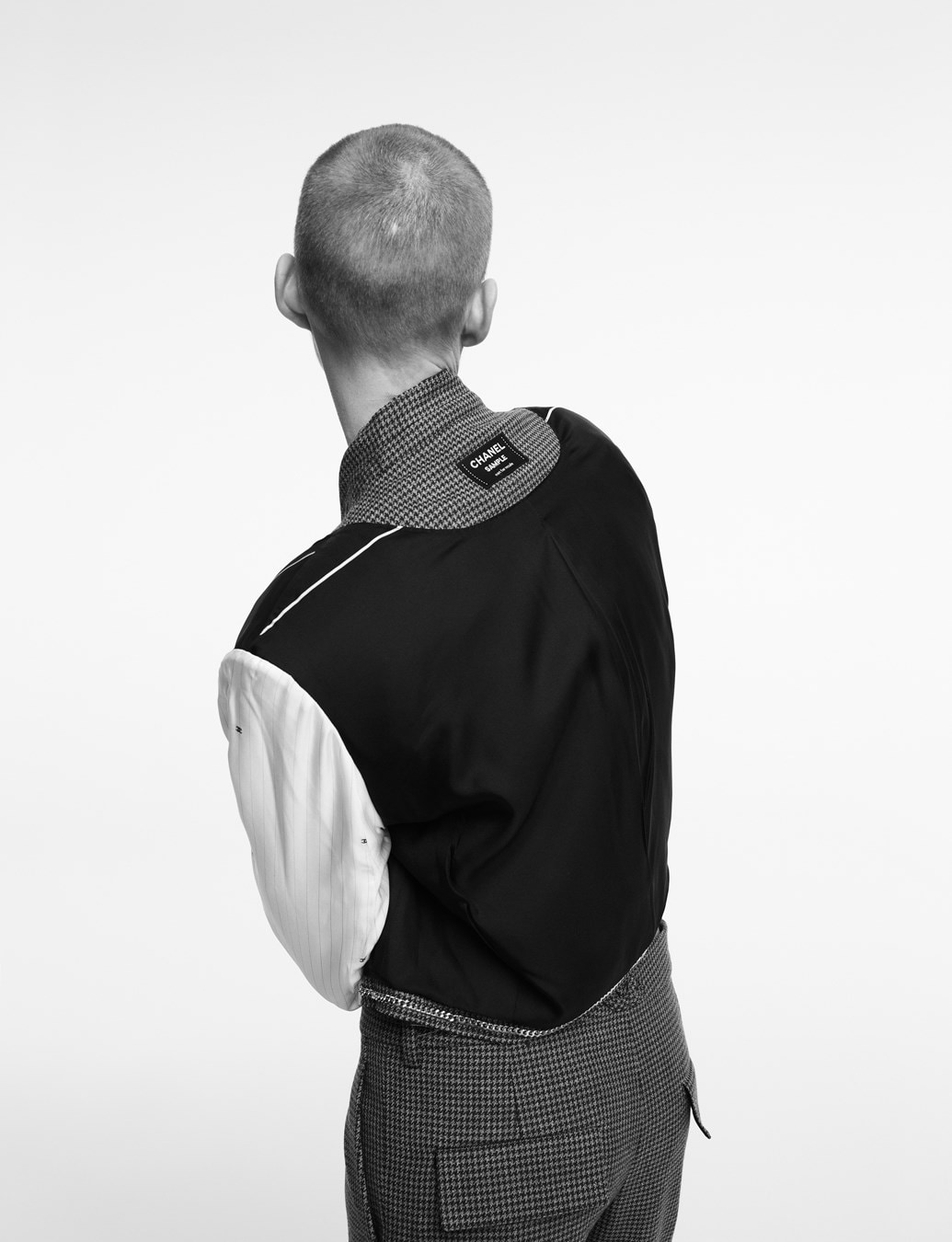
Blazy sees himself as a maker, primarily. He does sketch, like Lagerfeld but unlike Chanel herself, who fashioned her clothes on the body, scissoring open armholes and sometimes accidentally stabbing her long-suffering fit models in the process. Blazy has that instinct too – not blood-letting, but chopping and changing first-hand. “I draw, I sketch, I draw well,” Blazy says. “But I was always a maker.” He manipulates cloth, dealing directly with clothes, slicing, shifting, twisting. He also styles his collections himself, alongside a tight-knit team that largely moved with him to Paris. That hands-on approach has undoubtedly shaped his attitude to Chanel, alongside the remove necessary when managing the expectations of a multibillion-pound, multi-faceted company – similar to Calvin Klein, which like Chanel, also has very famous perfumes.
Arguably though, his most important experience was his time with Simons, who he still credits as a formative force. “Obviously, there was the idea of menswear,” he says of that period in Antwerp. “A certain kind of technique. If you make a blazer, it needs to be well made. It was not just about the impact of the froufrou, it was always something very precise, so methodical.” In hindsight, that was direct preparation for Chanel and especially for Blazy’s vision of Chanel, which opened in October – tellingly – with that chopped-up man’s jacket. Simons’s own pared-down style, his love of uniforms and of the influence of the street, is an odd but convivial bedfellow with the ethos of Chanel.
“Sometimes trying to be modern is the antithesis of what modern is” – Matthieu Blazy
So, weirdly, is Margiela. The ‘poorness’ of Gabrielle Chanel’s taste, for one – what Janet Flanner, in her famous 1931 profile of the designer in The New Yorker, called the “genre pauvre” – while the designer’s championing of waitresses’ white collars and cuffs and mechanics’ tunics all feels very Margiela (if not her propensity for self-publicity – Chanel appeared in her own advertising campaigns, after all). That was also present in Blazy’s Bottega, where he rendered the ordinary extraordinary by printing leather to look like flannel, denim or ribbed cotton and cutting it into seemingly normal-looking clothes. If in their trompe-l’oeil they were Margiela, in their faux banality they now seem distinctly Chanel. And Blazy opted to show his Métiers d’art in a New York subway station, a direct echo of a Margiela show staged in a disused Paris Métro station in 1991. “What I found interesting with Chanel, it’s almost like Margiela,” Blazy says unexpectedly. Bear with him. “Margiela was a lot about styling and put-together stuff, and I think Chanel is the same kind of recipe.” Indeed, Chanel was a pioneer of the idea of separates, which Blazy credits as a revolution. “It gave women the chance to dress themselves as they want,” he says. “It’s extraordinary to trust your audience so much, your customer, to give them that freedom.”
This is an idea Blazy finds fascinating, that plurality of Chanel – he speaks not of a Chanel woman, but Chanel women. “Especially today,” he says. “It’s global.” And another idea that fascinates him, as it fascinated both Chanel and Lagerfeld, is modernity. Lagerfeld was obsessed with reflecting the moment; Chanel embodied it. “I think sometimes trying to be modern is the antithesis of what modern is,” Blazy says. “You push too far, because you overthink things, but something needs to be kept. Something needs to be changed. But sometimes the loop doesn’t need to change. You just change the feeling of it, and it’s modern.”

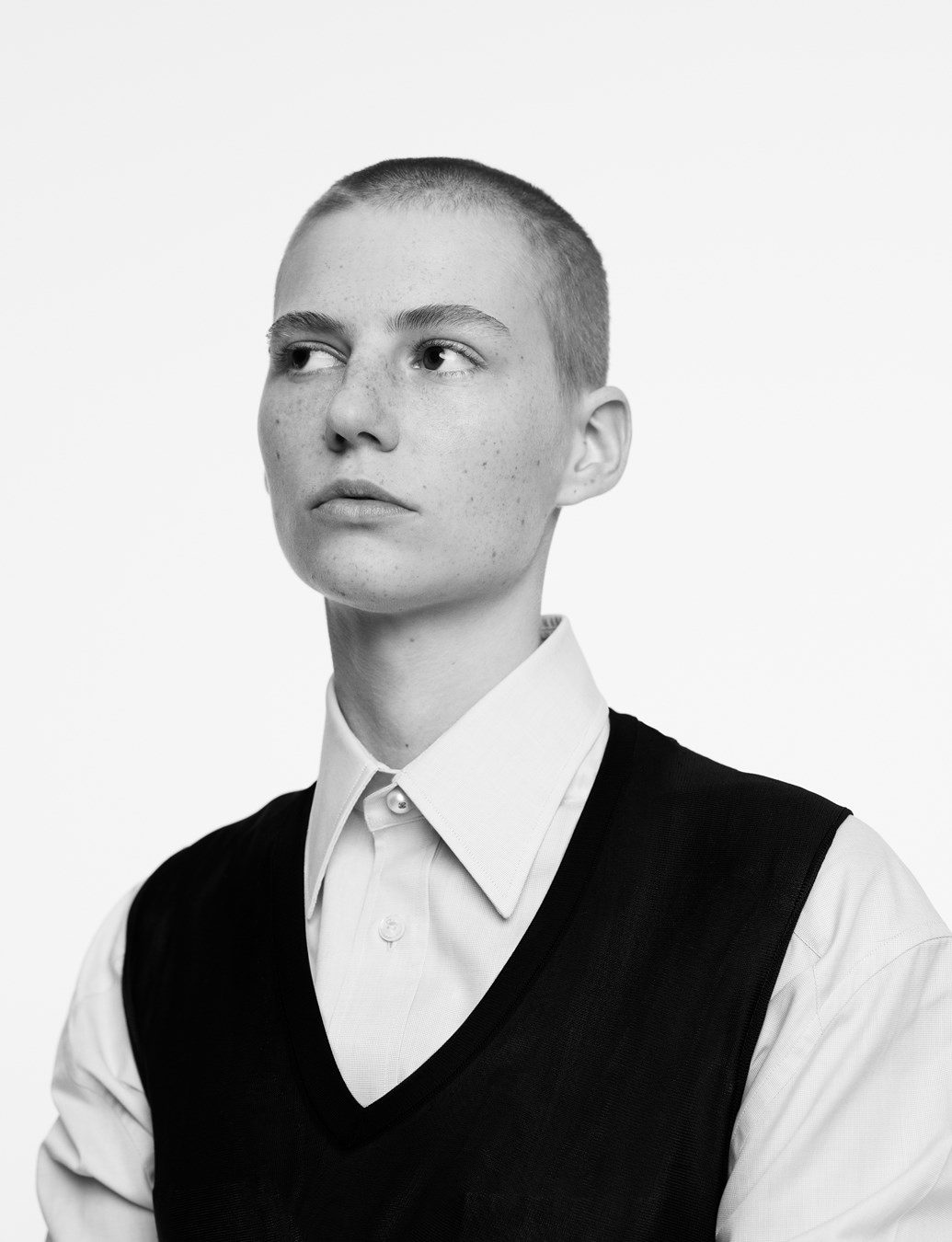

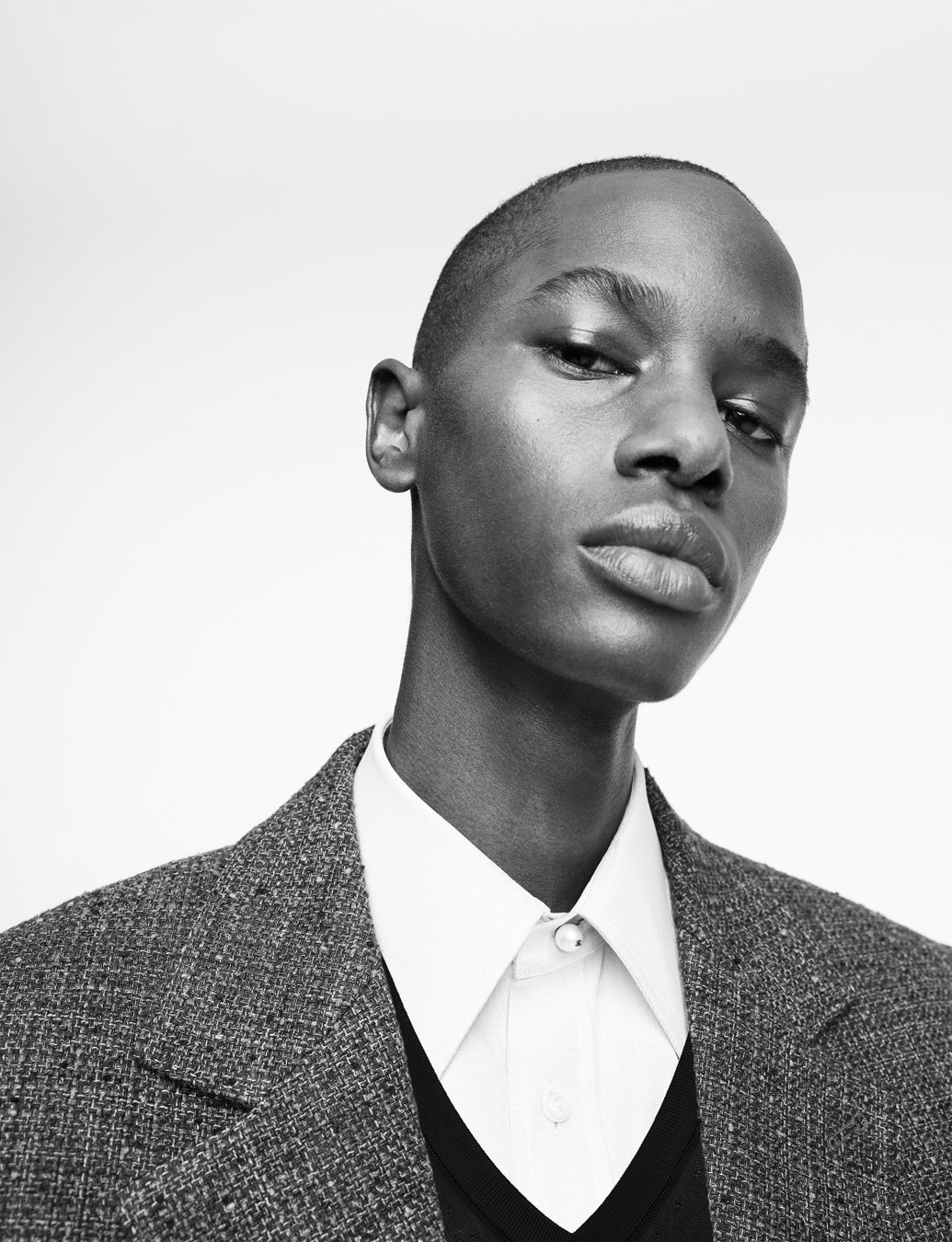
Hair: Louis Ghewy at MA+Talent using MR SMITH. Make-up: Lynsey Alexander at Jolly Collective. Manicure: Trish Lomax using La Crème Main by CHANEL BEAUTY. Casting director: Anita Bitton at Establishment Casting. Casting: Lorenzo Rotondo at Establishment Casting. Models: Emily Bador, Jessie Craig and Andrew Ohawa at The Squad Management, Leander Cowie at Rapture Management, Noah Falla at Boss Model Management, Alice Gianfrate, Safiye Gray at The Girls Agency, Thea Howarth at Brother Models, Lil Howard at Select Model Management London, Song Lee at XDIRECTN, Ebba Lindqvist at MIKAs Stockholm and Lamine Van Hollebeke at Let It Go. Digital tech: Paul Allister. Lighting: Romain Dubus. Photographic assistants: Tomo Inenaga and Tamibé Bourdanné. Styling assistants: Francisco Reis, Alexander Bainbridge, Izzi Lewin and Alicia Ellis. Hair assistants: Jordan Dufresne and Ainsley Walton. Make-up assistants: Sarah Edenborough and Maeve McElholm. Studio manager to Willy Vanderperre: Charlotte Cogen. Production: 138 Productions. Executive producer: Simon Malivindi. Producer: Imogen Stoddart. Production manager: Barbara Eyt. Production co-ordinator: Gigi Redhouse. Production assistants: Grzegorz Blazewicz, Ryan James, Sarah Nimmo and Harvey Wells. Special thanks to Stéphane Virlogeux
This story features in the Spring/Summer 2026 issue, marking 25 years of AnOther Magazine, on sale internationally on 12 March 2026.
