
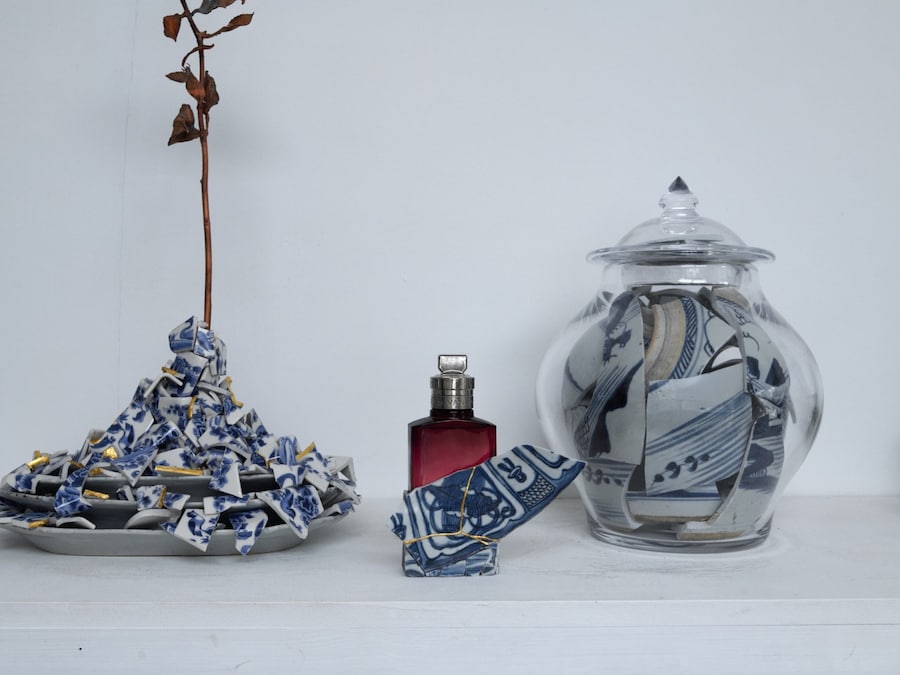
Dutch ceramic artist Bouke de Vries talks about transforming Soie Malaquais into five one-of-a-kind sculptural editions
This month, Dries Van Noten is celebrating its beloved cult fragrance Soie Malaquais by turning it into a series of collectable sculptures. The house is teaming up with Bouke De Vries – the Dutch artist known for transforming ceramic fragments into ornate, baroque reconstructions – to create five one-of-a-kind “masterpiece bottles”.
Soie Malaquais is one of Dries Van Noten’s most loved fragrances. Released in 2022, it was designed to evoke the “tactile pleasure” of silk – a warm, enveloping chestnut accord, lifted by rose, blackcurrant and cardamom. Just as distinctive is the bottle: like the rest of the Dries fragrance collection, it’s a statement object in itself, with a coloured glass and a porcelain base inspired by Delft blue-and-white ceramics.

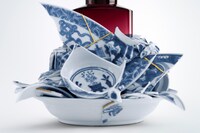
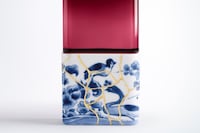
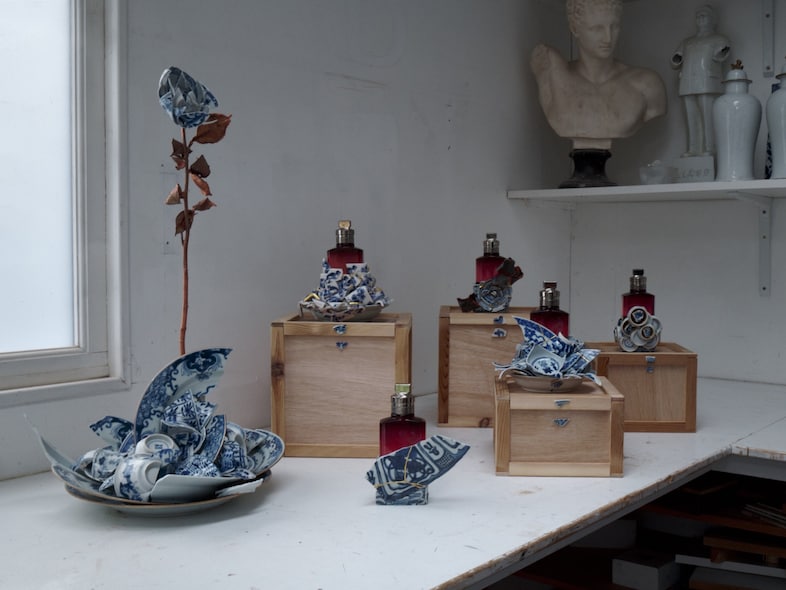
While de Vries notes that he was a long-time fan of Dries Van Noten, this foray into fragrance was new territory. “I never wear scent,” he says with a laugh, talking to me from his studio in west London. The brand approached him despite this, drawn to his meticulous eye, love of sustainability, and open embrace of imperfection. “They gave me total carte blanche,” he remembers. “They told me, ‘Do what you want to do.’” The only requirement was that he had to make five unique bottles, plus some additional still-life sculptures for the London and New York boutiques.
Within those parameters, de Vries worked intuitively, putting himself at the mercy of the fragments in front of him. “I don’t do drawings,” he says. “I don’t know where it’s going to end … The fragments I have in my hand determine how the thing develops.” He sourced materials by following leads online, prioritising offbeat pieces that are easy to overlook, from humble ceramics to fragments from a 17th-century shipwreck.
The resulting works feel like warped, theatrical variations on the original Soie Malaquais bottle. Each piece begins with the same blue-and-white porcelain base, which appears caught mid-shatter: shards cracked open and coaxed into new silhouettes, the breaks deliberately visible. The artist leans into a language of fracture and repair, using the Japanese Kintsugi technique, mending cracks with gold lacquer so they’re highlighted rather than hidden.

This love of imperfection matches with Soie Malaquais perfumer Marie Salamagne’s own philosophy. “I put imperfection in my work too,” she says. “If you create a scent that doesn’t have accident in it, you don’t tell the story.” Without that “little something,” she argues, fragrance becomes anonymous: “If everything is perfect, then you become everybody. You don’t really bring a personality to your fragrance.” She describes that essential detail as a deliberate beauty mark. “I always put this little grain de beauté in the fragrance, just to make sure it’s different,” she says. In Soie Malaquais, that distinctive, destabilising hook is the chestnut – a rare accord in perfume-making.
“It’s so difficult for us as perfumers to stop time, because scent is evanescent; we cannot put it in a box,” she adds. “We cannot take a picture of it. We cannot draw it.” Seeing de Vries’ response felt like a rare act of translation. “Having the opportunity to see Bouke’s work, I just loved it,” she says. “I love the imperfection becoming beautiful.”
