
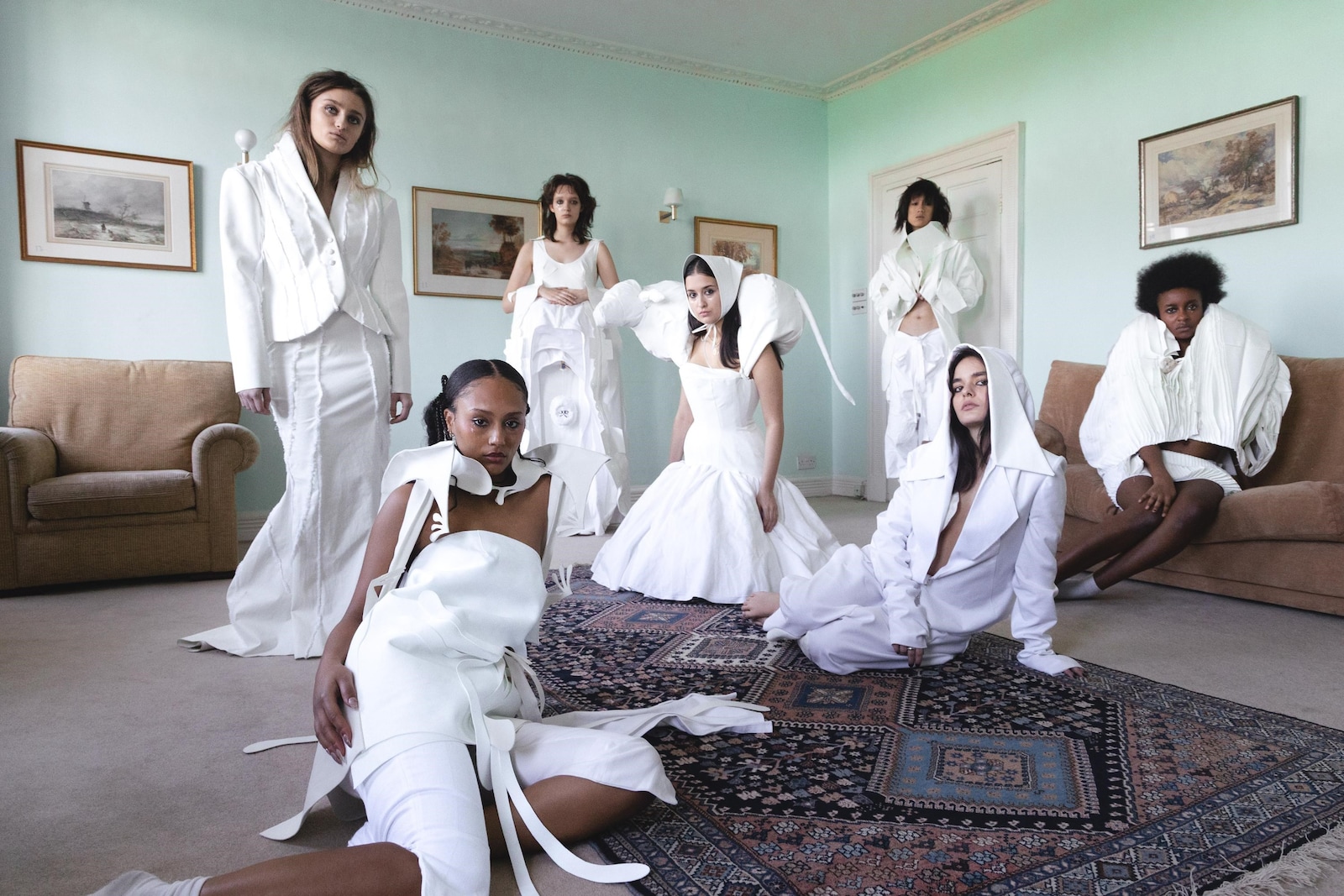
A tradition, a rite of passage, an initiation, perhaps even a mild baptism of fire: the Reset Show, formerly known as the White Show, returns every December for Central Saint Martins’ first-year fashion design students. The brief is straightforward: produce one complete look using only white. In recent years sustainability has entered the syllabus, with garments now constructed from recyclable white textiles that can be recut and reused for the following year’s Reset Show.


This year, 154 students across womenswear, menswear, knit, print and fashion design communication took part. As ever, the show was creatively directed by first-year fashion image and promotion students, an exercise in cross-pathway collaboration. The theme was ‘The House’, a domestic framework interpreted with the usual Central Saint Martins elasticity. Guests were handed white keys on arrival, and inside the central corridor of the Granary Square campus, abstracted ‘rooms’ appeared: televisions, beds and sofas arranged in a way that recalled the spare theatricality of Lars von Trier’s Dogville.
Over the course of 25 minutes, students presented their looks – for most, the first time their work has been seen in a catwalk context – accompanied by the institution’s trademark flair for the dramatic. There were sculptural beams dragging along the floor, papier-mâché heads inflated to yoga-ball proportions, models pushed in trolleys, bustles illuminated from within by LED lights and trains extending metres behind their wearers. Around them, students from across the university packed themselves into corners, stairwells and overhead bridges, craning for a view of whatever theatrical gesture might come next. It is, unmistakably, an experience.
Below, AnOther speaks with six first-year BA fashion design students who presented work in the show. Each look carries a personal backstory, rendered in textile and form. Here, they unpack the references that shaped their designs.

Denholm Bruce, 22, Fashion Design: Communication
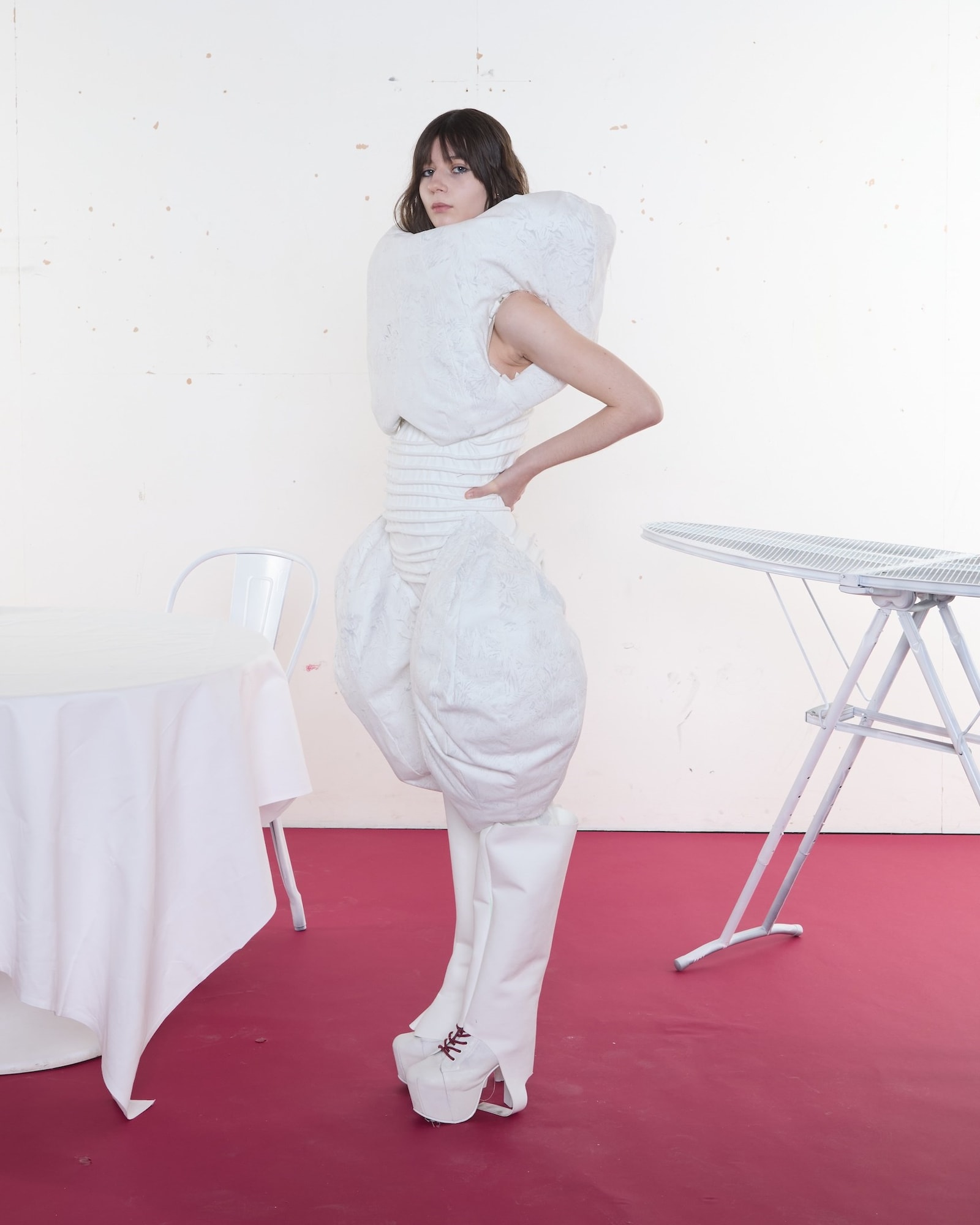
“The starting point for this look was this feeling of being caged inside, trapped by the rising cost of living, staring out of my window and longing to be outside. I knew if I was struggling financially, then single mothers must be facing even greater hardship, and that’s where the suffocation of the body began – society closing in from every angle. I wanted to evoke distortion, of what we know as the industry and beyond, because so many people never see the realities single mothers live with, the way they hide financial anxiety from their children. To me, that’s a strength beyond anything.
“It felt deeply personal. I spent my summer indoors because days out were money I didn’t have. My mum is my inspiration – giving three boys every opportunity, building my confidence. It started as something a bit down but became something very powerful, to me at least. The fabric manipulation became a way to explore social divide: William Morris curtains versus plastic blinds, tradition versus reality, tension, movement, imperfection. Growing up in Hertfordshire, that clash between classic and modern stayed with me. I had my girlfriend model the piece, who also came from a single-mother household. I feel the piece got us speaking about our mother’s hardships that we had never before, becoming prouder of their strength and love.”

Kirsty Mearns, 27, Print
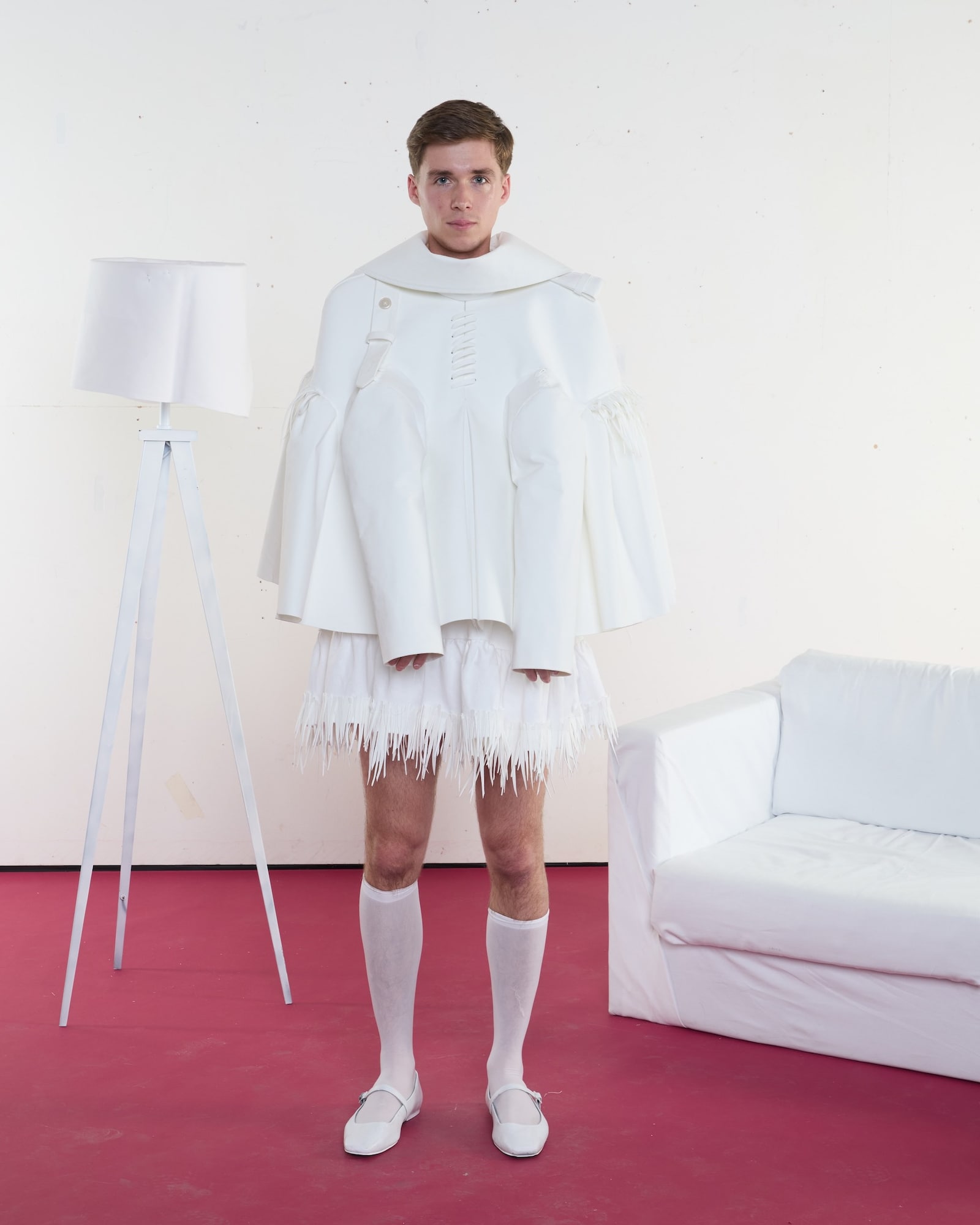
“The starting point was Little Red Riding Hood with a twist – what if she slayed the wolf instead? I wanted to lean into playfulness, mischief, drag, fantasy and that sense of childhood innocence, while exploring the darker themes that have always fascinated me within the fairytale: sexuality, power, deception and transformation. Reimagining the story felt like a way to reclaim Red’s agency, where her childlike innocence becomes her superpower.
“The look is imagined as the aftermath of the fight between Red and the wolf. I used braiding techniques to mimic stitches, as though the jacket had been ripped apart in the conflict, then put back together in an odd, imperfect way through the placement of the sleeves and collar. I’m especially proud of the fringing, developed from ultra suede scraps from my classmates, referencing the wolf’s fur after being slain while finding beauty in small offcuts. Coming from a background in economics and international relations, I’m drawn to concepts that feel playful, humorous and reconnect me to my childhood.”

Marat Arkalaiev, 19, Womenswear
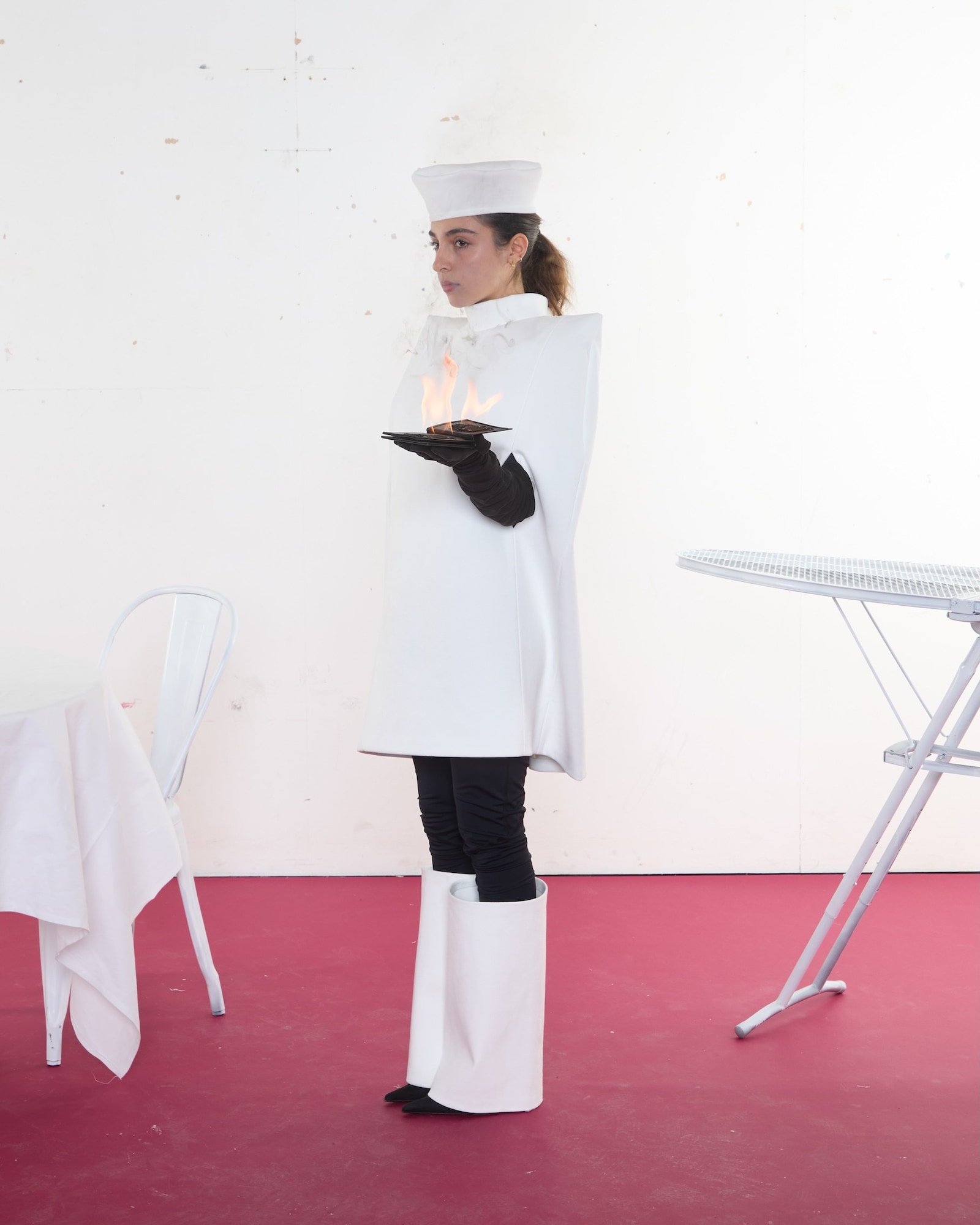
“My inspiration was women in politics and their outfits, which can exist within a certain context or opportunity to represent political problems. Another reference was memorials, their strict lines and silhouettes. To represent a memorial, I used a magician’s wallet that sets on fire using special technology, so it can burn without destroying the wallet or harming anyone. It can also reference the Statue of Liberty.
“I’ve always been interested in politics because of my history of immigration, and I believe it’s important to understand and speak about global problems. With this look, I want to remind people that there are more things than fashion that we need to focus on. My favourite part is the fire wallet, as it adds a performative element to the look. I’m also proud of my sewing and pattern making, making sure the look was perfectly fitted to the model. My work is shaped by political context and my experience of war and immigration. I’m from Ukraine – I was forced to leave my city at the age of eight when Russia invaded Donetsk in 2014, and in 2022 I had to immigrate to the UK after the full-scale invasion. My family is still there, often without water or electricity, which motivates me to do everything I can.”

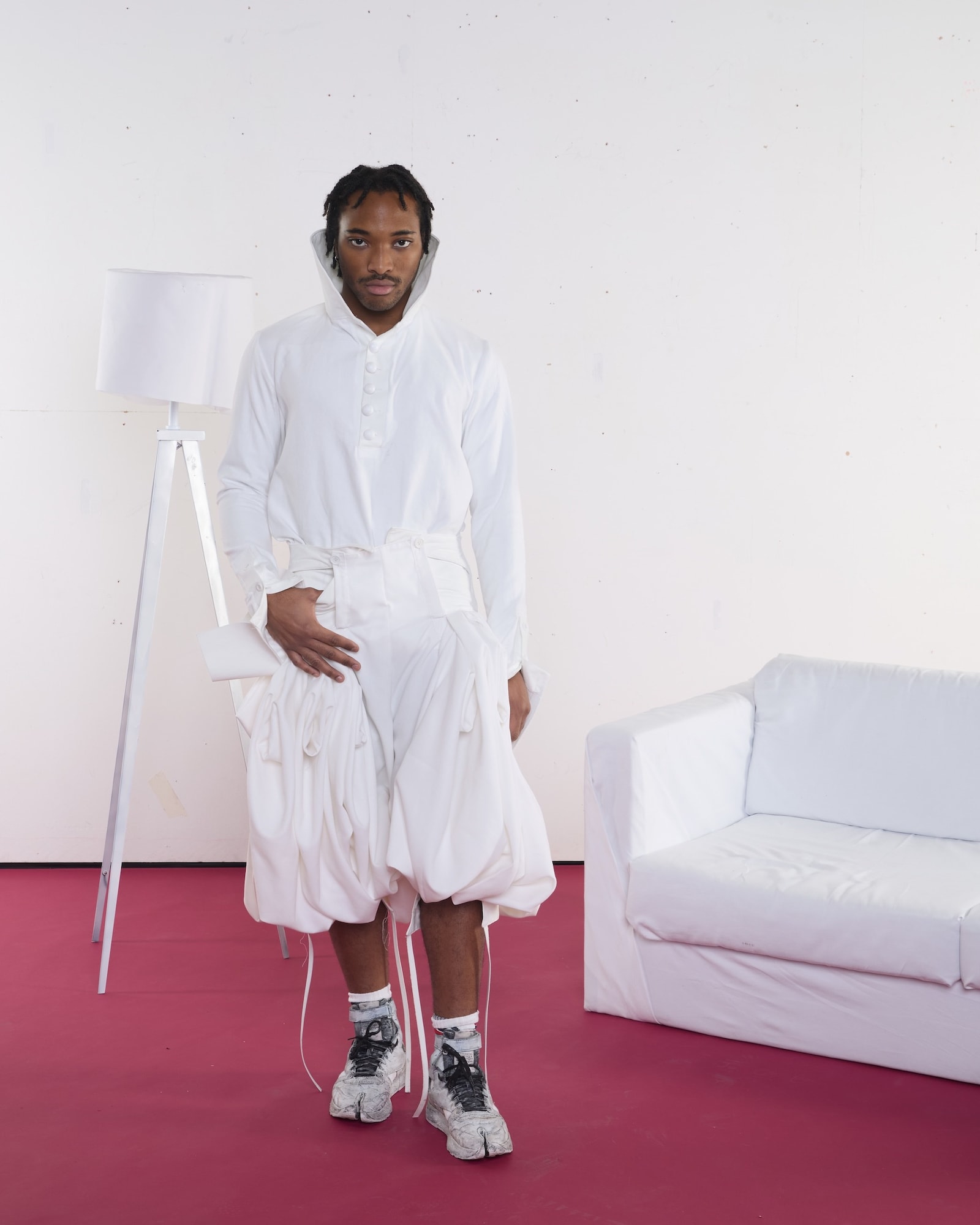
Alistair Burr, 19, Knitwear
“I was originally inspired by the current political landscape in England and the controversies that come with being English, especially during the marches in September. Because the subject felt so heavy, I wanted to express my research in a comedic way and translate the idea that being English is a joke. This led me to references like Austin Powers and Monty Python, mixed with modern-day stereotypes from where I grew up. It felt very current, as the town I grew up in was also affected by the events in September, which created a lot of hostility locally. Through humour, I wanted to open up conversation and make people feel more comfortable speaking about it.
“I focused on the idea that the polo shirt is universal across social classes in Great Britain, extracting the collar detail and placing it on the cuffs and trouser hem. The hat was inspired by my time working at Eton College, folding napkins into fleur-de-lis shapes from the crest. I’m proud of my use of digital embroidery, as it was my first time working with 2D software, and of developing my pattern cutting and sewing skills. My work draws on my lived experience between social class borders, using humour to push back against judgment and express masculinity in my own way.”

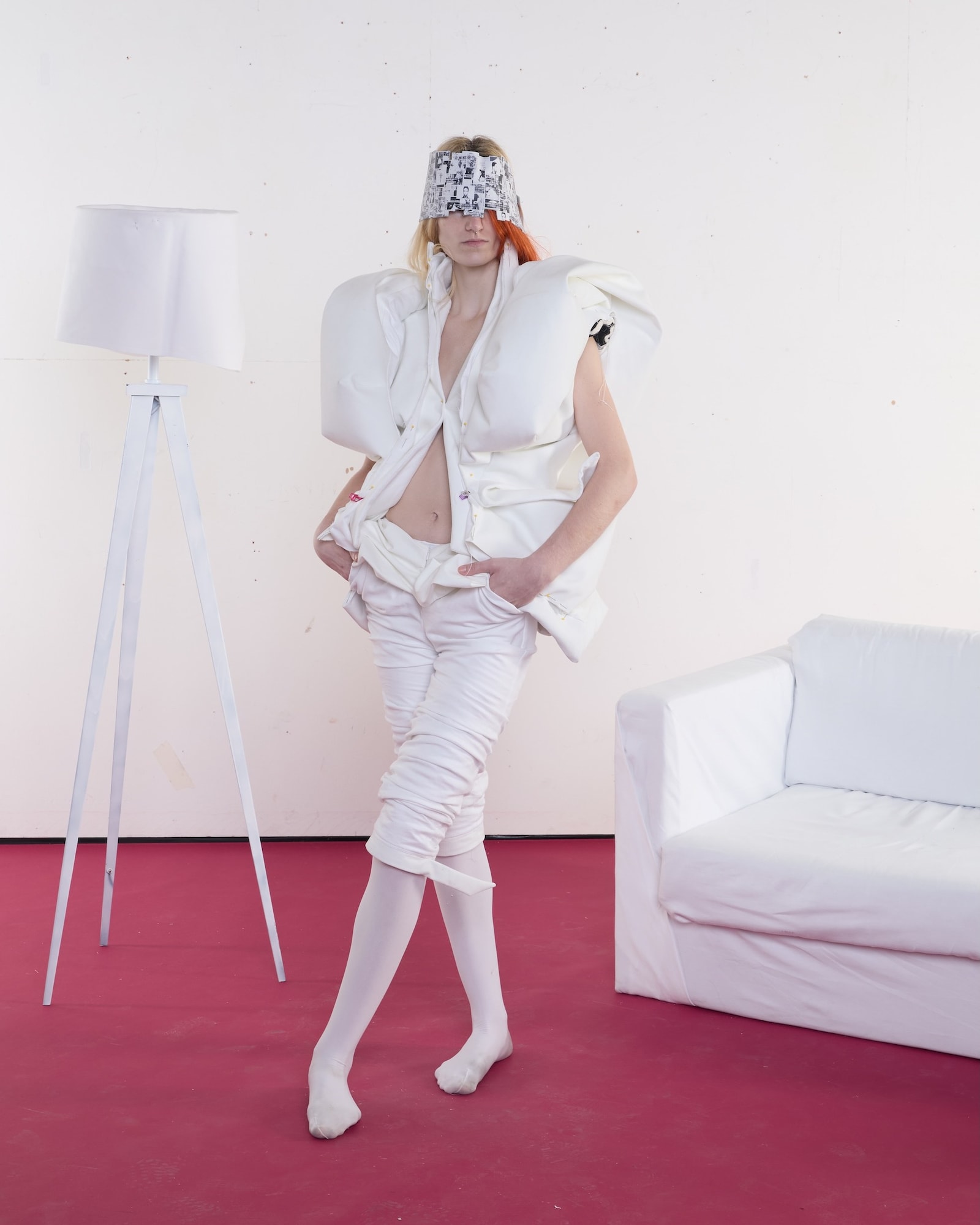
Emanuel Dawit, 20, Fashion Design: Communication
“For my Reset project, Pure, the starting point came from rewatching an old Metropolitan Police documentary about Trident, where a series of surveillance images were shown to a room of children – a lost hat on the street, a lost shoe on the street, a victim of gun crime. What stuck with me was how his belongings, once personal, became forms of evidence that betray. It made me think about the ways people choose what objects to hold onto, what objects they give up, and the tension between the two.
“I wanted to explore hoarding and the fear of losing something you’ve worked hard for – my mum hoards a lot. Our house feels like a time warp of random memorabilia, moving from the kitchen to the living room to the bedroom, with layers of memories being brought up. A huge part of the look is layering and things having the appearance of not fitting. I’m always drawn to how diasporic people layer on the street, out of necessity, pushing through clothes that stick out, pull open or sit wrong. Growing up in Hoxton, East London, the people around me, especially my dad, shaped how I see clothes – resilience, defiance, and just making it work.”

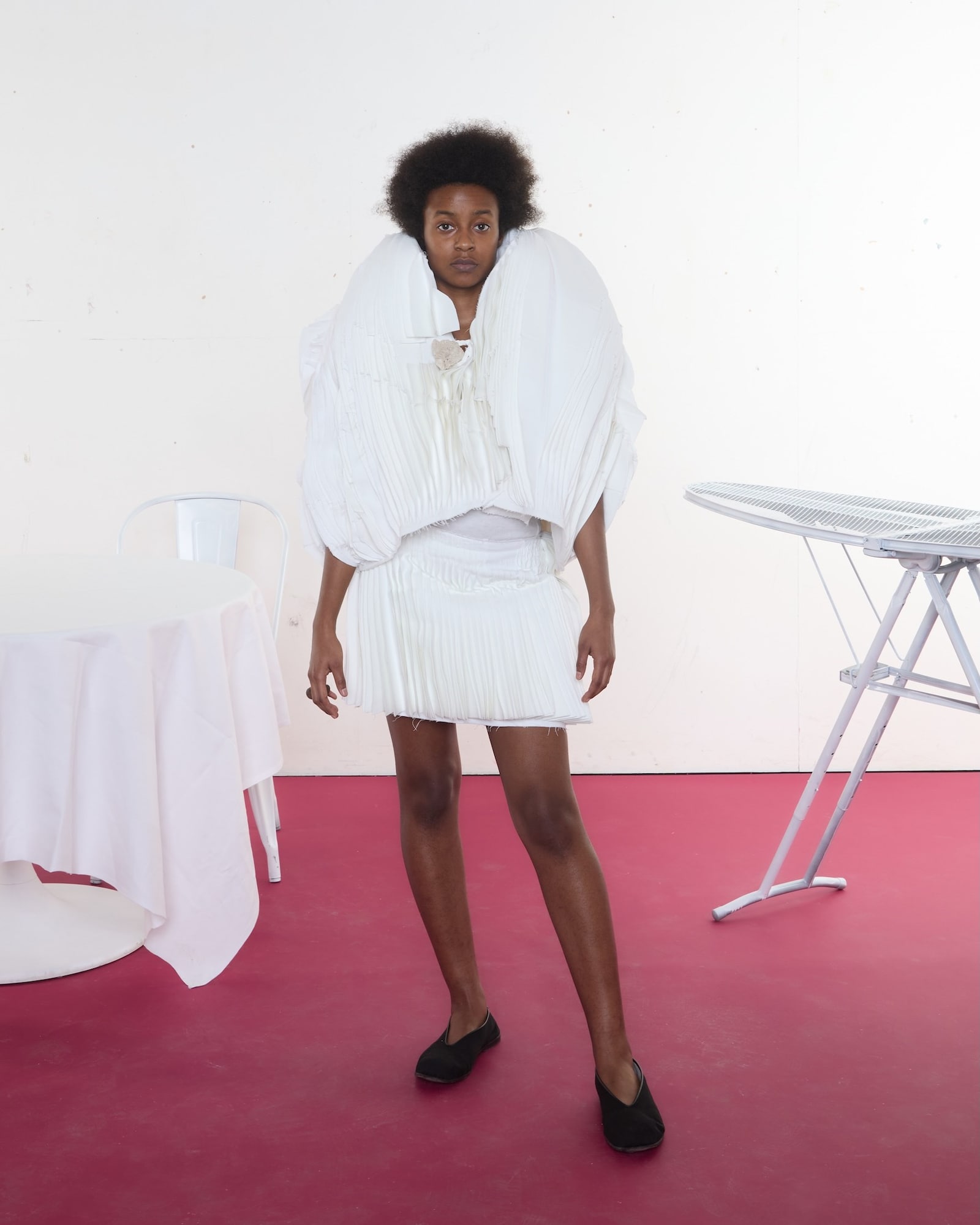
Myra Labé, 20, Womenswear
“The starting point for this look was my home, seen through the lens of topography – the highs and lows of land, and the way sand is constantly displaced, which felt like a parallel to myself. I titled the look ‘A Grain of Sand’ as a reminder that our worries can feel all-consuming, but we are only small grains within a vast human landscape, swept from place to place. Even though we come from different backgrounds, we are often more similar than we think.
“I wanted to explore the beauty of finding a home in multiple places, even when that can sometimes make it feel like you have no home at all. Before moving to London, I found a calcified sand formation in a bead store in Montréal, which made me question where its home had been before it was displaced. It felt delicate and lost, like me, so I carved into it and secured it with a screw and bolt to become a button on the look. The garments wrap the body like a folded map, made from 256 panels sewn at one-centimetre intervals. My work is always identity-based – a way of expressing my experience as a Black woman from an immigrant household, creating an imaginary home street that morphs between Montréal, London and Benin.”
