
This story is taken from the Autumn/Winter 2025 issue of AnOther Magazine:
Dragons were circling in Paolo Carzana’s mind while he was designing his Autumn/Winter 2025 collection. They were also closing in on him more literally. At his studio in London’s Smithfield Market, dragons carved in stone appear ready to swoop down from the eaves. Strong, cunning and beautiful, Carzana’s imagined mega-lizards are not so much eldritch as unbound by morality, their concerns grander than those of short-lived, shortsighted humans. They are the last of their kind, a literary representation of a dying time – wisdom and freedom made into scales and hot breath. Carzana, 30, is also Welsh, so the emblem links to Y Ddraig Goch, the red dragon of his home country’s flag. He was born and raised in Cardiff, before coming to London to study at Westminster University and Central Saint Martins.




Carzana’s show, titled Dragons Unwinged at the Butchers Block, was set in purgatory. It’s the last of a trio he calls the Trilogy of Hope and explores another eternal theme: heaven and hell. “Going up, going down, and then arriving midair at this kind of acceptance,” the designer, who launched his label in 2021, says of the collections leading to this one. “Dragons represented a community, I guess. The most prominent one was LGBTQIA rights worldwide – the dragon being the most beautiful, powerful creature and so magical. But also at the mercy of man.”
Carzana imbues his shows with the same elegiac energy. They’re also distinctly in the “last of their kind” category, with models slowly wending their way through intimate venues including the designer’s own back garden in Hackney, and a romantic sensibility that harks back to British enfant terrible designers of yore. Dragons Unwinged took place in a pub, The Holy Tavern in Clerkenwell, a suitably gothic backdrop to his richly textured, hand-dyed clothes. Carzana’s models looked like a Toulouse-Lautrec painting made real – slightly consumptive and ragged, with otherworldly headgear by Nasir Mazhar adding to the beyond-time feeling. “With all of what I’m doing, what I try to achieve is to move from darkness into the light. Even with the most depressing research imagery or story,” Carzana says, gesturing at the faded pictures stuck to the walls of his plant-filled studio.

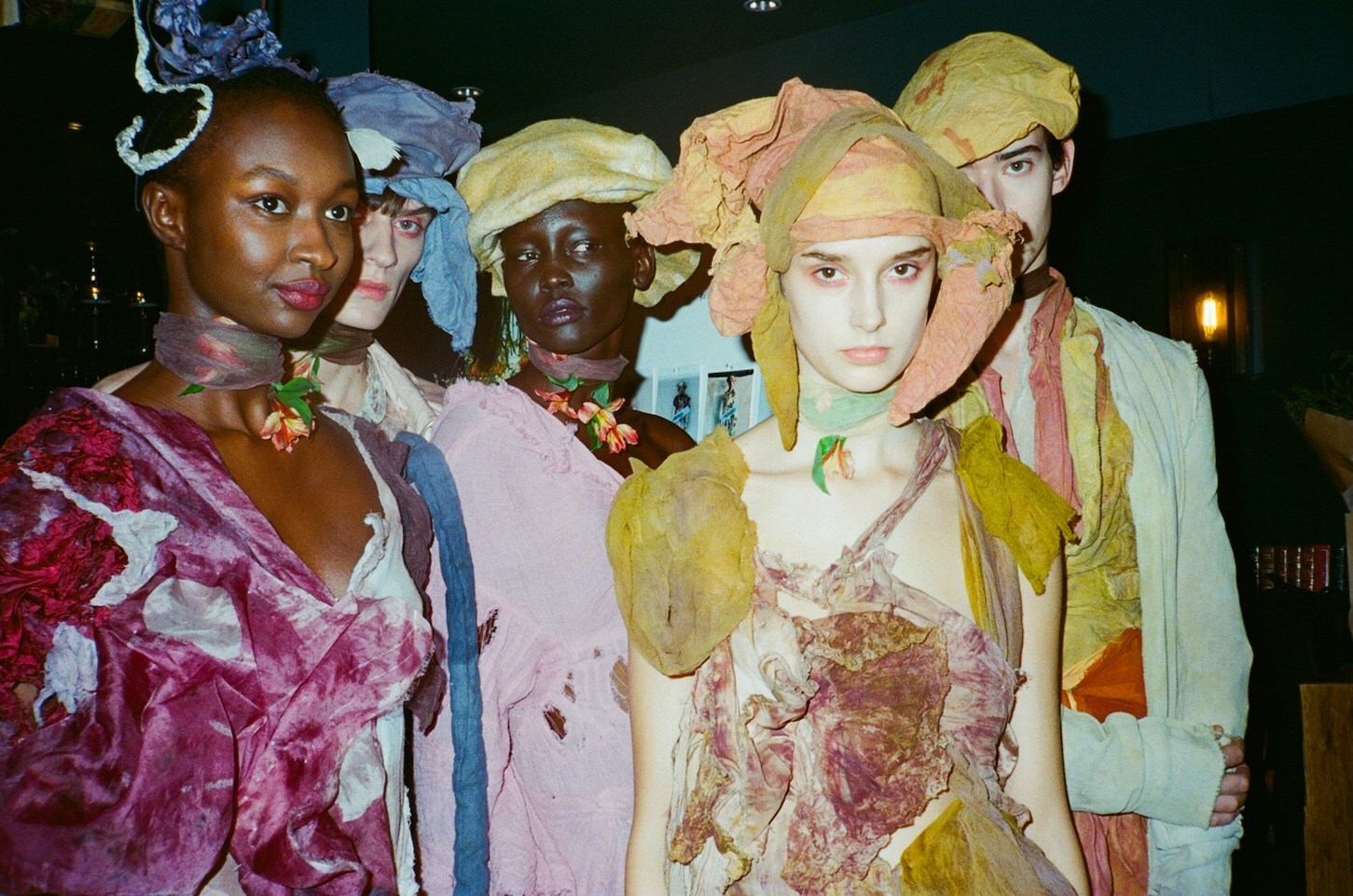
The collection, like the plants Carzana diligently tends to, adds some oxygen to the industrial surroundings of his studio – the clothes are richly organic. Looks seem to have sprouted rather than been made. “It’s about working with nature as opposed to against it,” he says, showing some polka-dot fabric he created. Carzana is keen not to contribute to the climate crisis while still creating something new – he uses natural dyes, deadstock materials and trusted mills. “Since my BA, it was, ‘How can I work with materials that are positive for the environment? Who are the local communities spinning that material? Does it increase biodiversity?’ It’s all-encompassing,” he says. “In terms of the dyes, everything I make is all natural, using food waste, onion skins or spices and plants like madder.” Many people may never have heard of madder, the roots of which are the source of the dye. Carzana is growing it in his garden to combat its paucity. “It’s a 360 way to not have an impact. And that is something I’m very strong on. This,” he pulls out a delicate dress, “is organic bamboo silk. All the cotton is organic. The way I see it, it’s a new attempt at modern luxury. Even the silks are repurposed, or peace silk, where the silkworms aren’t killed. It only takes two weeks more for the silkworm to excrete silk rather than be boiled. But two weeks is too long in the grand scheme of things apparently.”
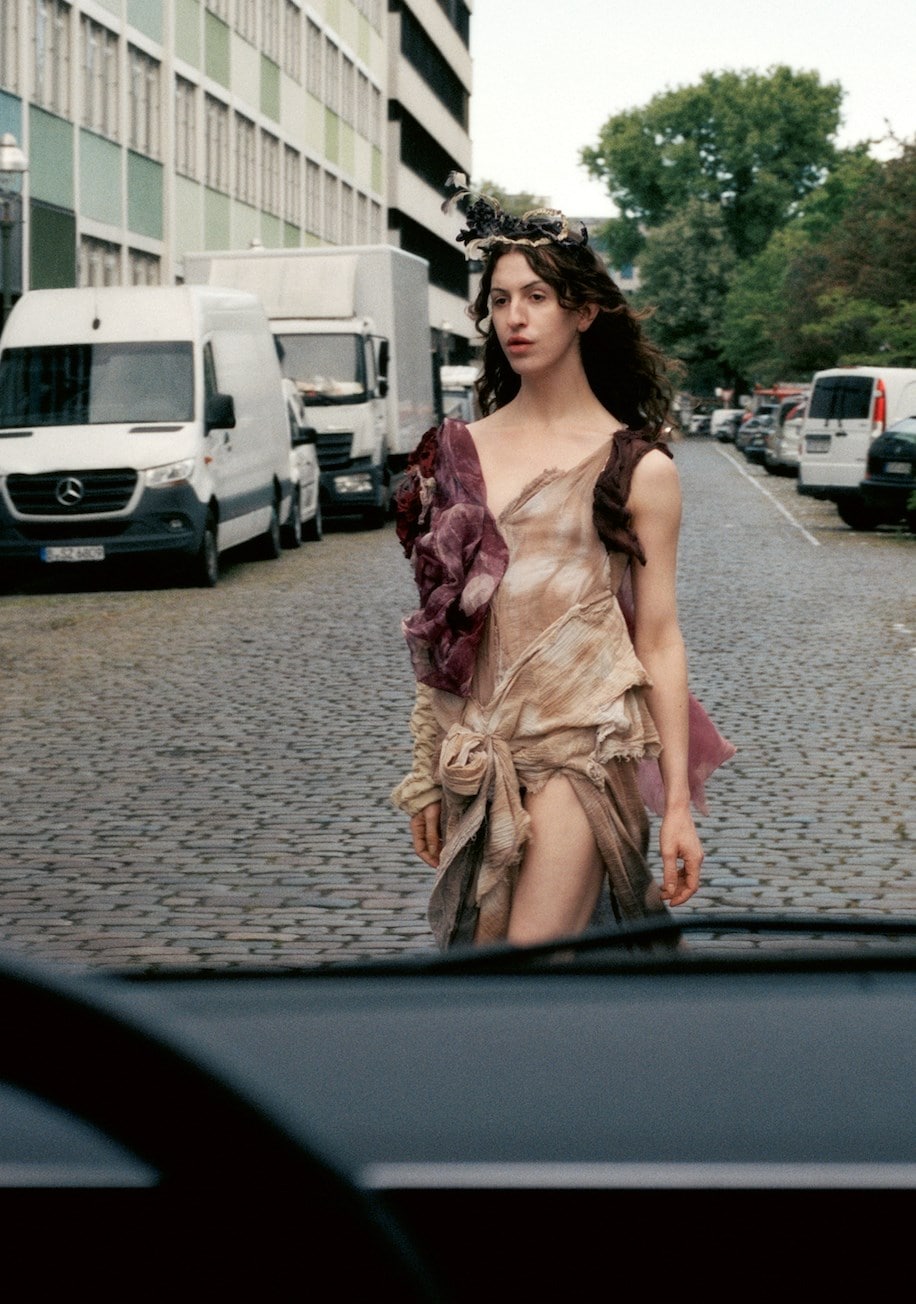
Carzana typically works on a collection for about six weeks. Without financial backing, he has to make money in between shows – which makes his embrace of peace silk all the more remarkable. With this collection, he was thinking about a slower pace more conceptually too, “arriving at a place where there’s an endless circle through pain, and that’s kind of OK”. The clothes that resulted are indeed almost painfully beautiful. In a colour palette of faded blush pink, vivid magenta, turmeric and indigo, the tailoring is intricately layered, like the spoils of an archaeological dig, while gowns fall in rich swags of shredded fabric. Carzana painted his own polka dots for the look photographed opposite “by making a stencil, spraying on top and applying the colour with brushes”. It’s brilliant to listen to him as he removes the precious garments from their bags. “This is muslin from India, with hundreds of pleats,” he says. “This is peace silk organza, which is then washed and boiled, then pleated, becoming almost a cobweb. And inside is a deadstock silk georgette.” He pauses. “I’m sorry, I feel like I sound quite annoying.”

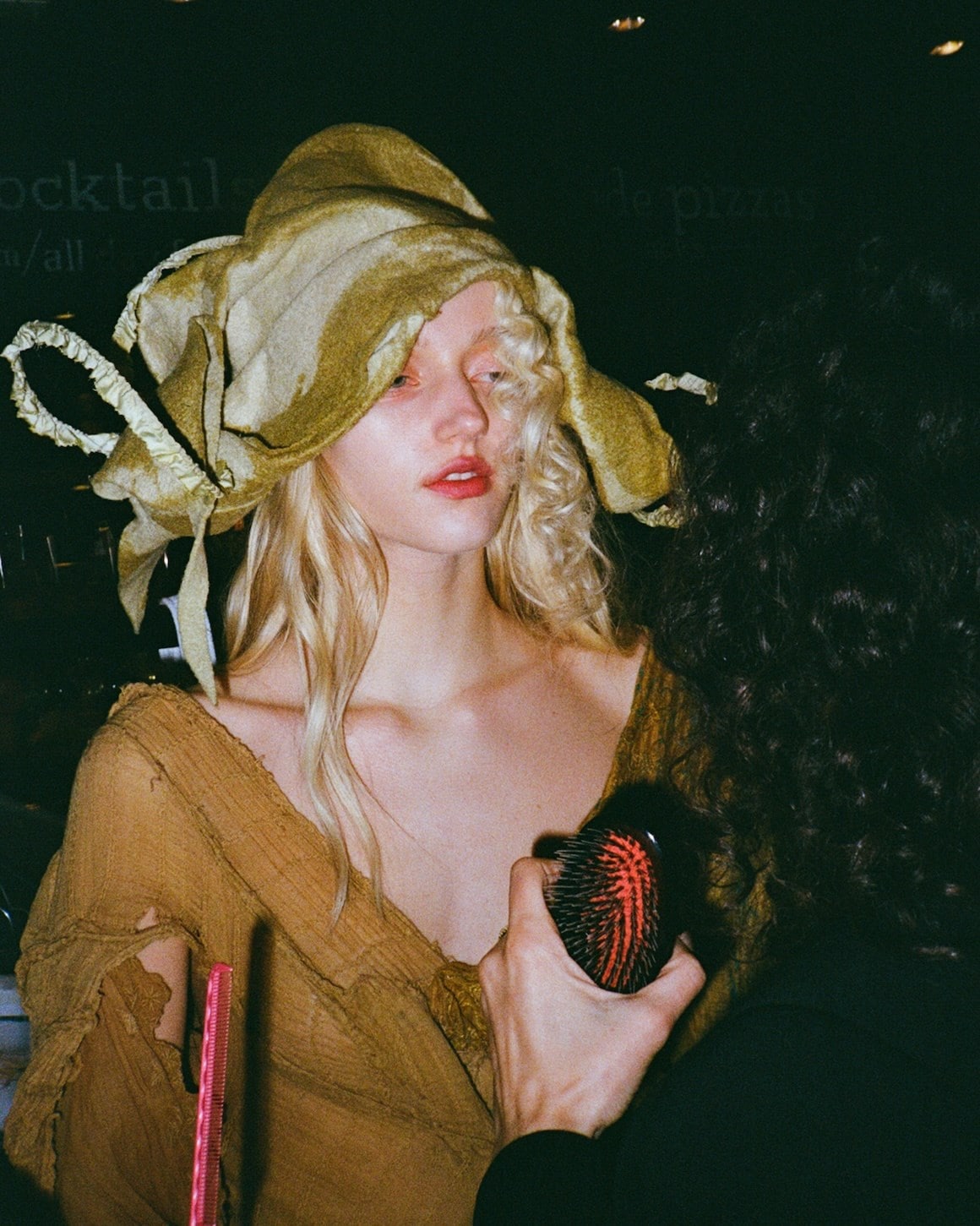
In the six weeks leading up to Dragons Unwinged, Carzana went from 80-plus looks to 14. He says the discarded ones were “very unfinished”, more like experiments, but still. Over a frenzied month, the designer and his team of collaborators built the show. Dresses became hats, an antique waistcoat grew subtle wings. “When we started building the looks, the silhouettes, the man became extremely linear. And with the woman, there was a focus on the three-dimensional, an endless spiral to represent purgatory.” Yes, he spent his childhood going to church on a Sunday, the Catholic kind, where his mother found solace after the death of his grandmother. “And so once that had happened, we continued on that journey [with the collection] and then stopped when it was enough.”
Last time the designer was in Paris to sell his collection, he rented an atmospheric attic to show it. Intrepid buyers and press ascended creaking stairs into the dimly lit space to meet him. When the team from one of his stockists, Dover Street Market, arrived late in the day, they resorted to holding the garments up against the crooked, lampshaded lights amid the Stygian gloom. Whatever they saw, they left duly convinced, having put in an order.

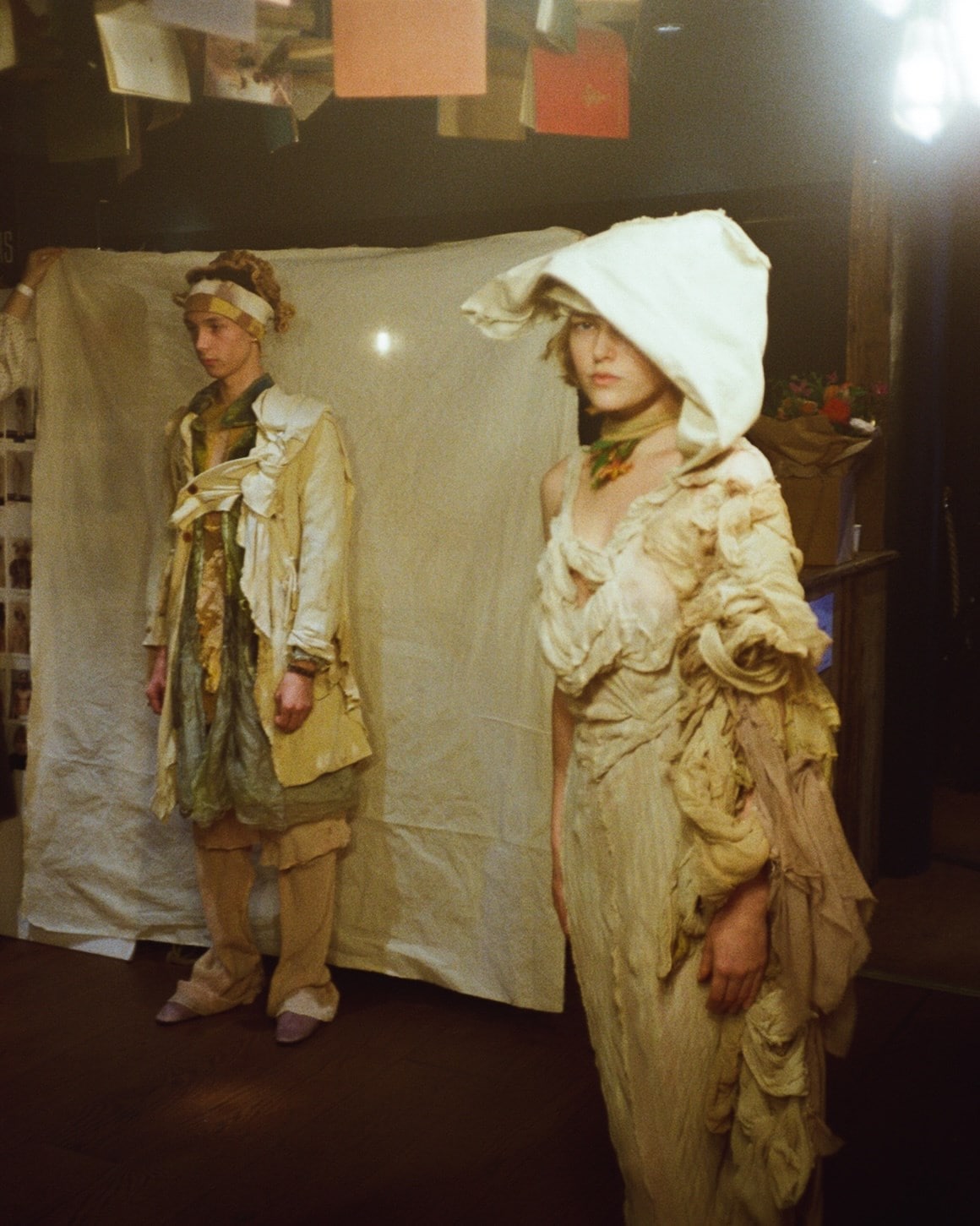
Carzana has climbed the stairs of his own tower through his collections. His three-part quest through the underworld over, he has emerged to find the dragons butchered, the world laid to waste. “There’s definitely the element of an emotional journey … Whenever we do a show, and my stylist Patricia [Villirillo] and designer and milliner Nasir [Mazhar] are here, with Troy [Fearn] on casting, and Claire [Grech] and Crystabel [Efemena Riley], who do hair and make-up, and my boyfriend Joe who helps me, and Laura [Holmes] who produces it ... During those final days it comes together with no resources at all,” he says, waving around at his fantastical cave. “It’s magic.”
This story features in the Autumn/Winter 2025 issue of AnOther Magazine, which is on sale now.
