
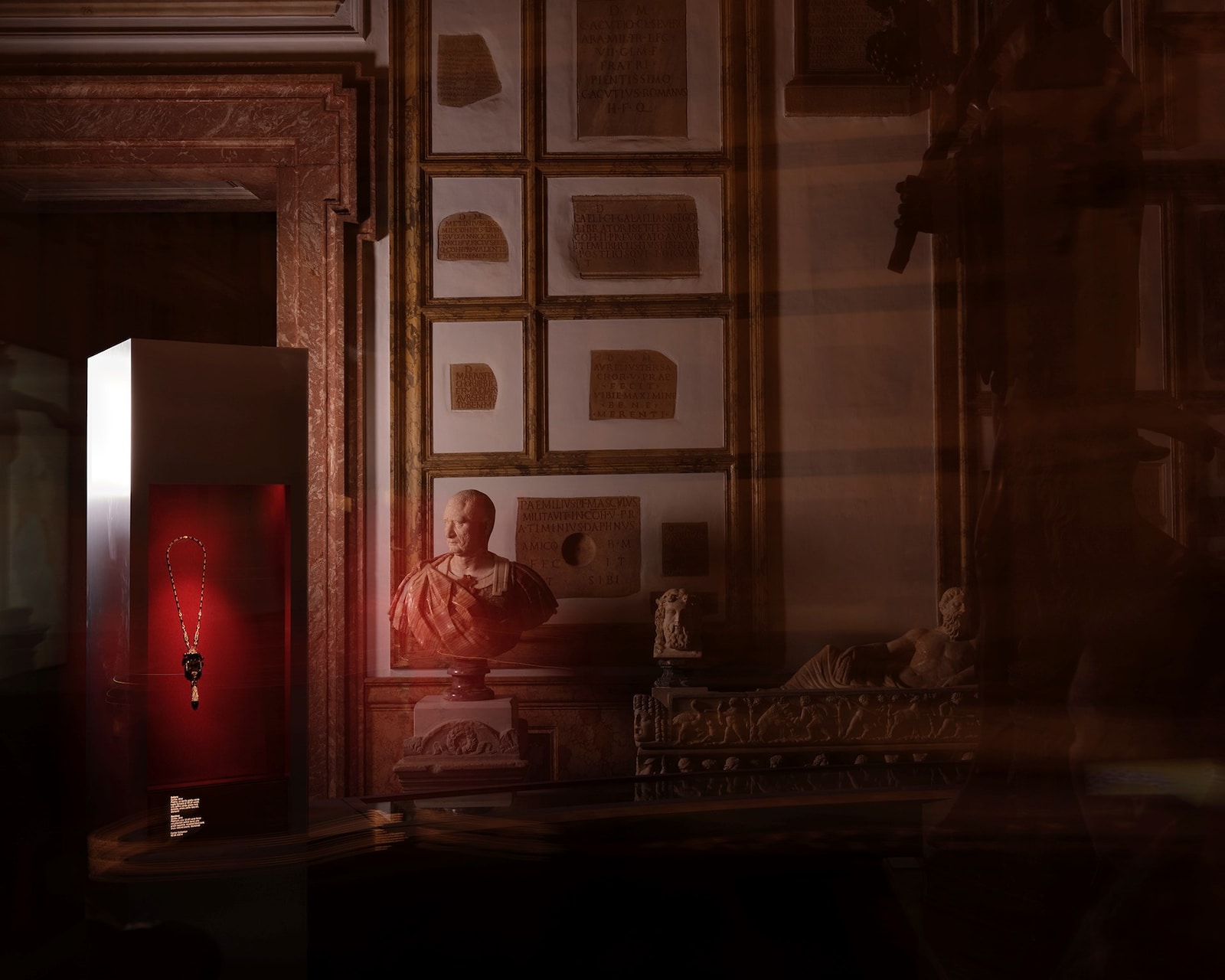
Okay, so citing a correlation between pretty much any creative expression from the Renaissance onwards and Greco-Roman classicism is hardly rocket science. The word itself, meaning “rebirth”, is tied to a rediscovery of classical art and ideals of Ancient Greece and Rome, often through direct emulation and assimilation – English architectural follies that resemble Roman temples, 18th-century evening muslin gowns that look like Greek draped states. And, indeed, lots of jewellery from just about every age with micro mosaics and columns and Greek key motifs and fragments of legend and epic saga woven into gold. That was Cartier’s thinking for its latest exhibition, Cartier & Myths, which opened this month at the Musei Capitolini in Rome.





Since 1989, Cartier has staged some 45 exhibitions exploring its enviable and truly priceless archive, in locations flung far – Shanghai, Mexico City and at the Louvre in Abu Dhabi, over only the past two years. Yet there has only been one exhibition to date in Italy, curated by design aficionado Ettore Sottsass back in 2002 and shown in Milan. Roads have never led to Rome, strangely, until now. And the Cartier show is a series of debuts: it is the first ever staged by Cartier in the Eternal City, the first to place Cartier’s creations alongside items from a museum, and the first ever temporary exhibition hosted by the Capitolini. It’s in the Palazzo Nuovo – 1654 is new in Roman terms (the rest of the museum traces its storied history to 1471) – a space peopled with ancient statuary from the 18th-century collection of Cardinal Alessandro Albani. It’s a spectacular setting, so much so it takes a collection as incredible as Cartier’s not to be upstaged. No wonder no one has ever staged a show here before.
Curated by jewellery historian Bianca Cappello, archaeologist Stéphane Verger and Capitoline Superintendent Claudio Parisi Presicce, the show swirls together Cartier pieces, ancient artefacts and loans of jewels spanning the BC, the Renaissance, right through to the 19th century (there’s an 1803 demi-parure of exceptional jewels featuring the doves of Pliny, once owned by Josephine Bonaparte, for example). Throughout, there’s a dialogue – also found between the marble statues of the permanent collection and plaster casts created of Cartier’s extraordinary jewels in the early 20th century, some of which were subsequently lost, redesigned or reset into new pieces, others hidden in private collections.


Aesthetically and ideologically, there’s an obvious parallel there between deep past and near past in these almost-archaeological relics of Cartier’s own past. There are also reflections of motifs like columns, overflowing urns, deliberately Neoclassical garland styles and the swirls of grotesques – rediscovered in the 16th century via Nero’s Domus Aurea. There are also more abstract inspirations, the gods and goddesses of mythologies reflected in jewels across the past century that examine their lives and legends, qualities of their characters reflected in precious metals and gems – Jason’s Golden Fleece as a chain-link sheep pendant, for instance.
It’s a whirlwind trip through a few millennia of jewellery and culture. What a way for Cartier to take Rome.
Cartier & Myths is on show at the Musei Capitolini in Rome until 15 March 2026.
