
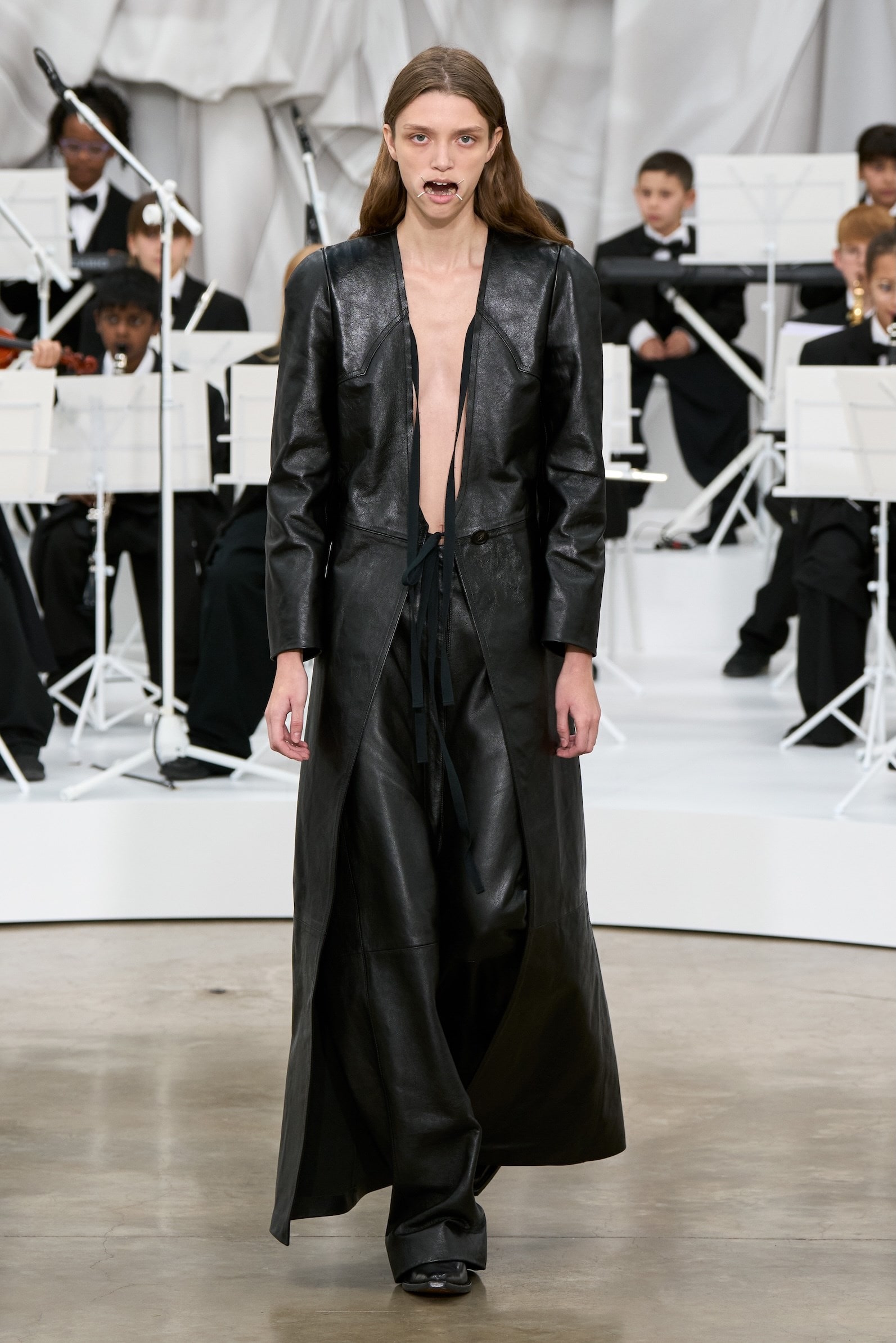
Imperfection was a signature of Martin Margiela – unravelling hems, careworn fabrics, the old, disused and forgotten rediscovered, still marked with the grime of time. There was an immediate echo of that in Glenn Martens’ debut Maison Margiela ready-to-wear show – not in the clothes, but the staging itself. An orchestra peopled with 61 young musicians, aged seven to 15, a few within their first months of music school, took to their instruments to play with various endearingly imperfect degrees of cack-handedness, grand pieces by Strauss, Tchaikovsky, Mozart and more. “They’re terrible,” one seatmate commented to me, laughing uproariously. Which was of course the whole fabulous, rousing, endorphin inducing point. Indeed, the entire audience broke out into wide grins before the first model hit the catwalk – a rare occurrence in fashion, and an auspicious beginning to any designer’s tenure. Ironically, the wrong notes hit just the right note, of tenderness and irony.





It is also, of course, rooted in Margiela’s past. Every debut this season – and there are very many – is in part a litmus test on an incoming talent’s ability to crib on their respective house’s patrimony and reflect it in new fashion. That means both actual garments, and the entire ambience around the house. Martens’ show seemed to reference Margiela’s Spring/Summer 1990 show, staged in a derelict playground in the 20th arrondissement of Paris where the children of the neighbourhood walked amongst the models. Raf Simons has stated that that show is the reason he became a fashion designer. There was also a nod to his Autumn/Winter 1997 show, where a Belgian brass band played a stretched out version of “Brother, Can You Spare a Dime?” as Margiela models decamped from buses at various points around Paris. Other designers have used orchestras, of course – it’s kind of a grandiose fashion cliché. But none quite like that, or indeed this.

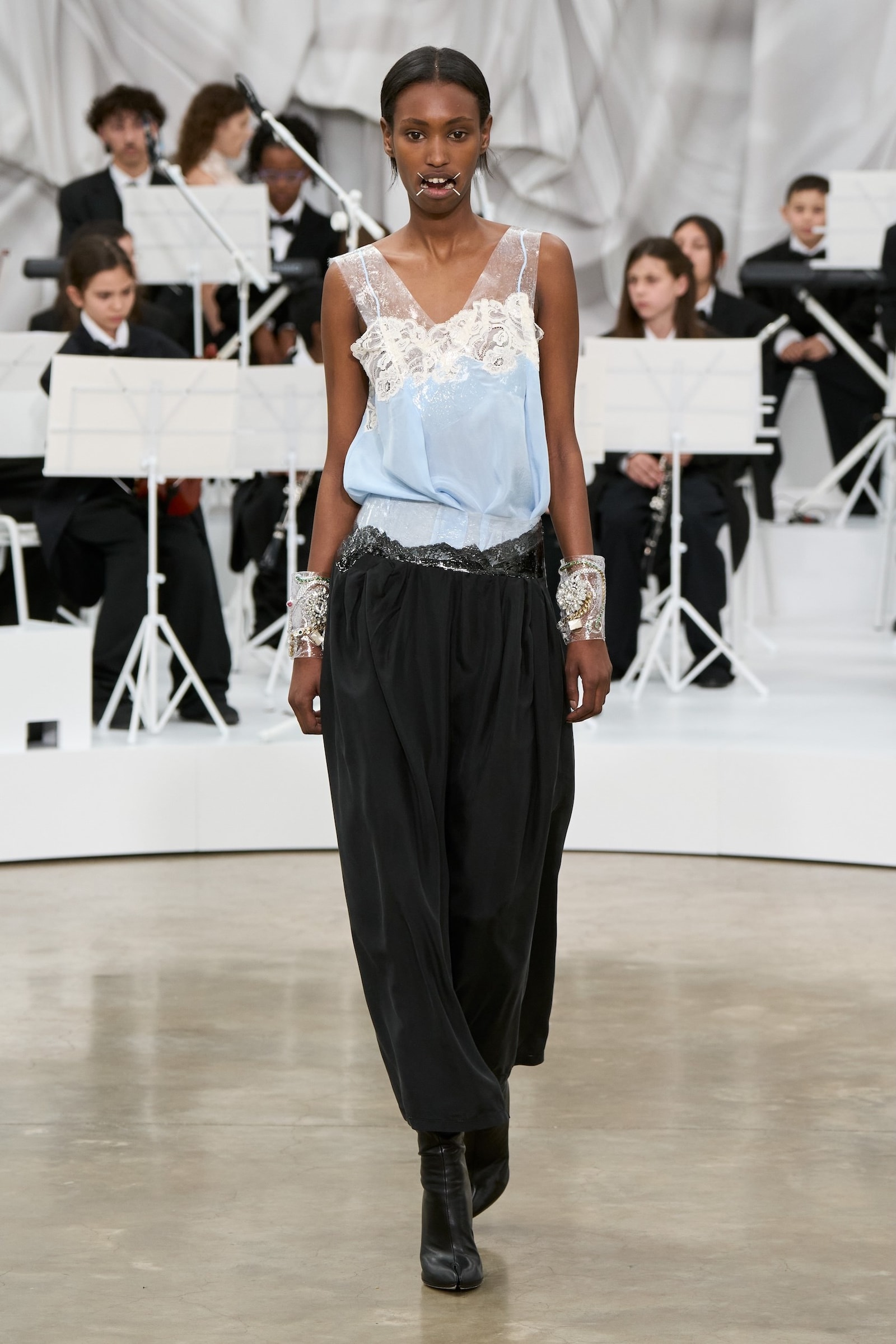

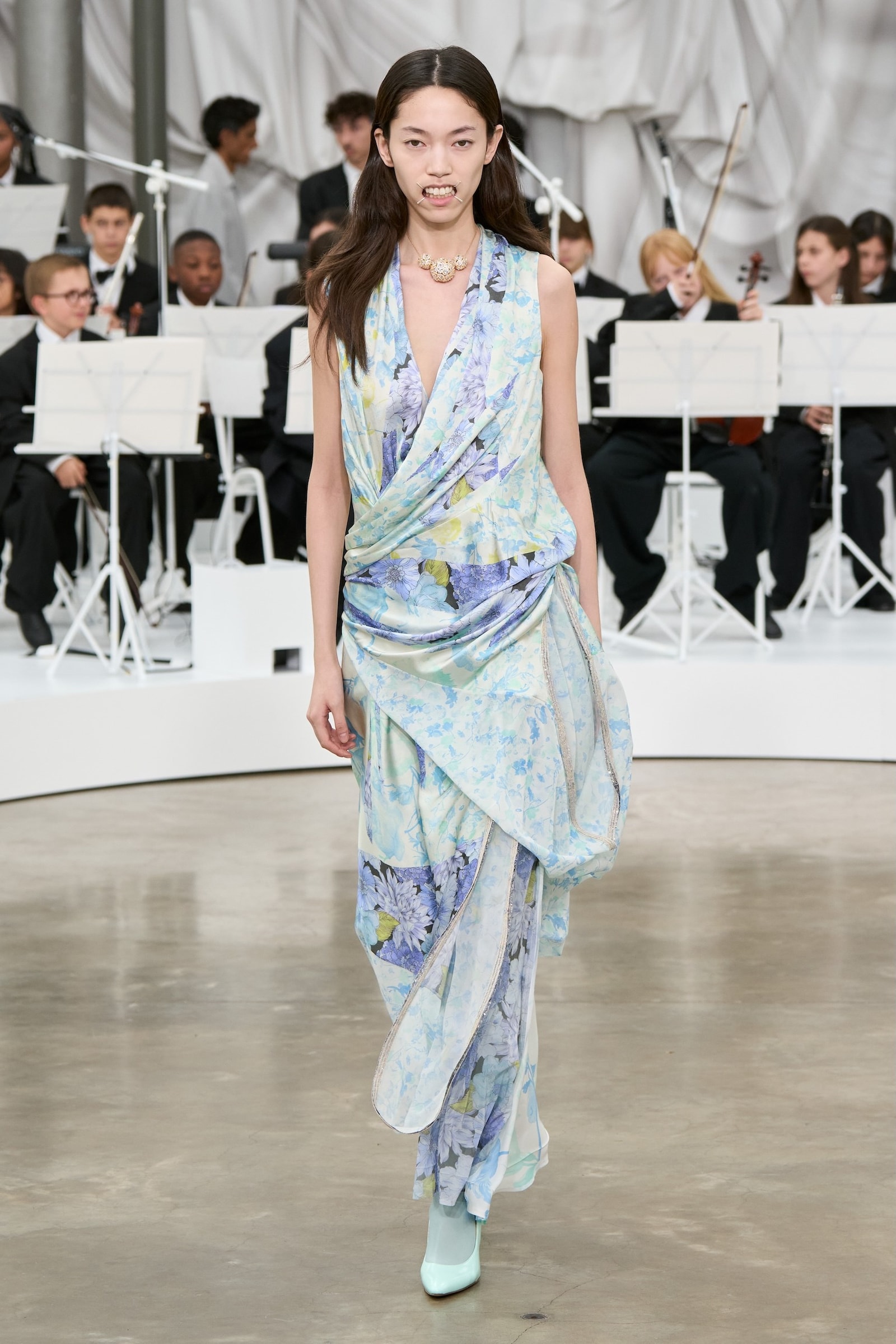
The clothes themselves equally demonstrated that Martens’ Margiela will be informed by a deep knowledge of what the house was, and is. In contrast to John Galliano, who reinvented Margiela as a reflection of his own indelible creativity, held onto house legacy with the finest of red threads (frequently, merely by being couched on a cloven-toed tabi), Martens studiously did his homework. His couture was the first indication that he had Margiela down pat, but this collection outright stated that it was equally old as new. “Re-introductions and evolutions of archival ideas,” was the phrase used – written in the pluralese that characterises the ‘Maison’ of Margiela.
Mouths were clamped open with devices that seemed to staple the lips open with metal bands that recall the label’s emblematic ‘four stitch’ non-logo. They seemed either screaming, or yawning, which could be a sarcastic nod to reactions to the recycling of Margiela’s back-catalogue, one of the most thoroughly plundered across all of fashion. But Martens is clever. While his new ideas were subtle – tailoring propositions fusing waistcoats into longer garments, differing shoulder constructions (a Margiela signature, from his first narrow-torsoed, puffed-up jacket block of 1989) and a crotch dropped to elongate the torso – they were fundamental shifts in how his clothes were made, new silhouettes and templates to build a future on.
In terms of the old, however, the references were plentiful, celebratory and bold – recycled denim, long slip-dresses crinkled around the body, adhesive tapes used as decorative devices and to bind bodies, changing volumes of pieces. Heel-less footwear was direct archival re-issues, while mixed floral prints resembled archival pieces, even if they weren’t actually there. Memories of Margiela can be deceptive, after all – some of Martens’ proposals felt like they belonged to his body of work, but were actually new. Which, in essence, is the greatest compliment you could pay – unlike that orchestra, he’s no kid messing around with old tunes.
