
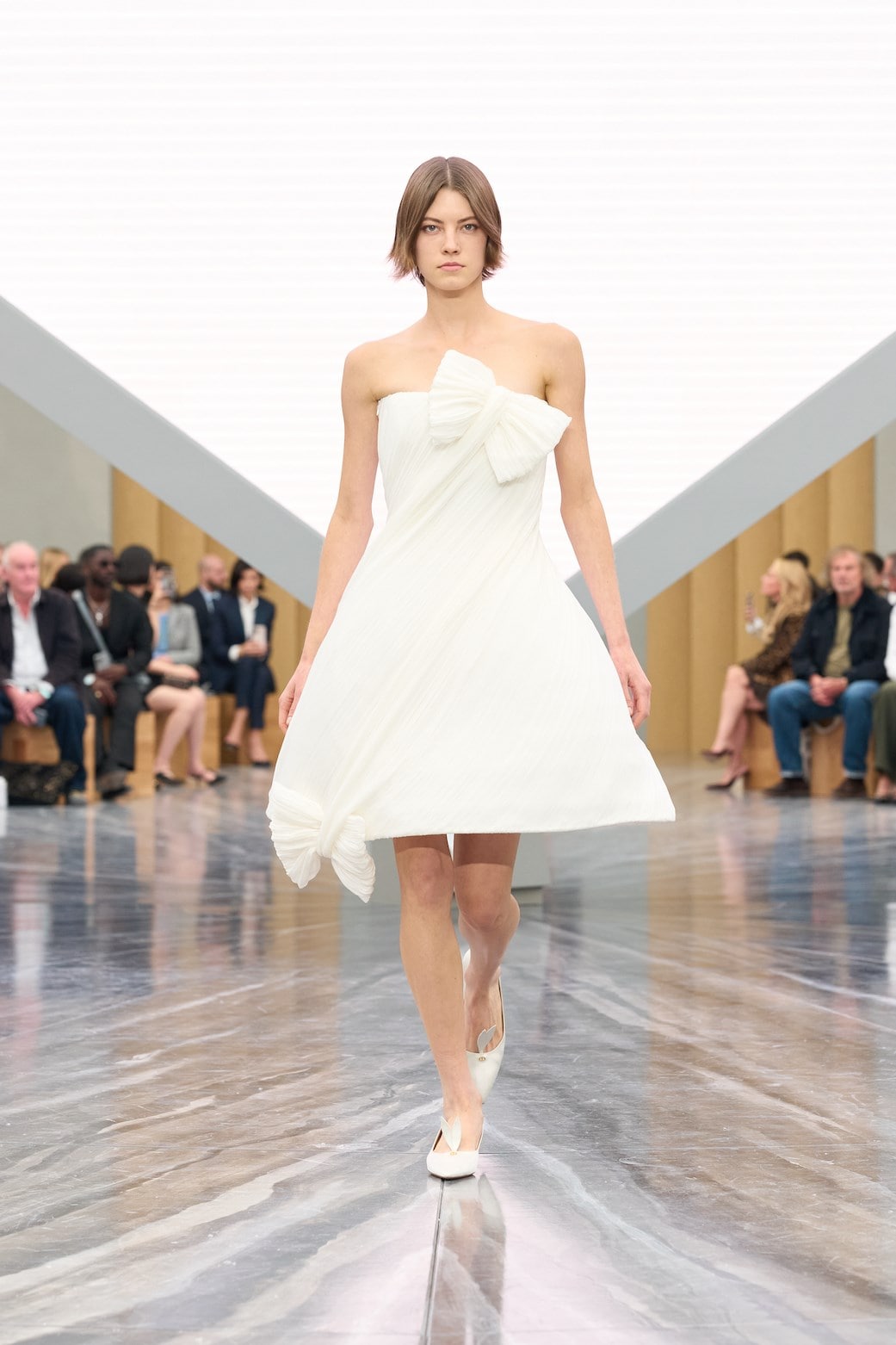
“Clothing is a type of armour.” That’s not the phrase you associate with the house of Christian Dior. In fact, it’s kind of anathema – Dior was a man who crafted dresses that transformed women into “femme fleurs” as an antidote to the “Amazones” of wartime France. But Jonathan Anderson is nothing if not unexpected. He’s certainly bold and brave, even brilliant. And he envisaged his first womenswear collection for Dior as a battening down of the hatches against the slings and arrows of today, a modern armour. “We live in a bizarre moment,” he said, backstage six hours before his show. “This is escapism.”
That sounds more like Dior. But Anderson, in essence, is bang on the money. What people often forget, in the overblown campy drama of Dior’s waspish corsets and swirling skirts, is that it is a house born out of the horrors of war, restriction, austerity. It’s all, perhaps, a counterintuitive reaction to that – an ideological armour, a retreat into nostalgia to obliterate the present. “Dior was born out of a time of trauma,” said Anderson – seemingly making a connection between the then and now, and the relevance of his Dior for today. “From horror, to beauty.”
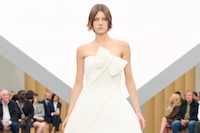
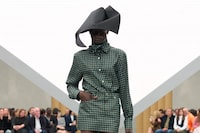

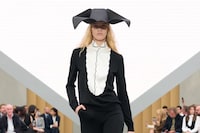
And Anderson’s Dior was often beautiful – unconventionally, unexpectedly, occasionally unabashedly. Anderson embraced what he called the “overt prettiness” that characterises the maison, Dior’s references to the 18th century and to the sweetness of the belle époque – both were there in panniered lace dresses, or gowns smothered in three-dimensional forget-me-nots, or knotted with great bows, or constructed like abstracted hydrangea blooms of pleated satin. Yet alongside that was strength, particularly forceful tailoring which for Anderson was a reference, again, to hardship. “That’s why Dior goes to something very tough, as a structure,” he says – think about carapaces of tailoring, and the mirage of Dior’s mid-century ball gowns that appeared light as air, but had a core of steel and could, quite often, stand up by themselves. “There’s something resilient about Dior,” he commented.
Resilience can be material, but also philosophical. Dior endures. Of course, there was reference to the house’s history – references that displayed a deep knowledge, paradoxical considering Anderson was only appointed sole creative director, officially, in June, and said he had worked on this collection for just two months. The opening film, by documentary maker Adam Curtis, made that explicit – it addressed “the elephant in the room,” according to Anderson. It whizzed together fragments of Dior’s beautiful past with horror films – Princess Diana in Galliano’s 1996 slip dress, Marlene Dietrich in Dior in Hitchcock’s Stage Fright, the meaty hand of Gianfranco Ferré adjusting a swathe of organza before his own début. In an increasingly frenzied scramble, those images were projected onto a vast inverted pyramid before whizzing down into a Dior shoebox beneath, like the traps from Ghostbusters. The spectres of Dior’s past addressed, then suppressed. Clean slate, new start.

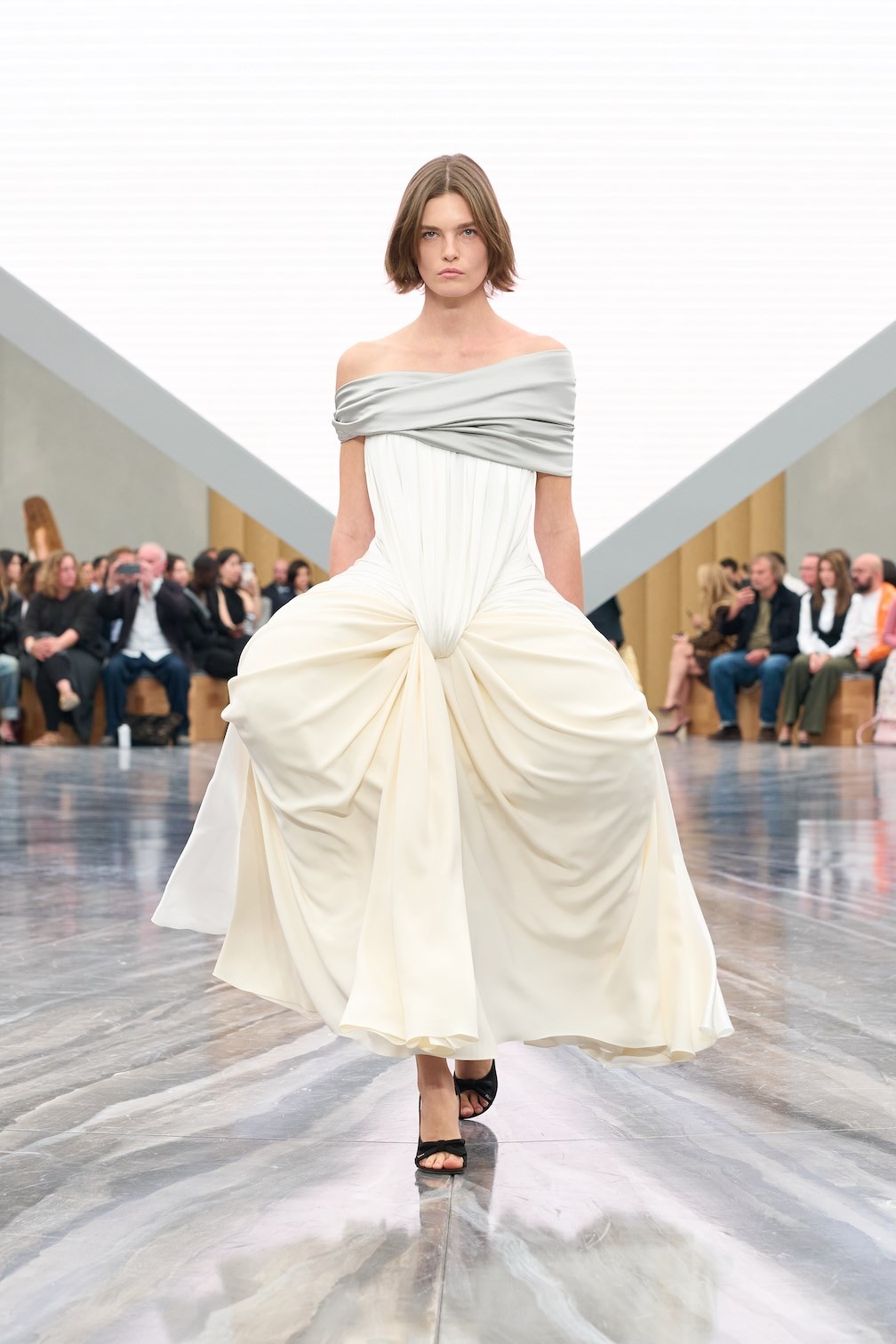

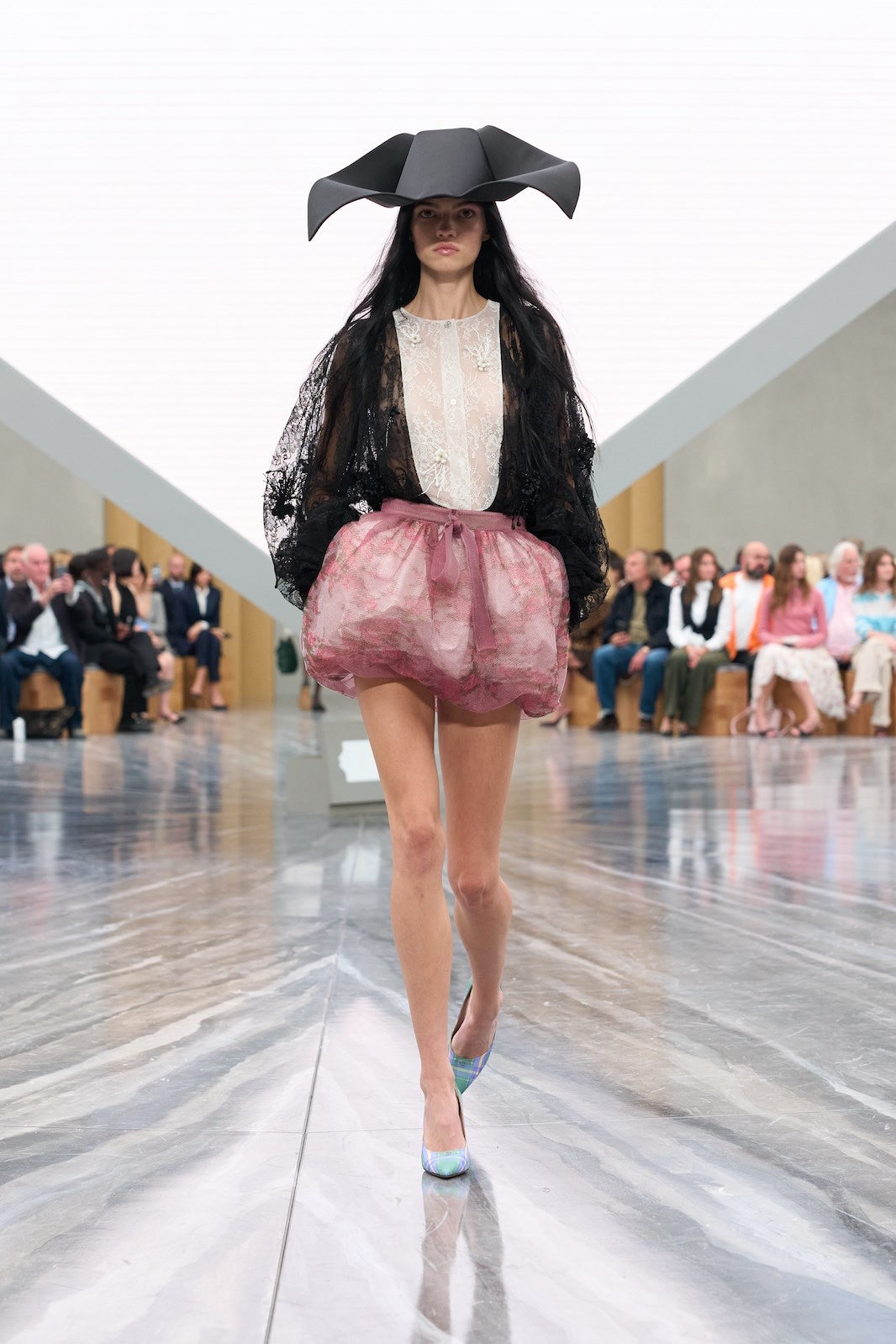
That said, of course Anderson did the Bar – it’s expected, demanded even. But he shrank the suit, the entire length of the hyper-minimised jacket and skirt equalling the original jacket’s measurement – the new look suddenly seeming new again. “I got all the French reviews of Dior – and some of the clothing they were proposing were seen as grotesque, and radical. It made newspaper headlines when he changed hemlines,” he commented. “That’s drama to me.”
Other notions of history were less known, more abstracted. A dress drawn from Yves Saint Laurent’s tenure surrendered a cleaved highwayman collar of scalloped black lace. A section of a 1953 collection – “12, 13 looks” – became twisted pleats around the body. And there were other echoes and shadows of the past passing over these outfits, but nuances rather than specifics, scrambled to give them a modern relevance. There was also a dialogue, back and forth, between genders – the vast pleated shorts in Anderson’s menswear collection, inspired by Dior’s 1948 Delft ballgown, were translated back to womenswear in a dizzying back and forth, traces of that passage between times and bodies reshaping their form.
Armour, of course, comes in many forms. “I really wanted to look at how we could do structured tailoring,” Anderson stated, and there was an armourial sense to Anderson’s iteration of the Bar jacket, latterly lightened and given an elasticity, here sculpted around the form. Its technique, nevertheless, was new – “how do we modernise?” was another question he posed to himself and the Dior ateliers.
Anderson has ambition – entirely healthy, and thrilling. Like Christian Dior himself, he wants to make the world look new, not just Dior. “It’s fashion. And it is a couture house, and therefore fashion has to challenge,” he said. Anderson certainly challenged our perceptions of Dior. He – modestly – referred to the show as “an opening chapter,” but his vision for Dior already seemed consolidated, which was also exceptional as it was multifaceted, many-layered. “A woman can be vulnerable, and she can be strong. And she can embrace drama,” he said. So, it seems, can Anderson. This was a bravado, sensational fashion show for any house. At the house of Dior? It felt revolutionary. In the grand house tradition.
