
Yves Saint Laurent was a designer shaped by his desires. I don’t necessarily mean sexual – although, frankly, there was plenty of that in both his life and his work. But rather that in his fixations and obsessions, there was always a fetishistic quality. How about the Oedipal complex of his constant resurrection of his mother’s wartime wardrobe? Or his love of the work of Marcel Proust, so intense that Saint Laurent and Pierre Bergé actually bought a Normandy château (the choice summer retreat of Proustian high society) where every room was themed after a different character of À la recherche du temps perdu. There’s a story that one day, a maid cut a swathe of calla lilies for a vase rather than the appropriately Proustian Casablanca lilies. Saint Laurent decapitated every one of them to demonstrate his displeasure. L’Amour fou.
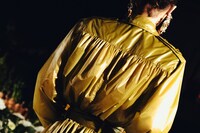
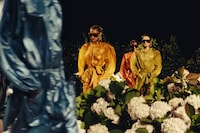
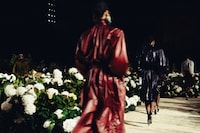
Anthony Vaccarello, in turn, has a fetish – his is for Yves Saint Laurent. At least, it’s his fashion fetish, his shows serving to demonstrate his compulsive knowledge of the details of Saint Laurent’s life and work, his dedication, a mania even. As with his recent shows, his Spring/Summer 2026 Saint Laurent collection dissected a selection of Saint Laurent preoccupations – Proust being one, leather being another, the others Saint Laurent’s bold shoulders, his love of filmy mousseline, and the strict lines of the trench coat translated from the masculine to the feminine. All are couched in Saint Laurent lore and legend – how about that leather jacket, to begin with?
“Did Saint Laurent ever do a perfecto?” a seatmate whispered to me, as I frowned. Bien sûr. In fact, he did the first one, the first leather jacket ever shown within an haute couture salon, for Dior in 1960. He called it Chicago. It was at a time when blouson noir was a term for hooligans who would mug couture clients, rather than a garment they would dress in – and it epitomised the start of Saint Laurent’s revolution, which would reshape fashion, of bringing the street to the elite, rather than the other way around.

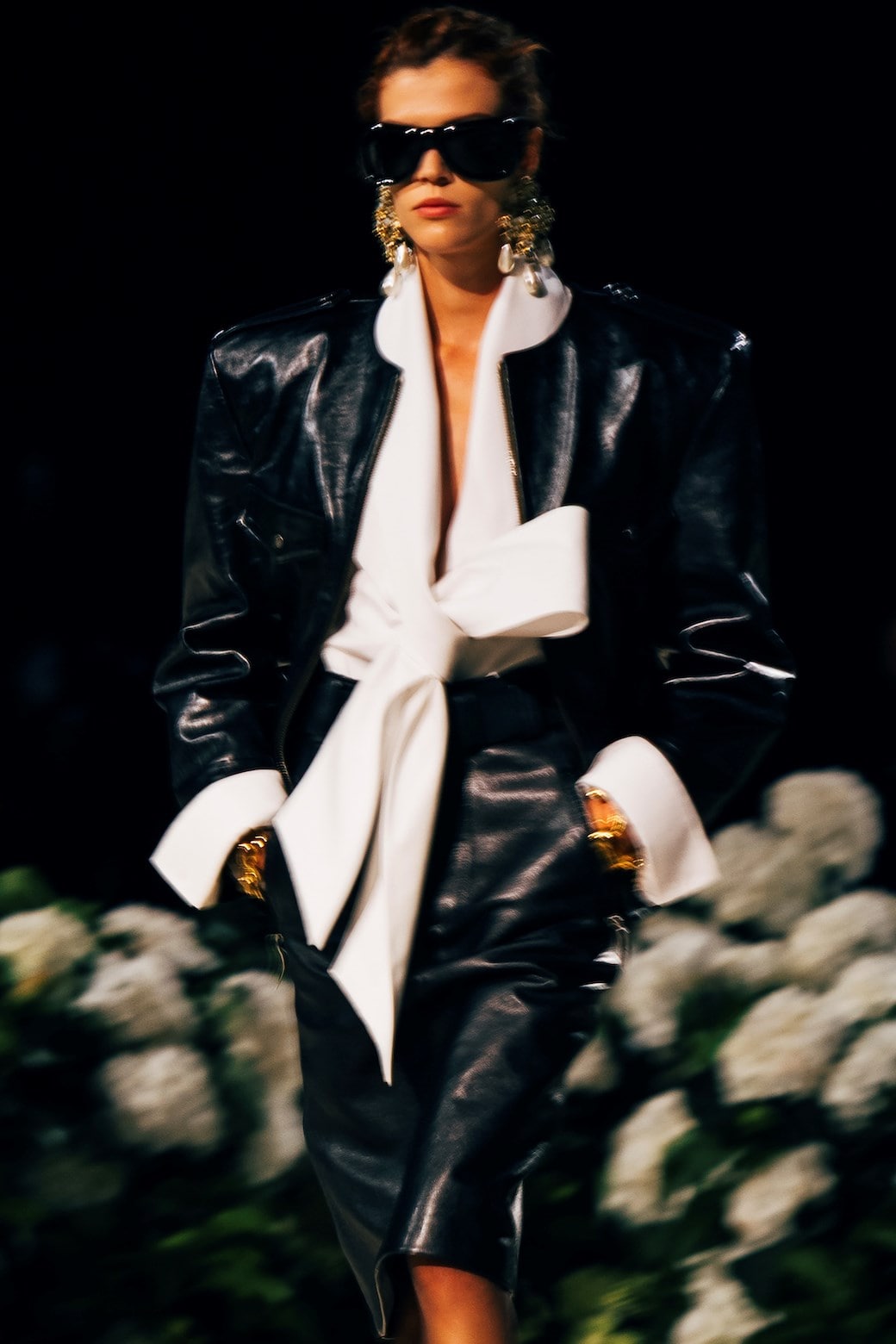

Here, those leathers, cut wide and buckled and zipped in gleaming metal, butted up against crisp white blouses, gestures to the bourgeoisie subverted – like Catherine Deneuve in Belle de Jour, an inevitable reference when you think of fetish and Saint Laurent. From leathers, Vaccarello slipstreamed into a reimagining of the kind of neat belted trenches Yves Saint Laurent dressed her in for that role, albeit translated into filmy nylon, a gesture to the chiffon blouses he scandalised the couture establishment with in the 1960s. The first black leather jacket, the first bared breasts, here coloured in the desaturated, bruised hues of seventies Rive Gauche – tobacco, olive green, a sickly raspberry.
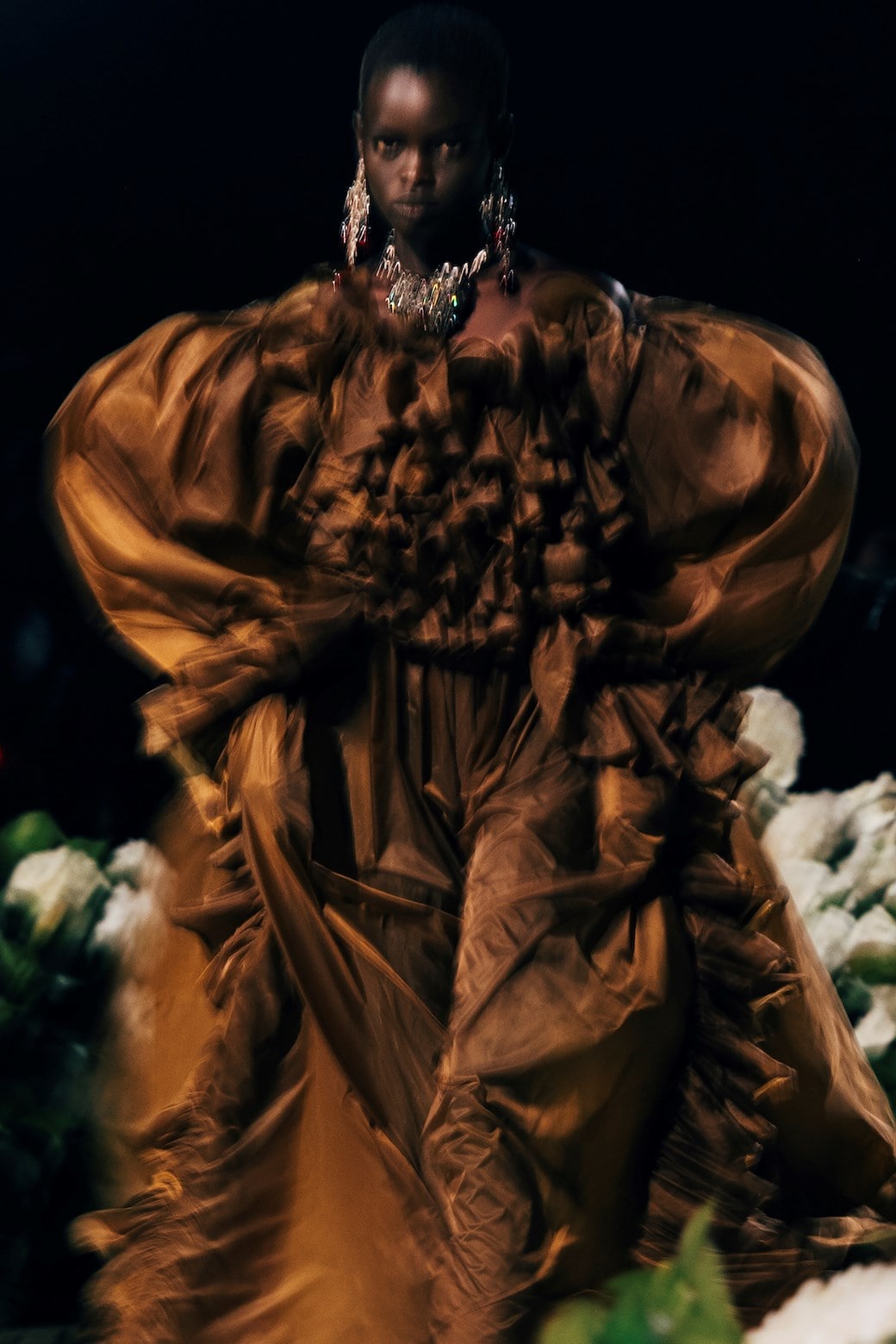
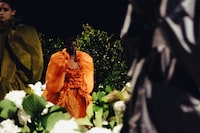
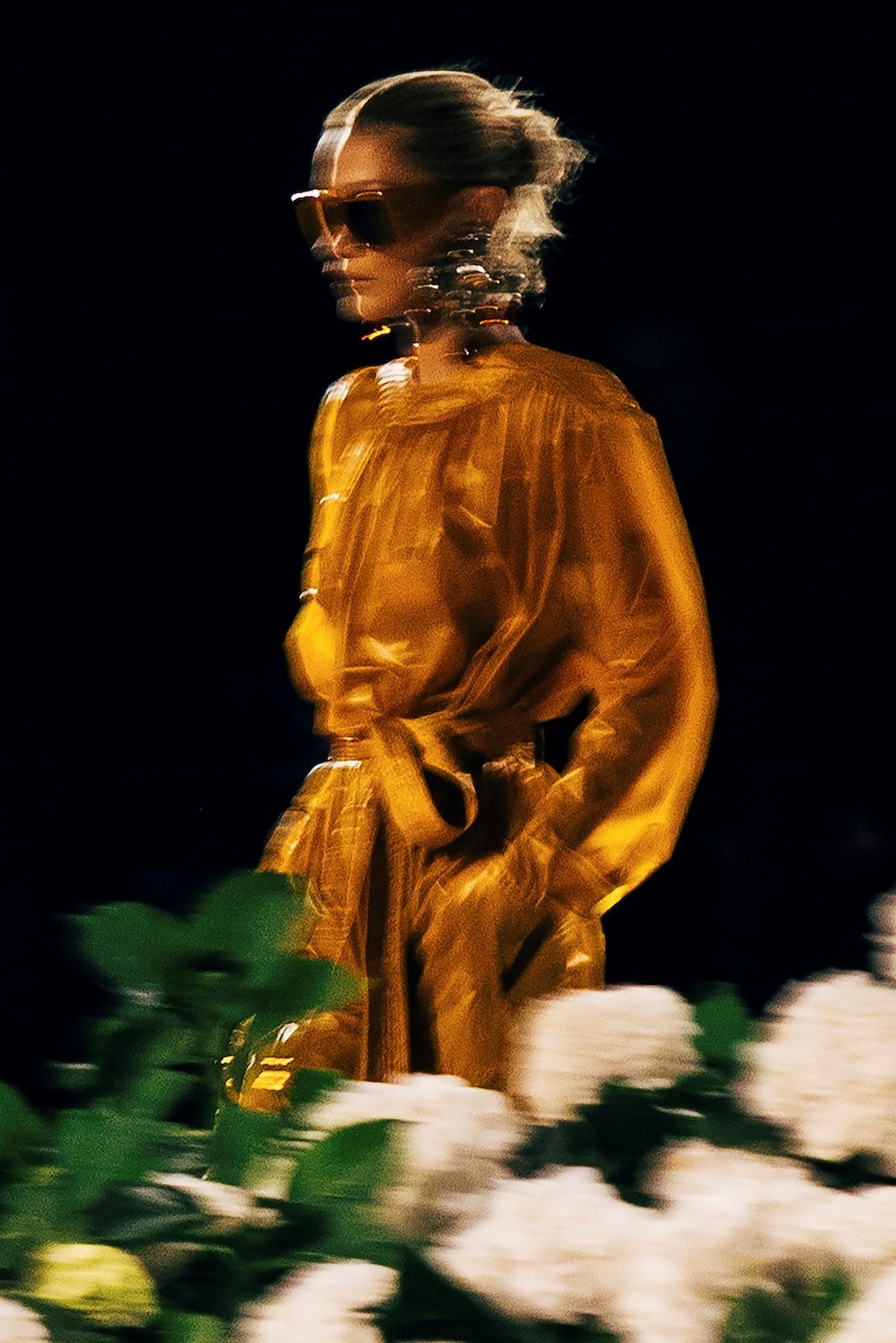
And, finally, Proust – in 1971, Saint Laurent created costumes for a costume ball devoted to his heroines, while later that decade he surrendered entirely to historicism with billowing dresses of taffeta, which would become a signature, an overt expression of his obsessive love for that writer’s work. Here, Vaccarello reinvented those dresses – rather than executing them again in silk taffeta or faille, with a grandeur belonging to that past, he chose more nylon, their billowing shapes suddenly diaphanous, strikingly modern. That reality that obsessed the radical young Saint Laurent, married with the couture grandeur of his later years. Those dresses streamed behind the models as they fled through the night and into the banked hydrangeas arranged, of course, into the giant Cassandre-devised YSL logo. And the colours were sublime – more of those burnt umber browns, a tart orange, emerald and petroleum black, and a distinct shade of purple Saint Laurent used on lipstick in the 70s. They were impeccably orchestrated, a careful symphony. Because you’d better not get Saint Laurent colour wrong.
Saint Laurent is an extraordinary legacy – it’s one that’s still desirable today. Vintage Rive Gauche does swift business, as do his couture pieces. It would be easy for Vaccarello to retreat into that, given our love – and his love. What he opts to do, however, is far more clever. He makes these clothes not desirable through a mist of nostalgia – they are not the lost times we are searching for – but rather because, through collective amnesia, they once again feel vibrantly new. That is especially to a generation for whom Yves Saint Laurent is a faded photograph in an obituary they never read, and for whom Saint Laurent is a name on a perfume rather than a fashion idol. Yet, for fashion fetishists such as myself, the satisfaction of Vaccarello’s Saint Laurent is in both the precision of the reference, and the resuscitation of a powerful notion of a modern woman whose identity feels innately keyed to that that first entranced Yves. That’s who you want to be, when you see these shows.
