
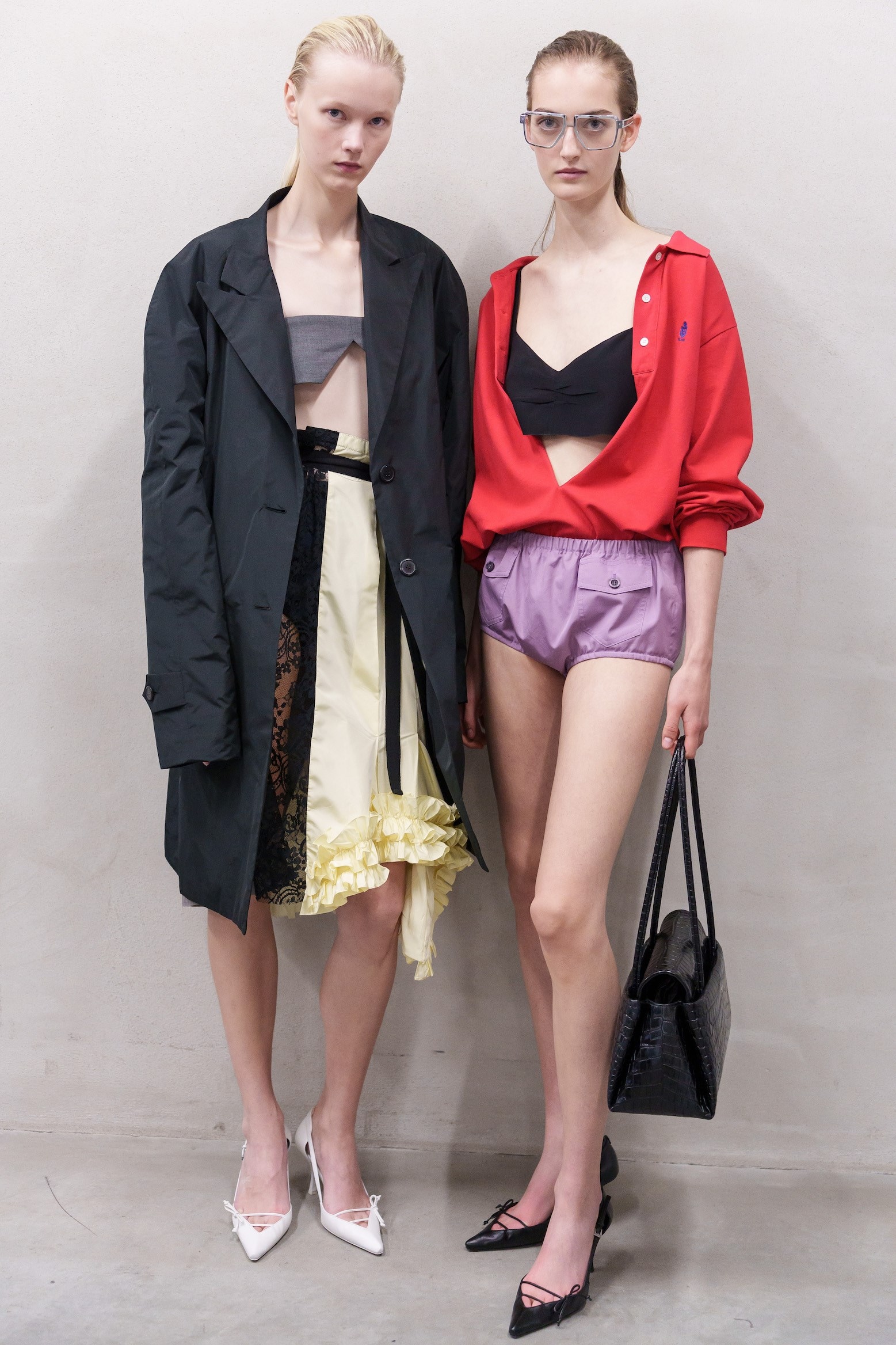
What is new in fashion? It’s an idea that is obsessing the industry even more than usual in the sea-change that constitutes Spring/Summer 2026, with an almost ceaseless shifting of designers between different houses, reinterpreting their definitions and reinventing their identities. Yet a search for the new is a notion that has always sat, more widely, at the very root of what Miuccia Prada and Raf Simons do – both separately, and now together. “A new elegance” was how Miuccia Prada described their latest Prada collection backstage, while Simons stated that “We always hope to offer something new.” What they mean isn’t newness in terms of fashion’s pursuit of novelty or meaningless surface manipulation to generate a grabby need, but rather something genuinely different, in the meaning and meaningfulness of their clothes.
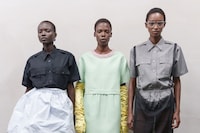
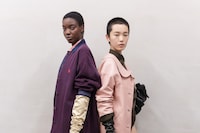
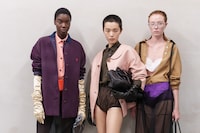
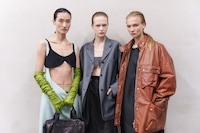
Elegance was truly the term, evoked here as sharply and strongly, albeit unexpectedly, through humble drill uniforms as quasi-gestures to evening dress. The latter was most directly conveyed through long opera gloves in a dazzling spectrum of satins and kid leathers, a simple and direct signal of formality, and through tiny drawstring evening bags, as well as fragile chiffons, silk georgettes and filmy lace.
Uniforms, however, are something that have fascinated Prada for decades. Before she began designing clothes herself, Miuccia Prada used to wear service uniforms – nurses’ dresses, lab coats – utilitarian antidotes against the excess of the 1980s. She mixed them with Yves Saint Laurent. Simons loves uniforms too – school uniforms, sometimes, and the subcultural uniforms of disaffected youth always. And his father was a night watchman, “so uniforms, for me, have a romance,” he said.


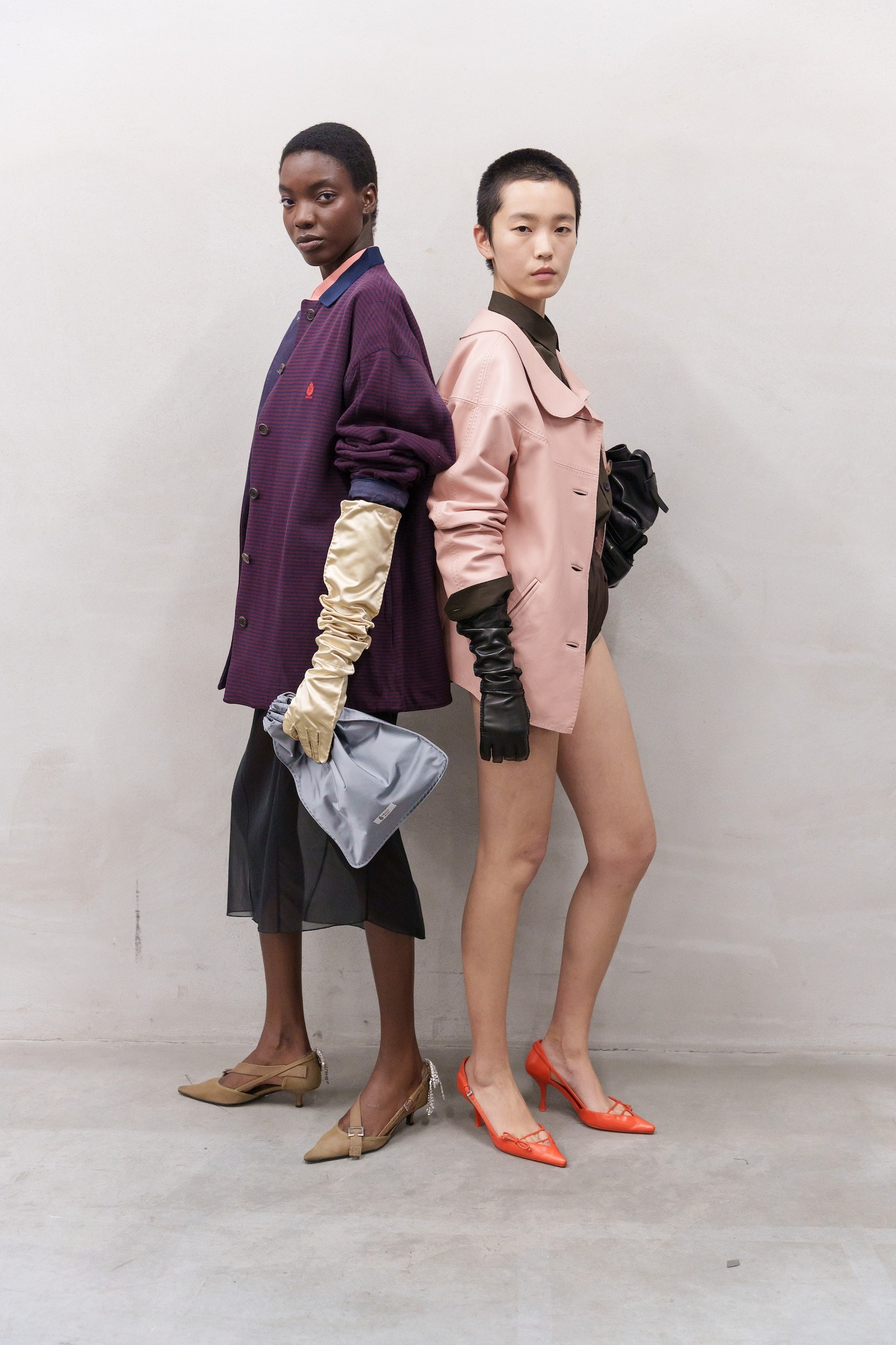
Prada uniforms both opened and closed the show – “like the Fondazione Prada’s,” said Miuccia Prada with a laugh. She was wearing a long white shirt dress like a doctor’s coat. However, the Fondazione Prada’s flap-pocketed drill shirts generally aren’t worn with evening gloves, nor duchesse opera coats, nor a pear-cut earring the size of a gobstopper in aquamarine and rose-pink morganite. That’s big on the body, but tiny within the vast thousand-seater void of the Deposito of the Fondazione Prada, yet somehow, you wound up fixated on that tiny detail. As you did often in this great show, in the crystal embroidery on a khaki drab heel or dirndl top, the top-stitching on a glove-leather jacket, or indeed in the vibrant, painterly contrasts of colours – dove-grey with pistachio, scarlet and violet, mint and satsuma. Then, they were interrupted with great black dresses, skirts spreading wide, palette cleansers and must-haves in one.
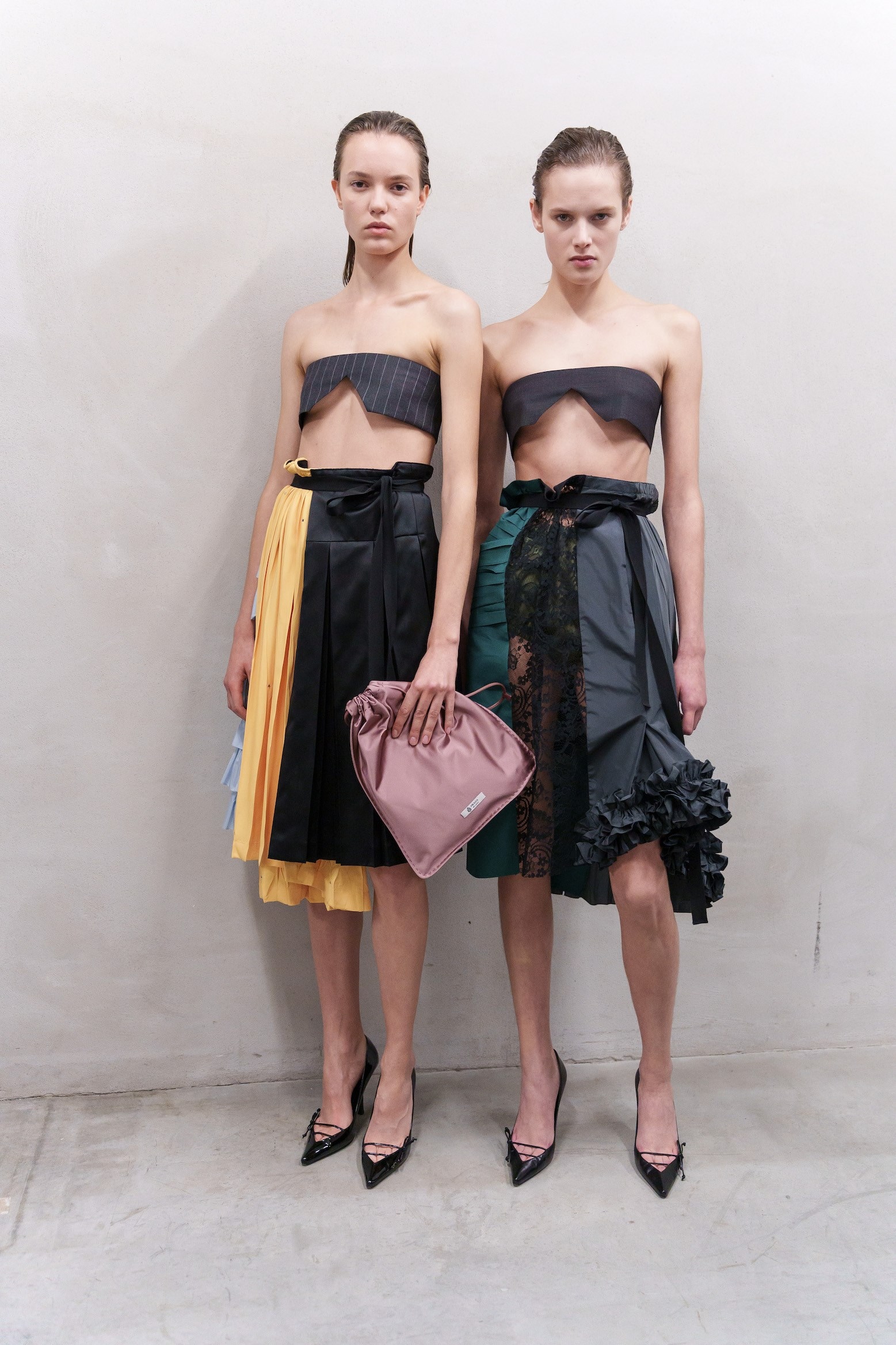
So, the elegance felt new. Yet there was a newness, too, in the actual structure of many of these pieces, in their rapport with the body. What Prada called skirts – lapping the lower half of the body in cloth, they were accurate alright – were suspended from the shoulder rather than the waist, moving around rather than against the body. Brassières eschewed function, becoming sketched silhouettes of cloth against the skin, like shadows. And within, typologies of dress were collaged and contrasted. Miuccia Prada called them “compositions”, and like music, even in their dissonance, a harmony could be found. That idea was perhaps most directly conveyed through skirts that patched together different fragments of fabric – a ruffled panel, a pleat, a piece of lace – into a glorious melange that danced around the body. For Prada and Simons, that was about freedom. “We started from a sense of freedom – of expressing this through clothes. There is the licence to combine different elements, to compose,” said Simons. “But also freedom as a state of mind.” “Clothes that can shift, change, adapt,” added Prada. “In the combination of the different elements, in this idea of composition, there is a choice and freedom, authority and agency for the woman wearing them.”
The woman wearing lots of this, it felt, would be Miuccia Prada herself. In an era of celebrity influence, she remains the greatest advertisement for the clothes bearing her name. She loves gloves, and often carries her accoutrements in a drawstring bag for evening, which came here in juiced-up shades, in nylon, slipper satin or leather. In the end, the greatest compliment is to say that this Prada collection looked like, well, Prada. Which is to say it looked bold, it looked brave, and it looked truly, elegantly new.
