
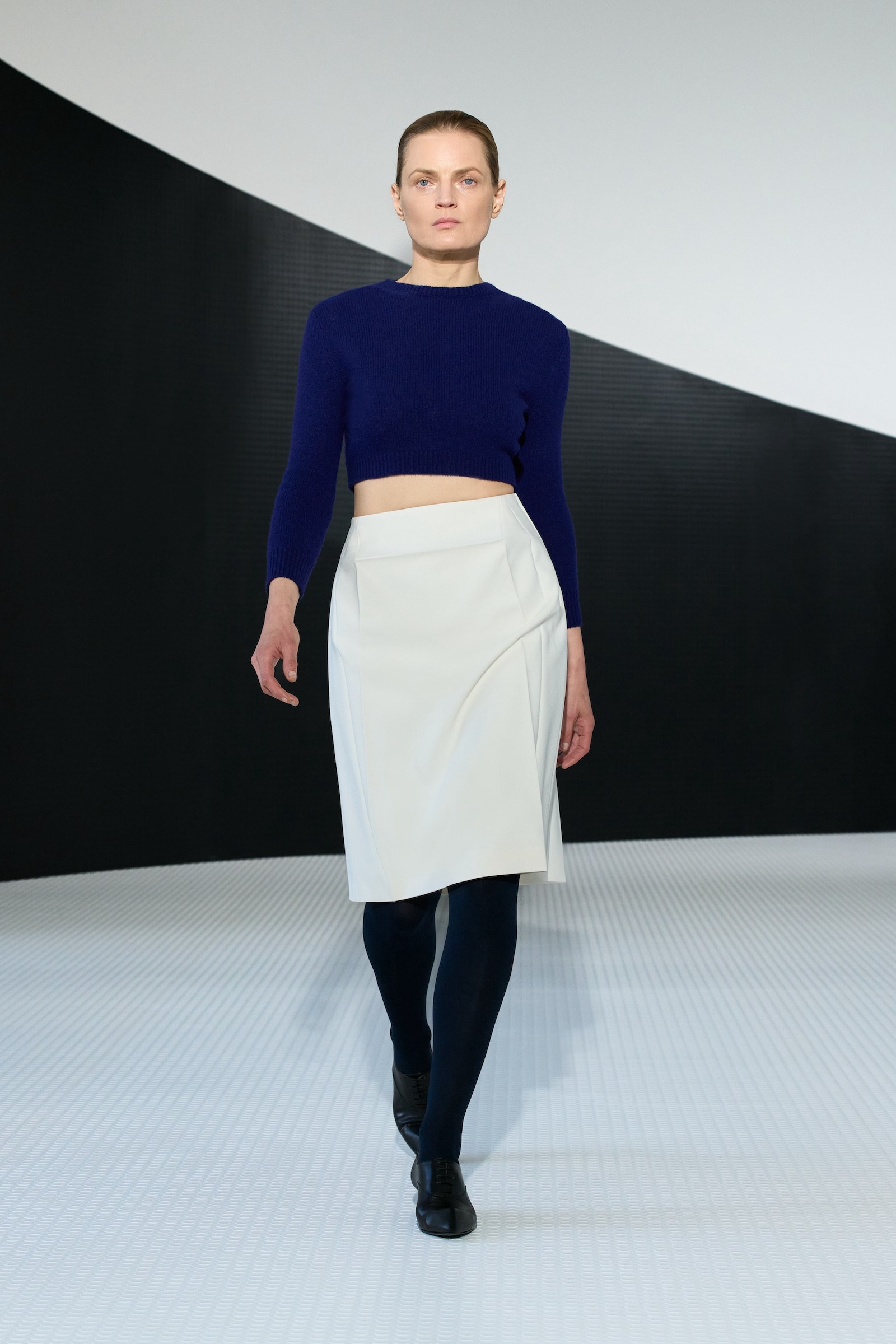
When you talk about modern fashion legacies, that of Jil Sander is a tricky one. Mainly because it’s both everything and nothing. A minimalist who helped shape the direction of late-1990s fashion, a period subject to sporadic revival for the past 15 years or so, Sander’s resolutely stripped-back perfectionism has proved tricky to emulate without hollow imitation. Plus the woman herself, now 81, is very much alive and kicking, and has ping-ponged in and out of the fashion scene since she last left her namesake brand in 2013. Which was, itself, something of a game of fashion squash: she first resigned in 2000, rejoined in 2003, left again in 2004, came back again in 2012, before that final goodbye in 2013. Got that straight? Perhaps understandably, over the same time period, the meaning of Jil Sander the brand has become somewhat blurry under a succession of creative directors of varying success.




By contrast, Sander’s latest creative head, Simone Bellotti, started with resolute, precise focus for his first Sander show. A black catwalk sliced sharply through the brand’s white headquarters on Via Luca Beltrami in Milan, a definitive statement, like a line in the sand. Rather than a metaphorical no-go zone, though, this felt like a break with recent history – here’s the stop, and a new start. And the new start? Taking us right back to where Sander began – not just in the building, but the imagery.
The first model in this Spring/Summer show – the first glimpse at Bellotti’s vision – was Guinevere Van Seenus, who featured in a Sander campaign photographed by Craig McDean exactly 30 years ago. Art directed by Marc Ascoli, the most memorable images are, probably, Van Seenus bisected by an elaborate pane of wallpaper, in one just her head, the other a black-clad body. She also wears a turtleneck in one shot, and a starchy high-buttoned white shirt and blazer in another. Those images still resonate – they’re pinned to many a designer moodboard.

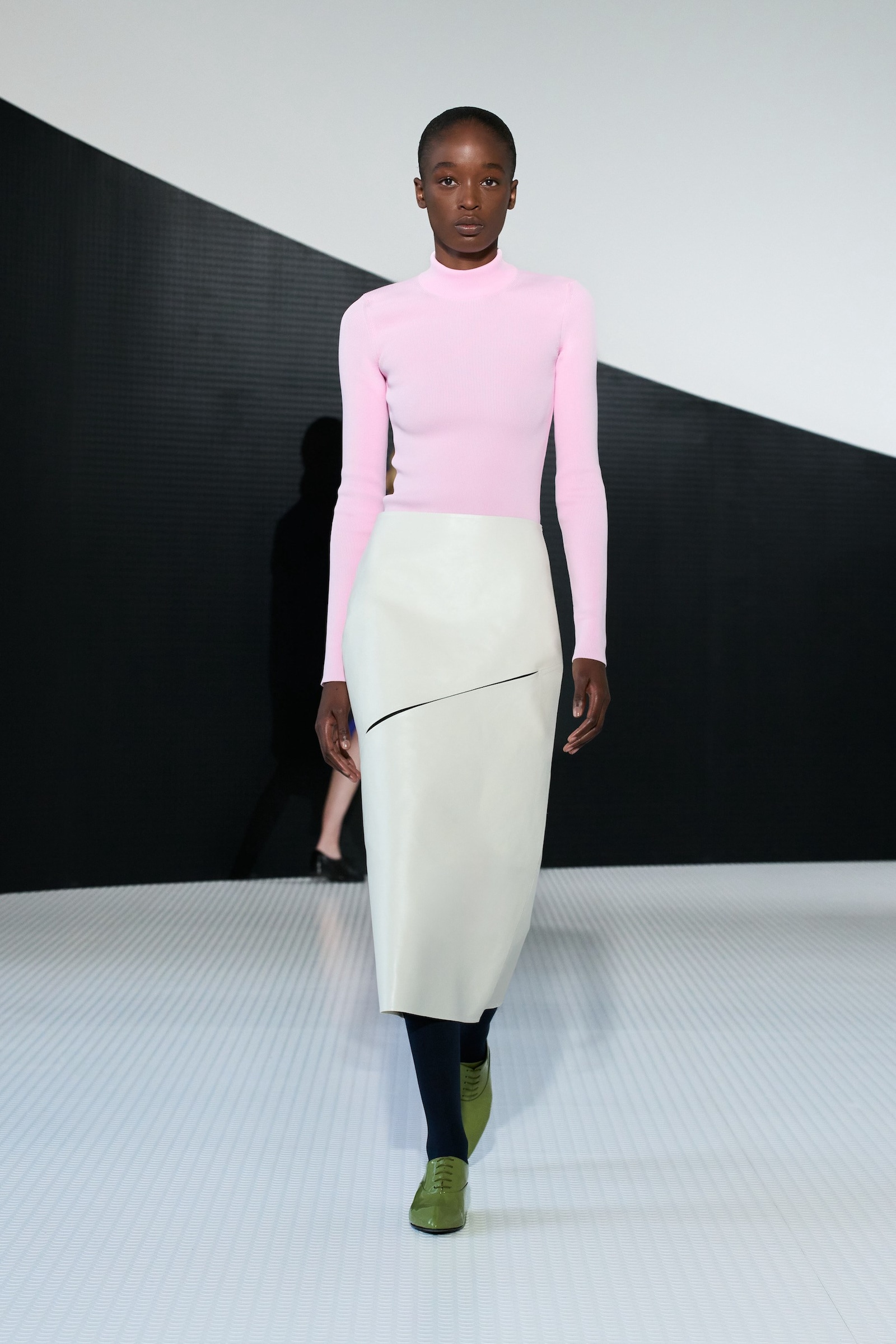

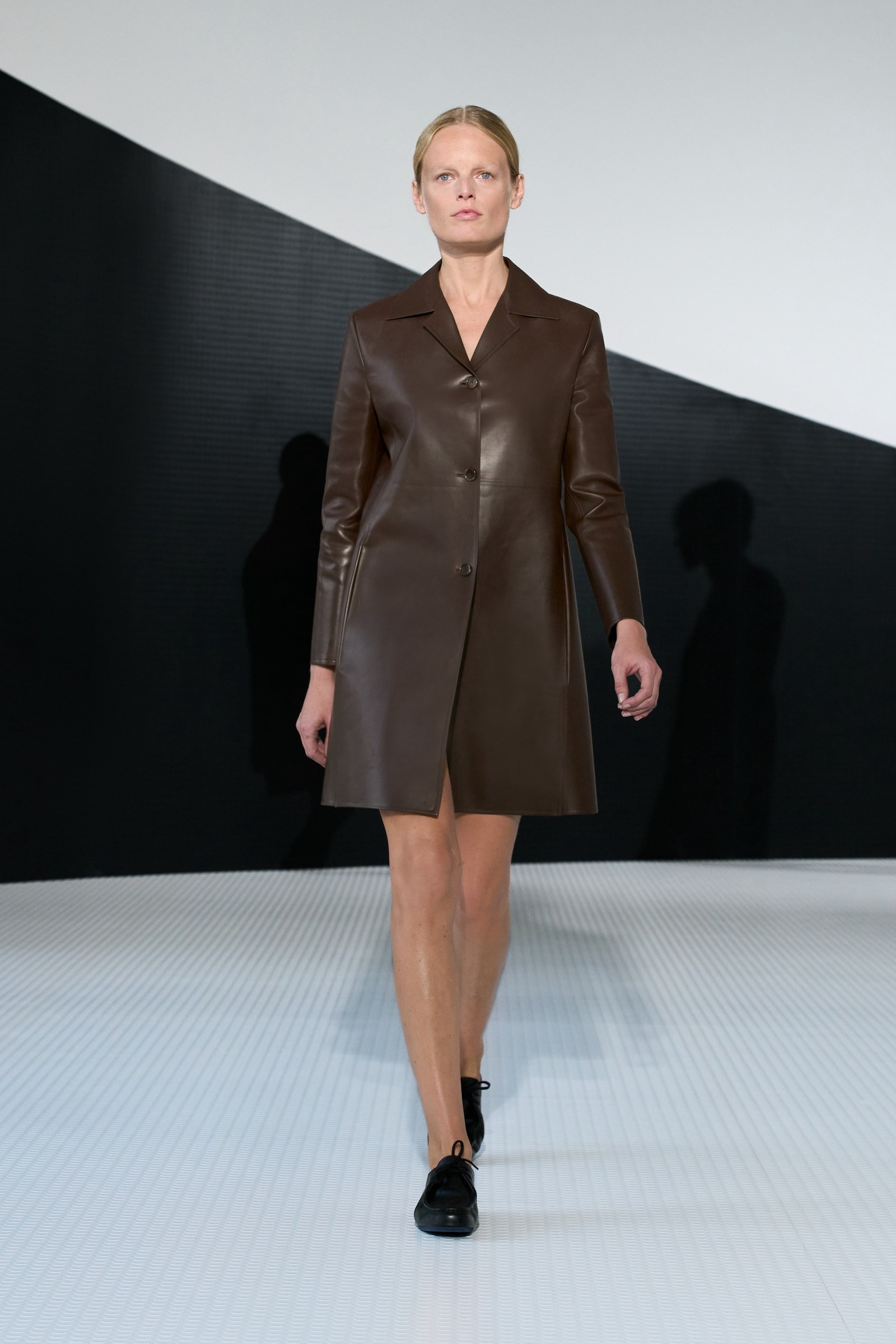
Which is all well and good. But how to translate that to clothes? Bellotti did it literally – those turtlenecks, that still looked great, and high-buttoning tailoring that felt resolutely 1990s, albeit in a manner that suddenly looks intriguing, old enough to seem new – but also ideologically. He nodded to art antecedents, notably Lucio Fontana and his Spatialism, canvases slashed, where rather than applying decoration to a surface, the art was created with pure cut. It’s often difficult to write about clothes like these – how to rhapsodise about a white cotton shirt or a grey tailored jacket? But they don’t need much conjecture. Everything looked clean, modern, meaningful. Stuff you’d want to wear, the kind of person you’d like to be. Clear headed, focused, dynamic – everything Sander sought in her own designs, but without a whiff of 90s nostalgia. Because, in all honesty, the silhouettes of those vintage clothes don’t really work on today’s bodies – some of the fabrics feel fusty, the finishes a little off. Instead, they were reimagined for now. And Sander’s nickname, the queen of less, was done duty – clothes were carved out and reduced, decoration stripped, seams shifted. Jumpers even cropped – a little less, making them a little more interesting.
Sounds like the perfect recipe for a brand based on precisely that notion of lessness as moreness. Which is, of course, a hoary old fashion cliché – maybe the mustiest of them all. Yet it’s one Bellotti embraced, honestly and wholeheartedly. He’s good at doing that – in his prior gig at Bally, he created collections based around cowbells for a Swiss brand, a notion whose obviousness should’ve been eye-roll inducing but was instead intriguing, exciting and new. Everything, everywhere, seemed to have been done with purpose and – most satisfying of all – conviction. Both convinced, and convincing. Bellotti wasn’t proposing a view of Sander, a possibility of what the brand could mean now – he was stamping it out with total and unequivocal surety. Here’s what Jil Sander is, right now. After years flailing, it was satisfying to see – and in a season of fresh starts, this one felt stingingly, exciting so.
