
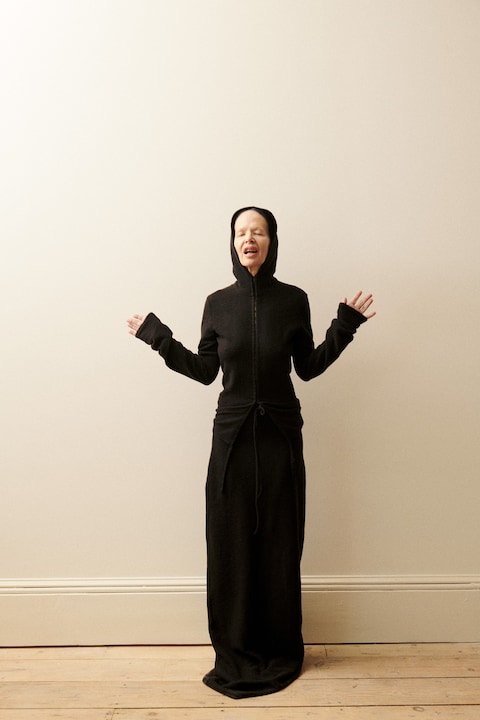
New York-based designer Colleen Allen and radical artist Kembra Pfahler discuss their collaboration – a living manifesto where body, garment, and belief find tempo within the unruly rhythms of womanhood
For her Autumn/Winter 2025 collection, New York-based designer Colleen Allen’s ethereal world of feminine resistance and spiritual enquiry found its natural counterpart in Kembra Pfahler – an artist whose radical performances and painted body prints incisively fuse persona, politics, and physicality into a gritty feminism. Their collaboration became a mutual act of becoming: the resulting lookbook moved beyond simple image-making and into a living manifesto where body, garment, and belief found tempo within the unruly rhythms of womanhood.
The two were introduced through mutual friends, Leopold Thun and Angelina Volk at Emalin Gallery, who brought Allen to visit Pfahler’s New York studio, a now-iconic space where every surface is painted a visceral shade of red. “It was this really magical experience to go see her in her space,” Allen recalls. “Every object, floor to ceiling, was covered in the same colour. It was totally immersive.” This resonant first meeting embedded Pfahler’s presence in the designer’s collection, long before any formal collaboration began. “She was just in the back of my mind the entire time I was designing,” Allen says. “Her energy stayed with me.”

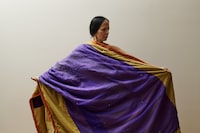
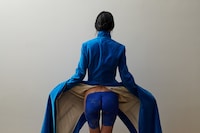
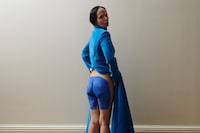

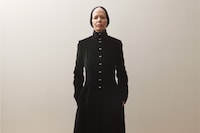
If Allen’s designs have always centred on the reclamation of body, both in flux and in stillness, Pfahler inspired garments that could nurture further contradictions: structure and exposure, softness and defiance. Slits were cut high into the back of stand collared velvet coats, bodily volumes built to cloak or reveal the wearer as they wish, and a palette of red, black, and electric blue echoed that of Pfahler’s painted prints. “She does these paintings where she paints her butt and sits on the canvas,” Allen explains, “and those colours were always in my head.” Even the slit-back bum-revealing coats were “literally cheeky, but completely intentional.”
When the lookbook shoot finally took place, Allen set aside the end of the day for Pfahler to allow unrestrained space for improvisation and transformation. “Kembra has such an innate physical presence,” she reflects. “The clothes just changed when she put them on.” If certain looks had been planned – like the vivid reds and blues, the high-slit coats – much of the session unfolded intuitively: Pfahler responded to the garments with an instinctive physicality, altering how the clothes took shape with every movement and pause. “Everyone in the room was completely transfixed,” Allen recalls. “It was the kind of magic you can’t plan.”

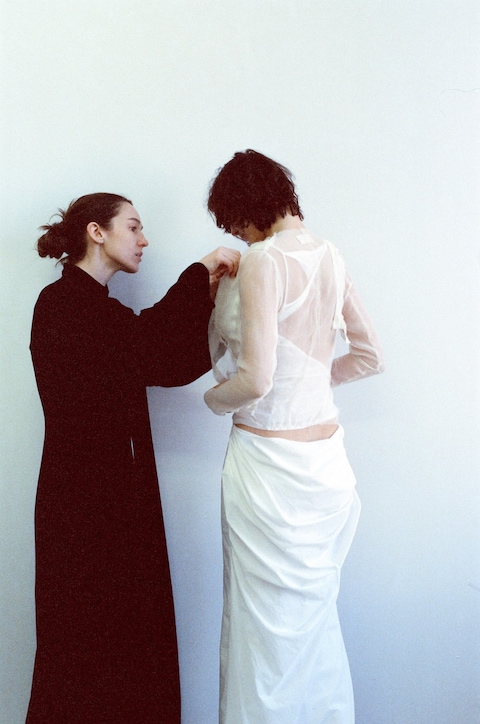
Pfahler is known for her big-winged eyeliner, red lipstick, and painted flesh, but for this shoot, she arrived on set without her signature theatrical makeup – a first for her in a fashion context. “It was such a vulnerable and raw moment,” Allen says. “She’s performed naked in public, covered in body paint and heels, but there was something quietly radical about this kind of exposure.” Makeup artist Romy Soleimani kept her skin luminous and unadorned, preserving the disarming softness of the gesture. “There was a real tenderness on set,” Allen reflects, a testament to the trust nurtured by her team, and by the garments themselves. “It was really about presence, not performance.”
For the final shot, Pfahler painted her buttocks in a cerulean blue before slipping into one of Allen’s high-slit coats in a matching shade. As photographer Annie Powers captured her from behind, she lifted the back hem to reveal the imprint – a literal and figurative stamp of the collaboration. This exact image had been on the designer’s mind from the beginning, but the act of it pushed Allen to consider how she can integrate her values more boldly into her work, and sync body and garment with belief. “Kembra doesn’t separate her aesthetic from her politics, or her physical space from her art,” Allen muses. “It’s a reminder to always live the work.”
