
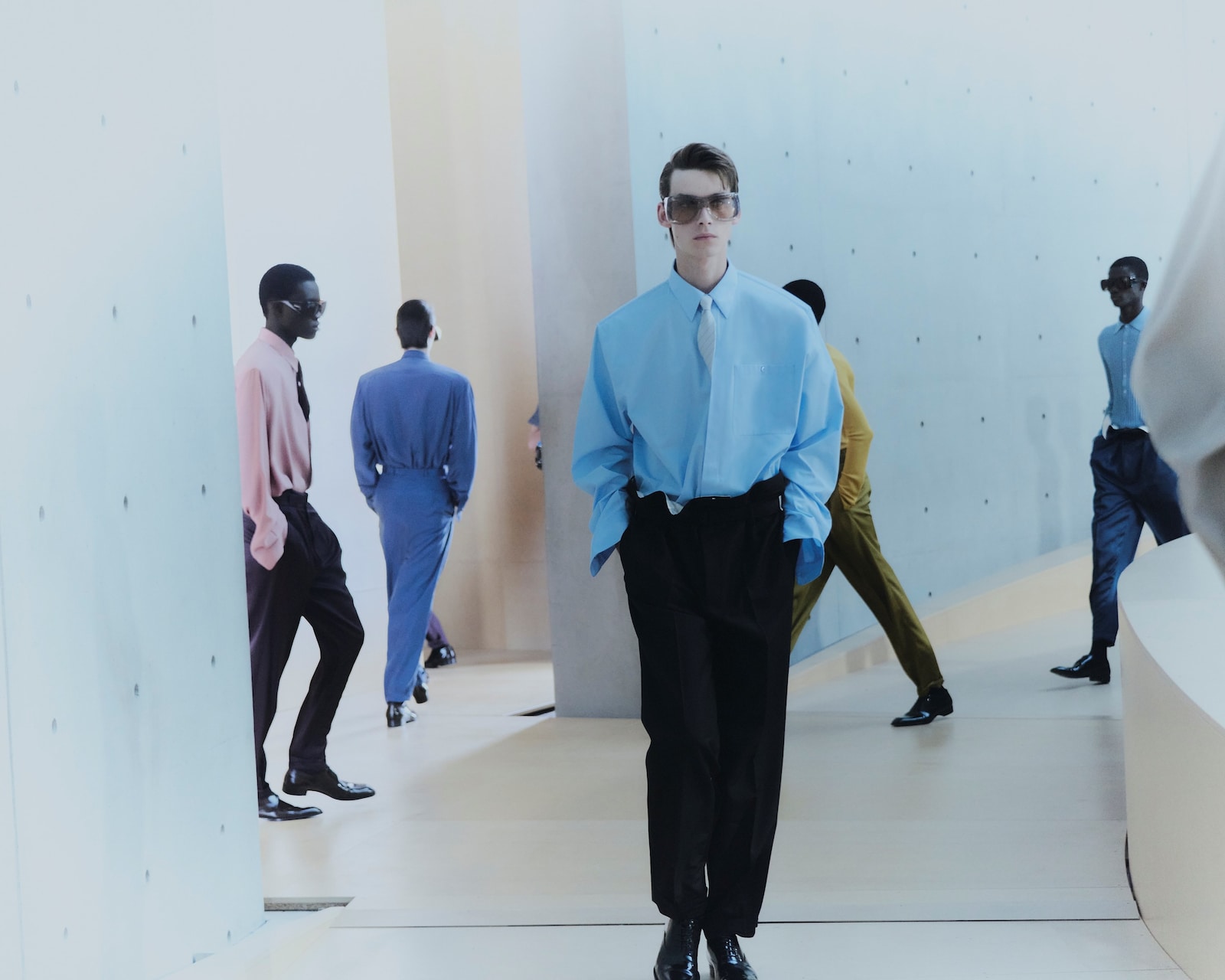
Scads of silk taffeta, slithery nylon windcheaters, jolts of eye-socking, unexpected colours and a limpid blue pool of tingling, clanging porcelain bowls by the artist Céleste Boursier-Mougenot. That work was the only incidental element of Anthony Vaccarello’s Spring/Summer 2026 Saint Laurent menswear show – he presented at the Pinault gallery in Paris’ old Bourse, where the work is installed until September. It’s called Clinamen, which a judicious Google search reveals means the unpredictable swerve of atoms in the doctrine of Epicurus. Which sounds impenetrable, but apparently it boils down to free will. Which, in a sense, is very Saint Laurent – in the 60s and early 70s, after all, Yves was the liberated poster child for wild living.
That was one of the sources of inspiration Vaccarello mined last season, where he combined nominally conservative tailoring with decidedly kinky boots in homage to an imaginary meeting of Saint Laurent and the artist Robert Mapplethorpe. He was thinking theoretically this time too – what if Saint Laurent went to Fire Island? A film by another gay artist, Larry Stanton, teased his collection, and provided the first inspiration for Vaccarello. “I always want to do a collaboration with Yves Saint Laurent in the 70s,” he said, at a preview about 30 minutes before his first model strode out. “But he never went there [Fire Island]. So, I kind of imagine the way that generation was in the 70s. In a different place. So, it’s my interpretation of a Parisian, going there.”
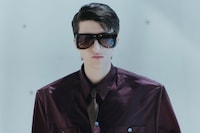
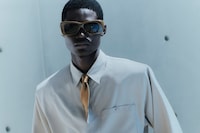
Elegant Parisian sliding into hedonistic climes was a fitting summary. Swaggering wide-shouldered bloused shirts in celadon green or turquoise, sometimes with tightly knotted neckties in matching fabric tucked inside, became transparent as the light hit them. They looked like some kind of couture silk but were actually nylon canvas. “Technical fabrics,” Vaccarello said. “To add into the vocabulary of Saint Laurent. To do something not in mousseline, but to find another way.” Saint Laurent himself once stated that “Nothing is more beautiful than a naked body” – he was the first, scandalously, to bare a woman’s breasts in a couture salon in 1966. Of course, since then, bared skin on the catwalk by either gender barely raises eyebrows – less than a decade after Saint Laurent’s shock, Karl Lagerfeld sent model Pat Cleveland down the runway in nothing but his shoes and a pink feather in her pubic hair to promote one of the myriad footwear lines he designed for.

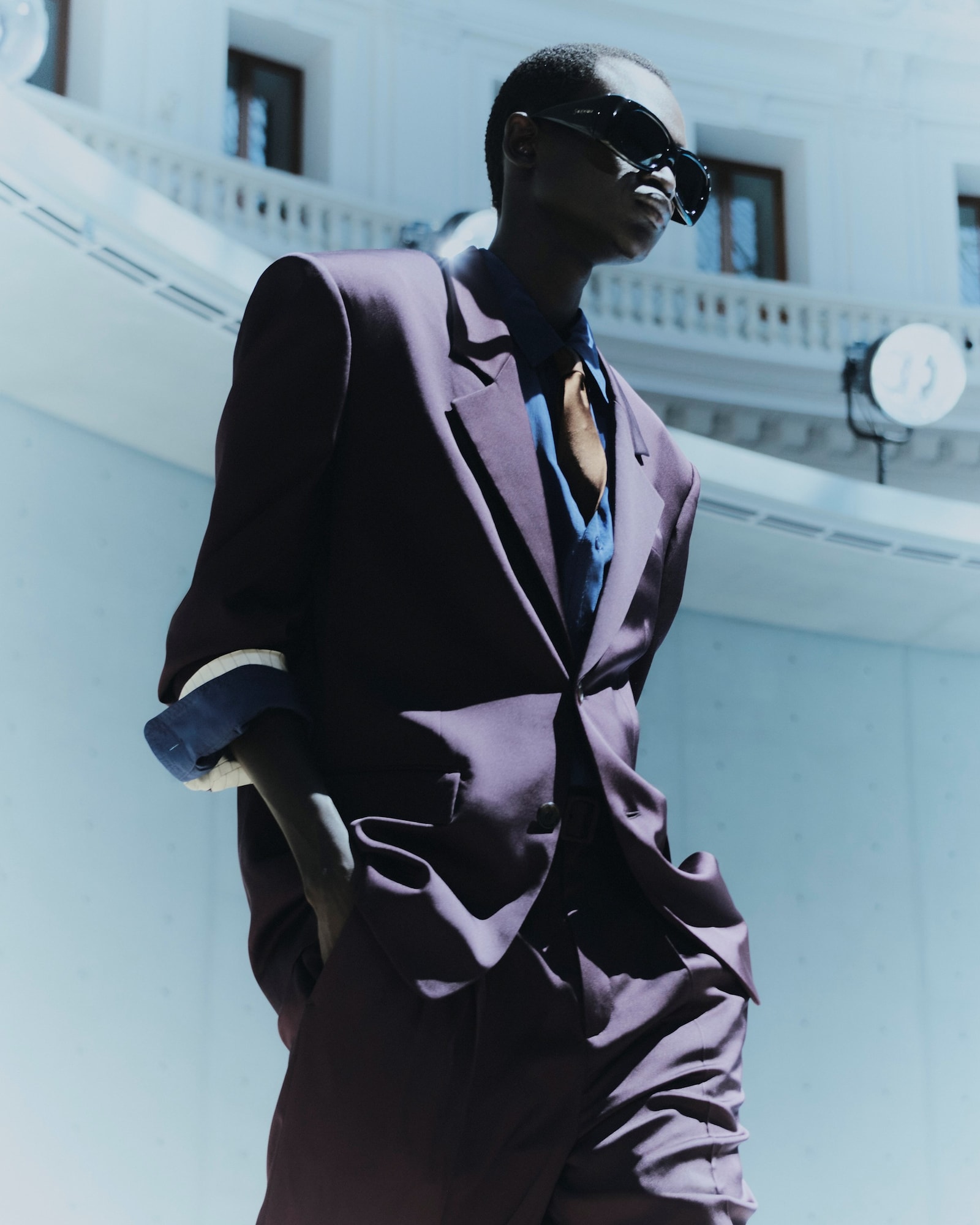
Vaccarello actually covered most of his models up here, in coats and formal suiting unexpectedly cut in duchess satin or taffeta, and in odd, off shades like lime green or plum. Those of course tied back to Saint Laurent’s unmatched colour sense – albeit more usually at show in couture ballgowns than menswear. There was always an artful darting back to pinched-out moments from the house’s history. Some of the shirts wound up looking more like the lavalière-collared blouses the late-period Saint Laurent primly dressed his couture matriarchs in. And many of the gangly male models resembled teenage Saint Laurents themselves – a picture of him in his birth city of Oran, Algeria, in rolled-up shorts and a loose shirt directly inspired a few looks. “Why not, to do a short for men? That was my perversion, like the thigh boots – kinky,” Vaccarello laughed. That image, incidentally, came from the archive of his business partner and the love of Saint Laurent’s life, Pierre Bergé.
The femme feel, the nude bodies, the freedom. It was a tight connection back to the intense creativity of the gay art world of the 1970s – Saint Laurent and Bergé were a major, internationally visible part of that. Although, there’s a fragility to that world, of course – many of their number were decimated by AIDS in the 80s; Saint Laurent avoided that fate but dealt with demons of addiction that essentially rendered him a glorious recluse from the mid-70s onwards. “They lived a very fun and intense moment, not knowing what was going to happen. I like that fragility, like a flower,” Vaccarello said. “It’s so beautiful and so fragile. If you don’t enjoy it, if you’re not aware of what you’re living, you just missed your life. It’s ephemeral – I am always attracted to what is ephemeral. I find it more beautiful and more interesting.”
That’s odd, because there’s nothing ephemeral about what he does at Saint Laurent – besides, this season, the Saint Laurent shoulder, which seemed sharply shaped but can have its internal constructions removed to be slouched and easy. What Vaccarello is building is truly an expansion of the Saint Laurent vocabulary, never expected and never the same. Saint Laurent himself, arguably, ended his career mired in reflections of his own past grandeur – perfections of his style, without evolution, let alone revolution. Vaccarello, by contrast, refuses to be locked in an ivory tower.
