
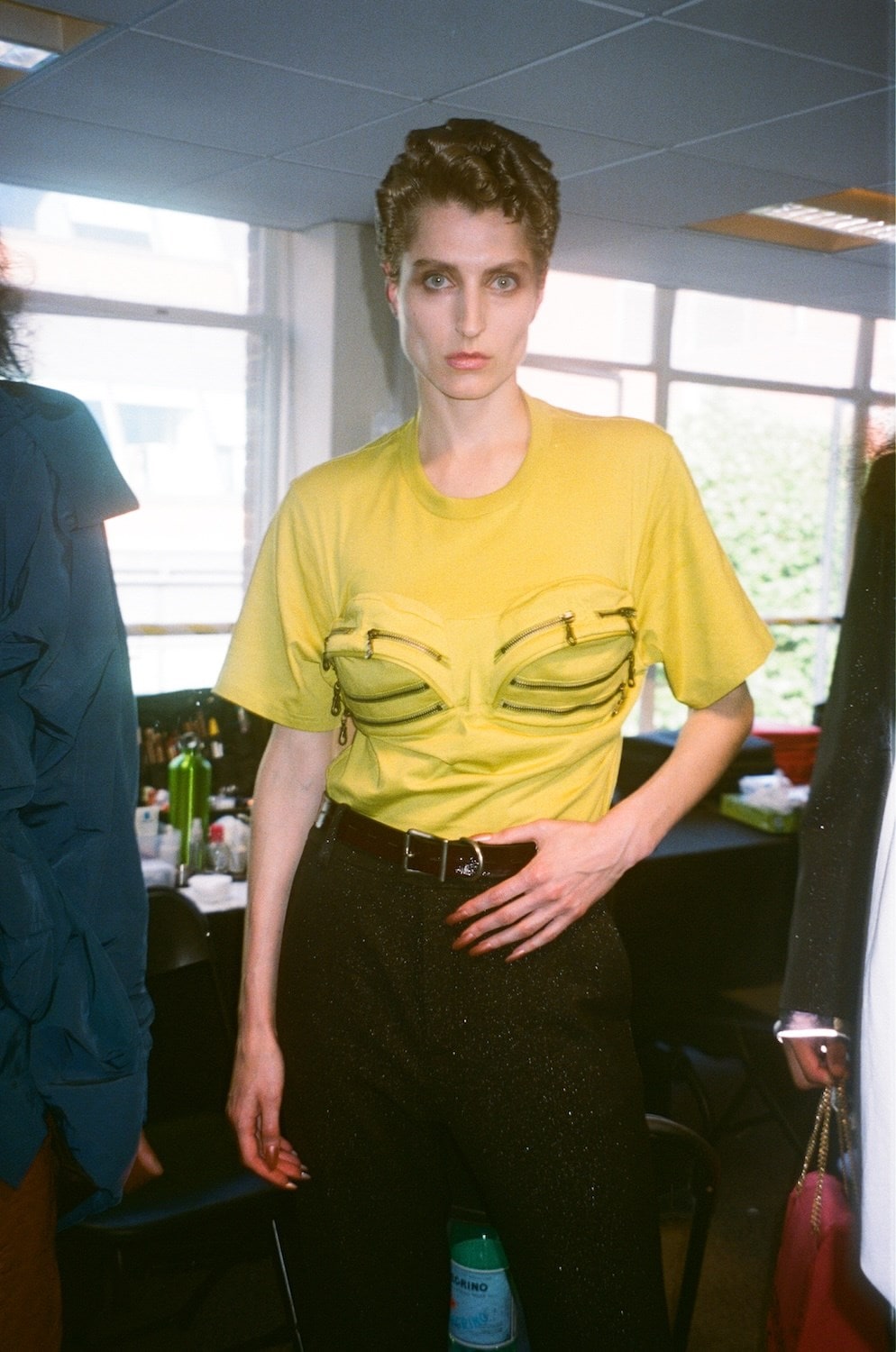
“Expect perfection”. That’s the slogan Martine Rose has used on her clothes for a few seasons – but I’m never quite sure if it‘s a challenge Rose is throwing down to herself, or a reflection of the demands placed on young designers. That feels especially relevant in London, where the biannual womenswear showcases have shrunk and whose nascent menswear weeks quietly wound up shop. Rose, indeed, was the only live show staged in London, in splendid isolation – cannily, after showing as part of the men’s calendars of Milan and Paris, she opted to leapfrog fashion month and show ahead of everyone else. And Rose’s aesthetic is strong enough to not only justify that stand-alone space on the fashion calendar, but to pull out an audience eager to see what she could deliver.




For her Spring/Summer 2026 show, that audience also included many of Rose’s peers – Craig Green, Simone Rocha, Jawara Alleyne, Feben, among others – as well as a beyond-healthy contingent of press and buyers. That’s because Rose is a true designer, one respected and followed, whose aesthetic influence punches above its weight.
The word ‘community’ is trite and overused in fashion, but Rose both genuinely crafts hers, and cares about the wider one. This season, Rose took over a derelict job centre in North West London off the Edgware Road – if anything is indicative of a cultural landscape shaped by austerity, it’s that. “I think obviously, it‘s been a really fucking terrible time for people. Millions of people have lost their jobs, lost their everything. So it‘s also at the same time trying to be sensitive to that and read the mood. Because that‘s also weird, isn‘t it? It‘s like we‘re not plugged in if we‘re not responding really honestly to how people feel.” Rose told me, before pausing. “I do feel quite plugged into the mood.” Yet Rose is nothing if not a cock-eyed optimist – in her own form of urban regeneration, she gave over one grimy-carpeted floor of the clapped-out building to a sprawling indoor market of independent traders, enlivening the usually deadened space with a vibrant contingent of T-shirt designers, record purveyors and pornography hawkers, open to the public over the weekend of the show. “You find your people, don‘t you?” Rose asked, rhetorically. “You find your light.”
Another floor above, an incongruous ‘salon’ space was created to showcase the collection, white plastic Venetian blinds shading windows next to walls swagged in ruffled satin like cheap wedding dresses, cosseting spaces. Rose wasn’t thinking about ceremonies or dressing up, however – in fact, kind of the opposite. Instead, she was obsessed with vaseline-lensed retro-erotica and the contemporary taste for underwear-as-outerwear – mainly, Skims as everyday everywhere garb. What that resulted in were clothes that grabbed at the body, for men and women alike, tightly clasping the waists of otherwise oversized jackets and suctioning trousers to thighs. There’s been conjecture about oversize being over – this seemed a definitive, directional move that way. But, actually, with Rose, the joy is always found in the details, heightened by that salon mood, models barely arms-length away, intentionally twirling around audience members in a campy send-up of couture traditions. It meant you appreciated the tiniest design nuances – indeed, the takeaway item for most seemed to be a couple of pairs of Chantilly-lace dipped boxer shorts, with tiny satin ribbon bows knotted on each leg, a slipstreaming of masc and femme, lingerie and fratboy, that was oddly compelling, and strangely attractive on – and to – whatever gender you may identify with.
Back to that opening phrase – don’t expect perfection. Because that’s not what Rose is interested in. That’s why her clothes twist and shift around the body slightly uncomfortably, finding new and strange proportions, intentionally ill-fitting. Actually, is it ill-fitting if it’s how it’s supposed to look? Rose’s work is rather a celebration of imperfection – and, indeed, a celebration of fashion. “I don‘t have a sort of manifesto really that I want people to ... a message or something,” Rose says, of her clothes. “I want people to feel how I felt, I guess, when I‘m looking at fashion, when I was young.” They feel part of her community, part of her world. And that’s pretty perfect.
