
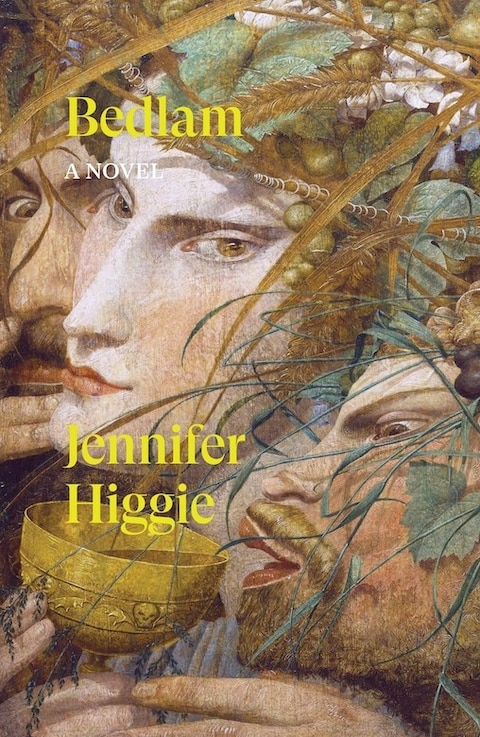
Tracking a year in the victorian painter Richard Dadd’s life as he toured Europe and went mad, Jennifer Higgie’s novel, Bedlam, is a fever-dream of visions and delusions, republished to coincide with an upcoming exhibition of Dadd’s work at the RA
Richard Dadd has held writer and editor Jennifer Higgie’s fascination since she saw his work in a 1998 show at the Royal Academy focusing on Victorian fairy paintings. Dadd was a popular painter, chosen by a benefactor, Sir Thomas Phillips, to accompany him on a grand tour of Europe in 1842. Over the course of the trip, Dadd went steadily mad and became a devotee of the Egyptian god Osiris. On his return, the god directed him to kill his own father; he was sent to Bethlem Hospital, known colloquially as Bedlam, where he spent the rest of his days.
Bedlam was a novel that Higgie wrote in a fever in the late 1990s: broke and unsure about her professional direction, staying on the Greek island of Amorgos for three months with a friend. It tracks a year in Dadd’s life, his slow descent into instability and madness while taking in the overwhelming sights and sounds. The novel had a limited publication in 2006 and is receiving its first wider release from Verso to coincide with an upcoming exhibition of Dadd’s work at the Royal Academy, Richard Dadd: Beyond Bedlam. In a time where both the arts and mental health services are under threat and actively being dismantled, Higgie’s book takes on renewed relevance as a sensitive take on how exactly a tender open mind can take a wrong turn. Through Dadd’s eyes, madness becomes knowable and tactile – recognisable and yet alienating.
Below, she speaks about the book’s circuitous publishing journey, how to write a sensitive portrait of mental ill health and outsider artists.
Jemima Skala: Take me through the book’s lifetime so far.
Jennifer Higgie: I’m astonished that it’s coming out this year because I didn't put it out there to do this. Verso approached me out of the blue, which was sort of amazing and I’m very grateful. I was working as a painter on this Greek island with my friend Martine for three months and living extremely cheaply because I’d sold one painting.
I really wrote it because I was going through this crisis with my own work. I was deeply wracked with anxiety. I was looking for meaning. I just wrote every day and the book emerged very swiftly. I don’t remember struggling with it; it just poured out of me.
When I got back to London I thought, OK, I should try and get it published. I got an agent but she couldn’t get it published anyway. No one wanted it. A few people really liked it, but said it’s too French – whatever that means. I guess it was too arty, too much of a fever dream. Sternberg Press published it from Berlin and then it disappeared. But it’s a book I’m very fond of. I’ve been a full-time writer for a long time and I wasn’t trying to write to any rules. Reading it again after so many years, I can tell it was from the heart.
JS: You embody this voice of Dadd’s so closely throughout the book, what resources did you use to get into his headspace and his voice as well?
JH: I was reading his letters. He wrote some wonderful letters back to friends and family when he was travelling so I paraphrased the tone of them. One of the really heartbreaking things about the story, when I first saw the exhibition was, I couldn’t believe how extraordinary these pictures were. When I found out what happened – that he was this really charming, brilliant young artist who was the toast of the town, had dear friends, was very close to his father and his family, and known for his gentleness and humour – then he comes back a year later and murders his father, I was like, what the hell happened?
I also read contemporary accounts; his friends were so devastated when he came back and he was clearly mad, because that gentle young man was no longer there. My heart broke for Richard that he had to suffer this. Two of his siblings ended up being put in asylums as well. So obviously it was something in their family. Bedlam is my imaginative response to what he went through, which could be entirely wrong.
JS: He’s so sensually aware throughout the book, which becomes quite threatening and upsetting by the end.
JH: I wrote most of it in Greece in summer in a really bright, hard light. I’m also Australian, so it's that bright, hard light I’m very used to and I love. I was imagining a reverse: he’d been brought up in the rain and then what would it be like where the increasing intensity of his thoughts was illuminated by the increasing intensity of the heat and the light.
JS: Women are also really ancillary to Dadd – did you have any sense of his relationship to women beyond his sisters?
JH: No. That’s why I wanted Maria’s voice throughout it. In real life, she also ended up in an asylum, so I wanted that relationship with his sister to run counter to the expectations of young men on the grand tour, which was often to visit brothels. I’d read a lot about that and it seems so appalling to me. I imagined that someone of his sensitivity and also someone who had a close relationship to his sister, how that would affect that experience. I must say, rereading it after all this time, that was the most disturbing chapter. Jesus, how did I write that? Where did that come from? And there’s a sort of fury in that chapter. And so I guess that’s where women come into it, either as sisters or as objects – sensual objects or erotic objects, but ones that he undermines.
It’s really interesting looking at women in his paintings because he was in the asylum when he was painting his greatest pictures and there were no women who could have modelled for him. So I imagine he’s modelling his women on men and just adding breasts or something, so they have this very strange masculine or androgynous quality to them as well.
JS: What do you see as the relationship between mental health and the spiritual being?
JH: It is interesting how much great visionary work was made in asylums because these are places where people are at worst having visions that destroy them or make them become killers. But at best, it makes them see or experience realms beyond the materiality of what must have been a grim world, so there’s a certain freedom in those visions.
What constitutes madness is very subjective and cultural because in some cultures, the seeing of visions is viewed as a transcendent and a powerful thing. In our Western culture, look at Renaissance art; they’re insane and extraordinary, the way that artists visualise the Bible, for example. They’re definitely visionary, but they were seen as acceptable because they were framed within the Catholic Church.
JS: What do you think that the book has to say in the current climate it’s being published in? Because it is a very different one to the one in which you wrote it.
JH: If anything, it’s just about a compassion towards what people suffer and how they live their lives.
JS: On that, what do you think of the label ‘outsider artist’?
JH: Oh, I hate it. What does it mean? Outside what? It’s been sort of a useful category, to look at people who are untrained, or who made work in asylums or hospitals. But the idea that there’s a clear distinction between rational artists, who are the so-called insiders, and then the irrational ones who are the outsiders: it’s such a false binary when to make art is to be a mediumistic being.
Bedlam by Jennifer Higgie is out now.
