
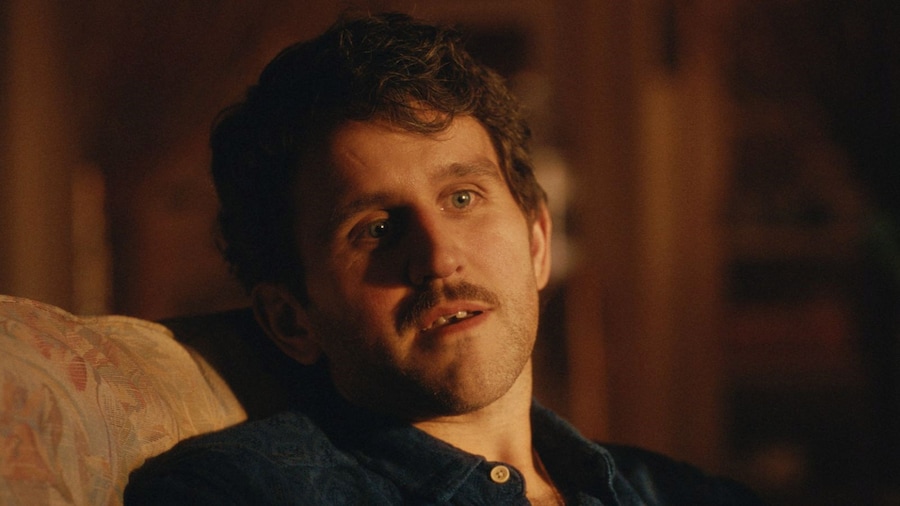
Harry Melling returns to Cannes for the second year running, this time playing a reckless, moustached lowlife in New Jersey’s Circassian community in new film Butterfly Jam, alongside Barry Keoghan and Riley Keogh
One year after the world premiere of Pillion, Harry Melling has returned to Cannes in Kantemir Balagov’s new film, the chaotic and dangerous immigrant family drama Butterfly Jam. “Two years in a row is not bad,” the actor jovially agrees, speaking to AnOther on the rooftop terrace of the glamorous JW Marriott Cannes – on what will undoubtedly be the windiest day of the festival. Furniture is being hastily rearranged to protect audio levels when Melling arrives; he rallies his interviewer to take courage and soldier on, promising to speak as close to the microphone as possible.
There’s a lot to talk about. Melling’s last three films received splashy festival rollouts – the land clearance historical film Harvest, biker BDSM romance Pillion, and Butterfly Jam, which opened the independent Directors’ Fortnight section. This career boom is the result of almost a decade of captivating supporting performances that quickly and successfully left the “kid from Harry Potter” references in the dust. After he played a travelling amputee actor in the Coen Brothers’ The Ballad of Buster Scruggs, Melling appeared in not fewer than three high-profile Netflix projects in 2020, including the megahit The Queen’s Gambit. It was an ideal year to be big on a streamer.
Melling credits his role in 2018’s The Ballad of Buster Scruggs for “opening up another chapter of my career”, which after 2020 led to a partial Coen reunion in The Tragedy of Macbeth, the quirky and kinky comedy Please, Baby, Please, and some meaty historical roles in The Pale Blue Eye and Wolf Hall. But Melling bristles at the idea of rhapsodising his recent career lift-off.

“I’m not memoir-ing it,” he insists. “I have some friends who are very good at talking strategy, ‘If I do this, then that means that, and if I do that…’ I've never been able to operate on that level. What has defined my thought process for potential jobs is if I read something and think I can offer something. It could be wrong, it could be the complete opposite of what the director wants, but there usually is a moment of going, ‘Oh, I have an idea about what this could be.’ I've always said [a role] could be for every scene, or it could be one scene. It doesn't matter to me.”
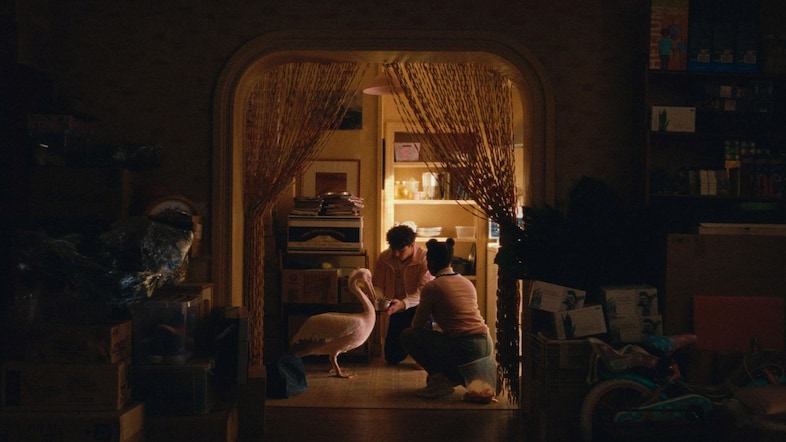
With Butterfly Jam, that character is Marat, a reckless, moustached lowlife in New Jersey’s Circassian community who hounds his friend and fellow Circassian-American Azik (Barry Keoghan) and irritates Azik’s sister Zalya (Riley Keogh) at their family-owned diner. His hapless schemes are a facade for a thin-skinned outsider who threatens to lash out if he’s picked on. Butterfly Jam is the first film by Russian director Kantemir Balagov since he left his home country after criticising the invasion of Ukraine. It focuses on a teenage wrestling prodigy Pyteh (Talha Akdogan), who shares his father’s ambitions for greater success than the diner run by his dad and pregnant aunt.
The nuances of the film’s personal roots soon became clear to Melling. “[Balagov] wasn’t ever specific, saying, ‘I experienced this, and this is the moment where you explore this point in my life.’ But I always got a sense that it truly was an expression of his experience. It is a love letter to Nalchik, where he’s from and where originally it was going to be set. When he left, he found this community in New Jersey, and [the story] was transposed to that community. I always felt that all the characters are a reflection of him.”
Any personal identification with Marat would be unflattering and should trigger some soul-searching. “He’s just hopeless,” explains Melling. “I said this to Kantemir early on – growing up, we would come home sometimes and there’d be a friend of mine who would always be in the fridge, helping himself to some food. That’s Marat. He’s always there. He's in your house more than you are. He’s in the fridge. How did you get in? What are you doing here? Where’s your own family?”

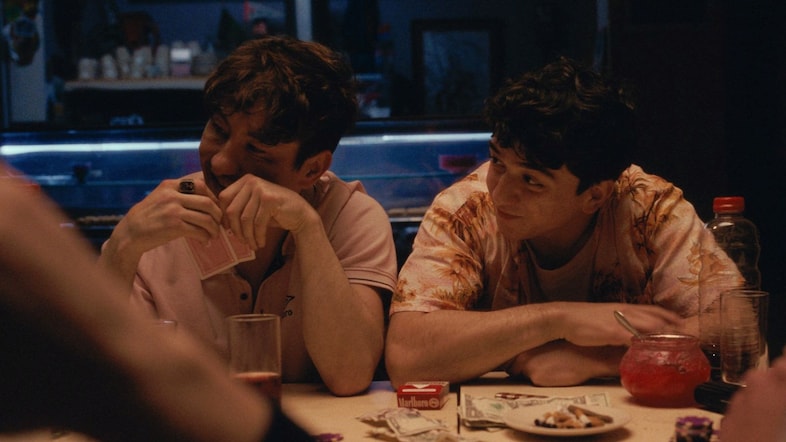
Marat’s position on the edge of Pyteh’s family makes him troublingly unpredictable. “A big thing for me coming to Marat was exploring this person who has seemingly no roots, and how to play it. There is a danger to that.” Marat is rarely anywhere without Azik, so Melling spent most of his scenes in Keoghan’s company, and was in awe of his scene partner’s gift for spontaneity. “We would have a script as a template of where we’re going, but we’d just find it on its feet [and] build it as we went. It wasn’t really a case with Barry of feeling like there’s a right and wrong [way], it’s just, ‘Let’s see what it can be.’ I personally love that way of working, and when you work on something with Barry, [it’s in] his DNA, so you’re constantly trying to dance with that.”
In Harvest, Pillion and now Butterfly Jam, Melling’s characters have an intimate male relationship defined by a clear imbalance of power – call it a strained, unreliable tenderness. Melling approves of the observation but stresses it’s a coincidence. (No memoir-ing, remember?) “What I am drawn to is a strangeness,” he says. He does explain what unites his three recent co-stars, Caleb Landry Jones, Alexander Skarsgård, and Keoghan respectively. “The shared commonality between all those actors is a generosity and a work ethic – really understanding the responsibility of telling a story.”
Butterfly Jam has not received the same full-chested, effusive praise that met Pillion last May – last week, it was Cannes’ first major divisive premiere. Pillion’s director Harry Lighton was in Cannes to celebrate Melling. “We were just saying it’s so strange that a year ago, that Pillion world was unleashed,” notes Melling. “It’s been an amazing year. We spent a long time with that film, getting it out, sharing it with the world. The American release was slightly later, so it’s been a long old journey. The fact that a film which was made with a relatively small budget, has, it’s fair to say, exceeded people’s expectations in terms of its reach is just incredible.”
