
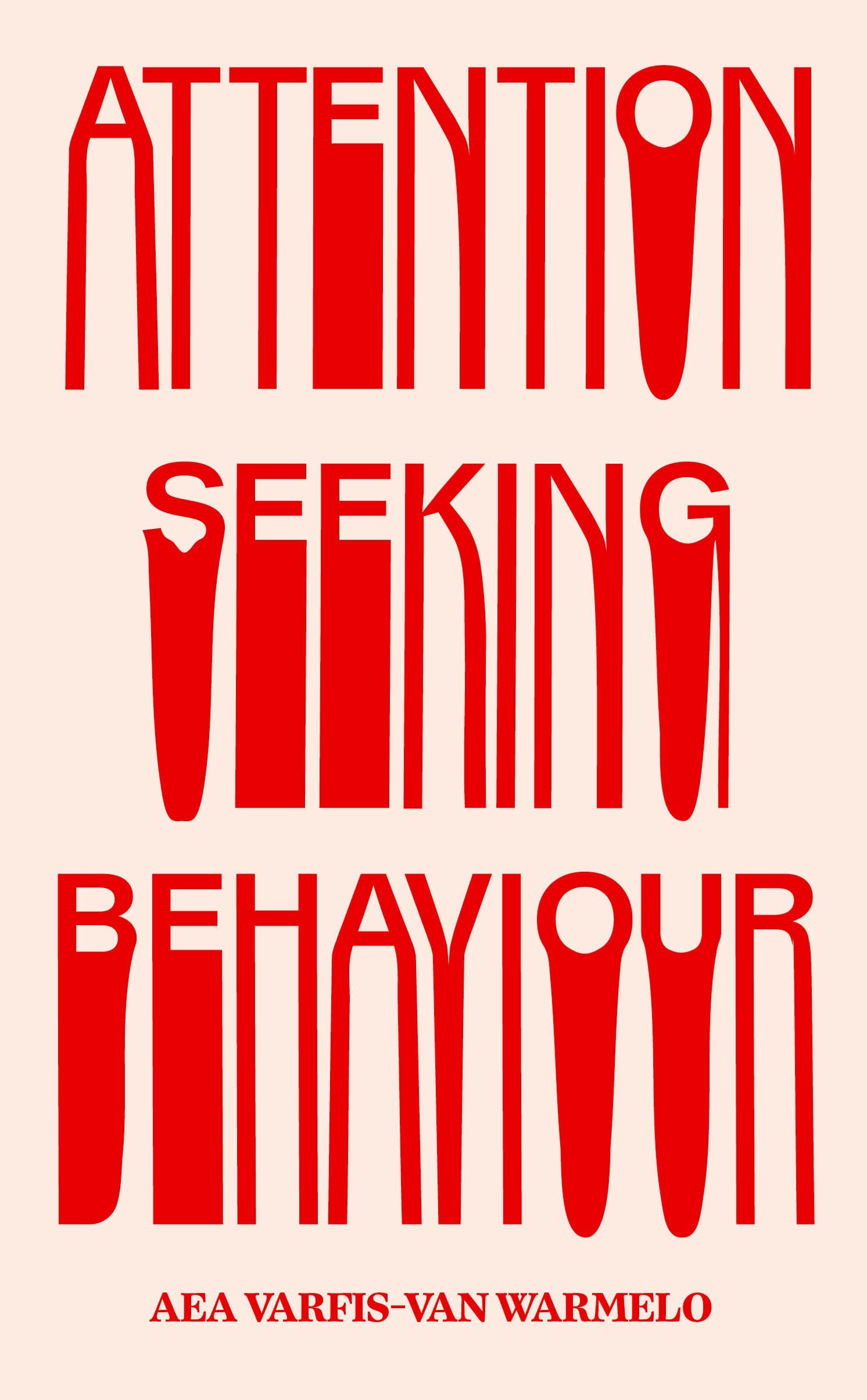
Plenty of authors have toyed with their readers by writing from the perspective of an unreliable narrator. But Aea Varfis-van Warmelo takes the idea a step further in her impressive debut novel, Attention-Seeking Behaviour. Her narrator, unnamed for most of the novel, admits early on that she is a liar. As she describes a suspicious number of dead bodies, her mind-numbing job assisting the demanding CEO of a PR company, and a side gig carrying out research for an investigative journalist, she also falls in love with ‘Normal Ben’, a man who matches her sardonic wit. How much of it is true to the world of the novel? The reader is never quite sure.
Interspersed throughout Attention-Seeking Behaviour are essay-like digressions on the narrator’s obsession: the American psychologist Paul Ekman, who wrongly believed that micro-expressions are universal and can reveal any person’s ‘true’ emotion. He made it his life’s work to try and catalogue minute facial expressions in an attempt to catch liars. The narrator details Ekman’s far-reaching influence, from airport security programs to legal proceedings, pointing out its malign impact and the flaws in his research. ‘No more Eccles. No more,’ pleads Normal Ben at one point.
Despite her love interest’s apathy, the narrator’s interest is compelling. When her smudged recollection of a night from her past is spoken out loud, the fragments of the novel beautifully coalesce. Her research into a sexual assault case, essays on facial expressions and descriptions of her own life come together into an intricate and satisfying whole.
Here, Aea Varfis-van Warmelo talks more about Attention-Seeking Behaviour.

Zoe Guttenplan: There’s obviously a lot of research that’s gone into this book, and I almost didn’t want to know until I’d finished reading it whether it was all true or not. What drew you to this particular format?
Aea Varfis-van Warmelo: Many people have told me that they waited until the end of the book to ask, ‘Is Paul Ekman a real person?’ And yes, he very much was. It’s so funny that you’d have read all of those chapters with that ambiguity; I really admire the trust that readers have.
Initially the project was going to be a monograph about lying. It was going to be a much shorter piece of creative non-fiction that used memoir with an element of creation. The idea was always, from the very beginning, that I would write a book where I made myself a liar by writing it. So I very sincerely and naively looked into lie detection. I knew the polygraph was questionable, but I didn’t really know why. And then I discovered this universe of pseudosciences that was so much deeper and more actively destructive than I thought it was.
The research had an impact on me and has changed how I think about communication. It was also interesting to me that someone could be reading the same misinformation and falling for it. It made me think about how opinions can be formed, so I included the material as straightforward essays because I wanted it to be presented to a reader in a similar form to how I’d found it, so they could be changed by it too.
ZG: What about lying and deception was appealing to you?
AVW: My first project as a writer was to work out what my relationship is to the text. And also what my relationship is with my own biography – what I want my readers to know or not know about me and whether or not I want my reader to have sympathy for me. So all of those things came together to make me write this, and especially to write as a liar. I felt like the easiest way to handle people’s attention was by making sure it was on my terms, by telling them that everything I’m putting in here is intentional and manipulative. It’s a way of asking someone to look at me, but also telling them that it’s entirely on my terms.
ZG: There’s a love story woven through these essays. How did the fictional elements start coming into being?
AVW: The first stage of coming up with the fiction element was determining the narrator’s character. And that meant that I looked at my own life with some remove, thinking about what circumstances would have had to have been different for me to become a pathological liar, and what elements of my personality would have to be amplified or diminished. I think this narrator is a kind of shadow version of me.
Sex and relationships are such a rich place for looking into lying, so I knew there’d be sex in the book. I wrote this character that she was having casual sex with, and I called him ‘Normal Ben’. Immediately, I just couldn’t stop writing about this man. I had constructed this character who had all of this need for attention and a real spikiness. And then progressively designed a foil to her, who could take every barb with a laugh and could play the same game but more honestly and more decently. He also introduced these stakes. I was trying to write a way to keep Normal Ben on the page. I would think, ‘What does Normal Ben do? How does Normal Ben handle it?’ That became the arc of the book.
“Sex and relationships are such a rich place for looking into lying” – Aea Varfis-van Warmelo
ZG: The idea of deception within sex and relationships brings us to another theme running through the book. The narrator spends some time in a solicitor’s office researching the legal proceedings of a sexual assault case for Anna, the investigative journalist character. How did you decide to include this element?
AVW: I knew that I was going to write about police proceedings, and I wanted there to be a sense of how these lie detection techniques actually get used in police rooms. I think that UK policing has a very interesting approach to language and interviewing. I wanted to write about how that is applied to a type of case where there is no evidence except testimony, and the testimony relies entirely on memory. I also knew that I was always going to write about sexual assault in some way because there was no way to write about women and lying without coming to the idea of how you narrate your life, especially when there is such an extremely high change that your life includes some form of violence, probably at the hands of men.
I also knew that I wanted to write about influence. In her research for Anna, the narrator is fairly impotent but working on behalf of someone with power. She’s mediating factual material and witnessing something real, but knows that whatever she does doesn’t matter. I wanted her to be at the confluence of those things, being confronted with interviewing techniques having gained knowledge about them, but aware that her attempts to wield truth won’t matter.
ZG: As well as longer essayistic bits, the book is full of short sections, sometimes no more than a sentence long. There’s also a sex scene that happens almost entirely in a series of fragmentary sentences. How did you think about the writing itself, about the parts versus the whole?
AVW: I see those fragmentary sentences either as a list or montage. I think very carefully about the pace and sound, how they slot together, because I want the rhythm to be incredibly compelling. But then the list and the fragment itself is also an element in bias-making for the reader, who has to pull together the scene around it. They have to fill in the gaps. They get implicated in the story that’s being told because they will make some leaps, and they will make associations that are entirely their own, building the narrative themselves. It was always an exercise in both engrossing the reader and making them complicit.
ZG: What’s next?
AVW: I’m working on a book about acting and psychological realism in performance, which explores quite similar themes. I’m interested in the idea of changing the self, and that in the past century, so much performance has pivoted from a representational form to psychological realism. It’s a huge cultural shift that we don’t really talk about because we see acting as this strange craft that is also entertainment. Attention-Seeking Behaviour is very much inside the head. I want to do a lot more reportage for the next one.
Attention-Seeking Behaviour by Aea Varfis-van Warmelo is published by Peninsula Press and is out now.
