
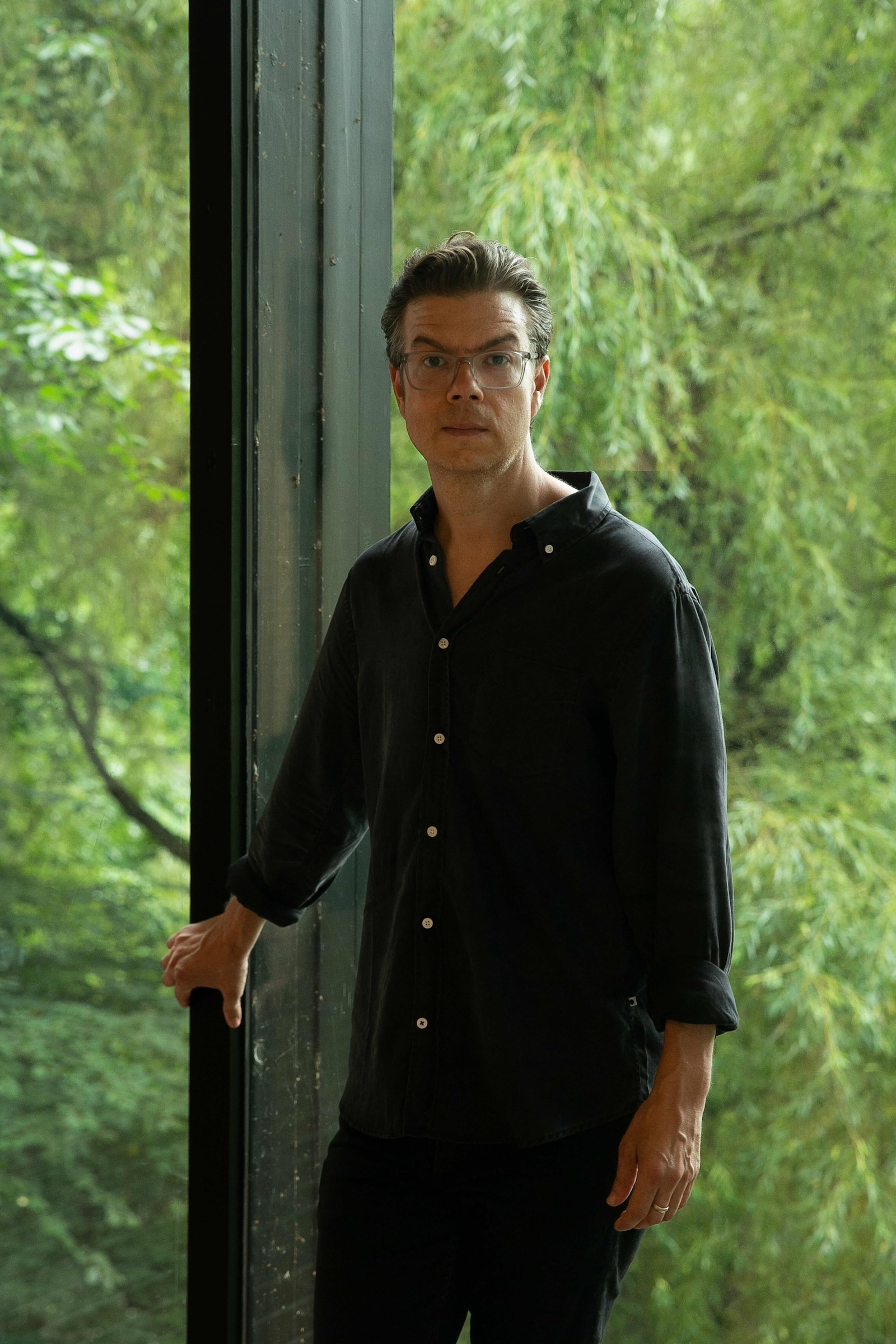
Ben Lerner’s compact new novel Transcription opens with a simple yet mortifying premise: an interview that fails to record. An unnamed narrator travels back to his college town of Providence, Rhode Island to interview his 90-year-old mentor, a German intellectual called Thomas, for a magazine. But before said interview, the narrator accidentally knocks his phone into the hotel sink, rendering his only recording device broken – a fact he is too embarrassed to confess. “I was glitching, craving my cellular phone on a cellular level,” writes Lerner, “shamefully unresponsive to the old media that surrounded me: books, paintings, analogue photographs, a vinyl record spinning somewhere in my mentor’s house.”
Split into three parts, Transcription then shifts to a conference in Madrid, where the narrator is lambasted by his peers for fabricating his interview with Thomas, who has now passed away. In the third and final climactic section, the narrator meets with Max – Thomas’s son – in Los Angeles, for a remarkable conversation spanning fatherhood, the pandemic, eating disorders, technology, and the nature of intergenerational baggage. Clocking in at just 144 pages, this slender novel packs a lot in: meditations on art and artificiality (the narrator has a particularly poignant encounter with a display of 19th-century glass flowers by Leopold and Rudolf Blaschka at The Harvard Museum of Natural History), how technology is changing the nature of humanity, and how we care for each other in the face of global disaster. It is also the author’s most moving novel yet, with a tender message about human frailty at its core that lingers long after the book’s end.
Transcription is Lerner’s first novel in seven years, following the critically acclaimed autofictional trilogy, Leaving the Atocha Station (2011), 10:04 (2014), and The Topeka School (2019), which explored memory, art, politics and relationships in dazzling prose (Lerner was a poet before he became an “accidental novelist”, a fact that explains the extreme beauty and formal inventiveness of his fiction). When I meet him on a sunny afternoon in Bloomsbury to discuss Transcription, I nervously tap my phone multiple times throughout our conversation to check that our interview is recording. “You can just make it up if not,” he reassures me.
Here, Ben Lerner talks about why novels are great vehicles for art criticism, his thoughts on AI, and how parenting has changed his life and work.


Violet Conroy: I’m intrigued to hear if you’ve ever failed to record an important interview, like the narrator in Transcription?
Ben Lerner: That hasn’t happened to me, but I’ve done interviews before where the interviewer has erased or failed to record the conversation, which always struck me as the kind of thing I would do. I went to interview this hero of mine, [the American poet and novelist] Rosemary Waldrop, for The Paris Review, and I kept being anxious that I was going to destroy my recorder. And then in that anxiety, some of the conceit occurred to me, of an interview that the fiction records, that the phone fails to capture.
VC: This novel is so much about parenting, and you’ve spoken about how parenting and writing are the biggest things in your life. How do the two interact?
BL: My daughters inform the writing in all kinds of ways, but it’s this mixture of wanting to let them in and keep them out, because you can’t take care of your kids in your work, or you would write really boring shit. I’ve written a lot of poems about this: wanting to protect my children from my voice, and to protect my voice from my children.
I also became more interested in how things are transmitted or transcribed across generations, and the voice as intergenerational technology. When you start talking to your kids, you open your mouth and all this stuff comes out that’s not you. It’s your parents, or your image of what parents should be, or your own voice as a child, travelling into the future.
VC: Voices are often blurred in your novels, along with character and time. Why are you drawn to superposition as a narrative device?
BL: Part of it is a kind of realism. I think fiction is really good at depicting the way the voice is a tissue of different voices. In Transcription, Thomas speaks through the narrator to Max, or Max speaks through the narrator to Thomas. The way that language passes through us sometimes has the intensity of a visitation. We’re all spirit mediums, and we’re all haunted. Technologies also enable hauntings. That was the centre of this book.
“I do think that there has to be an oasis away from the blue light” – Ben Lerner
VC: Do you feel like screens are, as mentioned in the book, dulling our senses? As a writer, how do you navigate your own screen time to protect your creativity?
BL: I’m totally compromised. In terms of my phone addiction, I’m probably average for an American, but that’s still really bad. I basically think technology makes us all mean and stupid, but that’s not a very interesting book.
There’s this American historian, D Graham Burnett, who is doing a lot of writing and thinking around attention. He’s trying to understand what he calls the ‘attention fracking’ that the algorithm does, but also the circumstances that can wrest attention back. Anytime something is under threat, it becomes more exciting, right? But I’m also trying to stay really open and curious before the horrifying miracle of AI. I don’t have the discipline to turn my back on the technologies.
Transcription is trying to think about all the technologies: poems, cell phones, paintings, iPads, radio, cinema, and what media configuration might produce the miracle of intergenerationality, where voices outlive their bodies and move through us.
VC: Do you think technology and screens can possess the artistic potential of things like paintings and poems?
BL: Phones have unbelievable power, but I haven’t seen them produce the haunting we’re talking about because they tend to be so flattening and lateral. There are incredible works of digital or video art that I have seen on small screens that have still moved me. I think Ed Atkins is really terrific at creating an uncanny digital environment in which the human actually rushes in, or is felt around at the edges. But nothing is as depressing to me as these things in The New York Times, where it’s like, “Exercise your attention and spend ten minutes looking at this digital reproduction of a painting.” I do think that there has to be an oasis away from the blue light.
VC: What are your thoughts on the controversy surrounding authors who are writing books with the help of AI?
BL: I feel like novels have to be distant from the technologies they comment on, so I don’t think we’re going to learn about what the novel can say about AI if the novel just becomes written by an AI. It has to be more like: what can the novel capture about how AI starts to enter the texture of our lives?
I’m sure there will be interesting works made out of the curation of large language models, but I haven’t seen them yet. I am primarily interested in writing written by humans with a heartbeat. I like the idea that the sentence measures the body and the breath and thinking in time.
“I am primarily interested in writing written by humans with a heartbeat” – Ben Lerner
VC: Art always crops up in your novels. In Transcription, there’s a scene where the narrator visits these glass flowers by Leopold and Rudolf Blaschka at the Harvard Museum of Natural History. What is the significance of this artwork?
BL: The narrator has this experience where he can see the work as real flowers one moment and as artificial flowers the next. And that ‘as’ is what fiction is for me. There’s the merely real – the brute facts of the world – but you can see them as this or as that. It’s like the duck-rabbit drawing, which you can see as a duck or as a rabbit. That’s the potential of art: imaginative re-description. Can we see the world as something else?
I don’t think I can write a novel without a museum scene. [These are] places where a kind of experience has been prepared for you, and then you can have some other kind of idiosyncratic experience.
VC: In an essay for Frieze, you write that “the novel is a great vehicle for art criticism, and much of the best art criticism seems to have learned something from fiction.” Tell me more about that?
BL: I really like this book by TJ Clark called The Sight of Death: An Experiment in Art Writing, where he goes to look at the same Poussin painting in the Getty every day. He lets in all these things that professional art criticism keeps out, like the weather, what’s happening in the news, and how he’s feeling that day.
That made me want to write novels that think about all the epiphenomena that can gather around looking. Not only do you let in the weather, but you let in what the character is holding and how it interacts with the way they see the painting, because they’re in mourning, they’re in love, they’re depressed, or they’re stoned. In the novel, you have all this freedom to use the encounter with the artwork to say something about the artwork, but also about the person who’s encountering it, and how those two things interact.
VC: In a recent essay about your heart surgery, you write about how literature can provide a defence against reality. How so?
BL: It’s funny because that’s very similar to this thing Max accuses Thomas of in the novel – of turning everything into literature. That essay was part of trying to recover, and I think it was a little bit about control. It’s about trying to recuperate that powerlessness through literary form, and to be able to produce a model of the experience on your own terms that can make it assimilable.
But again, that thing of transforming experience into literature is very double-edged. If you transform somebody else’s experience into literature, that can be a kind of violence. The good transformation of experience into literature is to make it more assimilable and communicable, so you’re less alone with it.
Transcription by Ben Lerner is published by Granta and is out now.
