

For the unnamed, young protagonist at the start of Polly Barton’s debut novel What Am I, a Deer?, life is pretty much mapped out. As foretold during a divination session with schoolmates, she will marry a Frenchman named Bertrand, and the two of them will govern a nudist colony. Except, it doesn’t quite work out like that. Fast-forward a decade and we find her moving to Frankfurt to start a job in translation and crushing hard on a decidedly non-Gallic colleague after a fleeting interaction. What begins as quiet infatuation quickly intensifies into an all-consuming limerence that provides the focal point of the novel. Accordingly, Deer asks how people are expected to navigate such an experience, whether attaining self-actualisation is possible in its midst, and what can help pull us through. Karaoke plays a more important role here than you might have imagined.
To date, Barton is perhaps best known for her 2024 translation of Japanese author Asako Yuzuki’s hugely successful crime novel Butter. Deer is her first foray into book-length fiction, and by its close, she has seamlessly invoked musicology, aesthetics, linguistic theory and cultural heritage as part of the protagonist’s experiences. It’s a brilliantly considered piece of work by one of the UK’s most exciting writers. It’s also really funny.
Here, Polly Barton talks about the difference between love and limerence, how her work as a translator has impacted her own writing, and what she wants people to take away from the book.

Sam Elliot Connor: None of the primary characters in the novel are named. Instead we have, for instance, the protagonist’s crush referred to as ‘umbrella man’. Why is this?
Polly Barton: It was a decision that was made quite instinctually, but I think there is something about wanting to imbue the narrative with a dream-like logic, which carries with it a sort of immediacy or universality or something. That’s perhaps an odd thing to say, as other parts of the book are so ludicrously specific, and the names that the characters do end up with – ‘the umbrella man’, for instance, or ‘the boob guy’ – are still quite unique. But somehow it generates this archetypal sense that I like, for a story that is in many ways age-old.
SEC: Through the protagonist’s self-conscious interest in karaoke and work in a video games company, it feels like the book is asking the reader to reconsider the culturally inherited – and very often problematic – distinctions between ‘high art’ and ‘low art’.
PB: Yes, absolutely. I think this book is preoccupied with the distinction between high and low anything – high and low selves, really, with all the class connotations that that implies – and definitely with high art and low art. The combination of the karaoke preoccupation and the games company setting was a way of bringing that into focus, and the series of Isabella Rossellini films, Seduce Me and Green Porno, that the book takes its title from, are also very much playing with that element of cinematic register.
SEC: The lead character’s role at the video games company is in translation, and the book relays the cultural sensitivities and ethical considerations of this work – ideas around localisation and fidelity versus sentiment, for instance. Has your own work as a translator impacted how you write in your first language?
PB: Oh, it definitely has: I would say it’s trained me as a writer, and expanded my sense of what’s possible. About all kinds of things: rhythm, pacing, cadence, structure, musicality – all these things that you absorb subcutaneously while translating. Maybe most relevantly to this book, I think it’s taught me a level of comfort with long sentences that I didn’t have before, and a sense of what can be done there, and the rhythm that can be generated internally.
“It’s important that it is limerence, rather than love – real love would be too mutual” – Polly Barton
SEC: The book depicts limerence as a condition, and the main character seems to derive all of her hopes and woes from it. It is also depicted as being clearly distinct from love. Was it a difficult state to write about?
PB: It’s funny, when I started writing this book, I didn't know the word limerence – I was calling them ‘violent crushes’. Now I see it everywhere and this is definitely what this book is about: a limerence triangle. I think of limerence as a mode, and once I was able to step inside it, then it sort of carried itself on its own momentum. I have plenty of personal experience in that vein, which helps. I think of the novel as being concerned with a triad of things – romantic obsession, karaoke and translation – that are all in a way about exiting the self through accessing the other, but in a very one-sided way. In that sense, it's important that it is limerence, rather than love – real love would be too mutual, I think.
SEC: Attaining a sense of authenticity is of paramount importance for the protagonist, and it is explained early on that she wants to return to an age of sincerity. Part of her daily struggle seems to be achieving this in a world of hierarchy and pretence …
PB: That’s definitely the way that she feels! Whether she’d actually be satisfied, if presented with a world of total sincerity and simplicity, is another question. Like her desire for the umbrella man, I think this is another longing that is revealing, but isn’t necessarily to be trusted in its entirety. She craves sincerity with others, but she’s also conditioned to work hard all the time for affection, and I’m not sure how it would suit her if she really had what she thinks she wants.
SEC: If there was one thing you wanted readers to take away from the novel, what would that be?
PB: I would always like my readers to feel less alone after reading. And maybe with this one, there’s something about having more criticality around their embarrassment or despair with themselves. You know that meme, ‘I am cringe but I am free’? I think I’d like my readers to feel at least 10% of that, as the protagonist herself learns to, or is on the cusp of learning to.
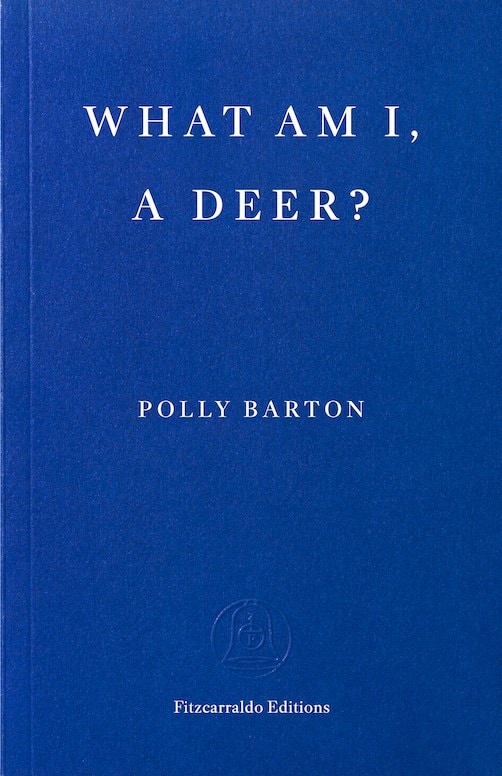
What Am I, a Deer? by Polly Barton is published by Fitzcarraldo Editions and is out now.
