
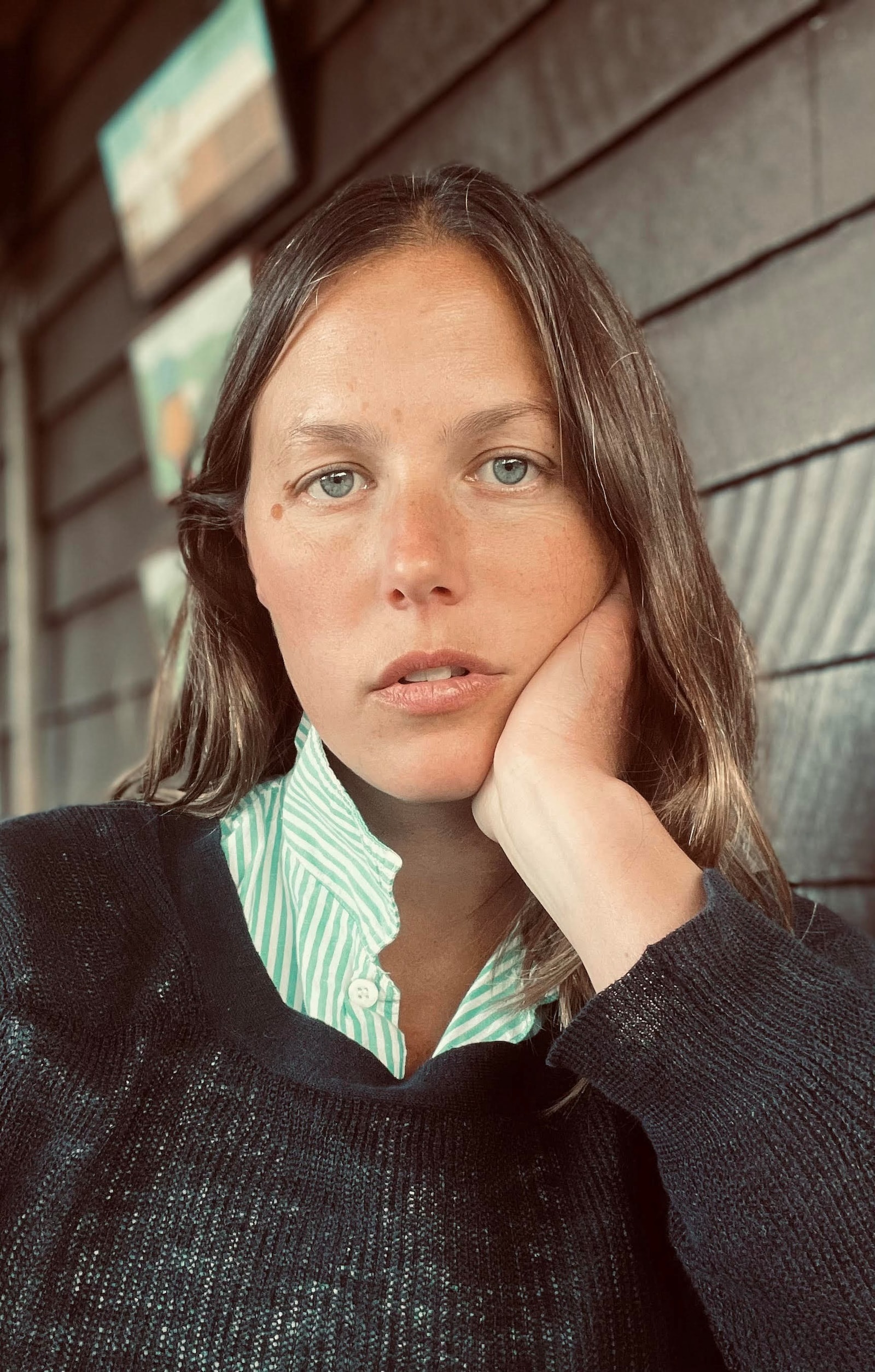
A young mother gets in her car from rural Vermont and drives through the night to New York to find a woman she’s become obsessed with online. This is the basic plotline for Makenna Goodman’s debut novel, The Shame, which some people transposed onto Goodman herself, a young mother living on a homestead in rural Vermont. The book (not autofiction, before you ask) is deeply concerned with what kind of a life we allow ourselves to live and what kind of life others are allowed to have, the stories we tell ourselves and are fed, how women are and how they are allowed to be.
With her second novel Helen of Nowhere, Goodman continues to draw inspiration from her own rural lifestyle, asking who is allowed ‘the good life’, and whether it even exists? A disgraced professor goes looking for an idyllic rural enclave and is shown around a house by a realtor who expounds on the eponymous Helen, the previous owner, as a prime model of ecofriendly living. Structured in five acts, the book is as surreal as it is cosmically revealing, as much a meditation on cancel culture and empathy as it is an examination of how we love another person. In Goodman’s hands, the story is a gripping, funny and careening portrait of a man-in-flux, unwilling to accept the life around him.
Here, Makenna Goodman discusses moving from her homestead to a town, and its effect on her creative process, being in love, and the colonial trappings of the idea of ‘the good life’.

Jemima Skala: How did the idea for Helen of Nowhere come to you after The Shame, and when did you decide on its form and structure?
Makenna Goodman: For both of my books, I began with a question, and the form sort of presented itself. The Shame is, essentially, an exploration of what happens when one encounters the Self, really sees oneself in full awareness. The idea of self, of course, is very interior, and so the book naturally took the shape of an interior monologue. Helen of Nowhere takes the idea one step further, asking what happens when one encounters the Other. How does one learn to re-question one’s idea of the Self, and make space for another person to take residence in our psyche? To do so, one must be in real, honest conversation with another person. So I knew the book had to take the form of a dialogue. It was only much later on in the editing process that Helen of Nowhere became more play-like in structure. And eventually, I found myself imagining the book performed, in an empty wooden room, lit like a stage, so I extrapolated that as far as I could while still technically inhabiting a novelistic space.
JS: Where did Helen come from as a presence? The name is reminiscent of Greek mythology but also Helen Nearing, who I know is a source of preoccupation for you.
MG: I knew Helen needed to have a contradictory essence, that she needed to hold deep wisdom and, at the same time, be untrustworthy and possibly dangerous. In some ways, very loosely, she’s based on an amalgamation of Helen of Troy, who holds such contradictory yet symbolic power around war and love, and Helen Nearing, who I have long had a fascination with around her ideas of ethical living and ‘the good life’. Nearing was an active collaborating partner to men of large ideas; in her early life, she was in relationship with Jiddu Krishnamurti, the Indian philosopher who became the anointed leader of the Theosophical Society, for whom she reportedly acted as a medium.
Later, she fell in with Scott Nearing, a socialist academic with whom she left the city in search of a self-made life lived in close relationship with nature. The Nearings famously wrote a book together called Living the Good Life, which outlined their decades-long experiment homesteading in a hand-built stone house in Vermont. Scott Nearing was a eugenicist, I later found out, and quite a rigid character, who believed that anyone could live the way they did as long as they had the ‘grit’ it took to get it done. This grit has captivated me for a long time, both in my desire to have it and my distrust of its underlying definition. It’s not without its contradictions and its violences, of course.
“Love is one of those keywords that everyone thinks they know something about and yet it’s a state of being and receiving that is infinitely impossible to understand” – Makenna Goodman
JS: How do being in nature and writing live with you? Are they very closely entwined as mindsets and practices?
MG: It is central to how I write, the act of experiencing nature in its dailiness. I suppose in the same way that a writer living in Paris has their writing imbued with a strong sense of Paris, or wherever. Of course, there are writers who can write completely separate worlds from the ones where they live, but I am very interested in the relationship between humans and our environments, and that figures strongly in my work. I find the boundary between myself and the world around me to be very porous, and I have to be intentional to protect that porousness. I am not especially introverted, but I live pretty hermetically. I walk in the woods every day. I spent a lot of time in my garden. This is a great privilege, to be able to spend so much time in conversation with my natural surroundings, and it gives me a sense of comfort to watch the light shift through the leaves at various times of day. In winter, I take great pleasure in feeding the wood stove – that kind of thing.
JS: How was the move into a town for you, given that you’ve been so rural and the homestead has been a central part of your life and work for a while?
MG: I actually wrote Helen of Nowhere while living on a homestead where I had spent over a decade growing food, tending animals et cetera, and I wrote the book as I was preparing to leave it. I was consumed with notions of abandoning my ethos and fears of missing the feeling of jumping into a pond when I was hot. It felt a little like leaving a church. Could I exist if not ‘all in’? This allowed me to uncover the paradoxes that exist in ‘right’ ways of living, as I saw myself as both a part of it and apart from it.
“Narrative is something that can confine us, and yet stories are also ways to liberate ourselves” – Makenna Goodman
JS: Empathy, perspective and love feel crucial to Helen of Nowhere. Could you expand on that a bit in relation to the book and your thinking while writing it?
MG: Love is one of those keywords that everyone thinks they know something about and yet it’s a state of being and receiving that is infinitely impossible to understand. How does love work? Like, really work? The mystery of how it functions was of great interest to me while writing this book. Part of my inspiration was a conversation with a healer (we’ll call it that) who I went to at a time when I couldn’t understand how to be in love correctly. He told me to really think from the perspective of the Other, which sounded so basic, you know? He gave me some other bizarre sounding tips on how exactly to do that, and at first, I was really offended. Me, centre a man? What about my own victimhood? I was very certain of my own narrative. But when I did what he said, really tried to see from the Other’s perspective, I realised that love is possibly about doing away with narrative. It’s not about submitting to the Other, at least not entirely, or if so, not forever. When one lays down their narrative, however, it invites the Other to do the same. Narrative is something that can confine us, and yet stories are also ways to liberate ourselves. The power of storytelling is really profound.
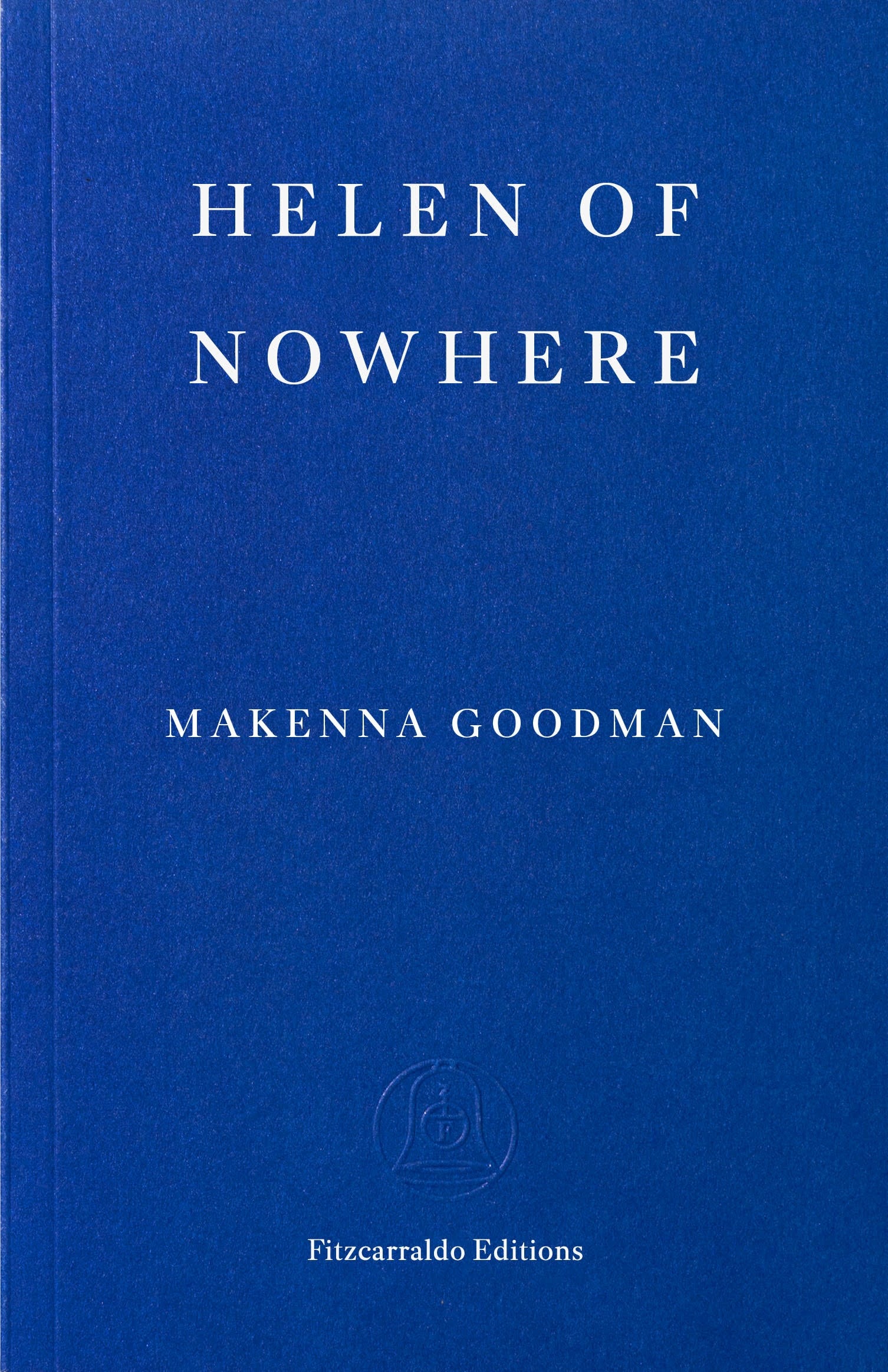
Helen of Nowhere by Makenna Goodman is published by Fitzcarraldo Editions and is out now.
