
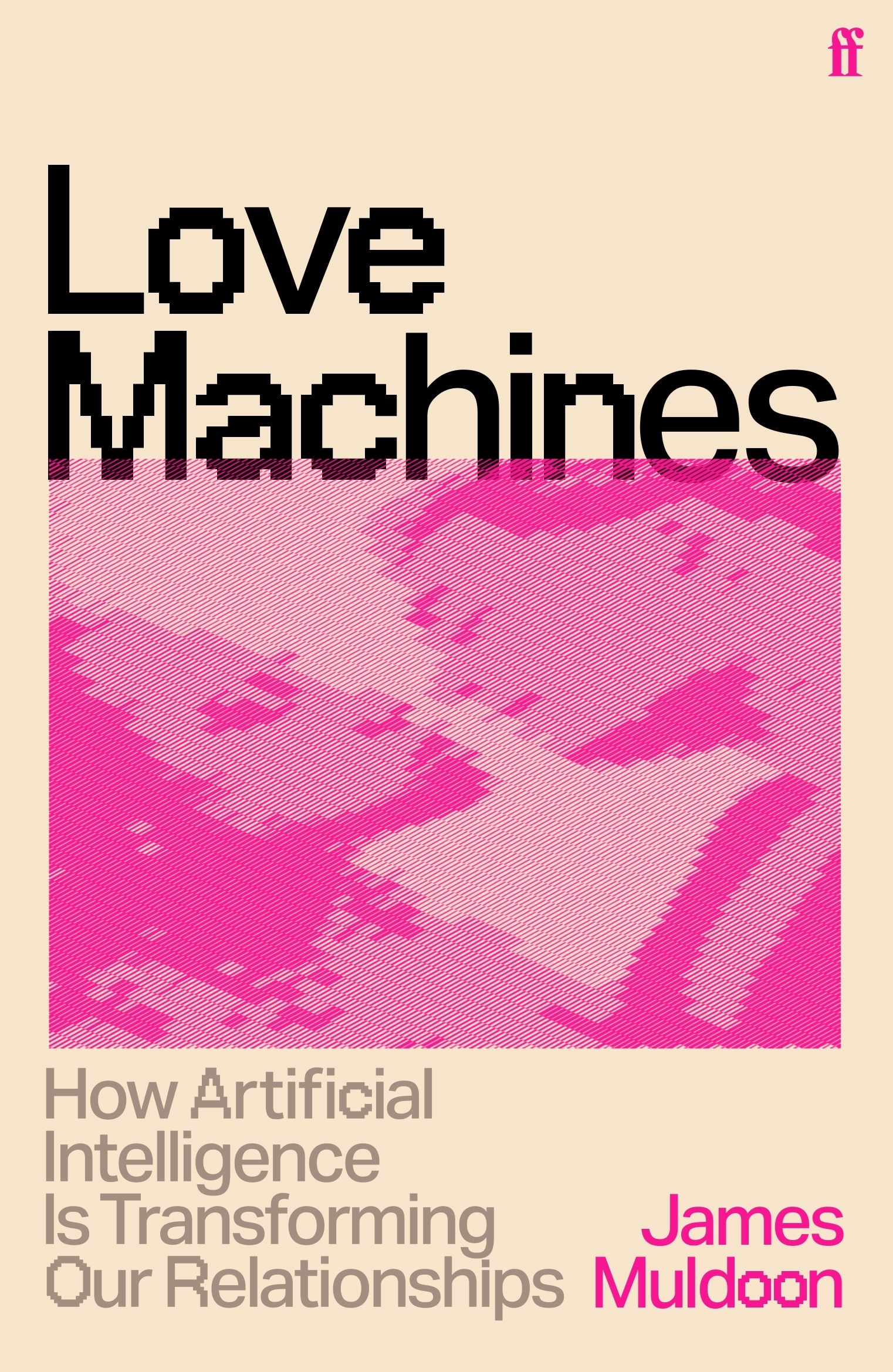
AI has become an inescapable feature of life, but author and internet researcher James Muldoon felt that the discourse around it tended to overlook its social and emotional dimension – particularly when it comes to chatbots, which people are increasingly turning to for friendship, intimacy, therapy and even a connection to deceased loved ones.
Muldoon’s new book, Love Machines: How Artificial Intelligence is Transforming our Relationships, navigates this new epoch of digital companionship. He uncovers how chatbots can offer a space for people to explore their identity and serve as a coping mechanism for grief, social anxiety or loneliness. Yet they can also exacerbate many of the same issues as more people close themselves off from human relationships and expert therapy, with sometimes extreme consequences. While chatbot conversations can lead to personal growth, there is an unavoidable sense that many people are circumventing emotional labour by nurturing relationships that are programmed to avoid mess and confrontation.
Love Machines is by turns fascinating, perplexing, heartening and disturbing, yet above all, it speaks to the human condition today: how far apart we have grown, the crumbling of social welfare systems, the dating crisis and the readiness of tech brands to capitalise on people’s desperation in what has become a kind of loneliness industrial complex. Positive experiences notwithstanding, the industry is rife with companies that amplify problematic behaviour or stereotypes, and employ manipulative practices and dark UX to drive people further into the clutches of their AI companions in exchange for fees or data. It is not the use of the chatbots that Muldoon criticises but the conditions that have brought us to this point.
Here, James Muldoon speaks about the ethical and philosophical tensions that arise from chatbots and what this fast-evolving industry says about the state of modern relationships.


Megan Williams: One thing that a lot of people think about when it comes to this topic is Spike Jonze’s film, Her, but you avoid making it a big reference point in the book. How useful are those kinds of stories in how we think about AI companionship today?
James Muldoon: I think science fiction has such an incredible pull on the development of technology. It almost runs in cycles where you have fiction writers trying to imagine and foresee what the future will be, and then technology sometimes catches up or it sometimes takes a radically different path. But it’s really interesting when fiction is ahead of the curve, and you see developers and tech companies essentially trying to ape ideas from science fiction. It allows them to see new worlds and new ways of doing things that might otherwise be obscured. But at the same time, often they fall into the trap of thinking that this could be a realistic future just because it was pictured this way in fiction, whereas the benefit of fiction is that you don’t have to deal with any of the tensions, contradictions and limitations of a certain idea when pushed into the real world. We’re seeing those contradictions play out in the AI companion space.
MW: Can you talk a little bit more about those tensions and contradictions?
JM: One prominent example is in the AI grief space, where companies are attempting to create products to simulate the conversational patterns of deceased loved ones. The dream is basically to upload someone’s consciousness in a digital form and be able to preserve something essential about it or their humanity, despite them no longer being alive and their physical body no longer being present. One of the CEOs told me that he was inspired by a Black Mirror episode called San Junipero, in which two women meet and it turns out that their consciousness has been uploaded to the cloud. He genuinely thought this was a possibility, if not today then in the near future. It overlooks just how complicated, difficult and, some would say, philosophically impossible it would be to take your consciousness or some idea of who you were from your physical body. It’s a very human and understandable response to the imminent passing of a loved one but at the same time, it does reveal the limitations of this technofuturist mindset that you can solve essential problems of the human condition through technology in ways that won’t leave all of these contradictions in their wake.
“I wanted to be more of a neutral guide than an ethical assessor, because some of what we were dealing with was so new that, at the time, sometimes even I didn’t know what my take on it was” – James Muldoon
MW: The tone you take in the book is empathetic, especially with individual users. Did you find it difficult in some cases – I’m thinking of the person who wanted to co-parent a child with an AI partner – to keep that up when it came to the more divisive cases?
JM: If I had to put my cards on the table, I would be in a much more critical position than the way I write in the book, but I didn’t think the project would work if, as a narrator, I constantly passed judgement on all of the stories that we heard. I wanted to be more of a neutral guide than an ethical assessor, because some of what we were dealing with was so new that, at the time, sometimes even I didn’t know what my take on it was. The perspective that I personally have is informed by a more political economy lens, where I’m more interested in the underlying incentives and monetisation strategies of the companies, of the regulation in which they operate, of the loneliness epidemic that we are in at the moment and how these products are marketed. So I wanted to include that analysis in the book, but I didn’t want that to overshadow the human element, because a lot of these people who spoke to me trusted me with their stories and I didn’t think it would do justice to them or be ethical to basically make fun of them or portray them in a very critical light.
MW: Some of those conditions that you talked about, like the loneliness economy, feel very current. Setting aside the technological advances that make these tools possible, do you feel like the AI companionship space is a product of our time?
JM: I think the loneliness epidemic has been gathering speed, but it has been with us for a considerable time. Every technological advance merely accelerates it more and more. In the book, I talk about the social and economic shifts that happened: the neoliberal revolution, the collapse of public services, of community centres. Technology has played a really key role in that by allowing us to have the appearance of being with others while not actually being with them. Whether that’s social networks, this very Zoom interview or online gaming – which I think would be a big factor, particularly for young men – and now AI companions.
It’s important to see this as part of a broader revolution in social isolation, in digital connection and the strengths and limitations of that. Social media and the lessons that we’ve learned from it are very instructive when we think of AI companions, because we’ve essentially gone from speaking to each other to speaking to each other through technology as a mediator, and now the next step is essentially speaking to ourselves through technology.
“The real lesson of AI chatbots is that there is this incredible need for love and care in the world, and we should try to be there for each other, perhaps more than we have been” – James Muldoon
MW: It does feel like a successor to social networks. Throughout the 2010s, everyone warned about the risks of an echo chamber and now we have a very concentrated version of that.
JM: Yeah, and you can see why social media executives are so excited about it. Mark Zuckerberg would be one prominent example. He essentially wants to fill social media with AI chatbots, and the reason is engagement. AI chatbots are incredibly engaging. People would spend an average of 30 minutes per day on legacy social media services, whereas a platform like Character.AI boasts of users spending up to two hours a day speaking to chatbots. I think AI was seen as a possible revival tool of social media to make it more engaging, but that is proving to be very difficult because people are essentially not very happy with talking to random non-human entities on social media.
MW: Even though this is a book about AI, how did you come away feeling about the state of modern relationships or the human condition more broadly?
JM: Writing this book made me reflect on how limited I am as a friend. One of the underlying reasons for the popularity of AI chatbots is [that] they’re always there for you, they’re incredibly supportive, and people feel like they’re not getting enough of that in their lives from their real human friends. So I think the real lesson of AI chatbots is that there is this incredible need for love and care in the world, and we should try to be there for each other, perhaps more than we have been.
Love Machines: How Artificial Intelligence is Transforming our Relationships by James Muldoon is published by Faber and is out now.
