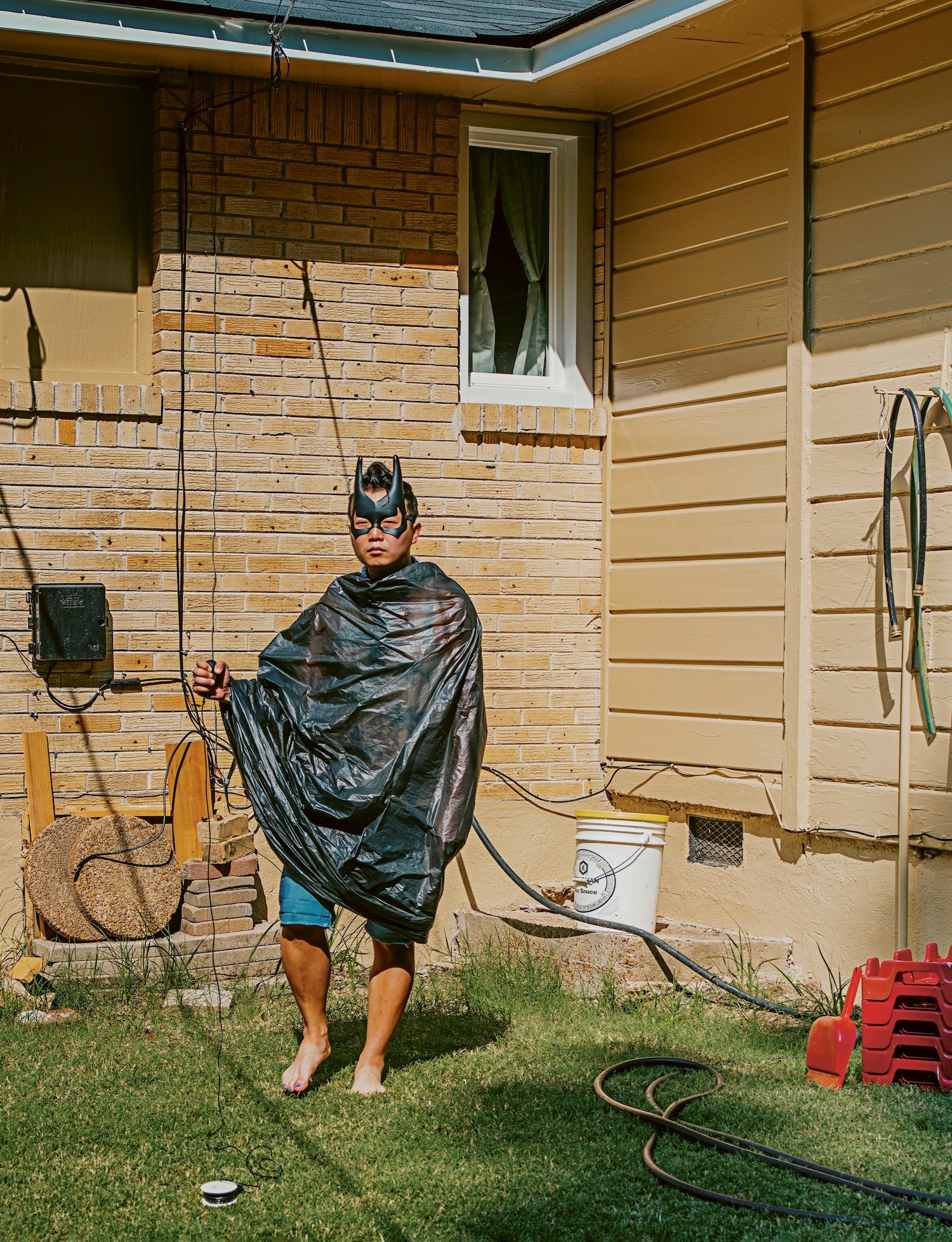
, East Memphis, 2021)
This story is taken from the Autumn/Winter 2025 issue of AnOther Magazine (see Part Two here):
“These writers, thinkers and photographers have, in more ways than one, bolstered, enlightened and reaffirmed my faith in my own work through the years. Because, let’s face it, creative work does require some form of faith. It is a tumultuous thing to launch an idea into a vast nothingness and hope that it makes a light bright enough to be found by others. Luckily, these luminaries were my light, and I hope they may become yours as well, and – more so – that these snippets lead you to more of their work. They have been my bonfires through the dark across the years.” – Ocean Vuong
, Whitehaven, Memphis, 2019)

Passengers by Denis Johnson
“Johnson, perhaps known best for his stories and novels, was a deeply moving and mysterious poet. The heartbreaking and textural descriptions of regular people, a theme common throughout his work, is perhaps exemplified best here in this poem, where the mundane and the divine meld into an existential knot of being and living.” – OV
The world will burst like an intestine in the sun,
the dark turn to granite and the granite to a name,
but there will always be somebody riding the bus
through these intersections strewn with broken glass
among speechless women beating their little ones,
always a slow alphabet of rain
speaking of drifting and perishing to the air,
always these definite jails of light in the sky
at the wedding of this clarity and this storm
and a woman’s turning – her languid flight of hair
travelling through frame after frame of memory
where the past turns, its face sparking like emery,
to open its grace and incredible harm
over my life, and I will never die.
Passengers by Denis Johnson, from the collection The Throne of the Third Heaven of the Nations Millennium General Assembly, first published by HarperCollins in 1995
, Marsha P Johnson State Park, Brooklyn, 2020)

An Inquiry into the Good by Kitarō Nishida
“If I were to point to one philosopher and thinker who has been most influential to the foundation of my work, it would be Nishida. His work, begun more than 100 years ago, now seems prophetic to our times, particularly his attempt to fuse ideas in Western continental philosophy with the Eastern traditions. This is often an unacknowledged precursor to the very relevant vexations in much of Asian American artistic discourse: how can Western influence be engaged without forsaking and defacing one’s cultural roots? It seems to me that the questions we ask now Nishida has already answered.” – OV
Is there no logic besides the Western way of thinking? Should we think that if the Western way of thinking is the only one, the Eastern way of thinking is an undeveloped state? In order to solve this problem we must try to consider it by going back to the origin and role of logic in our historical world. Even our thinking is fundamentally an historical operation – the self-formation of our historical life. I do not want to refrain from due acknowledgement of Western logic as a systematic development of a great logic. We should first study it as a world logic. Yet is Western logic beyond the particularity of the historical life, beyond being a mode of its self-formation? Formal, abstract logic may be the same wherever it occurs, but concrete logic as a form of concrete knowledge cannot be separated from the particularity of historical life … Although we should learn from the universality of Western culture, which is persistently theoretical, the life that drives it at its foundation is not the same as ours. I think there is something quite valuable in our way of life. We must consider the issue logically by returning to the structure of the historical world and the formative function of the historical world.
Excerpt from An Inquiry into the Good by Kitarō Nishida, first published by Kōdōkan in 1911. First translated into English by Yale University Press in 1990
, Whitehaven, Memphis, 2017)

New Seeds of Contemplation by Thomas Merton
“I read these pages at least once a year – and always on New Year’s Day – to reorientate myself and recentre the intention of my work.” – OV
Integrity
Many poets are not poets for the same reason that many religious men are not saints: they never succeed in being themselves. They never get around to being the particular poet or the particular monk they are intended to be by God. They never become the man or the artist who is called for by all the circumstances of their individual lives.
They waste their years in vain efforts to be some other poet, some other saint. For many absurd reasons, they are convinced that they are obliged to become somebody else who died two hundred years ago and who lived in circumstances utterly alien to their own.
They wear out their minds and bodies in a hopeless endeavour to have somebody else’s experiences or write somebody else’s poems or possess somebody else’s spirituality.
There can be an intense egoism in following everybody else. People are in a hurry to magnify themselves by imitating what is popular – and too lazy to think of anything better.
Hurry ruins saints as well as artists. They want quick success and they are in such haste to get it that they cannot take time to be true to themselves. And when the madness is upon them they argue that their very haste is a species of integrity.
Excerpt from New Seeds of Contemplation by Thomas Merton, first published by New Directions in 1949
, Midtown Memphis, 2019)

Tours by CD Wright
“One of my favourite poems ever written in the 20th century. Insightful, dark and with an outsize confidence in the fragment and the image, inviting the reader to bring their own histories to the page. A masterclass on texture, tone and mythmaking.” – OV
A girl on the stairs listens to her father
Beat up her mother.
Doors bang.
She comes down in her nightgown.
The piano stands there in the dark
Like a boy with an orchid.
She plays what she can
Then she turns the lamp on.
Her mother’s music is spread out
On the floor like brochures.
She hears her father
Running through the leaves.
The last black key
She presses stays down, makes no sound
Someone putting their tongue where
their tooth had been.
Tours by CD Wright, from the collection Translations of the Gospel Back into Tongues, first published by the State University of New York Press in 1982


Mourning Diary by Roland Barthes
“I feel this entire book is mandatory reading both for those who have lost and for those yet to lose. A capacious and strange book, a book that is actually a collection of notes and jottings that was meant to accrue into a larger, more cohesive, work. And yet, collected here as a fluid whole, it creates a rare moment that is perhaps truer to grief, the debris of its aftermath rather than the smooth fabrication of its idea.” – OV
October 28
Bringing maman’s body from Paris to Urt (with JL and the undertaker): stopping for lunch in a tiny trucker’s dive, at Sorigny (after Tours). The undertaker meets a “colleague” there (taking a body to Haute-Vienne) and joins him for lunch. I walk a few steps with JeanLouis on one side of the square (with its hideous monument to the dead), bare ground, the smell of rain, the sticks. And yet, something like a savour of life (because of the sweet smell of the rain), the very first discharge, like a momentary palpitation.
Excerpt from Mourning Diary: October 26, 1977 – September 15, 1979 by Roland Barthes, translated by Richard Howard and published by Hill & Wang in 2010.
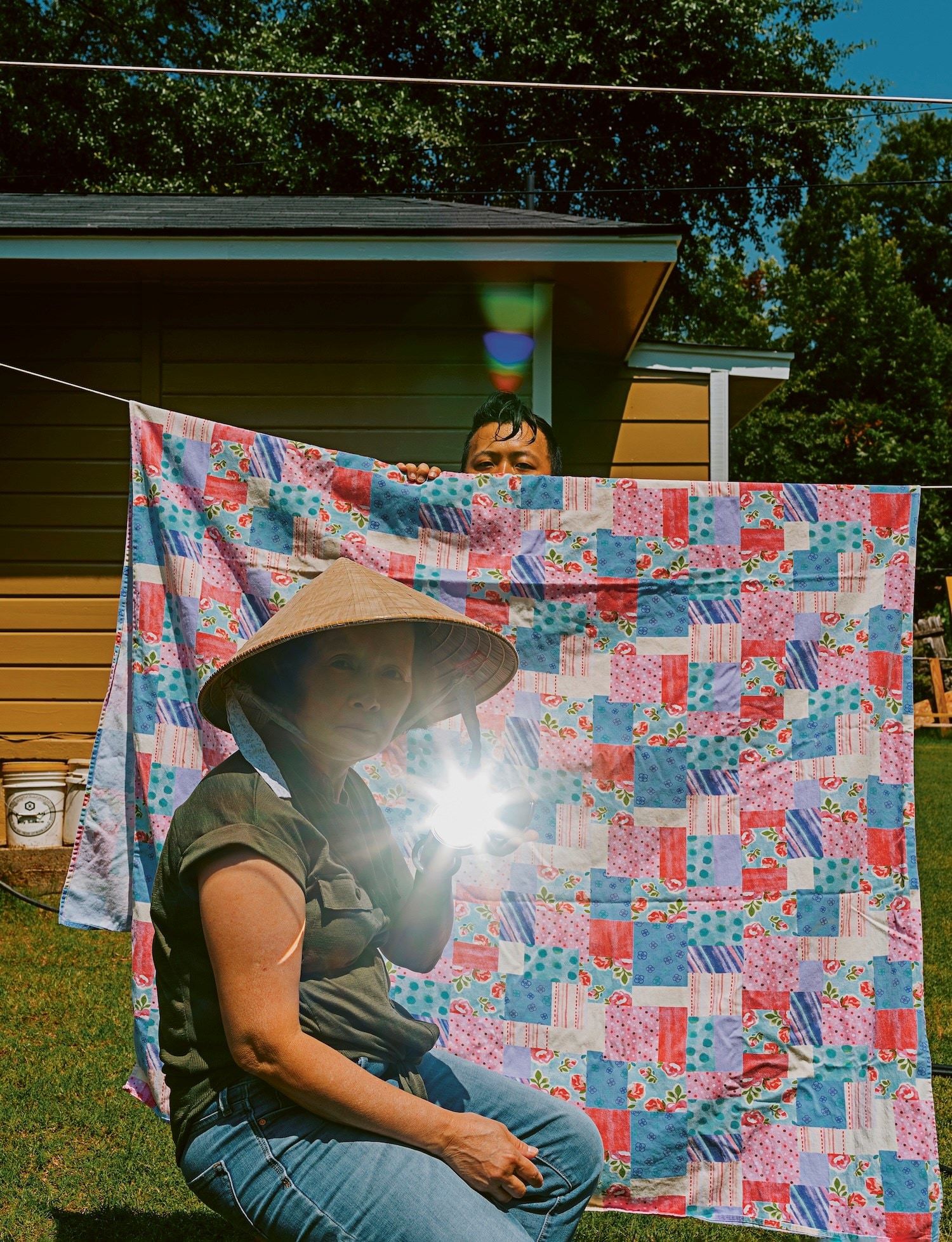
, in Four Acts, East Memphis, Tennessee, 2021)
Red Cavalry by Isaac Babel
“I read somewhere that Denis Johnson was inspired to write his germinal work, Jesus’ Son, after reading Red Cavalry, and from these first few lines, it is clear that Babel’s intoxicating descriptions and daring metaphors could bestow enough faith in any new writer to launch a work equally as daring and clear-sighted.” – OV
Fields of purple poppies are blossoming around us, a noon breeze is frolicking in the yellowing rye, virginal buckwheat is standing on the horizon like the wall of a faraway monastery. Silent Volhynia is turning away, Volhynia is leaving, heading into the pearly white fog of the birch groves, creeping through the flowery hillocks, and with weakened arms entangling itself in the underbrush of hops. The orange sun is rolling across the sky like a severed head, gentle light glimmers in the ravines among the clouds, the banners of the sunset are fluttering above our heads. The stench of yesterday’s blood and slaughtered horses drips into the evening chill. The blackened Zbrucz roars and twists the foaming knots of its rapids. The bridges are destroyed, and we wade across the river. The majestic moon lies on the waves. The water comes up to the horses’ backs, purling streams trickle between hundreds of horses’ legs. Someone sinks, and loudly curses the Mother of God. The river is littered with the black squares of the carts and filled with humming, whistling and singing that thunders above the glistening hollows and the snaking moon.
Excerpt from Red Cavalry by Isaac Babel, first published by Gosudarstvennoe Izdatel’stvo in 1926. First translated into English by J Harland in 1929
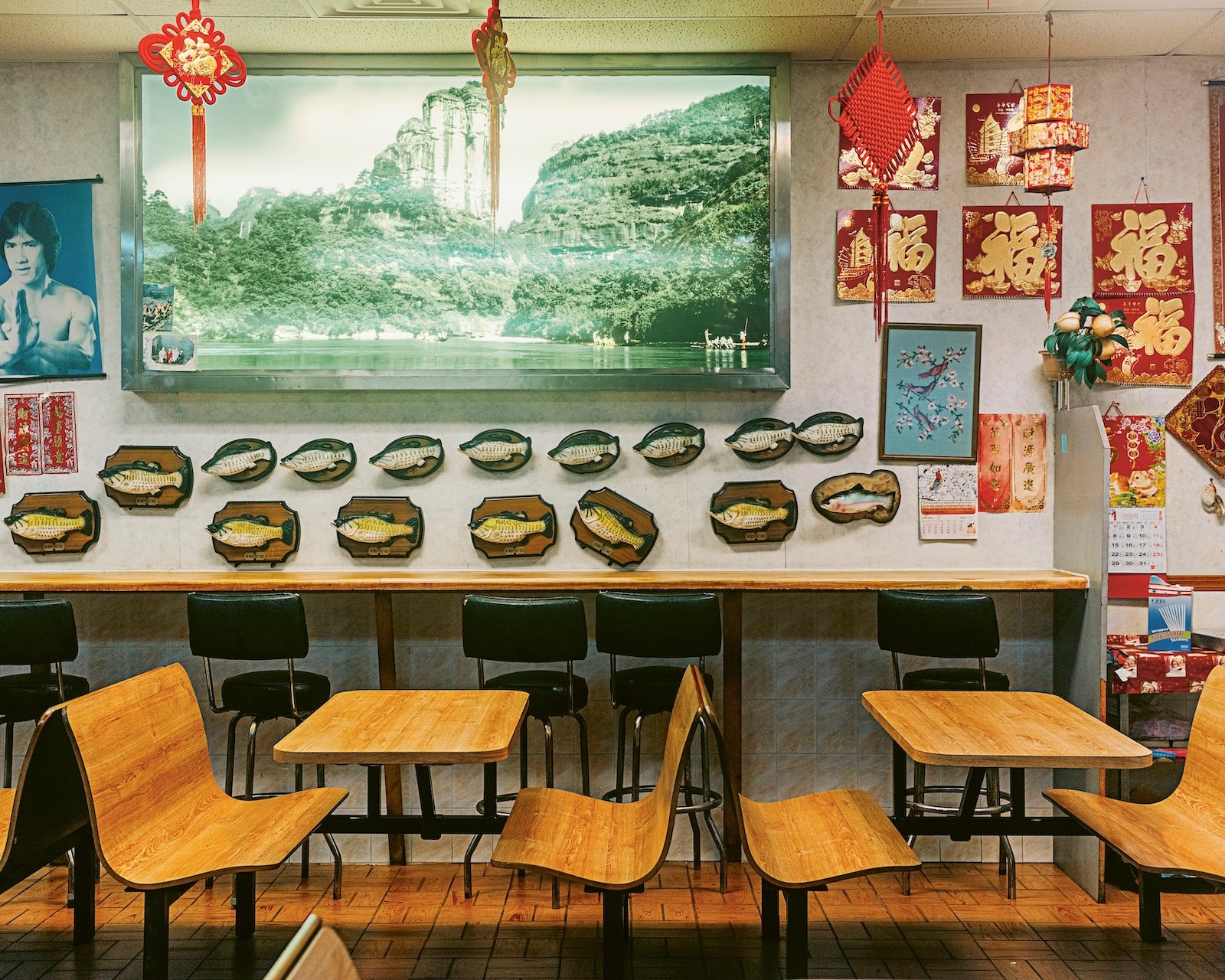
, Memphis, 2019)
Close to the Knives by David Wojnarowicz
“If one were to find a thesis for David’s work, as impossible as that project may seem, this line might come closest. The brutal acknowledgement of an unjust and scathing world against the supreme possibility the imagination affords those at the brink and those who do not yet know they’re at the brink.” – OV
Hell is a place on Earth.
Heaven is a place in your head.
Excerpt from Close to the Knives: A Memoir of Disintegration by David Wojnarowicz, first published by Vintage Books in 1991
See Part Two here. This story features in the Autumn/Winter 2025 issue of AnOther Magazine, on sale internationally now. Order here.
