

The cult French director who won the Palme d’Or for Titane, talks about her new film Alpha, a response to the culture of fear that emerged from the Aids epidemic
Few films can receive the Palme d’Or and still claim cult classic status but Julia Ducournau’s Titane managed it. After lighting the film world on fire with that sinewy and strange film in 2021, the French filmmaker had carte blanche to think about what the next Julia Ducournau film would look like – but she didn’t consider it like that. “Well, I don’t think of myself in the third person,” she says drily. We’re seated in a conference room the day after Alpha’s BFI London Film Festival premiere, joined by the film’s star Tahar Rahim. “That would be really strange. I honestly never asked myself this question.”
But the wheels did turn quickly on Ducournau’s follow-up to Titane – too quickly, as she would admit. “I tend to rush to the next project after I’m done with a film because I don’t want to get into depression and fall into the void.” She didn’t allow herself to dwell on her Palme d’Or win (“I hide it in my house so I don’t see it”) and began work on a new script, but after a year, Ducournau hit the brakes. “It made me realise that what I was doing was just a buffer zone after Titane. I needed to be assured that I could still write, basically. I realised I was repeating myself, reproducing recipes in a way that was extremely sterile.”
She went back to the drawing board again and the result became Alpha: a gorgeous, unwieldy quasi-ghost story that feels stranger and eerier than Titane. It centres around Alpha (Mélissa Boros), a teenage girl living in coastal France, who returns home to her doctor mother (Golshifteh Farahani) with a freshly inked tattoo on her arm. There’s a disease circulating, which transforms the infected’s skin into milky white marble – and it appears that Alpha is the latest to contract it. Her social ostracisation is swift and vicious but she finds succour in Amin, her uncle and a man in the throes of drug addiction, played wonderfully by Tahar Rahim.


Alpha wouldn’t work without a performance as raw and uncomfortable as Rahim’s. It’s obvious from the film and their chemistry together that Rahim and Ducournau are a dream actor-director pairing, drawing out the best in each other. Rahim felt the same when he first met the filmmaker: “I had a gut feeling that something even beyond just a collaboration could happen, but maybe I was mistaken – you never know.” On the first day of filming Rahim realised he was correct. “In that first sequence, that first take, something happened and we clicked right away. It felt organic and real. It was as if we didn’t have to talk, as if somehow our souls were discussing. It was what I call trust and it’s the best gift a director can give you.”
Rahim, in turn, gave chunks of himself to the film, losing an alarming 44 pounds to embody the part of a drug addict. He spent time working with an addiction treatment facility in Paris, speaking with people experiencing addiction. “They allowed me to watch them in their pure intimacy – when they were doing their fix – and I came to realise that people are watching them like ghosts on the side of the street. But they’re sick, [addiction] is a disease.”

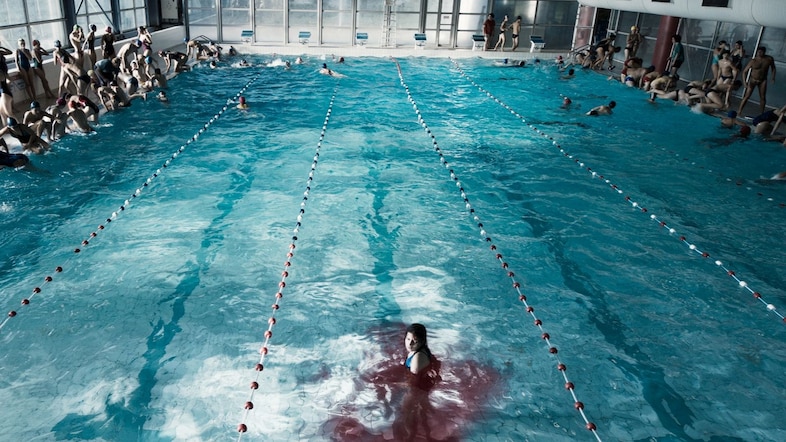
Critics have been eager to draw a line between Alpha’s disease and the Aids epidemic but Ducournau insists it’s not a literal Aids film. Instead, it’s her response to the culture of fear that emerged from the epidemic; in the late 1980s and early 90s, when Alpha is nebulously set, Ducournau would have been the same age as Alpha. “I definitely felt the fears that I’m feeling now for the first time when I was a teenager at the peak of the Aids crisis,” she says. “20 years prior, our parents had this freedom of sexuality and sex was healthy. That followed us for years and fear seeped into the interstices of society. I saw the rise of uninhibited homophobia. For younger generations that seems dystopic now, but it was incredibly real, and I’ve lived those scenes more than once, unfortunately.”
If Titane was divisive for its audacious content, then Alpha is the kind of audience-splitting fable that will be parsed out for years to come. The reception at Cannes was not glowing and, in some quarters, almost gleeful that Ducournau hadn’t reached the same heights as Titane. How does she feel about audiences and critics defining her against Titane? “I think it’s something that applies to all artists nowadays, because more and more people need to feel comfortable and they need things to be predictable because nothing is predictable today,” she says. “People feel comfortable with a linear story and a linear career, like the critics who said, ‘Ah, of course she couldn’t do it again after Titane!’ as if they had predicted it. It was satisfying and comfortable to say that and I understand the reflex because I understand the world we all live in.”
Alpha is out in UK cinemas now.
