
From Emma Stone in Bugonia to Nicole Kidman in Babygirl, the high-flying girlboss has swept the big screen. But is this trope quite as progressive as it seems?
Listen closely, and you may hear her coming. There’s the distinctive sharp clack of heels on laminate flooring. The sumptuous swish of a silk skirt. You catch words like “bandwidth” and “synergy” wafting down the hall. This is cinema’s favourite new antiheroine: the girlboss.
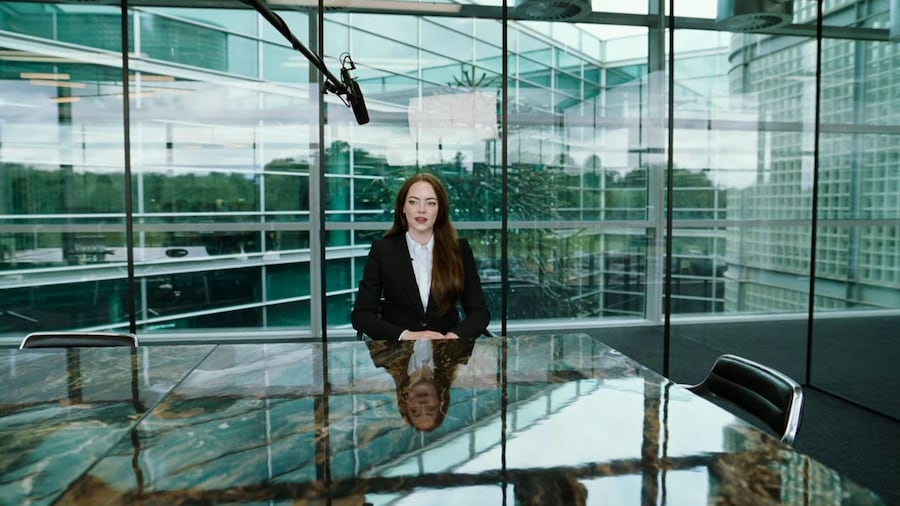
Fierce, pristine female workaholics are cropping up everywhere on screens right now. In Yorgos Lanthimos’s Bugonia, in cinemas this month, Emma Stone plays Michelle Fuller, the high-flying CEO of a pharmaceutical company whose sleek, corporate exterior and vocabulary stuffed with HR lingo make her seem so inhuman, two kidnappers become convinced she is a literal alien. In summer, we had Celine Song’s Materialists, Dakota Johnson donning her quiet luxury officewear as Lucy Mason, a matchmaker and hardened career woman for whom romantic relationships are a business deal and nothing more. And last year, Halina Reijn’s Babygirl saw Nicole Kidman slipping into silk and cashmere as Romy, a high-powered CEO of a robotic process automation company who is searching for something, well, a little less robotic from her sex life. Throw in the likes of Kate Hudson’s shady wellness CEO in this year’s Shell, Emma Stone’s clout-chasing nepo baby in The Curse (2024) and Rosamund Pike’s care-home scammer in I Care a Lot (2021), and the growing ranks of girlboss grifters begin to look like an army.


Each story opens with the girlboss in her prime, the serene queen of her modern-day corporate empire. In Babygirl, Kidman’s character is shown darting between boardroom meetings and Botox appointments, while Emma Stone’s CEO in Bugonia undertakes a rigorous pre-work training regimen of running, boxing and stretching before strutting into the workplace like a warrior queen. These are women who can have it all – or at least, who think they can. But before long, the cracks begin to show in their corporate armour, and their ambition ultimately leads to their undoing.
In Babygirl, Romy’s swaddled life of stability leaves her yearning for something uglier, rawer, kinkier. Her affair with a young intern flips her carefully constructed power dynamics on their head and threatens her empire and, by extension, her own sense of self. In Materialists, Johnson’s Lucy finds herself torn between the ultimate corporate win (a “unicorn” in the form of the rich, handsome, placid Pedro Pascal) and a girlboss fail (a relationship with the deadbeat love of her life, Chris Evans). Ultimately, she can’t stomach the emptiness of a relationship for money, and gives up the high-flying girlboss life she had created for herself. Meanwhile, Stone’s sense of self is so wedded to her corporate identity that not even the prospect of kidnap and torture can shake her from her complacency.
These filmmakers are, of course, responding to a real-world phenomenon. Springing into the public consciousness about a decade ago, the girlboss was originally seen as aspirational. A shorthand for girl power in a traditionally masculine corporate world, the girlboss promised to do what the men did; perhaps even do it better. She too could dominate the boardrooms, oversee lay-offs and rise to the top of the corporate ladder, and she would do it all in heels.


However, the world soon turned on the girlboss. What was once a badge of honour became an underhanded insult: these days, the term is practically synonymous with “conscious, willing cog in an evil, repressive capitalist system”. Perhaps you’ve come across the phrase “gaslight, gatekeep, girlboss” on social media? Spoiler: it’s not complimentary. As it turned out, women who not only entered into, but held up the patriarchal corporate system (rather than fighting against it) were probably nothing to celebrate. It didn’t help that a number of prominent real-world examples were revealed to be actual criminals – take Elizabeth Holmes, whose billion-dollar company Theranos turned out to be built on technology that didn’t actually work, despite Holmes’ claims, or scammer Anna Delvey.
Although each film has a different level of sympathy for its respective girlboss, each of these characters represents an uncomfortable, dated brand of (it must be noted, glaringly white) feminism. It’s a simplified, uncomplicated, Instagram-friendly version of empowerment that fails to separate itself from the misogynist patriarchal system it clumsily pretends to defy. While they may, on the surface, be breaking down gendered barriers, perhaps they are only serving to keep an unbalanced system going – a system in which only a few can rise to the top at the expense of the many. This sort of one-woman tokenism is perfectly encapsulated in Babygirl, which sees Kidman’s character losing her position to a female underling.
Although the girlboss has been fading out of popularity for some time, at this particular moment, she’s experiencing new lows in popularity. Chalk it up, perhaps, to the kind of spiralling wealth inequality that’s now become teeth-grindingly familiar: this year, for instance, research by the Resolution Foundation found that it would take the average earner in the UK 52 years of work to become as wealthy as the richest 10%. Another staggering figure: the UK’s wealth gap has grown by 50% in eight years up to 2024. In this context, the pseudo-feminism that preaches the empowerment of “hustling” and “bossing it” all in the name of claiming money and power at the expense of others not only leaves a sour taste in our mouths, it’s downright infuriating. This year, there has been a noticeable reappraisal of certain real-world girlbosses. Take Taylor Swift, a billionaire who girlbossed her way to reclaiming her entire music catalogue, but whose fans are nonetheless beginning to call her out on her seemingly money-obsessed approach to her latest album release. (One of her new songs includes the line “Did you girlboss too close to the sun?” and many would argue yes, she did.)


It’s worth asking ourselves if this trope is quite as progressive as it seems. Is the girlboss really the villain we think she is? Or is she merely another symptom of a toxic system? Is casting the girlboss as the big screen villain and/or antihero du jour really an insightful commentary on the ways in which capitalism subverts the ideals of feminism, or is all of this girlboss schadenfreude merely more misogyny in disguise? After all, these women know they must squeeze themselves into something they know the male corporate world will accept in order to succeed; they make themselves palatable, adopting the approved aesthetic and the jargonistic lingo. Is that really such a crime?
My inclination is that we should treat our female characters with the same respect we treat our male ones. It’s good to have complex, unlikeable female antiheroes. And we certainly shouldn’t excuse them for doing bad things just because they are women. These filmmakers seem to agree. That being said, it won’t be long before the downfall-of-the-girlboss trope begins to get a little old. And the more films that dare to dig deeper – to confront the system itself that allows for girlbosses to exist in the first place – the better.
