

The Four Spent the Day Together is Chris Kraus’s first novel since 2012’s Summer of Hate. In the years since that novel, her native US has changed in ways most writers would struggle to chart. Kraus’s own life changed radically in that time, too. In 2016, her first novel, cult classic I Love Dick, then nearly 20 years old, was made into an Amazon series starring Kathryn Hahn, exponentially raising her profile. After that, the author, critic and co-editor of influential press Semiotext(e) published a biography of Kathy Acker and a book of essays. The new novel is a state-of-the-nation kind of book, weaving together the unruly strands of contemporary culture and finding confluences between Kraus’s straitened childhood in blue collar Connecticut and a senseless murder in small-town Minnesota in 2019. (That the murder really took place on January 6 – an inauspicious date if ever there was one – is a startling, random synchronicity in a cultural landscape littered with them.)
The book begins with the parents of Catt Greene (an avatar for Kraus) as they start a family and strive to attain the American Dream. Catt’s family circumstances remain precarious, and bright-but-bullied Catt is going off the rails by the time she reaches her teens. The family’s abrupt decision to emigrate to New Zealand reroutes her from what increasingly feels like a foregone dead-end. The book then picks up her life as an adult. There’s the divorce from her first husband, Mikal (a stand-in for the late Sylvère Lotringer); remarriage to Paul, a social worker struggling with drug and alcohol addiction; and the purchase of what Catt hopes will be a dream retreat in North Minnesota. Then there’s the dissociating experience of having her first book suddenly explode in the public consciousness, only to later find herself “cancelled” for being a landlord (a fact which fictional Catt, like Kraus herself, has never hidden). Finally, there is the murder, which takes place on a trail not far from Catt’s rural retreat, perpetrated by local kids who cap a day-long meth binge with a man they hardly know by blindfolding him and shooting him dead. Addended by the arid DMs of the murderers over the course of their fateful binge, The Four Spent the Day Together is a fascinating trip into the ambient systems powering contemporary life.
Here, we talk to Chris Kraus about how she conceived and wrote this brilliant book.

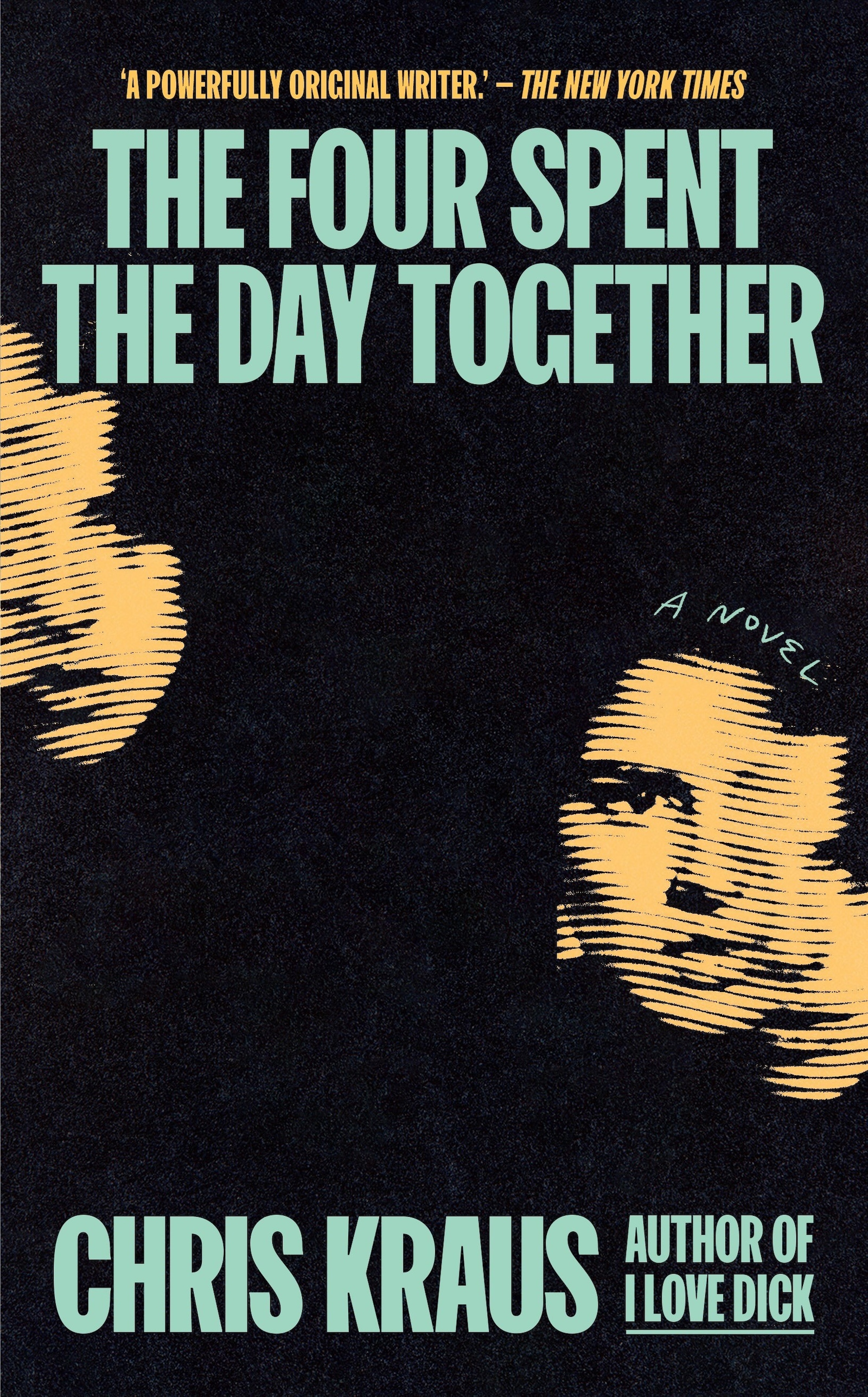
Laura Allsop: The title of this book – The Four Spent the Day Together, taken from a newspaper report about the murder – is so compelling. It opens so many possibilities. What drew you to this story?
Chris Kraus: The crime was really interesting to me initially because of its durational nature. There’s no shortage of murders in North Minnesota – and it turns out that all of the murders there for the last 20 years have involved methamphetamine. But it was the fact that they kidnapped the victim and spent 18 hours together, almost an entire day. That interested me, because I’m wondering, what were they doing? My first thought was – you know the Michael Haneke movie, Funny Games, where the preppies torture this young couple and give them multiple chances to get away? I thought it would be something like that. Yes – and no. In fact, there were multiple times where the victim could have left. But these were not preppie serial killers, they were kids who were just getting high together on methamphetamine. It was an 18-hour meth binge.
My first job was to try and reconstruct what happened during that time. I guess I learned this when I was writing the Kathy Acker biography – the first thing you do is make a timeline, and then everything slots into it. Well, talking to the kids, which I did while they were in prison, I wasn’t going to get very far, because no one could remember anything. You know, they’d been up for five days. They’re all trauma victims who tend to shut down when things get too intense. It was all a blur in their minds, they had no memory of what happened when.
The next step was to get the police reports, which were more helpful. Not only was there an avalanche of police reports after the murder had been reported, but there was also a lot of police stuff prior to the crime. I went back to all of the people involved in the crime, not just the kids themselves, but their parents, their close friends, everyone who was around, I went back over their police histories over the last decade and they are like a personal diary of these people’s lives. But then, at the very end of the research phase, when all of the cases were concluded and the kids were in prison, the police gave me a present, and it’s what’s in the appendix of the book – the DMs and text messages from the cell service provider – and I could read exactly what the kids were saying as the crime went on.
LA: That was fascinating, just the emptiness of it. It’s very difficult to pinpoint the moment where the situation shifts.
CK: These are not premeditated crimes. There’s no motive. People are getting high and then paranoid, and then violently psychotic, and then just doing the most insanely violent thing. There’s a Larry Clark movie called Bully that came out in 2001, and it was so analogous to this. It was about a bunch of kids out for the night, driving around, and something happens. The idea that they’re going to kill one person in the friend group turns from this preposterous idea to an actual murder at the end of the night, and it’s really impossible to say at what point – there is no hinge. It all just blurs together, and suddenly it’s done.
LA: Something that comes through so forcefully in the book is the multifactorial nature of addiction and crime. There’s a scene where Catt’s husband Paul gets drunk and starts talking about free will and determinism, “one of his favourite subjects”. It’s so tragic, how little you’re able to determine anything when you’re stuck in that cycle.
CK: I mean, the power of it. There’s a line in the book where he is describing what happens when he starts again after a period of sobriety, and he says, “it always starts with a plan”. And as soon as the plan appears in your mind, it becomes inevitable. You could almost say that about the murder. On some level, as soon as the plan occurs, it becomes inevitable.
LA: You have a long art critical writing practice alongside writing fiction, but you started out as a journalist in New Zealand. Did that journalistic background inform the writing of this book?
CK: Absolutely. In all my books, I feel that I’ve drawn on that. When I started writing I Love Dick, the first thing I remembered was being a reporter, and sitting in the reporter’s room and having to write 500 words before the deadline in two hours. That thing people have, the fear of the blank page – I realised I could completely overcome that by switching into journalism mode. The other thing that’s so helpful about journalism is you’re not inventing, you’re reporting. In a novel, you might be reporting on more internal things – on psychological states, on subjectivities, on interior states, emotions, subtext – but you’re still reporting. It’s still a matter of observation and then telling it in an engaging way.
LA: True crime as a genre has exploded over the last ten years. I wonder if you could talk about some literary examples of the genre you perhaps looked to, like In Cold Blood?
CK: The first thing I did when I thought I was going to work on [The Four Spent the Day Together] was go back and reread In Cold Blood. But then a friend, Colm Tóibín, recommended The Executioner’s Song by Norman Mailer. It is to the 70s what In Cold Blood is to the 50s. Both books do that great thing that a crime book can do, which is mirror the period, the zeitgeist. The Executioner’s Song is so much a book of America in the 70s, and Mailer captures so well the cadences of people’s speech, the kind of flat, affectless, dissociative drawl. And I didn’t know that about Mailer before, but it’s something I’ve had in mind for a long time. When I wrote Summer of Hate, I was already thinking along the lines of how to capture the consciousness, which is really the speech, of someone who has a much more limited bandwidth of culture, which is, of course, the majority of people. So how does that alter the way they speak and think? I really tried to capture that in the last book, and even more so in this one, with the kids and their parents.
LA: Catt, like you, experiences a Twitter firestorm and is “cancelled”. How did you find that section to write, and how have critics responded to that aspect of the book?
CK: Well, unfortunately, some people take it as if those five pages were the entire book, like I’ve written the entire book to exonerate myself from people slagging me off on Twitter! It was never the point. I feel there’s resonance in the book between the bullying of Catt on Twitter and the bullying that Brittney [one of the murderers] experienced as a child on the school bus, and the bullying that Catt experienced when she was ten years old in Milford, Connecticut. It’s all the same bullying. It’s a very American thing. To grow up in America damages people for life, because bullying and ostracisation is lurking around every corner. When those things happened to me, I took screenshots because I knew that at some point, I would probably do something with it. I didn’t want it to just vanish. I took screenshots and put them in a big cardboard box at the back of my closet and forgot about it until it was time to write, and in the book, it becomes a hinge in the plot. It’s at that moment that Catt starts to want desperately to look outside the bubble of the literary and cultural world to other experiences in America – and that’s when she discovers the crime.
The Four Spent The Day Together by Chris Kraus is published in the UK by Scribe Publications and is out now.
