
Elmgreen & Dragset’s immersive installation at Prada Mode during Frieze Week is an eerie plea to urge people into public spaces once again
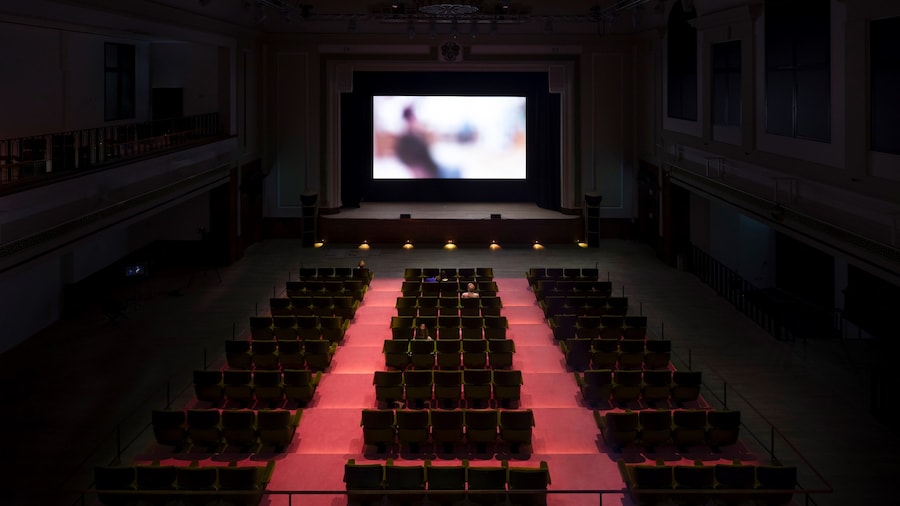
A woman clutches a large red and white striped box of popcorn as she stares intensely at the cinema screen. Nearby a couple of men gaze in the same direction; one has his head slumped on the other’s shoulder. Close behind, an older man with folded arms glares at them disapprovingly. This is Elmgreen & Dragset’s installation, The Audience at Prada Mode, and the bodies are inanimate sculptures. They are rendered with such realism that I watch each for a couple of moments to ensure they don’t move before photographing them. I also find myself staring shamelessly at a temporarily still person who turns out to be a fellow visitor.



On screen, a looped 18-minute film features actors in the role of a painter and writer, discussing their creative practices. It is intentionally blurred, offering a counterpoint to the image overload that we experience every day on social media. The artists hoped to create a feeling of beauty in the semi-abstraction of the film, and also frustration. The opaque film might recall the feeling of an image not loading properly or prohibited content being blurred.
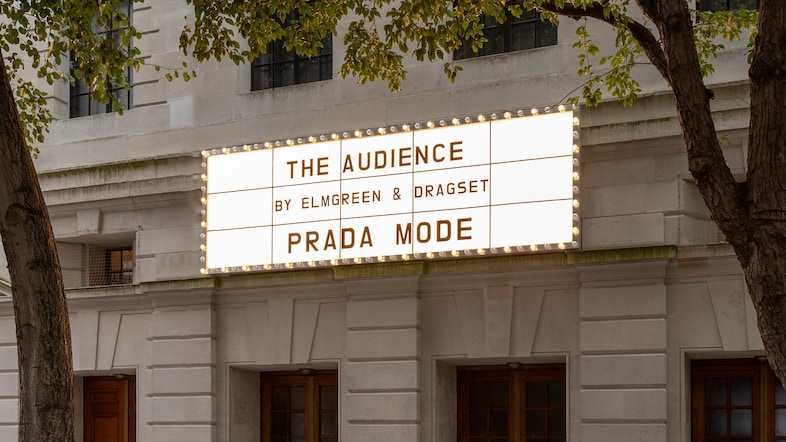
Michael Elmgreen and Ingar Dragset, born in Denmark and Norway respectively, are famous for their ambitious and immersive installations which pull the viewer into an alternate reality. They are perhaps most famous outside the art world for their iconic 2005 installation Prada Marfa, a permanent, non-functioning store in the middle of the West Texas desert. Their latest exhibition, The Audience, is installed across Prada Mode’s temporary space within Town Hall, a newly restored arts venue in Kings Cross. In keeping with their ongoing work in public space, the show combines the building’s architecture and design with the artists’ interventions – they have added retro velvet cinema seats, steps and handrails – blurring the line between installation and existing space.
“Many of our exhibitions are based on confusion,” Elmgreen tells me, at the Frieze week launch of The Audience. “You often become a lot more aware of yourself and you might feel awkward.” Before speaking with the pair, I found myself wondering whether to sit in the cinema chairs and join their sculptural audience, and if so, how close it was appropriate to get to them. Once I chose my seat, I immediately felt exposed, as though I had also become one of the sculptures for visitors to ogle at. “Here everyone is too late for the movie,” says Elmgreen, noting the film’s looped nature, which means there is no clear beginning or end, and everyone seems to enter partway through. “We might also feel a bit embarrassed on behalf of the guy doing the projection because it’s out of focus, so it’s like something went wrong. You are watching something that isn’t really working.”

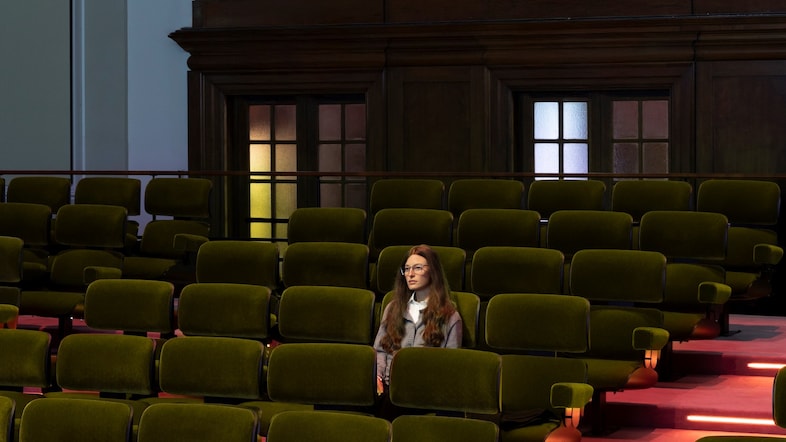
The artists wanted to represent a range of ages in the audience, and cast the figures based on friends and mutual acquaintances. It feels unnerving to hold the gazes of these still bodies; in public, usually one person would quickly look away, but here there is the surreal chance to just observe their faces. The duo is intrigued by the emotional and bodily responses that their works bring out of visitors. “We don’t know how people are going to feel when we make the work,” says Dragset. “Our practice is not like studio art, it’s completed when we show it.” As much as possible, they hope to replicate the feel of real people in a space. “We spoke about whether visitors would be allowed to touch the sculptures, but you wouldn’t touch a real person in the cinema,” says Elmgreen. “Hopefully not!” laughs Dragset.
Over five days, Prada Mode becomes a multifunctional space, featuring performances, talks and other screenings alongside Elmgreen & Dragset’s installation. This work follows a series of shows that play with the social dynamics of public space. In 2018, the artists transformed Whitechapel Gallery into an empty swimming pool, exploring the gentrification of London’s East End. In 2023, their exhibition Read at Prague’s Kunsthalle Praha explored the evolving role of the community library. They have also installed work in public spaces, such as Han, a 2012 sculpture of a young man sitting in a mermaid-like pose overlooking the ocean in Copenhagen.

“Public space in general is great because you meet a totally different audience,” says Dragset. “It’s not necessarily an audience who have paid or decisively come for a cultural experience. We like this openness. You can get a lot more interesting reactions in public space.” They note that public space belongs to all of us, and buildings like cinemas represent a place we can gather with people from all backgrounds – unlike contemporary online experiences where algorithms tend to group us with like-minded users.
“Civic space is really important in this time because we are on our phones so much,” says Elmgreen. “The physical space of public libraries, theatres, and museums are more important than ever, so that we can have the awareness of living in the city with other people. We are then less afraid of people being different from us, instead of just being in our own world, reflected to us through our phones.”
The Audience by Elmgreen & Dragset is on show at Prada Mode in London until October 19.
