

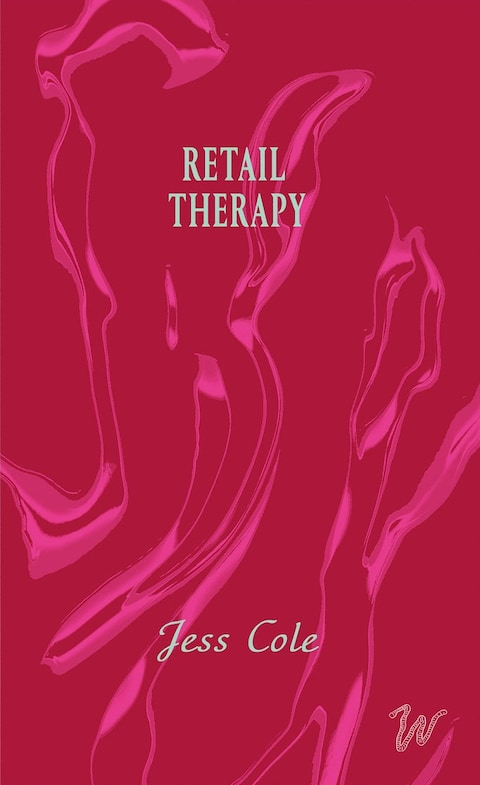
In Retail Therapy by Jess Cole, shop girls negotiate desire, ambition and the reality of having to work
In the opening pages of Retail Therapy, Jess Cole dedicates her debut play to all the “Saturday jobs and shop floor girls”. You might read this as a show of solidarity. Before Cole cut her teeth in journalism, wrote poetry, walked for Tom Ford and Hermès or faced campaigns for Burberry, Phoebe Philo’s Celine and Wales Bonner, she entered the rag trade as a sales assistant at Topshop, the golden goose of the British high street. It was the height of indie sleaze – though nobody called it that yet. Written over two years and performed in snippets to live audiences at Sadie Coles’ Gargle series and Adult Entertainment, with her first book, the Devon-born, London-based writer bottles this period.
Set outside of the English capital, in the airless basement of a department store gone to seed, described by one bubblegum-blowing shop girl as “Dante’s eighth circle”, Cole lays the groundwork for HOTShop. The air is perfumed with sachet latte, microwaved spicy rice and spores of black mold. MIA’s Paper Planes and Lana Del Rey’s Video Games blare through the speakers. The light is artificial and shadowy. To the 20-something shop girls and much to their manager’s chagrin, retail is a place where you trade time for money. The three of them trauma bond over their strungout bosses, dwindling bank balances, and hangovers while folding skinny jeans and fluffing swallow-print dresses. All of this boredom and unfulfilled ambition amounts to tension so palpable it’s leaking from the pipes.
At once claustrophobic and relatable, and punctuated by witty, delicious dialogue, dramatic graphics, and absurd stage directions, Cole’s protagonists negotiate desire and the shameless ways we cope with the reality of having to work.
Here, AnOther spoke with Cole about the decline of the high street, the allure of closet dramas and finding joy outside of consumerism.

Jasmine Pirovic: Where did your impulse to write Retail Therapy come from?
Jess Cole: I was thinking about the high street. I used to work at Topshop and that was the pinnacle of the British high street. It was more than just a shop, it was a destination. When IKEA opened up in the space on Oxford Circus after being empty for so long it triggered something in me. It’s mad because that was a part of going to London, you went to Topshop Oxford Street. And I know there’s a lot of issues with Topshop, fast fashion and Philip Green, but the high streets are dead and no one really talks about it. The shops are all closing down. It isn’t about buying, the high street is a part of the community; it’s a massive source of employment, especially for women and for people that leave school at 16 or 18. Having a Saturday job was my first form of income, my first sense of independence and a soft landing into adulthood. Also with the whole indie sleaze thing …
JP: It’s a timely release for the play given Topshop’s relaunch this year.
JC: It was this funny period. You’d go to work and afterwards we’d go to the indie club. Then you’d be back to work the next day not having slept. I remember taking six Pro Pluses in the fitting room because I was so tired and thinking I was going to have a heart attack.
Not to shit on online shopping, but when you go into a physical store, say it was Topshop, you’re a bit more conscious of what you're buying because you're trying stuff on. In a way, it makes you a better shopper, you’re engaging with members of staff, and you feel part of that world. Whereas when you’re online, you’re so removed from any chain of the process and you’re not thinking about how it’s made. You’re totally removed from all human elements of it.
JP: Is that why two of the characters discuss the 2013 Rana Plaza garment factory collapse in Bangladesh?
JC: I wanted to put the story in a subtle timeframe. I was thinking about how we’re so conscious of global issues and we’ll talk about them, we’ll get annoyed about them, and then just move on to the next thing. I did want to make that loose connection between the working conditions – I mean, they’re totally different – in the factory and the store, how capitalism erodes that away, and trying to create a relationship between the two. I just wanted it to be in the background because that was horrific – 1,400 people died and you don’t know who they were working for because of the deliberate steps of removal in the supply chain between the makers and the brand.
“We’re so conscious of global issues and we’ll talk about them, we’ll get annoyed about them, and then just move on to the next thing” – Jess Cole
JP: What about the shop floor makes it a fitting stage to discuss the anxieties surrounding late capitalism?
JC: It’s a space of performance because when you’re a member of staff, you’re deferential and performing acts of service for customers. Then there are these clothes. I wanted it to feel like they were trapped on the shop floor. It was more about the confinement of that space. I was drawn to this idea of it being in the basement of a department store, because it reminds me of places like Debenhams or House of Fraser, which we had in Exeter. That phenomenon where every store quietly closed and this was the last relic left and it’s in the basement because they've had to keep moving because they can’t afford rent.
JP: You laugh at your characters, they stroke clothes while quoting Roland Barthes and Mark Fisher. But they’re also sympathetic too, despite the way they treat each other. Did you mean it as a commentary on the way corporate structures create rifts and competition among workers?
JC: I like the silliness of it. It’s quite performative and people want to feel like they’ve got stuff to do, but it’s just clothes. But I also think of the desperation of wanting to get out of that situation and how it pits you against each other, especially if there are no jobs and you're stuck there. Coming from a fashion background or the arts in general, it’s kind of funny that everyone is fighting over the tiny little crumb.
I think with Retail Therapy I was just super interested in the fantasy of fashion, how it’s a space to dream and make believe and then thinking about how that is then meshed into the grind and mundanity of working at the bottom of the bottom in retail. But I also wanted it to be funny, because I hate art that is didactic, I want to think for myself, and laughter is a powerful tool for thinking.
“I love theater but I find it really inaccessible” – Jess Cole
JP: There are no customers, which I guess is because HOTShop is a failing store. But it reminded me of Waiting for Godot. I mean, one of the characters is explicitly telling her staff to get to work, they agree and yet, no work is being done.
JC: I did try to write customers in. The thing for me when I was writing this, which is why I found it really difficult, is I used to do some journalistic writing and I thought that the skills for that were really easily transferable to fiction writing. They’re not. As a journalist, you’re documenting and there's a set structure. The reason it took me a few drafts was because I was writing this crazy world where it was akin to a documentary and it was so boring. I just decided that I didn’t really care about the customers so I took them out and made it so the girls were just waiting around. I love that idea of the tediousness of work. When there’s nothing to do and you’re pretending to do stuff, it creates this tension and exhaustion.
JP: Why a play and not a novel?
JC: Because I love theater but I find it really inaccessible. It’s expensive which makes it a gamble to go. I also think people don’t want to read a script, people want to read novels. So there’s this historical genre of playwriting called closet dramas, which were written by people who, because of something like their race, couldn't get their plays performed. They would end up writing dramas that could be read more like a novel. In Retail Therapy I did this by extending the stage directions to make it feel that it wasn't just a bombardment of dialogue. But I wanted to keep it open so that it could be performed. I also liked the idea of the performativity of the text on the page, which was something I spoke to Worms co-editor Caitlin McLoughlin about and resulted in fun graphics like the blackout scene.
JP: Are there any closet dramas in particular that you love or writers that have inspired you?
JC: Yes, Jeremy O. Harris. He hasn’t written a closet drama but he put the idea of that into my head. I met him a long time ago and he allowed me to consider that I could write a play. Zora Neale Hurston and Gertuide Stein. Annie Baker’s The Flick, for how it situates a play within the work and world of cinema workers as they clean a screen up, the meta of it all. Aleshea Harris’s God Is, reading her script offered another mode of engagement, playing with different fonts and sizes of the text, she turned the page into a stage.
“Aimless walking is my favourite thing” – Jess Cole
JP: There’s this throughline of class, fashion and labour in your past journalism, poetry and fiction.
JC: This is going to sound so lame but I find work really interesting. Especially work when it’s not something you want to do but it’s a means to an end. Because it’s something that dominates your life until you retire and especially now, I’m curious about how it alters your behaviour and personality. In London, your work is a massive part of your identity if you’re in the creative industries. Then I go home to Dorset at my aunt’s pub and no one talks about their job, no one asks about what you’ve been doing. For our generation especially, I’m talking as a millennial, it’s the first time our timeline for life is really disrupted. People aren’t married by the time they’re 30. You don’t stay in the same job now. You used to just get the job and work your way up. Which sounds kind of nice. But now everyone’s chopping and changing all the time and the nature of work is changing all the time. Also as a woman, your biological timeline doesn’t correlate to that.
JP: Are you still modelling now?
JC: I stopped. It takes up a lot of your thinking time. It’s a lot of waiting around and not making plans in the event that you book that job. I had done it for seven years and stuff was drying up. I knew I really wanted to be a writer, so I got a job at a cinema and I've got reasonable rent, which made it easier to write. Then I did this book and I've just done a writer’s program at the Royal Court.
JP: How do you find joy or self-soothe in a way that doesn’t involve consuming?
JC: Aimless walking is my favourite thing. As a writer, you get stuck in your head and I think sometimes you forget about life going on outside. I just go without my phone and I walk for ages. I have to do it every day. I think it has to do with my childhood: my dad and I would spend the whole of Saturday walking for hours. Nowhere or anywhere. It helps everything.
In London we’re so spoiled because so much can happen and change on one street. But you also end up in your little bubble and you realise that there’s so many worlds here. It’s such an amazing place for that, when everyone gets along. You just happen upon things.
Retail Therapy by Jess Cole is published in the UK by Worms, and is out now.
