
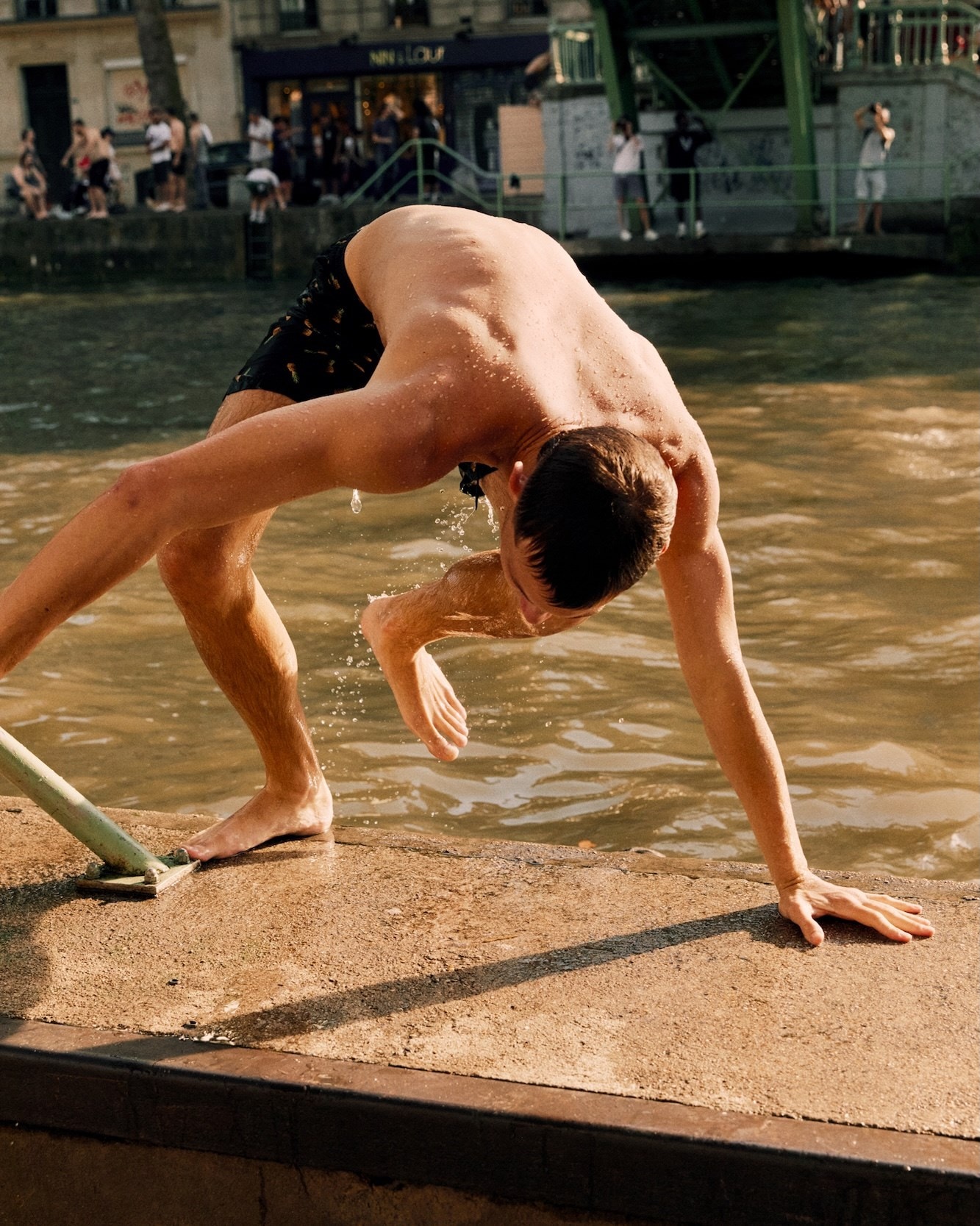
High-pitched shrieks ricochet off Canal Saint-Martin’s muddy water. There are splashes, whistles, the slap of wet feet against hot concrete, voices playfully calling out to one another. The canal feels impossible in the middle of Paris, transformed into a suburban pool by the giddiness of summer break. Only I’m not surrounded by schoolchildren but gay men. They are sun-tanned and burnt, their hairy shoulders slick with sweat, stomachs held in with theatrical resolve or proudly let loose. They cannonball into the water with delight, they squeal loudly when the consequential splash hits them as they’re sitting on the rough bank of the canal. From that same ledge, I see him. Across the greenish channel that divides us, a man with dark curls, a thick moustache. Hair scatters across a chest that swells towards his shoulders. Tight shorts are worn high, almost reaching his waist. We lock eyes. He dives. I follow. My body, feverish from the canicule, is swallowed by the cool water.

Down there, delusionally expecting to feel his hands, I’m instead greeted by the long algae that sit at the bottom of the canal. Whatever relief I had from the heat is gone. I remember the words that kept me from diving in before desire got the better of me. “Seuls les étrangers se baignent.” Only the foreigners dive in. I have heard it so often that I now mouth the words before they do, anticipating the familiar flicker of Parisian disgust. However pathetically I flail in protest, however confidently I defend myself, they’re not wrong. It’s my first summer in the city yet nowhere in Paris do I feel less foreign than here.
The judgement I’m subject to begins outside the canal’s confines. Just as it is mine, this is the first Festival season in its history in which swimming has been made legal. In response to the heatwave, what was before an act of defiance has been turned into a municipal invitation. Commissioned by Napoleon I in 1802 to connect the Canal de l’Ourcq to the Seine, the Canal Saint-Martin was built to supply water to a growing population and facilitate trade in the city. I’m using it for something similar. Perhaps not to facilitate it, but surely to find it. And I’m not the only one. Along the banks of this dubious water, gay men puff out their chests in impossibly small speedos. Peacocks in the middle of Paris. My chosen finery, a Gucci Spring/Summer 1999 pair, has long lost its elasticity, clinging to my hips by sheer luck. Around me, bodies lie shoulder to shoulder on a narrow strip of prickly grass browned by the heat. Faces are nearly stepped on as passersby search for the last unclaimed centimetre of ground. I decide to join them on dry land, finally tired of avoiding the weeds wrapping themselves between my toes.

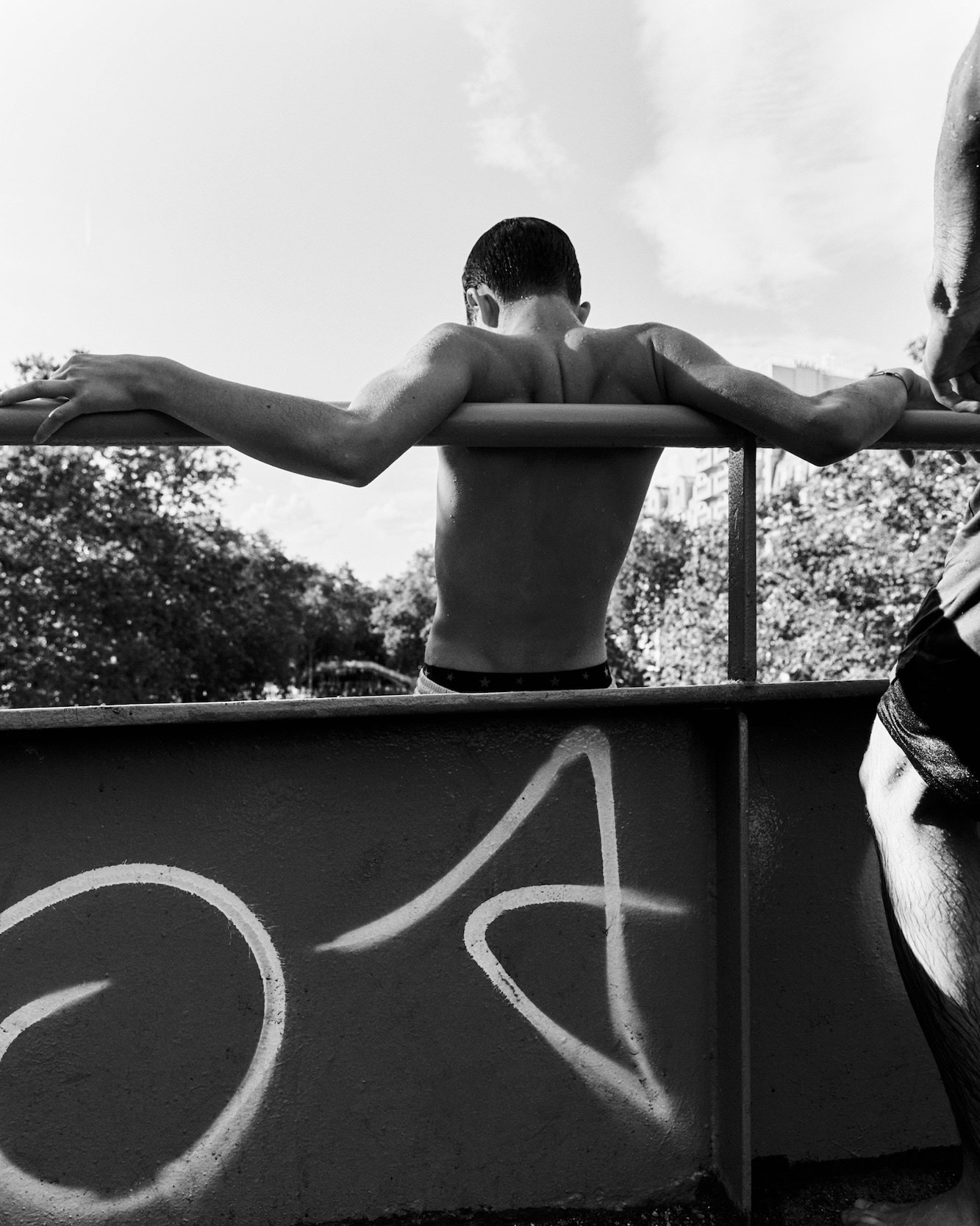

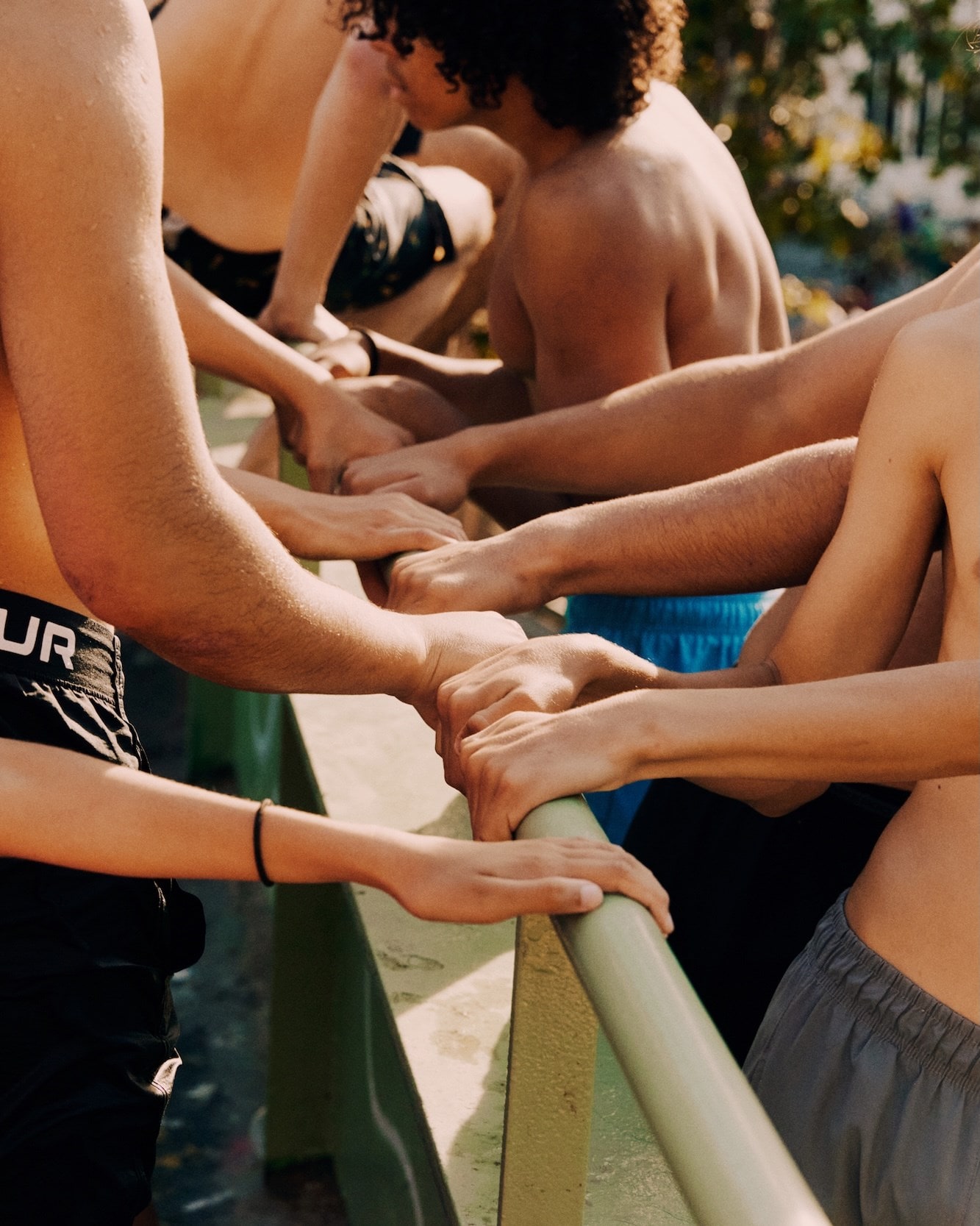
I put on more decent shorts and go for a walk with photographer José Cuevas, he’s been photographing this unusual amalgamation. We discuss the temperature, how strange it is. The canicule has dissolved smaller social anxieties, replacing them with larger societal ones. Across the city, 40-degree afternoons leave stains of sweat on shirts and of worry across faces. “After years of vague threats about climate change, consequences are no longer abstract,” he says. The heat gives the city an apocalyptic cast. And yet, it is children who seem least concerned with the world they are inheriting. From the water, there’s a different image of the future. The city erected fences along the bridges to stop people from jumping into the canal. By the afternoon, they had become climbing frames. One after another, young men and women swing themselves over the metal railings, dropping into the water below. Through Cuevas’ lens, acrobatic figures are captured, one of which is doing pull-ups off one of the bridges, to the cheer of spectators and the chagrin of those waiting their turn, their faces just as annoyed as they are relieved for the extra seconds before their self-appointed sentencing.
It is, objectively, a terrible place to swim. At intervals the air is nauseating, the stench of sewers rising from somewhere beneath the surface. Even while floating, you drift past the evidence: a bloated rubbish bag, a cigarette butt, a piece of fruit decayed beyond recognition. Locals say shopping trolleys and abandoned bicycles lie beneath the opaque green surface. We are told it’s safe to swim in. Perhaps it is, perhaps it isn’t. By the time the question arises, I’m already submerged. The canal becomes a swimming pool because everyone agrees, even if only during this relentless canicule, to treat it as one. It requires a collective act of make-believe long enough to forget the heat.
