
Capturing the atmosphere of the city at night, this artist’s work is now on display at the newly renovated Our Legacy flagship store in Soho
Rut Blees Luxemburg’s photographs capture the atmosphere of urban landscapes in the dead of the night, but, she tells me, she doesn’t identify as a photographer. Rather, she’s an artist using a 4x5 large-format analogue camera as her medium. “It’s a cumbersome apparatus that needs a tripod,” she says. “But it captures the nuances of light, especially at night, in a way I don’t think digital is capable of – let’s call it the magic or alchemy of film photography.”
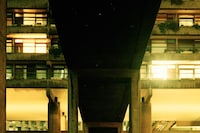
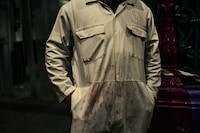
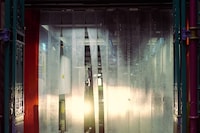
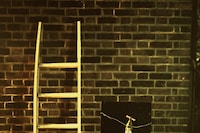

When using film, every shot counts for something, which is in part what draws the German-born London-based artist to it. “It’s not instantaneous, you have to give it time and I think time is a good thing when it comes to making art,” she says. “There are a limited number of shots so each comes with a risk – the shot might not work out.” Those shots now decorate the walls of the new Our Legacy flagship store in Soho, London. Each store, of which there are now eight globally, embraces the work of a photographer that aligns with the overarching sentiment of the city that store calls home.
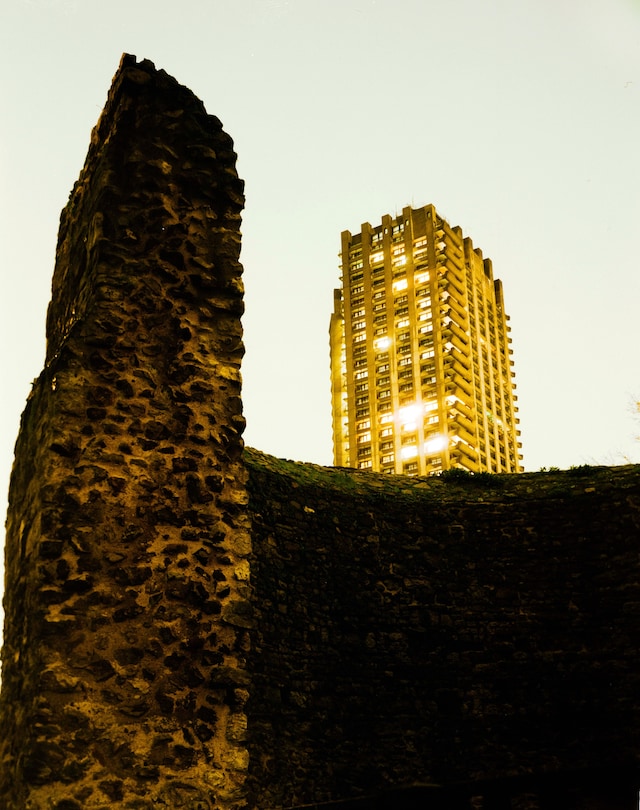
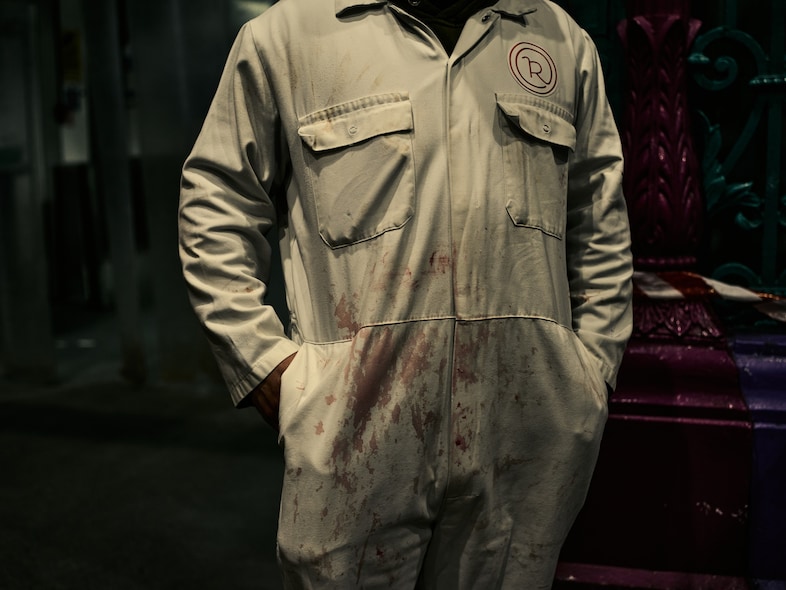
In one photo, the Barbican stands tall before a cloudy grey London sky, to its left is a worn-out brick wall, one of the city’s oldest, thousands of years old – the brutalist high-rise almost mirrors its form and shape. “Between each of these structures something like 2,000 years has passed.” In another, a bloody butcher steps out for a cigarette in the covered ventricle of London’s Smithfield Market, a historic landmark in its own right. “These moments in the night, you’re in the middle of this city that is working away in a way it’s worked for centuries. Something like a meat market, at night, it’s almost hidden away but at the same time it’s a very public manifestation of a very essential part of our lives, as in the preparation of food, and in this case, meat.” Another captures the city’s famous skyline, illuminated by the lights of the corporate world.
Luxemburg’s photographs show a version of London that circadian rhythm-typical Londoners may not know or see. That’s what her photography is about, capturing and documenting sensations, feelings, moods, the invisible, as is reflected through the city’s architecture. “I’m trying to visualise something we sense,” she says, quite ambiguously. “To visually manifest something that is present but not necessarily visible – it’s a contradiction, a paradox. Which is what a lot of art is, right? It’s about giving a visual form to a type of thinking, to help us better understand a concept.”

There’s a darkness to her images, an ominousness, as she documents the goings-on of the night when most of London sleeps. “I’d say it’s more reflective,” says Luxemburg. “My photography is a reflection of the city and its inner-workings.”
It’s the unusual minutiae of midnight that inspires Luxemburg. “We live in these gated cities, where access is difficult, and people don’t really find themselves exposed to these facets,” she says. Her camera gives her access. “I go out at night, not every night, of course, and it’s not romantic, but the camera gives me this passport and reason to access these spaces, and to spend time with the people populating the city at night.” The people who support and sustain the city we know and take for granted, the invisible economy. “And they’re essential for the functioning of this urban scenario.” That said, she tends not to photograph people. “I’m not a sociologist.”
But she is a Professor of Urban Aesthetics at the Royal College of Art in London. She’s long been interested in cities and their architectures, and considers buildings to be manifestations of ideas and socio-political moods. She references JG Ballard’s 1970s novels Crash and High Rise, both of which explore how modern environments interact with and fracture the human mind psychologically – the Ballardian dystopia, where societal norms deviate against contemporary tech-saturated backdrops and automation. “These stories are quite foreboding, ominous. There’s disaster lurking somewhere and you seem to be moving towards it, but you can’t quite grasp it.”

Luxemburg visualises cities. “It’s not only about how one consumes a city, but also how one is visually pleasured, also how cities are changing and how we relate to these big shiny towers as they’re erected,” Luxemburg says. “But my special interest in urban aesthetics is how to better understand public space, and how we can participate in it, and how public space can generate conviviality, and allow for time spent encountering others, feeling like the city is a place of exchange and openness, and this doesn’t need to come down to engineering, it can happen organically.” Indications of life, exchange, security, surveillance, patterns and how functional brutalism becomes beautiful. She shows me an image of a garage in east London, a sharp barbed fence sits on top of it. “It’s potentially very destructive and could inflict a lot of pain, but it’s also almost like jewellery in its ornamentality and allure. I think that contrast, that aestheticism, that essence is what I look for,” she says.
What’s in the essence? Is it home, freedom, confinement? Something left behind, something found? Having lived in London since the 90s, Luxemburg has a long history documenting the city. She moved from the Moselle River in Germany in her early twenties. “Maybe I am looking for home, a lost home, which sounds terribly sentimental and I’m absolutely not sentimental. Perhaps that freedom, the first experiences of outside, of interacting with people is what I’m really looking for, and it’s very much that, an interest in public spaces, not interior ones.”
The Our Legacy London flagship store is open at 1-2 Silver Place, London, W1F 0JW.
