
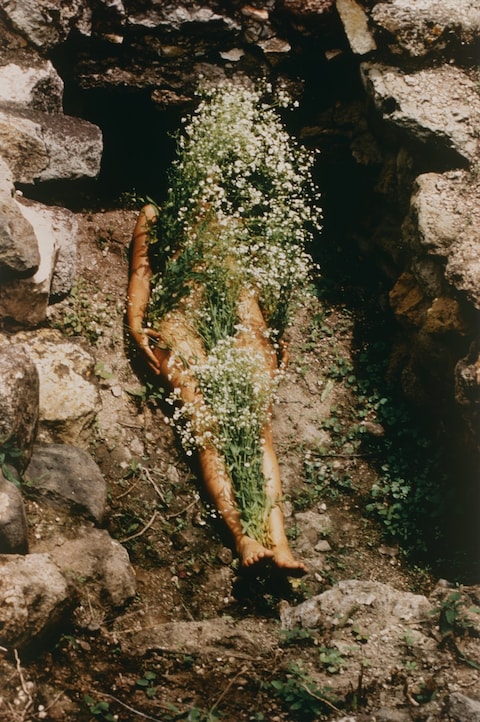
As Tate Modern opens the first in depth UK exhibition of Ana Mendieta’s work in more than a decade, we explore the Cuba-born artist’s earthbound, body-led practice
In less than two decades, Ana Mendieta made a profound, lasting impact on contemporary art. Born in Cuba in 1948, she was exiled to the US at the age of 12. She first trained as a painter, then embraced a gutsy, experimental range of art forms, at times using animal blood from butchers, plants, burnt wood and her own body in the work. Mendieta was deeply connected with the Earth, creating powerfully political pieces with natural materials which sometimes reflected the Cuban landscape. Displacement and otherness, felt so strongly in her own life, thread through her pieces, which demand a guttural response or highlight a jaded inaction in her audience.
In 1985, at the age of 36, Mendieta fell from her New York apartment window to her death. Her husband, artist Carl Andre, was charged with pushing her, and later acquitted; those who knew her and many in the art world still strongly believe he murdered her. This violent death has at times threatened to overshadow her formidable oeuvre, reducing her to the victim of a horrific crime. The artist’s niece and estate manager Raquel Cecilia Mendieta has long campaigned to return the focus to her life and work.
As Tate Modern opens the first in-depth UK exhibition of Mendieta’s work for more than a decade, AnOther explores the defining aspects of her practice.




1. Ana Mendieta was exiled from Cuba at the age of 12
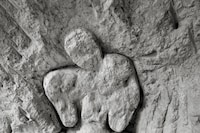
Ana Mendieta’s father was a lawyer in Cuba, her great uncle Carlos was the president. After the Cuban Revolution in 1959, her father was jailed for collaborating with the CIA and the young artist was exiled without her parents. She was airlifted out of Havana in a joint initiative between the CIA and the Catholic church, settling in Iowa, where she was moved between orphanages, reform school and foster care. She experienced being an outsider for the first time, and later joked, “I decided I was going to become an artist or a criminal.” Cuba has a recurring presence in her work: she angled a 1981 Siluetas piece so that the Cuban tide could wash in and out of her empty body outline; in the late 1970s she was a founding member of the Circulo de Cultura Cubana, which organised artist exchanges with the US.

2. She originally trained as a painter
Mendieta’s initial art training at the University of Iowa was more traditional than her eventual practice, with a focus on painting. She studied for her MA under the German artist Hans Breder, who had a powerful impact on her experimental work, overseeing the Intermedia Program and encouraging a cross-disciplinary approach. Her paintings contain some recognisable elements of her later work, including restrictive physical compositions and self-portraits. Some of Mendieta’s paintings are included in Tate’s retrospective; a 1969 piece titled De película depicts a fiery red and yellow figure squeezed uncomfortably into the canvas, while a 1970 self-portrait shows the artist in kaleidoscopic colours gazing directly at the viewer.
3. She worked with real blood
By the 1970s, Mendieta’s materials had become less conventional, with numerous pieces employing buckets of cows’ blood or butchers’ waste. In works like Sweating Blood (1973), she dripped the organic substance over her face in response to the rape and murder of a woman on campus at Iowa University. Blood was used to highlight injustice – and the frequent indifference shown towards it; for Moffitt Building Piece (also 1973) she poured butchers’ waste under her front door and across the pavement, photographing the lack of concern or response from passers-by.

4. The body was central to her work, sometimes through its absence
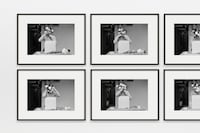
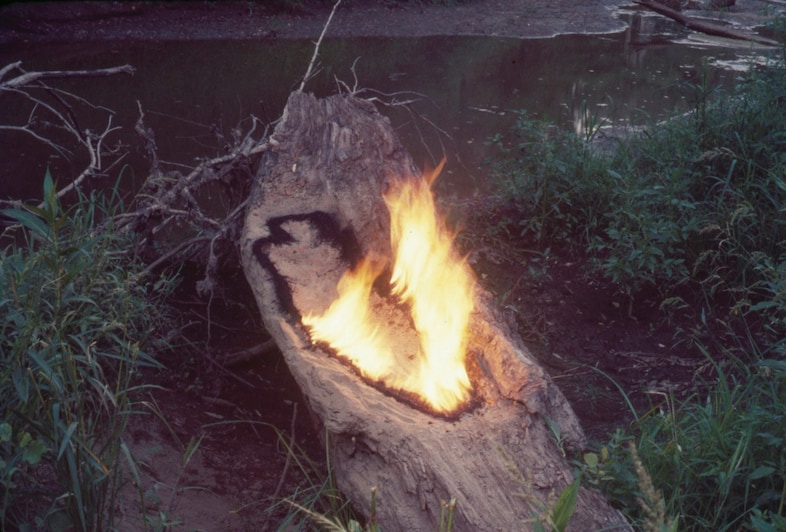
Mendieta’s body was vital to the work itself. Sometimes she directly used her own presence and image. An early series Untitled (Glass on Body Imprints – face) from 1972 featured her face pressed violently against a pane of glass at different angles. She manipulated her image in other ways, lightening her hair and skin in the series Untitled (Facial Cosmetic Variations), 1972, to challenge her racialisation in the US. She also played with the absence of the body, covering her physical form and later outlining her silhouette for her decayable Silueta series. She used natural materials such as flowers, mud, rocks, leaves and sand for these works, and ignited gunpowder to burn the image into the ground. “I decided I didn’t want to be in the work anymore [because] I don’t particularly like performance art,” she said.
5. Her work embraced intersectional feminism
Driven by her lived experience of displacement and othering within the United States, Mendieta took an intersectional approach to feminism, exploring the meeting points of gender, race and even age. These ideas are woven throughout her work and were expressed not as a need to escape otherness but to embrace it. In the curatorial statement for an exhibition of women artists of colour Mendieta wrote, “As non-white women, our struggles are two-fold. This exhibition points not necessarily to the injustice or incapacity of a society that has not been willing to include us, but more towards a personal will to continue being ‘other.’”
Ana Mendieta is open at Tate Modern until 17 January 2027.
