)
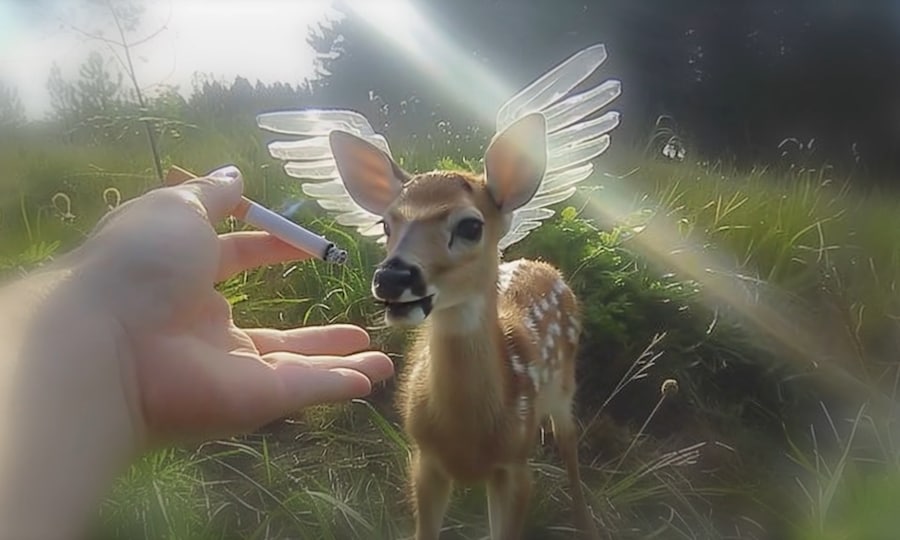
The artist’s new book in collaboration with Alix Ross and Liam Denhamer, MSM Vol 2, explores the collapse of the mainstream and the ‘fragmented’ world that follows
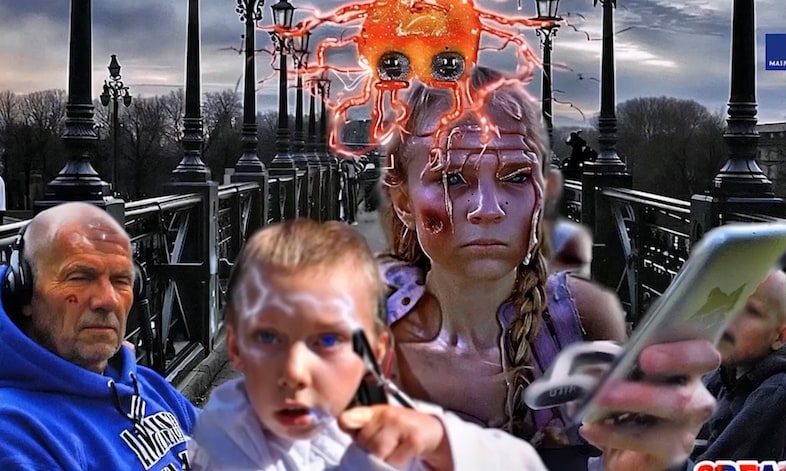
Few artists manage to capture how it feels to live inside the modern internet with such fidelity to the real, dizzying experience as Jon Rafman. In the 2025 video and installation Main Stream Media Network, the Canadian artist displayed music, images and music videos from a cast of imaginary artists – including Cloudy Heart, Pledged Torment, Iron Tears, and Flux Arcana – working in niche and newly invented genres, and realised with the assistance of AI. These characters and their creations were aired via the titular MSM Network, in a “nostalgic” throwback to the collective viewing experiences of years gone by (think: hanging out and watching MTV together).
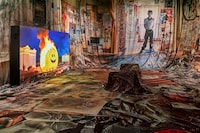

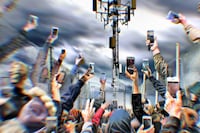
“Right now, there’s a sense that the idea of there being a mainstream has stopped existing,” Rafman tells AnOther. “The last moment of a coherent mainstream, where we all had the same reference points, was the end of the 90s, early 2000s.” This consensus collapse that occurred with the mass adoption of the internet (and, later, algorithm-driven social media) also led to the disappearance of coherent subcultures as a central pillar of identity formation, especially around the aspirational aesthetics of bands and popstars.
Despite a sense of yearning for the “retro” media landscape pre-Y2K, Rafman’s world-building leans into the “fragmented and diffuse” dynamics of the extreme present. While tools like game engines and AI have “liberated” the artist to create and distribute new kinds of work – and forced him to keep moving – the MSM universe has also been enabled to evolve organically, without a clear centre. This is epitomised in a new book conceived alongside Alix Ross (known for co-founding the clothing brand Farmer’s Daughter) and architect Liam Denhamer. Their collaboration, MSM Vol 2, taps into a decentralised network of writers, artists and collectives to expand the universe even further.
Here, Rafman explains why he made a hardback art book in our new media landscape, how the Disney business model inspired his approach to making art and why people constantly misunderstand how to creatively use AI.
)
Thom Waite: Firstly, could you describe your approach to building the MSM universe?
Jon Rafman: Early on in my career, what excited me most was exploring the internet, especially virtual worlds, and video game worlds too. Then, as the internet stopped existing in the way I knew it, I became more interested in world-building. New tools, especially AI, liberated me to do things that in the past would have cost tens or 100s of millions of dollars, which I can now do with a subscription and a small commando team.
So it’s been a movement from being this sort of internet explorer or virtual flaneur, to constructing worlds with their own lore and characters. Partly because I think the internet’s less interesting, because you can’t really get lost on it anymore ... everything’s filtered through these giant social media platforms, which flatten everything. But also because it’s just exciting. I’ve always wanted to build fantasy worlds.
“That’s what culture is now ... the fan art is more interesting than the canon” – Jon Rafman
It was really fun to work with a bunch of people to create an extended MSM Network universe. We made music videos, entire discographies uploaded to Spotify, and also this prime example of the print form, which started off as a TV guide but then turned into a hybrid publication where, among other things, artists and writers could riff off the MSM world to develop their own work and writing. To me, that’s what culture is now. The fan art is more interesting than the canon. I don’t watch the Disney Star Wars movies, the people writing Han Solo erotica are what interests me.
TW: Between consensus collapse and the flattening of culture that you’re describing, we’ve seen the disappearance of the mainstream but also of clear subcultures. What are the effects of this disappearance?
JR: We used to construct our identities via subcultures, and music was the central place for that. MTV fabricated desire, and they also fabricated who you would aspire to be. Now that there has been a hyper-fragmentation of subculture – I mean, subculture is all there is, on some level – you’re just pulling from a bunch of diffuse sources.
What excites me most about the internet, from the beginning of my practice, is discovering new subcultures that I didn’t even know existed. Lots of them are based around fetishes, but not only ... When I would explore the virtual world of Second Life, I’d discover a furry subculture within a furry subculture, and to me that was the most sublime experience, because it was a fully developed subculture with their own rules, hierarchies, ways of speaking and lore. You see that more and more, like The Backrooms, which is a community-created online mythos that finally the mainstream is picking up on. That’s where the vitality in culture is, in this communal lore-building.

TW: As an artist, how does one intervene in, or compete with, this new media and image landscape? What does a gallery or museum space offer that the internet can’t?
JR: I don’t think you can compete. Even the idea of attempting to compete is setting yourself up for failure. You can strive to create something memetic ... I remember even just 10 years ago you’d have an album cover, a Kanye or Drake cover, and everybody would riff off of it. But that doesn’t happen as much now because there’s so much noise, except for Brat, which was the exception that proves the rule.
But what the gallery and the museum space still offer is a place where you can experiment, that doesn’t fit somewhere else. They allow you to create these environments that you couldn’t otherwise, in a way that has institutional framing, and a budget, and gets people out there to see it.
Also it’s a physical experience, and I think there’s a deep exhaustion with screens, and online [content]. The new CEO of Disney was the head of theme parks, and I was looking at the numbers – the theme parks make double what their entire IP makes, so the physical experience is clearly important. And people still want to read books and have physical objects. That’s how bands survive, from selling merch and vinyls. There’s a difference between [that] and being alone in your room, watching a video on your laptop in bed. There’s value there that you can’t capture in a gallery, but it’s a very consumer experience; you feel gross after a while. And nothing is coherent. There’s a video, next to an infographic, next to somebody’s wedding photos, next to war photography. Whereas in a gallery you can create a sense of narrative, to give meaning, to take all this chaos and try to create a coherent vision.
TW: Obviously, the book is also a prime example of a coherent, legible object. What was the approach to curating MSM Vol 2, which draws on a wide and distributed network of collaborators?
JR: I want to stress that this is not a Jon Rafman book. I built a team to create the MSM video world, and I met Liam [Denhamer] through Dustin Cauchi, who does the Opioid Crisis Lookbook. It was an organic thing that came out of a larger network of artists working together, out of this MSM infrastructure, or world. I was trying to recreate the model of what happens in these internet lore communities where a 4chan post spawns the most successful A24 movie of all time.
TW: In a world where images are arbitrarily plentiful, thanks to AI, do you as an artist feel a conscious desire to move up a ‘layer’ in the creative process?
JR: Yes. We now have an infinite image-generating culture. As Benjamin wrote [in The Work of Art in the Age of Mechanical Reproduction (1935)] the image lost its aura, and now that’s reached its logical conclusion. In the face of that, where do you go? I still like the old media genres, but I’m also interested in these new ones where there’s no centre to them, necessarily – it could be a video game, or a virtual reality experience, or an alternative reality game. They have lots of tentacles and they can go off in different directions.
)
TW: Psy-ops and subliminal messaging are a recurring theme throughout MSM Network, and feature in the intro to MSM Vol 2.
JR: One of my favourite memes is ‘You are not immune to propaganda’. The idea that you’re not affected by psy-ops is a little naive – this idea that your reality is the true one, and everybody else, who doesn’t believe it, has been psy-opped. And I think it’s interesting how that word has really struck a nerve. I think the fact it’s so sticky says something about this sense of there being no ‘reality’.
With radical extremism in the 20th century, you could categorise if they were a Nazi, or a radical Marxist. Now it’s so mixed up, the categories don’t even make sense any more. You can see it with people who perpetrate violent terrorist acts: oftentimes it’s just a mixed-up combination of things. Have they been psy-opped? Yes, but I don’t think the psy-op comes top-down from some totalitarian organisation, or puppet master. It’s just that our world is so confusing, and to vulnerable or lost minds ... you stare into the abyss, and the abyss starts talking back to you, it makes connections that are completely incoherent and indefinable.
TW: Maybe the term ‘psy-op’, in this case, ascribes too much agency to the people producing our culture, when instead it’s emerging from the bottom up?
JR: The darker side of that is what I saw coming out of 4chan, where people start losing any connection to the reference – when something that was done out of ironic trolling, trying to be a sort of punk act or trigger people, is no longer connected to that. You actually believe in your racist, horrible, extremist ideologies. At the same time, it’s important to confront the dark sides, and to understand where the alienation is coming from. And a lot of it is coming from this lack of a sense of being part of a larger story, or a sense of meaning in a world you feel totally ignored by. People are still looking for that ... maybe in the 70s they found cults, or different ideologies, or religious fundamentalism. Now, there’s even less to grab onto.
TW: AI, or anti-AI discourse, has become one of these narratives that people grab onto, especially in art. Why do you think it’s such a flashpoint?
JR: There’s a fear of the new, and there’s a fetishisation of labour, especially in fine art and the film world. But ultimately AI is a tool, and you can use the tool for good and bad. You can use the tool to make great work and slop. I think it’s very important for artists to be in these new spaces, because that’s where the vitality is. That’s what attracted me to the internet, or video games. GTA VI is probably on the level of the pyramids, in terms of the investment of time and capital. The streamer is the new celebrity – people thought the world was going to become more like MTV, but it actually became more like Andy Warhol videos, where you just look at somebody for hours and hours and hours, and these parasocial relationships take over. Maybe art is dead. Maybe we need new categories.
MSM Vol 2 is published by Farmer’s Daughter and is available to buy now.
