
The Dutch-born, Paris-based photographer’s new photo book, Wolves, is an exploration of the collective: still, watchful, almost eerily cool, that finds beauty in the teenage pack
“When I was fourteen, I needed glasses. I didn’t want to wear them because I was too vain [...] everything I could see was only close by, and the rest was blurry,” photographer Winter Vandenbrink reflects. “It’s basically what I’m photographing now.” On our call, his thick-framed specs are hard to miss as we discuss his latest book from IDEA, Wolves (2026), which captures the togetherness within teenage groups, the adolescent pack.
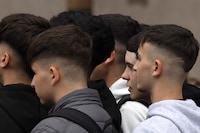
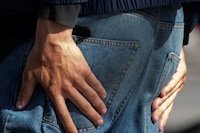
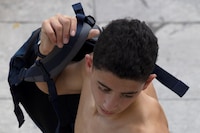
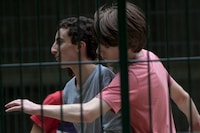

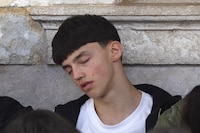
The Dutch-born, Paris-based photographer first met the IDEA team three years ago at a book signing. Six months later, co-founder and photographer, Angela Hill invited him for a drink at her Paris hotel. “I think it was The Bristol,” he says, “she mentioned we should do a book”. The result was Vandals (2024), a 400-page doorstopper of unwitting youth portraits. Two years on, Wolves expands on this logic, turning the lens to the singular within the collective: still, watchful, almost eerily cool. Though documentary in subject, the book’s polish and Vandenbrink’s fashion past give these images a hyper-stylised editorial vision of the teenage collectiveness. It is perhaps unsurprising that Vandenbrink works so closely with IDEA, Hill’s preoccupation with girlhood mirroring his own with adolescence. “She sometimes jokes that I am her twin brother,” he adds, “because of the work, and that we are both only children.”
The book’s genesis lay with Vandenbrink’s boyfriend, his “creative consciousness” as he describes him, who first came across a text by French philosophers Gilles Deleuze and Félix Guattari, 1914: One or Several Wolves, which muses on the position of the subject in relation to the whole, or rather the pack or wolf-multiplicity. Applying this understanding to the aesthetics and sociability of adolescence, Vandenbrink’s images look at the urban teenage pack, gathered in public space. Both the original Deleuze and Guattari text and a newly commissioned response, Field Notes by Eliot Haworth, are printed alongside the images. The latter is a gorgeous description-cum-analysis which, Vandenbrink notes, “first reads very literally about wolves” before, on second and third reading, reveals itself to “also be about teenagers.” Haworth’s abstracted descriptions of the shared behaviours of teenagers and wolves perfectly articulate the complexities of the philosophical inquiry “at once the collective, and wholly themselves.” Image and text alike occupy the teen-wolf hyphen.
The book itself is non-narrative and intuitively organised. Working with designer Linda van Deursen, Vandenbrink tells me, “She read the text and questioned what wolves would do […] made a bit of a skeleton,” selecting images for certain characteristics: “resting, playfulness, howling, all these things.” The enactments aren’t literal, but an underlying animalism surfaces: bodies resting together on the street, physical contact, eyes peering out the corner as if scanning for prey, one boy even bears a scar above his eye.

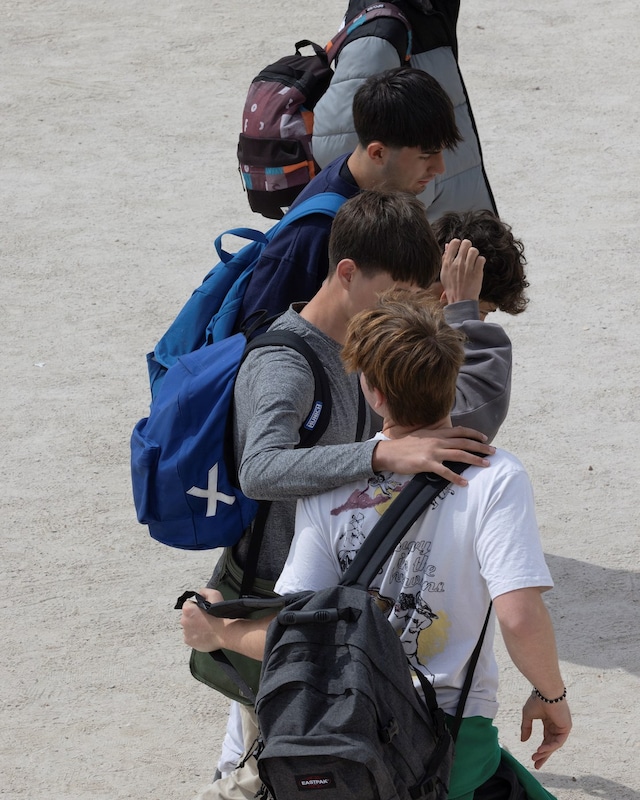
“When I’m shooting in public, it’s kind of like hunting and meditating at the same time,” Vandenbrink reveals. The images were shot across various European cities, Amsterdam, Paris, Milan, and Venice, some only months before printing. His previous work was made at a distance, anonymous and voyeuristic; for this project he’s submerged himself in the action. “I used to use a long lens, so nobody could see me or talk to me, but I wanted to change that because it was not very honest,” he says. “Now that I’m standing in the middle, a lot of them come up to me and ask me what I’m doing or ask me to take another picture on their own iPhone, which is quite funny.”
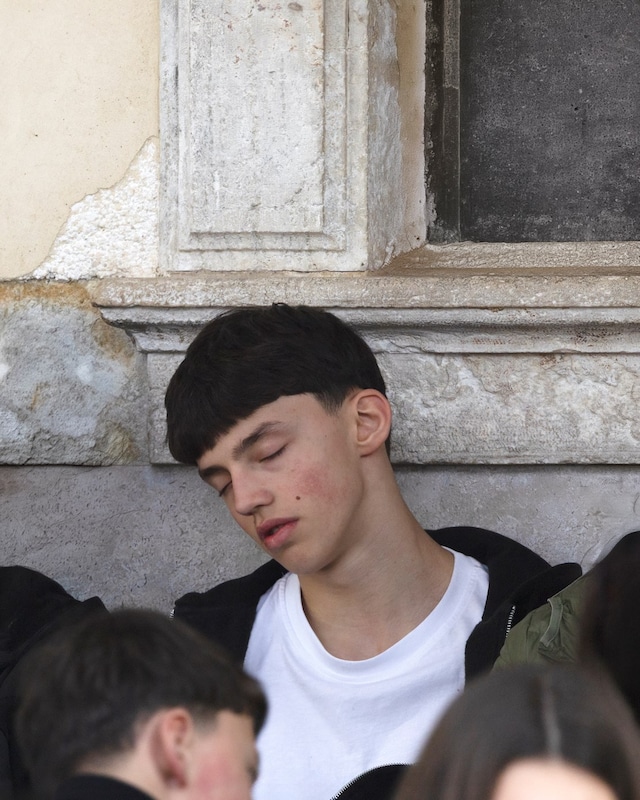
There is an image, taken in Venice earlier this year, of a young boy resting against a stone ledge. His eyes are closed, lips slightly parted; the sharp line of his haircut and jaw lend the face an almost statuesque clarity, while the flush of his cheek and a small mole returns him to the realm of the living. A restful Antinous in a white top and zip-up, framed by the blurred crowns of surrounding heads.
It is, Vandenbrink admits, “a manipulated view of the world […], what I’m aiming for and who I’m aiming at.” He mentions he gets plenty of requests to do casting. “There is a certain type, I guess, that I’m looking for,” he says. “Although, I try to be very open.” He singles out Milan, where “the guys wear the same brands – Puma, Adidas, Balenciaga – but they look different. They look more stylish,” he says. “It’s strange, but it’s almost like their tracksuits are more tailored”. While the images are not constructed or styled, it is through their assembly that they become editorialised. Winter’s wolves are dressed in caps and fur hats, black cotton hoodies, puffer jackets and dirty trainers. Even the props (a smattering of plastic bottles, coffee cups, phones, and backpacks) are elevated images of contemporary teenage life. “Maybe in 30 years’ time you’ll see these images and think, “this wasn’t the 70s, but the 2020s.”

Adolescence is something Vandenbrink keeps returning to and he has a theory as to why. “I think it’s a reliving of my own youth, partly,” he says, “but also that age is just super interesting, because of the transformation. The subjects I photograph are still innocent, but you can see a little shift starting, [as they move] into the real world. I find that super fascinating.” Vandenbrink grew up in a small town in Holland, an only child. “I had to go out and find friends. I was always hanging out in the same spot where I’m now photographing.” What emerges across his images is a particular quality of closeness. Nothing is overstated. There are no grand gestures, just a tender simplicity of people being together. In the photos of teenage lads especially, that intimacy feels quietly at odds with the harder codes that often shape adult masculinity.
“I’m hoping it’s a book that you take on your lap or on your table and just flip through slowly, and the pictures give you a feeling that you’ve been somewhere, that you’ve learned something,” Vandenbrink tells me. He continues to shoot both commercial and personal work around Paris, with an eye on a future project in Morocco. The same eye, in fact, that at 14 refused glasses in favour of aesthetics, and that today, decades on, finds beauty in the teenage pack.
Wolves by Walter Vandenbrink is published by IDEA and is out now.
