
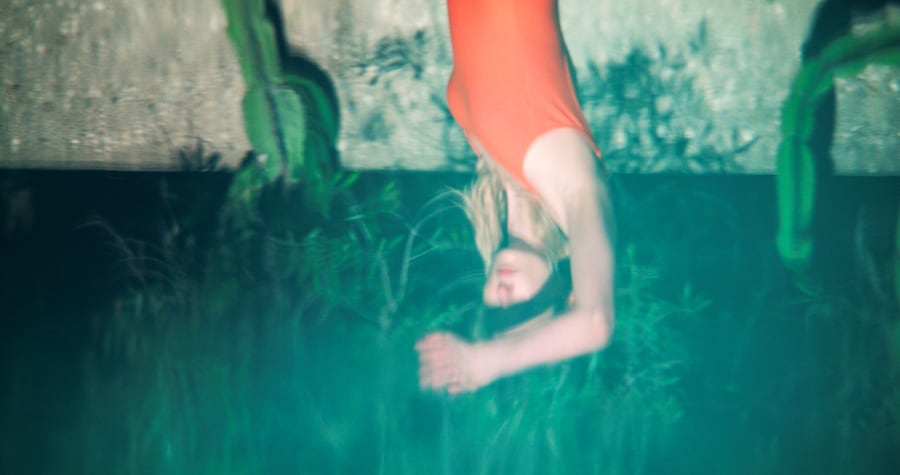
The California-based artist’s new multimedia show features Beck, Natasha Lyonne and Philip Glass among others. Here he speaks about art as the opposition of “the white noise and anxiety that is out of our control”
Doug Aitken dials in from his California home, seated against a lush backdrop reminiscent of scenes from his film Lightscape. The whole house is a kind of artwork-musical instrument of the artist’s devising – including the table he’s sitting at, which he explains is made of slices of marble that are tuned and can be played. “The house can be ‘turned on,’” he says. “There’s microphones that go into the earth, and they can amplify the sound of the earth’s movement or of the ocean down the street.” It’s a fitting home for an artist renowned for his site-responsive installations, whether it’s moving images projected onto city buildings at night (sleepwalkers, 2007), a multi-part “happening” along a train journey across the US (Station to Station, 2013), or a series of sculptures beneath the ocean waves (Underwater Pavilions, 2016).
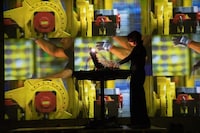
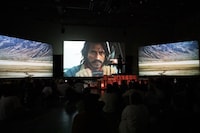
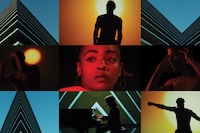
Lightscape is the anchor of Aitken’s immersive new exhibition at The Shed in New York, a seven-channel film installation with resounding score that will be activated by live performances over the course of the show’s run. He likens the work to a planet whose different aspects represent an array of media, from music and film to installation and performance. “It’s really looking at the idea that art can be completely de-material, and art can be any vessel – it can flow freely through any media, whether it’s a movie or sculptures or performances.”
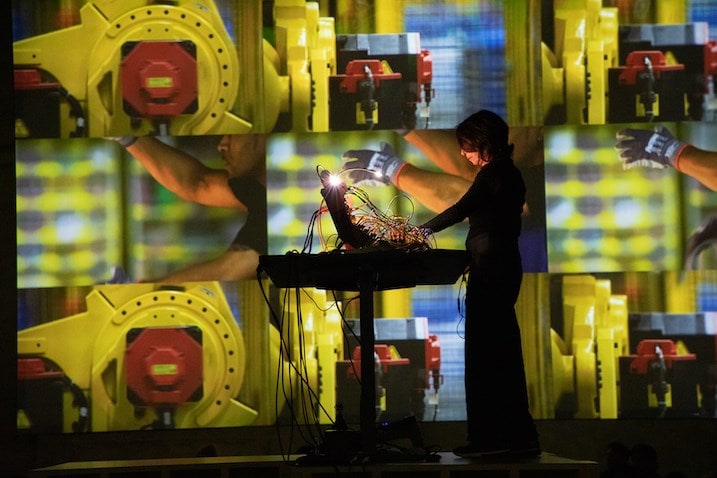
The film itself, which he plans to release as a feature later this year, is a series of interconnecting, Altman-esque vignettes following different characters – played, among others, by Natasha Lyonne and Beck – as they navigate the different textures of our destabilising present. Airplane trails arc overhead, machines do their work in eerie synchronicity, and lights signal and shift in the urban darkness. Among these slices of alienation and velocity, a gardener manicuring the grounds of a Richard Neutra house finds himself in a teeming forest with giant, knotted roots like those of a prehistoric jungle. It’s an arresting moment taking us out of the atomised ‘now’ and into deep time, a sensation which the exhibition at The Shed is similarly intended to provoke.
Here, the indefatigable artist discusses this hypnotic artwork, his instinct for collaboration, and a new project he is forging out of the debris of the 2025 Los Angeles fires.

Laura Allsop: How will the different elements of the work come together at The Shed?
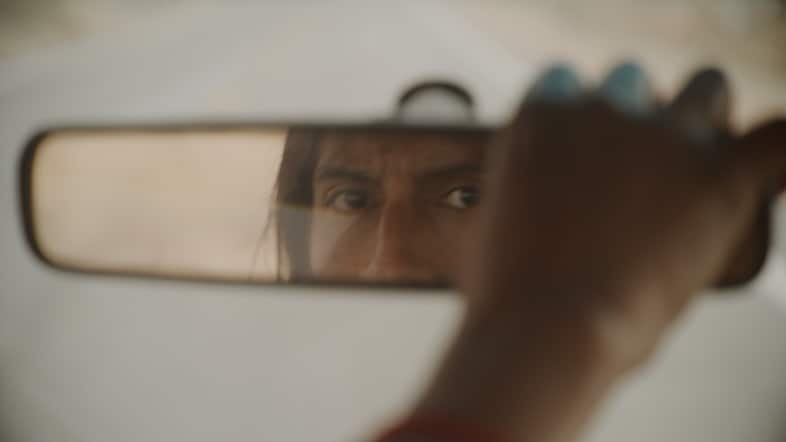
Doug Aitken: The installation in New York will be seven screens and they’re very architectural. You walk into this dark space and find yourself surrounded by these different screens, almost like billboards or signage that are moving. You can walk into the centre of the space, sit or lie down or kind of lose yourself. I wanted to create an environment where the artwork would dissolve and perform with the viewer. It’s a very non-linear story, there’s multiple characters that you come back to over and over but it’s not a traditional structure driven by dialogue or drama. It’s much more of a graphic narrative, propelled on the one hand by music and sound and patterns of repetition, and on the other, by diverse individuals in completely separate places but drawn together to create this larger story. So you have everything from a mechanised robotics factory to a remote, arid desert-scape with a migrant miner moving through space in his truck. It’s these really radically diverse stories that somehow intertwine and create a more complex portrait of who we are now and how we’re moving. I see Lightscape as a film choreography – we’re using moving images, but we’re also looking at it almost like dance. The way that the screens play off each other, there’s cause and effect moments where the entire exhibition kind of folds open like a lotus blossom or it contracts.
LA: The title, like all of your titles, is very evocative, and I wondered what the word Lightscape means to you?
DA: I think Lightscape came to me when I was thinking about how to describe the modern landscape. We’re living in this fascinating moment in time where the lines between fiction and nonfiction are blurred, the idea of the landscape is a question. We look outside our window and it’s a built landscape: the trees have been planted by humans, the streets are paved, the sky is sliced with planes crossing, and the invisible signals of connectivity and electricity are passing through us as we speak. This is a very different idea of a traditional landscape, but a geological landscape, a sense of deep time and deep ecology. How do we describe this, and how do we define it? Because I think it’s important that we don’t just take this for granted and just assume that this condition is normal [laughs].

LA: Your work is very collaborative. Could you tell me about the collaborations on Lightscape and what they brought to the project?
DA: I love it when an artwork can create a huge dinner table, invite other people to create and share and partake. I also love improvisation. So much of what we see around us is so constructed, so contrived, and I like the idea that when you make a work, there’s room for spontaneity. With Natasha Lyonne, we’ve always wanted to do something, and when this project surfaced, I had an idea for a character but we really just made up the character in situ. Bryn [Mooser], who is her ex-lover, is part of the scene, and we thought about this woman who’s in a luxury apartment hotel, looking out, and the glass window is separating her from life. It’s almost like a pleasure prison that she can’t break, and she’s looking out at the world around her at the circulation, the variety, the diversity, but only through the lens of a voyeur. That was something where we got a room and just started improvising. A lot of the scenes were like that. The location was the script, but then what happened in it was really made up on the spot.
LA: The horizon is very prominent in the film, and you’ve talked before of the horizon symbolising what lies ahead. It’s an acutely anxious time – what do you feel about the future?
DA: I remember I asked Paolo Soleri, the architect – he was in his 90s – “what’s your idea of the future?” And he just looked at me and said, “You can’t ask that question.” He said the future is just a conjuncture, we have no idea – all we have is the present and we have to just focus on that. On the one hand, we need to have visions for where we can go, personally or as a society, but on the other hand, we also have this power of presence and the present, and that’s something that we can’t lose track of. These are times which are just incredibly challenging, politically, socially. How do we navigate this? But I think in some ways, it does go back to creativity and culture. That is a space that we need to hold on to, and it’s more valuable than ever, because it’s the opposition of that white noise and anxiety that’s outside of our purview and our control.

LA: You typically tend to work on lots of different things at once – what’s next for you?
DA: There’s a number of things – one of them is a project based around the Los Angeles fires a year ago. We’ve been collecting and harvesting materials for the last eight months and right now exploring the idea of turning the materials into instruments that the landscape can perform. I want to see the fire zone create music and sound out of its debris.
Doug Aitken: Lightscape is on show at The Shed in New York from 25 June to 13 September 2026.
