
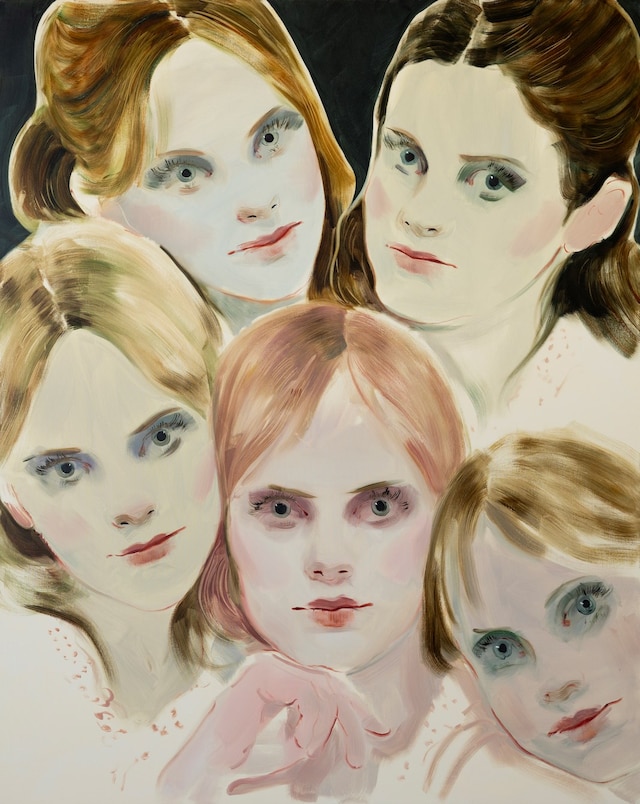
In Near Field, Czech painter Adéla Janská presents uncanny portraits of women whose steady gazes draw viewers into an exploration of intimacy
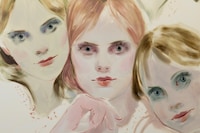
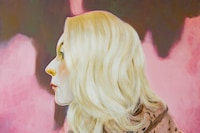
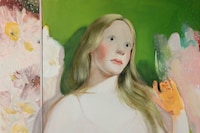
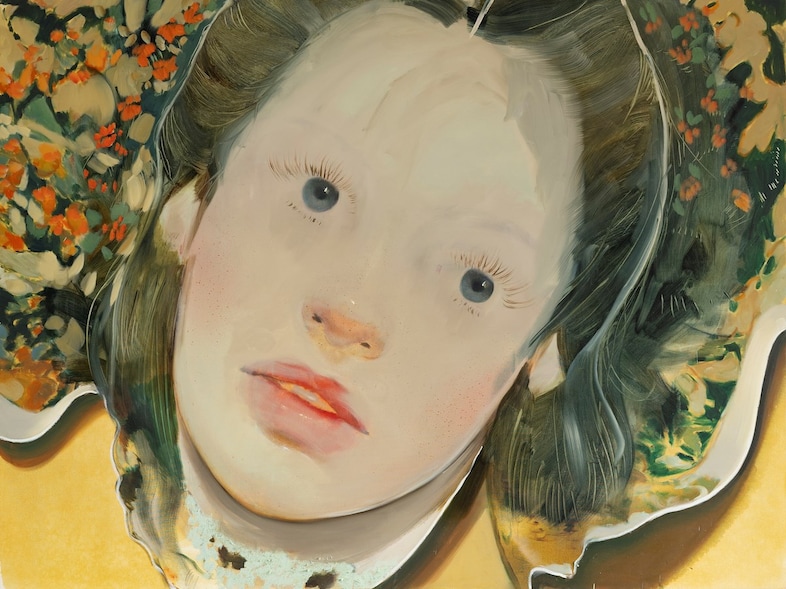
“It is important to me that the woman is not perceived only through her body, but also through her own gaze,” says Adéla Janská, whose large scale paintings of doll-like figures are now on display at Rolando Anselmi gallery in a solo show titled Near Field. “I feel that the gaze largely determines who the woman in the painting is.” Familiar yet strange, Janská’s figures appear to dwell in a different dimension, one that is close yet beyond our reach. Humming with tension, each subject seem to carry the weight of something left unsaid. Janská’s women watch and wait for some kind of acknowledgement, their muted chalky pastel hues only accentuating the sense of disquiet.
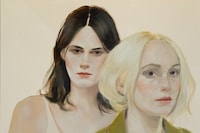
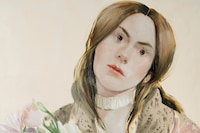
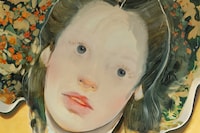
Born and based in Olomouc, in the present-day Czech Republic, Janská was raised in the final decade of the Soviet Union. She recalls growing up in a house filled with art books and paintings. “Painting and drawing were always a natural part of my life, but for a long time I did not see them as a defined professional path,” she says. “After grammar school, I had to decide what to study next, and at that point it felt most natural to try applying to an art academy. But without any systematic preparation, it took some time before I actually started studying painting.”
Some years on and the artist has exhibited internationally in group shows in New York, China and across Europe. Near Field is Janská’s second solo show at Rolando Anselmi, following her residency in 2024 which culminated in an exhibition that saw her work paired with Lexia Hachtmann’s at the gallery’s Berlin headquarters.
Since then, her compositions have become sparser and the colour palette more subdued, as she paints with a sense of clarity and maturity. “These paintings came very lightly, almost as if they happened without me,” she says of her more recent work. “There is no visible conflict in them, no attempt to improve or add something. They feel exactly as they should be.”

For Janská, painting is a way of life. She goes to the studio daily, starting early in the morning and working until the evening. She doesn’t like to be interrupted, needing to concentrate to maintain momentum and a clarity of vision. “When I become immersed in a certain painting or subject, it stays with me until it gradually becomes exhausted,” she reflects. “Sometimes this takes several weeks, sometimes even months. I feel that my work has a certain recurring cycle: to begin with something new, to discover it, to test it, and then to stop in time, before only routine is left.”
Janská adopted the term ‘near field’ for the exhibition’s title from scientific vocabulary to describe electromagnetic fields. “The term interested me because of the idea of a close field – a space where things affect each other from immediate proximity,” she says. Relationships engender a kind of magnetic pull, becoming a two-sided exchange. The gaze reflects this dynamic, in which there is invariably a non-verbal dialogue between two people.
Last year, Janská became her father’s carer as he neared the end of his life. “This experience shook my life deeply, not only because of the loss itself, but also because I cared for him until the very end.” The term ‘near field’ took on a more poignant meaning, as family members became closer, especially Janská and her sister. Subsequently, pairs of women began to appear in her work.

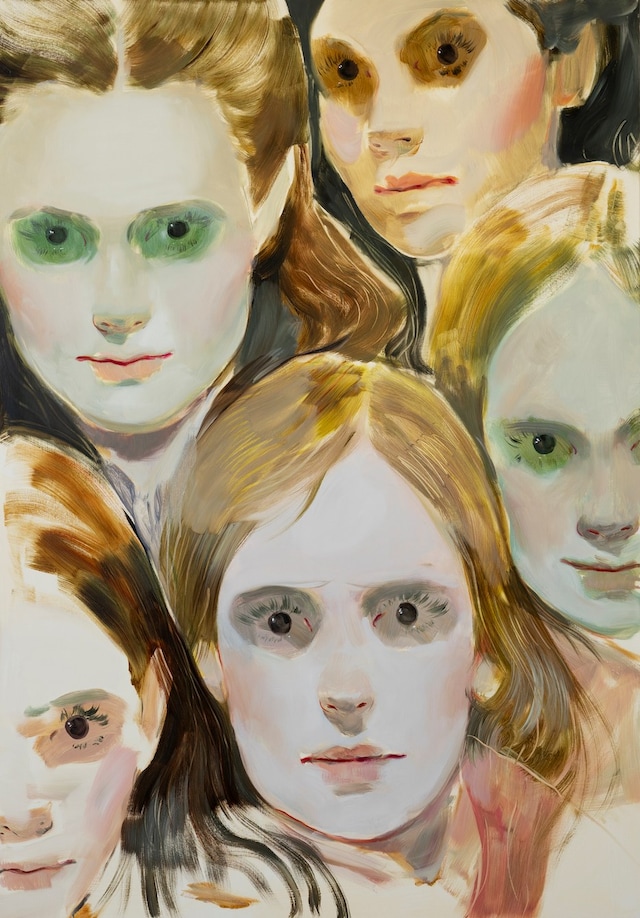
“Only with some distance did I begin to understand how strongly this period had affected my work,” she says. “I see caring for my father as a great privilege. It brought me to a deeper understanding of our relationships, and also of things that we often do not perceive so clearly in everyday life. I dealt with everything in the solitude of my studio.”
Janská’s portraits occupy a space that is both personal and universal. She references a variety of sources and visual materials – dolls, mannequins, fashion photography and sometimes even herself – rather than selecting a specific person or life model. Opaque in their perfection, there is a flatness to each figure that belies their personhood. “I feel that painting naturally carries something from both personal and collective experience,” she says.
She denies that her works are a commentary on female beauty standards. “This naturally affects me, because I am a woman and I live in a time that repeatedly reopens questions around the way women, the female body, and beauty are looked at.” But she does admit that the works undeniably absorb their surroundings. “Paintings are made within the world, not outside of it. The way the female body is perceived, represented, or judged is of course part of that environment.”

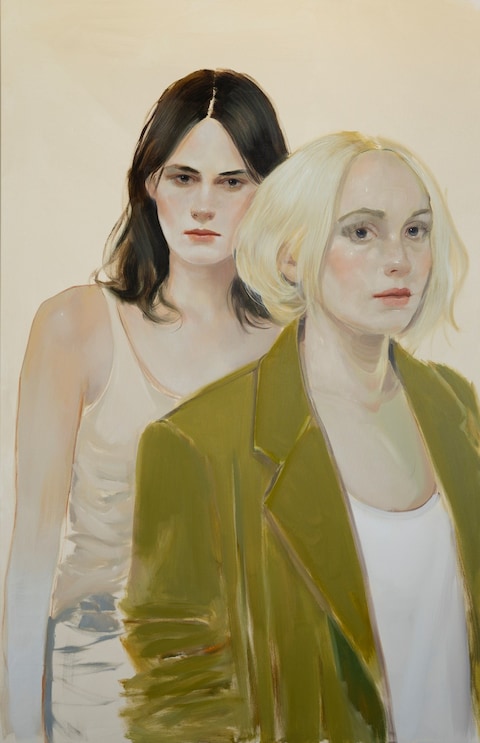
Janská highlights that the gaze is dependent on both onlooker and subject. “Near Field describes a state in which something, or someone, is so close that it is no longer possible to remain a neutral observer,” she explains. “That gaze can be insistent, and sometimes it almost seems to follow the viewer wherever they move. I think it always says something not only about the woman in the painting, but also about the person looking at her.”
For Janská, painting is a process of teasing out this dynamic, creating a portrait that is visually harmonious but charged with tension, “so that it does not feel like a dead image, but instead like something alive.”
Near Field is on show at Rolando Anselmli gallery in Rome until 30 September 2026.
