
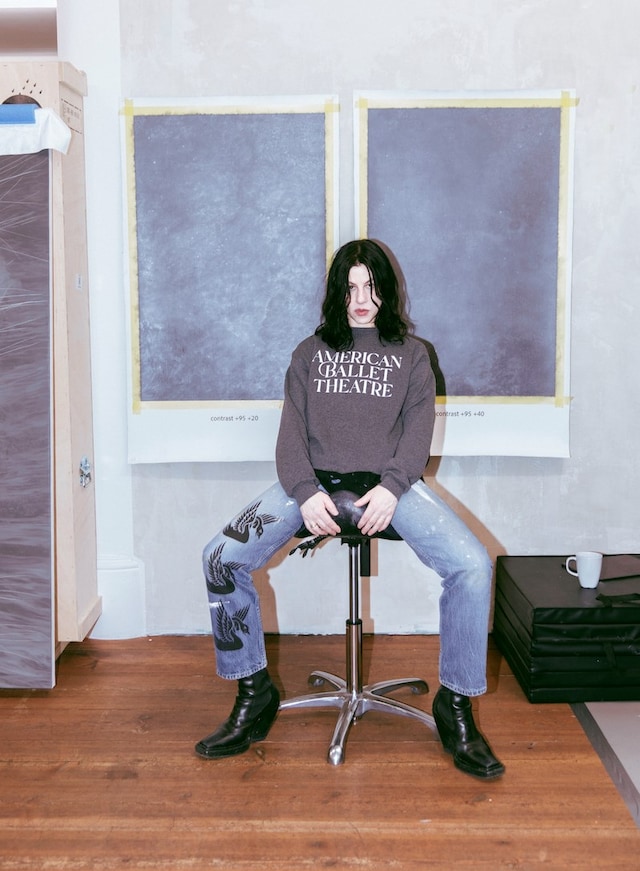
As Citizen opens at Sprüth Magers in London, Imhof discusses the ideas that connect her work, from Faust and ballet to female pleasure, death and the evolving language of her Wave paintings.
Death, female pleasure, the danse macabre, and Swan Lake are all sources of inspiration for Anne Imhof’s new exhibition Citizen at Sprüth Magers, London. In conversation, the German artist and musician traces the through-lines of her work, from the Golden Lion-winning Faust at Venice in 2017 and her collaboration with American Ballet Theatre principal dancer Devon Teuscher, to the scratched Wave paintings and crowd barriers repurposed from her monumental DOOM at New York’s Park Avenue Armory last year.
Sofia Hallström: My mother was a professional ballerina, so I grew up watching a body trained to its absolute limit and the consequences of that. When you entered the world of classical ballet and started working with your now partner, American Ballet Theatre principal dancer Devon Teuscher, what surprised you most about what that form does to a person?
Anne Imhof: A life dedicated to ballet means training from a very young age and preparing your body for extreme performances. What isn’t obvious to most people is how much discipline is behind something that appears so effortless on stage. When a ballerina is preparing for a season, it is very much like an athlete training for the Olympics.
I’ve worked with dancers for about ten years now, and what they bring is a body that has internalised movement through years of repetition. Their muscles carry a kind of memory. Ballet is a very strict form, but that discipline and rigidity can also create a particular kind of freedom. It would sound like freedom and ballet do not quite go together, unless you start telling stories with classical ballet that are different or reinterpreting the old ones. All the queens and princesses and their mothers, their rivals and fairies, deserve their own origin stories.
SH: The first time I encountered your work in person was Faust at Venice in 2017. I still think about the performance often, about the performers beneath the floor, and all those bodies around us at once. Looking back now, does that performance feel like a beginning, or a foundation you had to keep building upon?
AI: It feels quite far away now. But it was the first time my work was presented on such an international scale. For a young artist, presenting a pavilion in Venice is a life-changing experience, especially with winning the Golden Lion.
At the time, it wasn’t always clear where the stage began or ended, or what role the audience occupied within the work. People often wanted to categorise it: was it art, dance, performance? Was I an artist or a choreographer? Those questions were never my starting point. I was simply following what felt necessary. Performance has always been the backbone of my practice.
Looking back, besides the composition, what interests me most is the relationship between the gaze and surveillance. In Faust, the dynamic of who was watching whom was central. That relationship has changed dramatically since then. Surveillance operates differently now, and I still find myself thinking about some of the questions that piece raised.

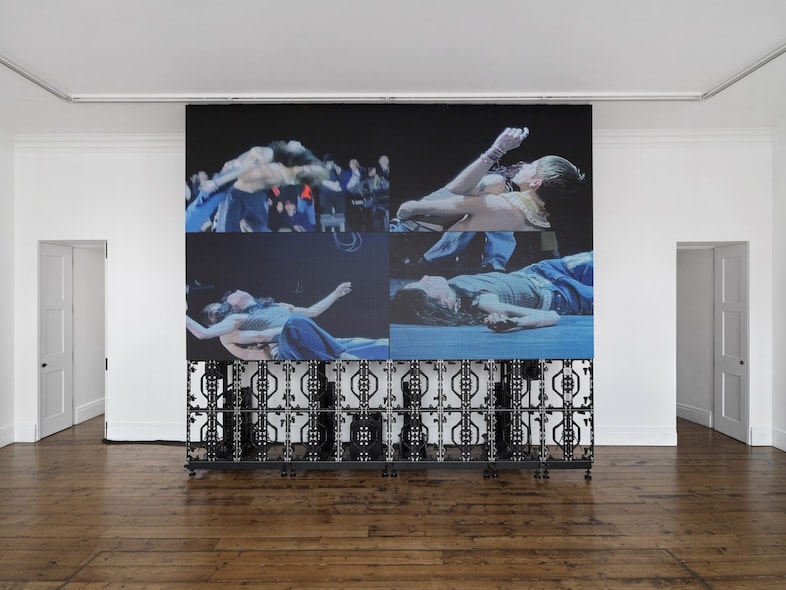
SH: It is interesting what you say about where the performance starts and the stage finishes. I feel that here in Citizen too, with the fragments of stage and the crowd barriers, the way those elements dissolve the boundaries between them.
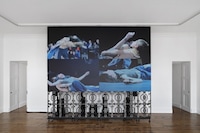
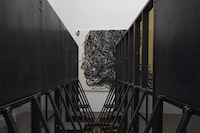
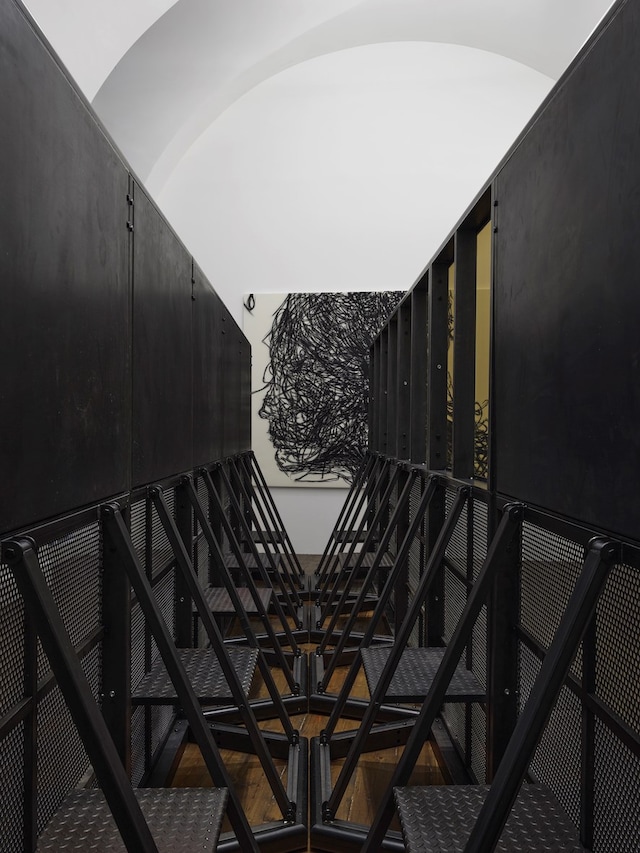
AI: In DOOM, the crowd barriers became part of the mise-en-scène, but they also functioned as ballet barres. The dancers used them during class on stage. The ones you see here in the gallery are fabricated, redesigned and slightly enlarged.
I’m interested in taking a modular object that normally separates people and turning it into something more fluid. Depending on how they are arranged, the barriers can suggest enclosure, protection, division or openness. If you push them together, they almost become a communal shelter; if you stretch them out, their form is reduced to a single corridor. A very minimal form. Just a line. I like how such a simple structure can constantly change meaning.
SH: Is that something you are actively thinking about in relation to protest as well?
AI: I am, and also in terms of symbolism, though it started a long time before DOOM. I made a show in Bregenz called Wish You Were Gay, and the barriers played a role there too, as an installation built beneath an uncannily elevated stage, the kind you would see at a festival or in a stadium. The crowd barriers made smaller spaces within that. That was the first time I used them as sculpture.
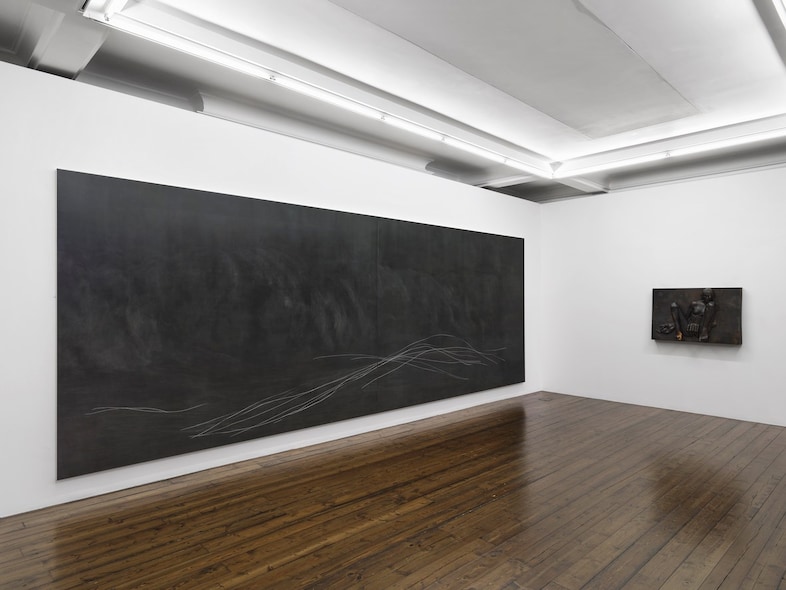
SH: There is an urgency to your Wave paintings, scratching the oil paint with a blade that feels like it is almost compulsive. How did you arrive at this process in the studio?
AI: It is only since my show last fall that I started placing figurative paintings underneath the scratched drawings. It began quite practically. One painting was not working and I didn’t want to discard it, so I used it as a backdrop for the drawing. Suddenly something clicked. The figurative and abstract elements could coexist on the same surface.
What interests me is the layering and the way it allows different moments to exist simultaneously. In performance, you can move through time very freely and even contradict it. Painting operates differently, and that tension between the two is something I keep returning to.

SH: Speaking of gesture, I wanted to ask about the hands too, and the sculpture in the first room where the bronze has been rubbed back. It reminded me of public statues that have been touched so many times they have worn away, that of a good luck gesture. Was that something you were thinking about?
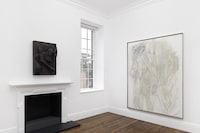
AI: I made this drawing about three years ago of a figure masturbating, dressed in a leotard. It is a single figure and it is showing female pleasure. That is what it’s about. I started making relief sculptures from it, and the bronze you see here has this change in patina on the foot and the eye. It evokes that it has been touched a lot. You shouldn’t touch a bronze in an art space, but with a public statue, you can. There is something about the idea of being allowed to touch it, and of appreciating or being appreciated by a female figure that pleasures herself.
I hung it prominently because, in many ways, it captures something central to the exhibition: the tension between softness and violence. Waves and ballet both embody that contradiction. Ballet remains a form deeply tied to ideas about how women’s bodies are presented and understood, and that’s something I’m interested in examining.
That is why the ephemeral feels so important – these are magical moments you can’t really control. The titles of the big paintings are taken from ballet mimes used in Swan Lake. It is what Odette, the Queen of the Swans, tells the Prince when they meet. One title is ‘there is a lake of my mother’s tears’, and it carries a whole history, the pain but also the power and the heritage but also trauma passed from generation to generation. I took it out of the ballet mime and used only the words that come with the gestures. I separate movement from image. The second title is you are a queen, so I bow to you, like the moment in DOOM where the group of dancers use that very pantomime to bow in front of Efron Danzig who is playing the Queen of the Wolves. There are things lying in those old figurations, those old stories, that I think are worth telling new stories with.
SH: The text for Citizen mentions the danse macabre, the medieval death dance where all bodies, regardless of rank, are led to the same end. Is mortality something that you are actively thinking about in your work right now, or has it always been present?
AI: Death has always played a role in my work, particularly the danse macabre. Historically it was a critique of society, death is a threat to everyone, vice was attributed to the male figures of power not to the women for the first time. But the dance of death is also a celebration. By dancing with death, you become more aware of life.
In the paintings and drawings downstairs in the gallery, death appears as a female figure dancing alongside other women instead of the skeleton.

SH: In your recent interview with Tyler Mitchell, you mentioned that the desire in your work is for a moment to last forever, like falling in love. Do you feel like you found a way to prolong that moment in this exhibition, or does that feeling always eventually escape?
AI: There is definitely a longing that motivates me always. In my pieces it is connected to movement and dance and its inherent power. When performers and audiences share a truly magical moment, everyone knows it cannot last forever. That’s why it is so precious.
I tend to make works that last for many hours, to stretch time and hold onto that feeling longer. But the reality is that these pieces require enormous preparation and care. Even so, I keep returning to that fleeting moment of being present with other people. That’s the thing I’m ultimately trying to reach.
It may seem paradoxical because painting endures while performance disappears. But the tension between permanence and impermanence is ultimately what drives me.
SH: I’m struck by how your material language, using steel, the barriers, the black surfaces, stays consistently severe, even when the subject matter becomes very intimate. Wish You Were Gay was particularly personal and vulnerable, exploring queerness and parenthood. Does the darkness protect the vulnerability?
AI: I think that is especially palpable now in Citizen. With Faust, my career accelerated at a moment when I was still figuring a lot of things out. I felt an urgency to create environments that reflected one side of who I was as an artist. I worked closely with friends and collaborators, building a sense of community and collective experience that felt important to me. I was choosing materials like aluminium, steel and glass and often worked with those “pseudo” readymades evoking the world that you find outside of the gallery space.
I feel a need to redefine myself. Staying in that transition, in flux. Like the waves. Its deeper meaning can be my desire to stay fluid, and this is vulnerable and needed for some spaces that I created with performance and movement and the mise-en-scènes and sculptures deriving from it. The flux and changing in between stillness and movement is like making music.
In music and dance, it is a burden to have to keep writing the same songs or defending a fixed style. Performance is about being present, constantly reinventing yourself and responding to the people in front of you. If you are a performance artist, it is important to respect the audience and create ways for people to enter the work. They are precious and this can be magical. You have to be ready for this.
Citizen runs at Sprüth Magers in London until 1 August 2026.
