
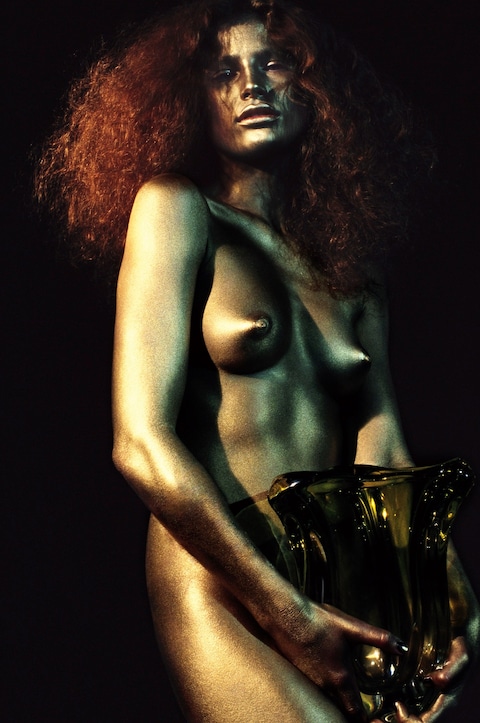
As the first major survey of her work opens in Paris, Camille Vivier discusses her singular career in art and fashion photography
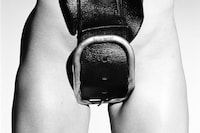
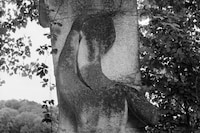
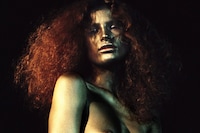
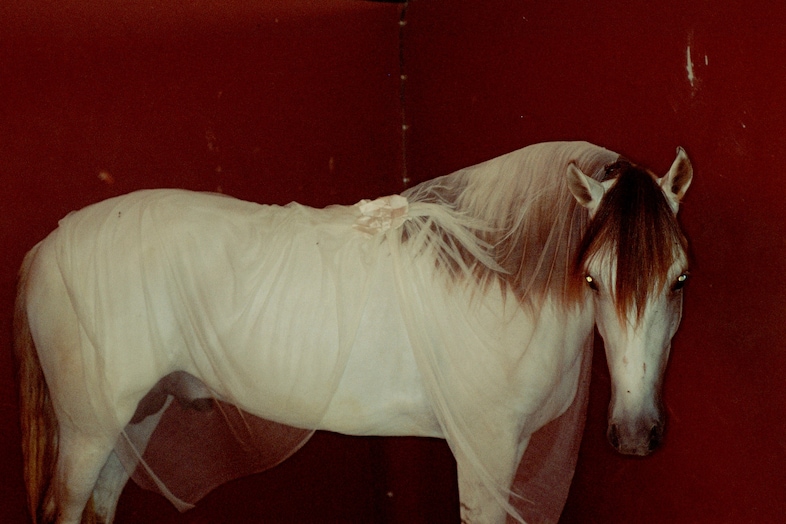
A white horse with a fiery auburn mane stands against a deep red backdrop, a white chiffon veil cascading across its back. A woman poses inside a tall, spiral metal sculpture, her athletic form and buffed skin mirroring the artwork’s curvature and glow. A tree, captured in black and white, seems to have sprouted a female form – back, neck, arms, plump buttocks, shapely thighs and all. This is the universe of the French photographer Camille Vivier. Existing at the intersection of fine art and fashion photography (the key facets of her practice), it’s a world where animals and objects frequently appear human, while humans may resemble architecture, sculpture or forms found in nature, or – just as likely – characters in a film.
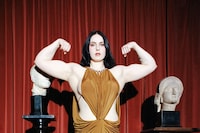
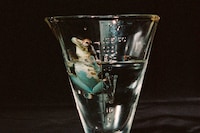
Dreamlike, theatrical, irreverent and enticing, Vivier’s work abounds with artistic, cultural and cinematic references. Frequently, these evocations are subtle and layered: a hint of David Lynch, a whisper of Alfred Hitchcock, a sly nod to Cindy Sherman, comic books or Carlo Mollino. Occasionally, they are immediately apparent: her striking, statuesque depictions of women bodybuilders and bold, beautifully staged still lifes, for instance, pay direct homage to Robert Mapplethorpe.

It was this particular connection that Paris’ Maison Européenne de la Photographie (MEP) was keen to explore when its team first approached Vivier about hosting an exhibition of her work. “They originally wanted to do a cross-exhibition between Mapplethorpe and me, which I thought was a great idea, very challenging,” Vivier says over the phone from her home in Paris. “Unfortunately, it was too complicated to get the works from the Mapplethorpe Foundation, but they still wanted me to do a show.”
Instead, the newly opened exhibition – titled simply Camille Vivier and spanning an entire floor of the photography museum – is dedicated entirely to Vivier’s esoteric oeuvre. “It’s a sort of retrospective, but not really because I’m not that old,” the photographer laughs. “More a selection of different works from among my body of work, looking at the key subjects and patterns like the body or anthropomorphic shapes, shape in general … ”

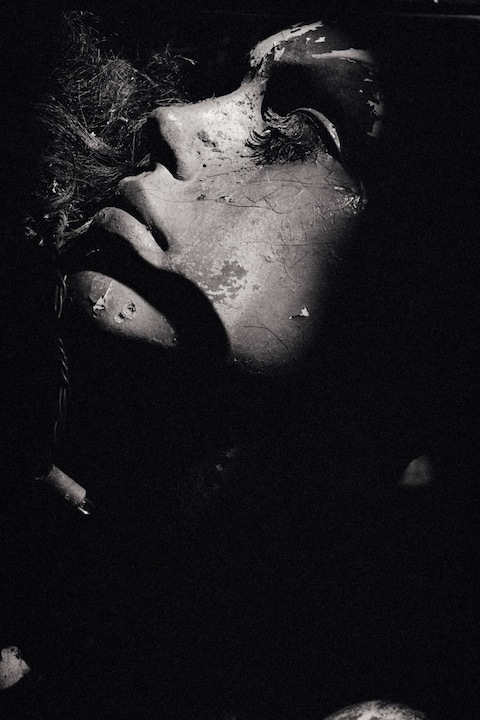
The result is what the museum terms a “thematic journey” across Vivier’s 25-year career bringing together around ten series and almost one hundred works, from gelatin silver and digital prints to Polaroids, to showcase her distinct visual vernacular. Often she works in a studio setting, building sets or backdrops, experimenting with compelling colour combinations and using light to sculpt volume – like a director and DoP rolled into one. “My references stem from this studio approach, not in a nostalgic way but in a way that’s cinematic, or crafted,” she explains.
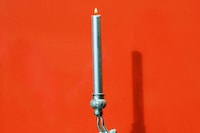
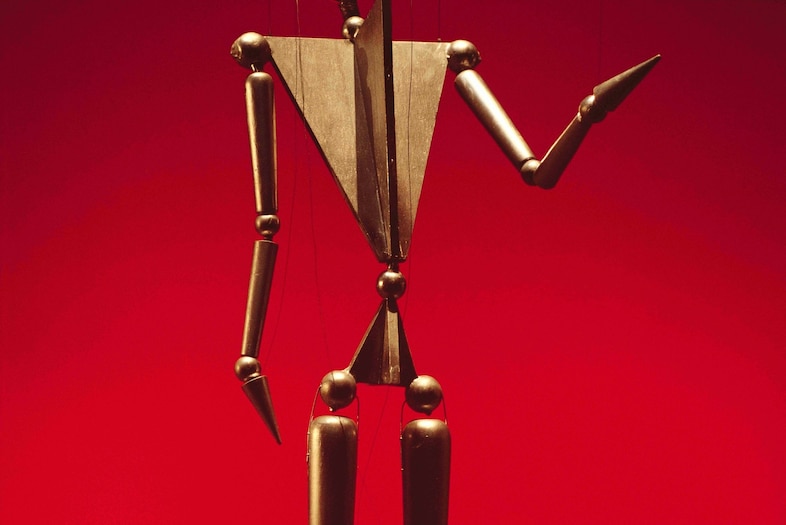
A number of the works included in the show reveal the evolution of this methodology. There’s the aforementioned horse – part of Vivier’s 2002 series Horses, wherein individual animals are captured against a contextless background, appearing almost as mythic symbols. There’s Teatro Colla (2014), the photographer’s playful “portraits” of puppets designed in the 1930s by Luigi Veronesi, a pioneer of Italian abstraction. While the long-running project Monument (2002–2022) sees Vivier centre on anthropomorphic candles used in Afro-Brazilian rituals, which she captures against colourful studio backdrops. In every instance, formal beauty is offset against an air of mystery or narrative tension, at once alluring and disquieting.

Perhaps the best encapsulation of this duality can be found in Vivier’s series HR Giger (2021–2022), titled after – and photographed in the home and studio of – the late, great Swiss artist responsible for dreaming up both the set design and the Xenomorph creature for Ridley Scott’s cult sci-fi horror Alien. “It’s a huge body of work,” Vivier says, “so for me it was important to have this in there – there’s a room dedicated to it.” In Vivier’s photographs, Giger’s fantastical, and frequently female biomechanical creations come face to face with Vivier’s female models, who claim the setting as their own in a weird and wonderful merging of metals, cast synthetic materials and human flesh. Cronenberg, eat your heart out.
When it comes to photographing the human form, Vivier is – again – interested in staging, in the porous nature of identity, in the tension between masculinity and femininity that exists within us all. (Her three series focussing on different female bodybuilders captured in studio settings are a perfect example of this). This fascination is an enduring one – in her late teens, Vivier applied to the Sorbonne with the aim of learning under the French body artist Michel Journiac, who in the 1970s had photographed himself in the guise of various female archetypes. “He died the summer before I started there,” she remembers, “so that was really demotivating for me.”

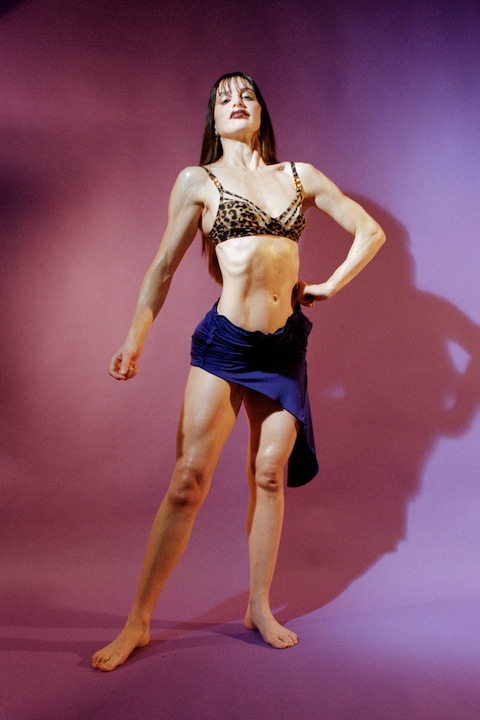
Three months into her first term, however, she met the team behind Purple Magazine and began working there instead, kickstarting her ongoing career in fashion photography (although she would later return to art school to complete her studies). The world of fashion imagery proved the ideal platform for Vivier’s cinematic eye – “even though at the time fashion photography was ‘anti-fashion’: Wolfgang Tillmans, Juergen Teller, Anders Edström” – and a vital influence on her personal output. “I enjoyed working with a team,” she recalls, “and it was quite close to what I liked stylistically – this idea of artifice, of working with makeup, the glamour … I guess the way I photograph [personal projects] is probably the same as the way I capture a fashion image, except that it’s not about [showcasing] the clothes.”
Reflecting back on her impressive career so far as the first major survey of her work opens, Vivier notices a few changes: “I sense a sort of naivety in my photographs from 20 or 25 years ago, and I am less romantic now. Although of course I’m still romantic,” she laughs. “And I think I have more fun now, more freedom.” What is most evident, however – from an external perspective, at least – is that much like her artistic heroes before her, Vivier has succeeded in cultivating a style that is, for all its synthesis of references, unequivocally her own.
Camille Vivier is at La Maison Européenne de la Photographie in Paris until 13 September 2026
