
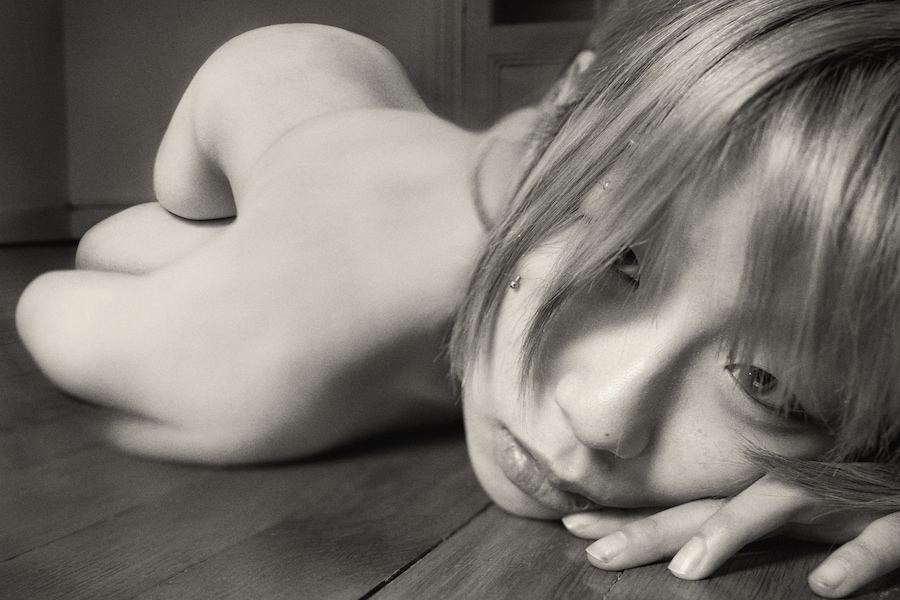
For his book Reconfigurations, Tammaro twists the conventions of nude photography, using dual focus to transform bodies into strange forms
“Painting is a more elastic representation of what is in front of you,” photographer Matthew Tammaro says via video call from Paris. Having studied painting in his hometown of Toronto, Canada, Tammaro quickly turned to the immediacy of photography – but has never abandoned the shifting parameters of fine art. “It allows you to collage multiple ideas onto a two-dimensional surface in a way that relieves some of the frustration of photography.”





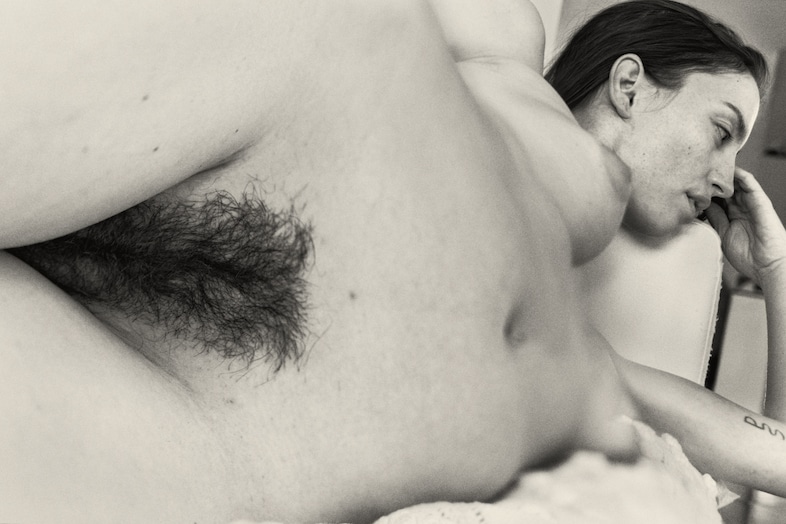
Tammaro’s most recent venture, a photographic series and book titled Reconfigurations, was borne from this frustration and a wish to rediscover the playfulness of the camera. The project situates nude photography somewhere between eroticism and the grotesque. Tammaro began taking portraits of his then-partner during the first Covid lockdowns, then expanded his roster to include friends and models. In the images, their naked bodies contort sometimes to the point of near-abstraction, sometimes to such intense focus that individual follicles and goosebumps are visible. “It’s based on the intimacy we have with our own and other bodies,” Tammaro says. “We can be attracted to and repulsed by the same thing simultaneously.”
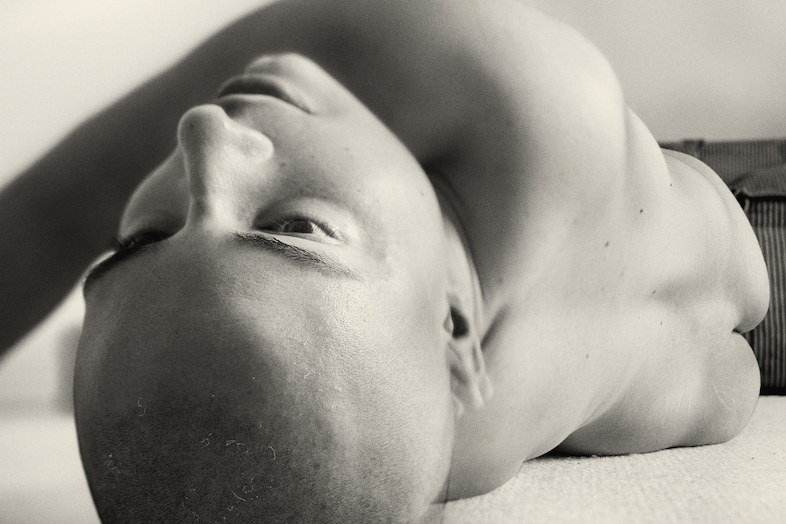
Tammaro used an inexpensive filter to achieve the images’ distortion. “In the Eighties, they would sell these amateur filter packs: cheap packages of hundreds of different filters that can change an image,” he explains. After buying one on eBay, he experimented until landing on the ‘split diopter’: a lens which works similarly to bifocal glasses, enabling both the background and foreground of an image to remain in focus. “It is a little bit of a campy filter, used in old thriller films to show two things happening at once.” In this series, it evokes a similar effect of exaggeration: bodies are both indisputably real and clearly distorted. In one image, half of the composition is taken up by a foot whose dark hairs are as defined as fine ink marks; in another, a pale expanse of buttocks seems to stifle their owner, whose face is diminutive in the corner of the frame.

For Tammaro, the dual focus technique implemented a physically intimate process; for the viewer, it prompts active looking, whereby one must intentionally engage with the image to comprehend both of its focal points. “I hope this challenges – or at least puts into question – the traditional hierarchies of the gaze, and what it means to be the photographer, the subject and the viewer,” he tells me. The work also became unusually collaborative. “I am very aware of the power dynamics involved in creating an image,” Tammaro continues. “I shoot digitally because you receive live feedback, which brings the image up before both yourself and the model immediately. And the nature of the poses means that the model needs to contort themselves in real time, because you are fitting an entire body into a very small frame.”
The work echoes the Surrealists whom Tammaro cites as references, alongside the visceral paintings of Ambera Wellmann and the nude photography of Edward Weston and Lee Friedlander. Bodies twist into unfamiliar forms; limbs appear detached from their owners; familiar anatomy becomes strange. The photographic manipulations of Man Ray, whose rayographs and solarisation techniques pushed the mechanical boundaries of the medium, come to mind, too.

These artistic influences are further evident in the book that gathers the project’s images together, published last year in collaboration with Angelique Piliere by Oui Non Editions. To call it a book is a stretch, though: it is actually an unbound album, with photographs included as loose inserts, to be handled, reordered and reperceived to a point at which viewing becomes a physical act. When asked what he would like his audience to glean from this experience, Tammaro emphasises perspectival awareness. “I want people to have an awareness of both intimacy and their own distance to the photograph,” he says. “As well as perceiving this tension between playfulness, frustration and desire; the seriousness of portraying a nude body and the playfulness of its distortion. I want Reconfigurations to hold all of these emotions, simultaneously.”
Reconfigurations by Matthew Tammaro is published by Oui Non Éditions and out now.
