
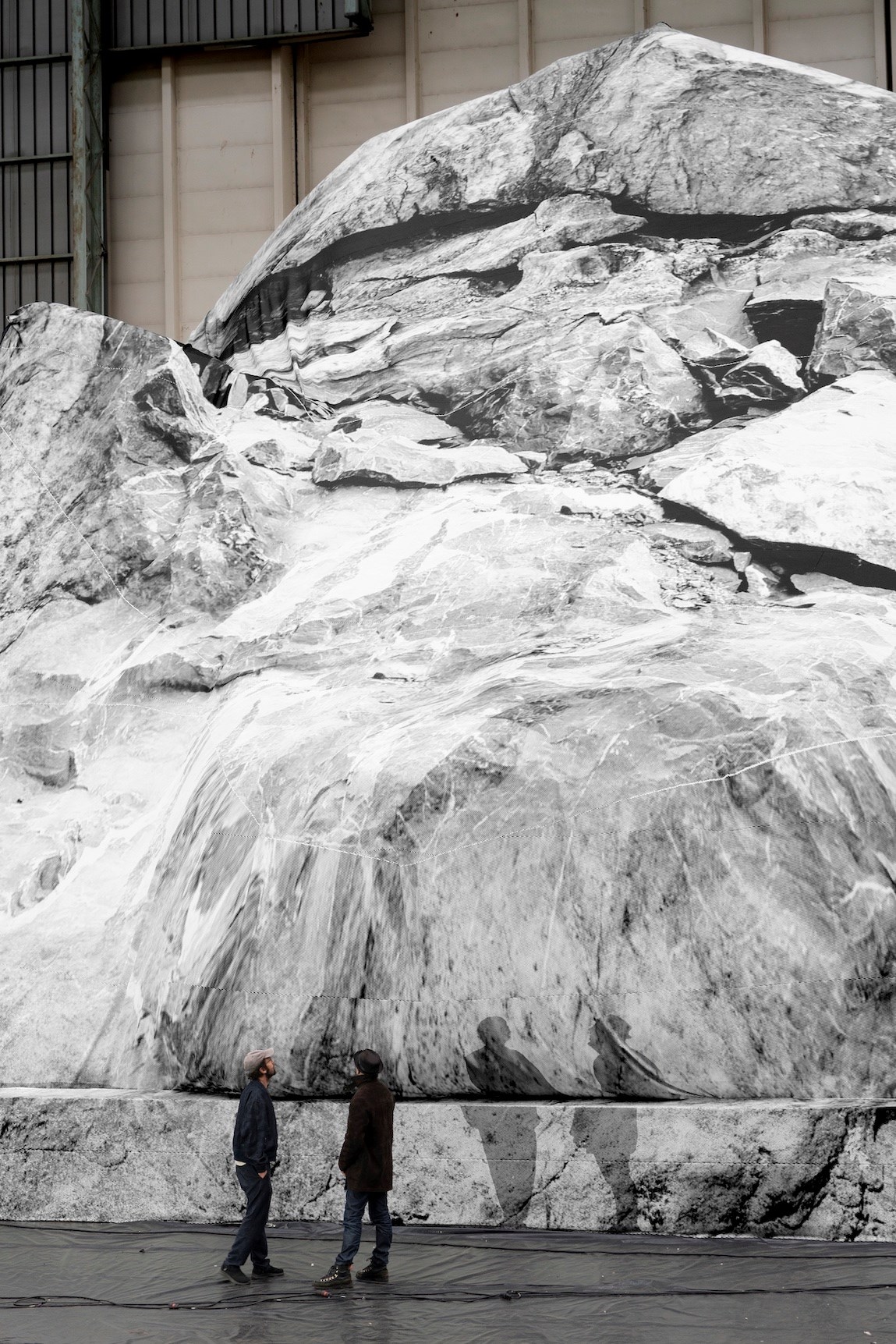
Thomas Bangalter, one half of the former French music pair, Daft Punk, has now collaborated with artist JR on La Caverne du Pont Neuf, a temporary installation on the monumental Parisian Pont Neuf bridge. Designed to look like a mountainscape, the immersive installation wraps the bridge in packed fabric, paying tribute to artists Christo and Jeanne-Claude’s The Pont Neuf Wrapped, which celebrated its 40th anniversary last year. Accompanying the physical installation is a soundscape, designed by Bangalter. “I realised we needed to make a sound as a texture, made up of several elements,” Bangalter tells Hans Ulrich Obrist, in a conversation about the project. “[I wanted] a certain form of sound dimension that could amplify and in some way increase the symbolic and mystical value and almost hyper-realism of the experience – to channel my definition of the vibratory emanation of this moment and this space in an ephemeral way.“
Here, Hans Ulrich Obrist talks to Thomas Bangalter about his collaboration with JR, designing the “anti-soundtrack“ and the importance of music as a lived experience in an increasingly digital world.
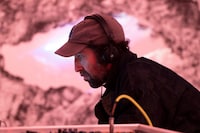
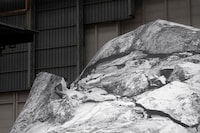
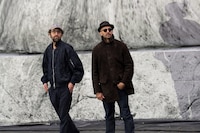
Hans Ulrich Obrist: I’m happy that we can talk to each other today about the collaboration with JR. I’ve wanted to meet you for a long time. It was Samuel Keller who told me about this exciting project. And Emmanuel de Buretel always thought we should meet.
Thomas Bangalter: Emmanuel has also been an accomplice of mine for a very long time, almost 30 years.
HUO: Your new bridge project, La Caverne du Pont Neuf, is fascinating. I asked JR if it’s a soundtrack for the installation you’re doing. He told me it’s much more complex than that. He told me it’s all but a soundtrack. It’s more of a vibration, a tremor.
TB: It was kind of an anti-soundtrack. I had worked with JR before and he explained this project to me as both a tribute to [visual artists] Christo and Jeanne-Claude, but also a continuity of the two large-scale installations he had done with the Grand Pyramid of the Louvre, and the work we had done together at the opera. And he asked me to think about the sound dimension of the project. I had a really strong relationship with The Pont Neuf Wrapped, Paris, 1975–1985 and Christo and Jeanne-Claude’s packaging. It was a very important memory for me as a child and teenager – it defined my relationship with art and this idea of an ultimate work of art that was not for sale, and that was totally magical.
I remember its radicalism – it was totally pure, hyper-accessible and at the same time ultra-minimalist. So when JR told me about this idea, I had no desire to create music. There was a certain obscenity in imposing music in the urban space and in an installation like this. Rather, [I wanted] a certain form of sound dimension that could amplify and in some way increase the symbolic and mystical value and almost hyper-realism of the experience – to channel my definition of the vibratory emanation of this moment and this space in an ephemeral way. It was also important to focus on Christo and Jeanne-Claude’s minimalism. There was something very ambitious but also very simple in the idea of choosing a fabric and packing it, so I wanted to pack a sound fabric – a vibratory texture. It had to be as simple and as radical as theirs.
“Music is a vector with which we build universes” – Thomas Bangalter
HUO: Edouard Glissant, the philosopher of sounds, talks about the tremor.
TB: Indeed, there are several aspects. The first aspect is to say, here is the limit between noise and music. When you hear a noise, like a television noise, analogue television, or the noise of the radio, these are the frequencies, from the lowest frequencies to the highest frequencies, all played at the same time, like a breath.
It’s an illusion – contrary to Christo who packs [objects in] tissu, where there is no illusion – for JR it’s really the material of the tissu with the bridge. It’s really a false rock. This false rock was created with a structure which is inflatable, and so it was created with air. It was ultra-aerial, so I needed, for the illusion to work, to have something extremely mineral, like extremely heavy rocks. What was missing was a certain form of oscillation and vibration with infrabasses that anchor, and make the earth resonate – quite the opposite of something aerial. So I started with very low frequencies that we might hear in construction works, or in raves, or in urban music – the air moves at a certain frequency. So if there are infrabasses which are at 30 Hz or 20 Hz, it’s ultimately the speakers that move 20 times per second, making the air move. I realised we needed to make a sound as a texture, made up of several elements.
There are three layers: a rock element, a very organic and low vibration; the representation of the air, which is engulfed in the tunnel, and is also done with synthetic, electronic elements, almost like the idea of a wind. And then the final layer which picks up from the work that JR and I had done for our 2023 collaborative performance installation Chiroptera with Damien Jalet – very high frequencies of noise which could signify the unknown, what we don’t see, whether it’s crickets or insects or bats – the order of the invisible – brings a strange presence.

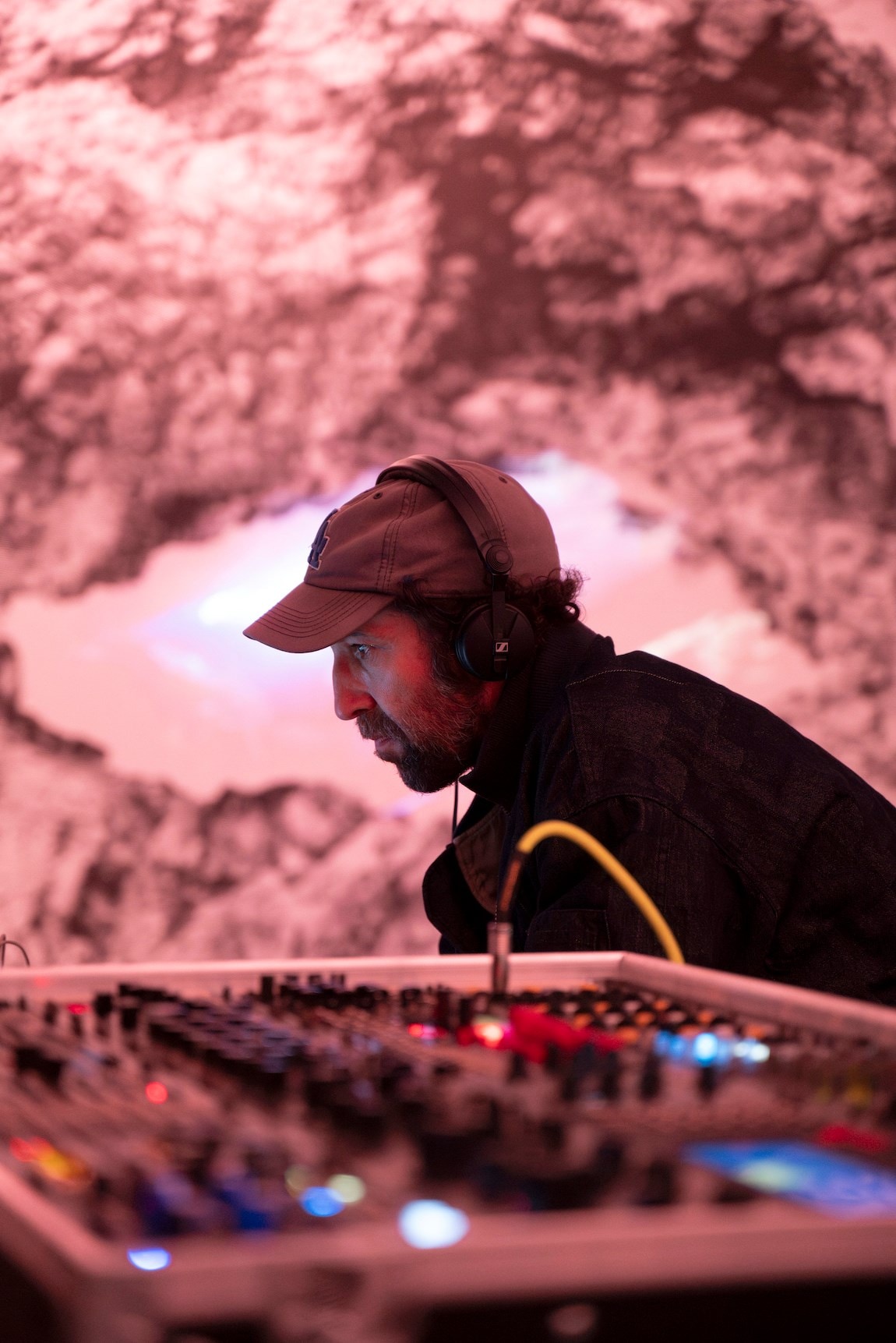
HUO: And it’s been almost 10 years that you’ve been working with JR.
TB: I was producing the album Everything Now by Arcade Fire and he had come to New Orleans when I was working there. We spent several days walking the streets of the city, in the French Quarter, and having great passionate conversations about art, about the relationship with the public space, with commerce, institutions. We were quite opposed in a way. We had quite heated discussions but I have always greatly appreciated his eye, his universe, his radicality, his determination and above all, his ability to federate extremely collaborative work and bring people together.
I worked for a long time in small groups, not alone, but even the work I did with Daft Punk, which was team-based, was very focused, without the ability to exchange or be open to the outside world. Chiroptera was ambitious – 200, 300 people working together – a real purity of human and artistic collaboration, which touches me. It’s extremely relevant at the moment given this opposition with machines, algorithms, artificial intelligence, which makes me focus even more on living art and this human aspect.
HUO: I remember an interview you did at the time of Homework, where you said you wanted to go beyond the single, since everything has always been short-form. Homework was an album, but far beyond the temporality of an album – it goes towards the long term.
TB: In fact, it goes towards the absence of time, similarly to the work I did on Mirage, with Damien Jalet, which is finally on disc and comes out on 5 June, so at the same time as the bridge.
A composer cuts time. We take the time and we beat it to measure. There is an idea of cutting time with the beginning, the middle and the end, and what interested me more in Mirage and maybe in La Caverne du Pont-Neuf, too, is the idea that there is no more temporality. I am more inspired by the noise of nature, like the noise of the waves or the noise of a river or the noise of the crackling fire, where finally we are ultra-minimalist but almost in a temporality because they are permanent. So there is something ephemeral because it is a work which lasts only a moment but even in the moment of this ephemerality, there is no more time. We hear a river flowing and we have the impression that it is always the same but it is permanently different. So, indeed, I created a programme which does not change. Ten minutes after, it is the same as ten minutes before, but at the same time, it is a cycle, it is never the same, it does not happen again.
“The most difficult thing for me today is this contrast between the machine and man and precisely the obsolescence of man” – Thomas Bangalter
HUO: So, there is no repetition, each moment is different?
TB: Exactly.
HUO: You once said that ‘music is a vector with which we build universes’. That remains valid even today because it is a vector, you build a universe in a certain way – a world in the world.
TB: When I was a child, I never wanted to be a musician. But I realised that my ability to express myself could lead me to experiment and to create and to look for different combinations where music emerges. Sometimes that’s the soundtrack of this experience, the soundtrack of that research, this proposition. On the one hand there’s an ultra-rare, ultra-radical, ultra-experimental and avant-garde form; and on the other, a formal, academic, lyrical and classic form. I like this contrast. The current that interests me is the coexistence of these forms that one could imagine as contradictory. For me, the contrast can create surprises and accidents, and to accept these accidents. It’s the contrast that continues to motivate me.
HUO: Yes, there is this wonderful book by AI researcher Kenneth Stanley [and Joel Lehman] called Greatness Cannot Be Planned.
TB: Exactly. In fact, what depresses me a little with AI is the instantaneity of the result of a prompt, which ends up being completely cut off regardless of the result itself. Above all, it is this aspect of research, of trial and error, of development that seems to me much more interesting in the experience itself of this idea of instinctive research. There is a piece in Random Access Memories called Fragments of Time where there is a line that goes, “Our only plan is to improvise.”
HUO: Amazing.

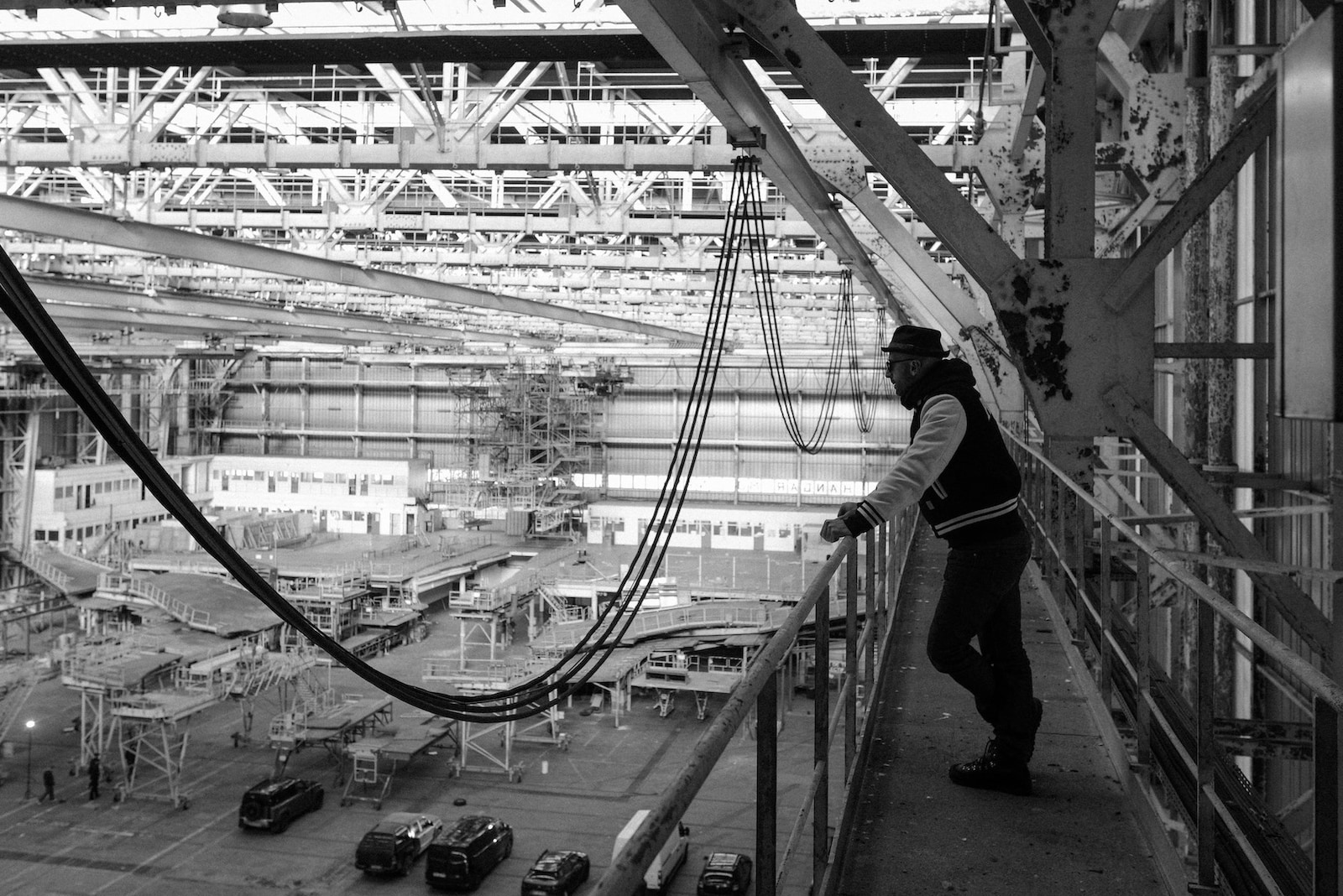
TB: The most difficult thing for me today is this contrast between the machine and man and precisely the obsolescence of man. And it’s true that virtual universes and digital creation actually offer spaces and temperatures that are open 24 hours a day. We forget we are in something very impatient, but the experience is really made of a unique moment and of a moment that cannot be repeated. I am more interested in the concentration of a unique event in a space and a time, and to feel really alive. It’s now time that we have to live it, rather than the capacity of a process or a device that would allow us to go anywhere which is already what this virtuality and the metaverse present.
It’s complicated because it goes through rituals, it goes through formats that sometimes are established forms and so we want to break them because rituals are both tradition and classicism. To create the avant-garde we started to welcome technology. At some point the fascination for technology eradicated the possibility to ask if these tools increase the symbolic and mystical value of the moment or not. There is the need at some point to be able to say yes, there are sometimes things where people can no longer use their phone, increasing the relationship to the present moment, to the experience etc. At other moments, we say “ah no, the virality that it will create”, it will be able to increase this aesthetic value and this mystical value. There is no clear answer but there is real work and real research on circumstances and a relationship to technology and to behaviours of social psychology and groups that only evolve very quickly.
HUO: Magnifique. Merci infiniment, c’était formidable. Et à bientôt, j’espère.
TB: À bientôt. Bonne soirée. Au revoir.
Due to damage to the artwork caused by extreme weather conditions, the opening of La Caverne du Pont Neuf, originally scheduled for 6 June, has been postponed to a later date, which will be determined once the artwork has been repaired.
