
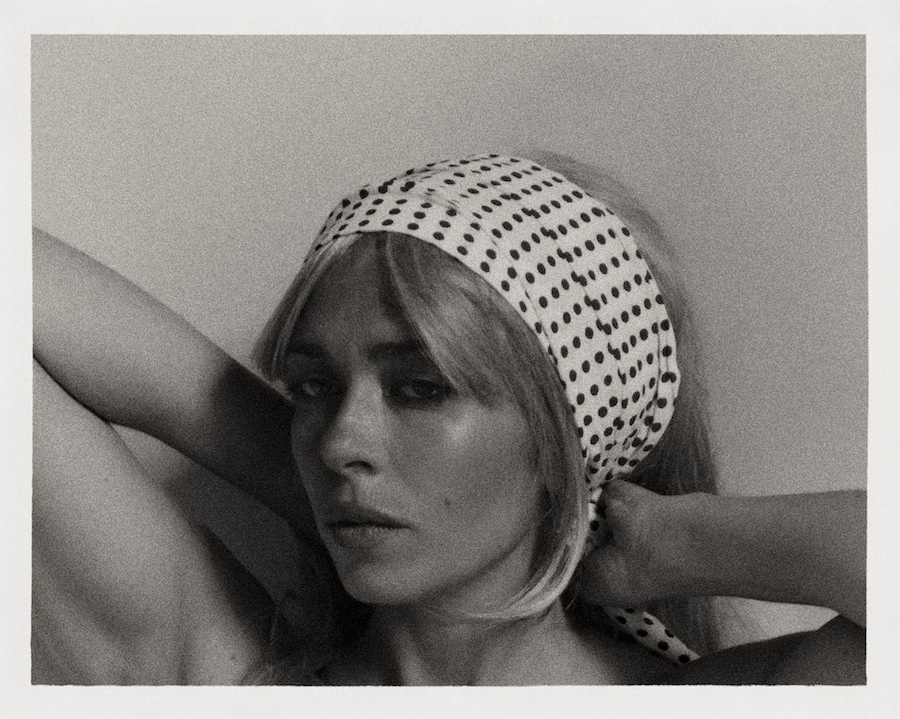
As photographer Agnes Lloyd-Platt debuts her solo show Make Me Saline at Monument gallery in east London, she explains the stripped-back process that transmuted the pain of postnatal depression into hope
When photographer Agnes Lloyd-Platt went to Menorca to develop a personal project, she did so as a practice of stripping back the architecture of her everyday life, something she says felt necessary for survival. “I don't think I was trying to escape. I was trying to find something,” she says, explaining how the trip came following a period of postnatal depression. Travelling solo as a mother might have felt controversial to some in her life, but for the photographer it was essential “to be able to listen to my own thoughts,” she explains.

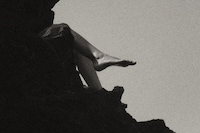
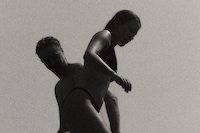
A draw to Menorca was the chance to see the major retrospective of Cindy Sherman’s work, which was being exhibited at Hauser & Wirth’s space on the Spanish island at the time. “There’s a really amazing film there about how she works as a solo maker, as well as artist, as well as photographer. I loved her perseverance with just trying different things and learning a lot about herself in the process,” says Lloyd-Platt.
Sherman’s methodology provided a blueprint to Lloyd-Platt, who adopted a character she named Cindy for her own work there. It allowed her to operate more freely: “I did find myself being a bit more open in conversation in my own mind with these characters,” she says. But working as an ‘other’ also allowed her to treat herself with the kindness she might not otherwise afford – that inner voice saying things you’d never say to a friend – and neutralise the guilt of perceived ‘selfishness’ she might feel in this act of self care.
“Any kind of choice to put yourself first is seen as really selfish,” Lloyd-Platt explains. “I consoled her in ways I couldn’t for myself, I listened to her and tried not to interrupt, and mostly we were quiet, but her presence was equal and non-judgemental – and that felt radical. The cruelty we lay over ourselves burns and the societal suggestion of manners pacifies that harshness when it’s applied to others – thinking of ourselves as a friend can hush that voice.”

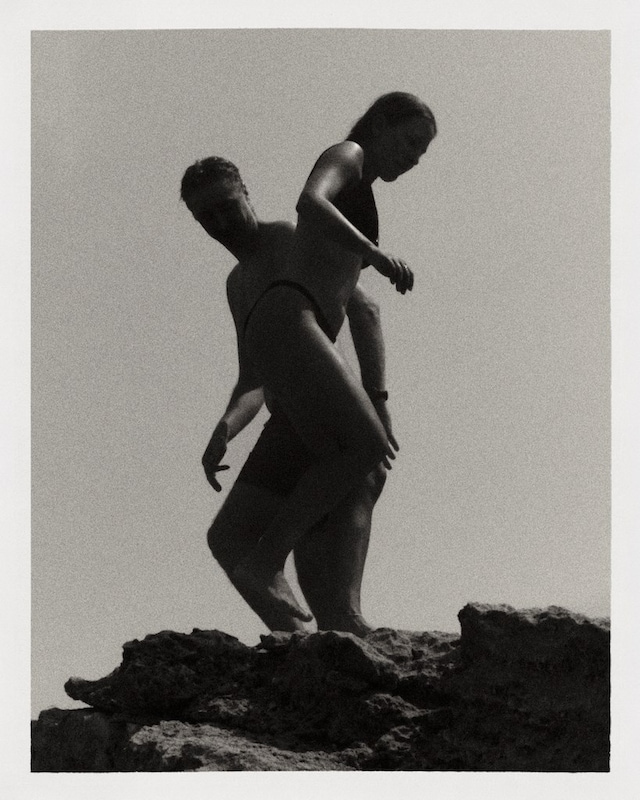
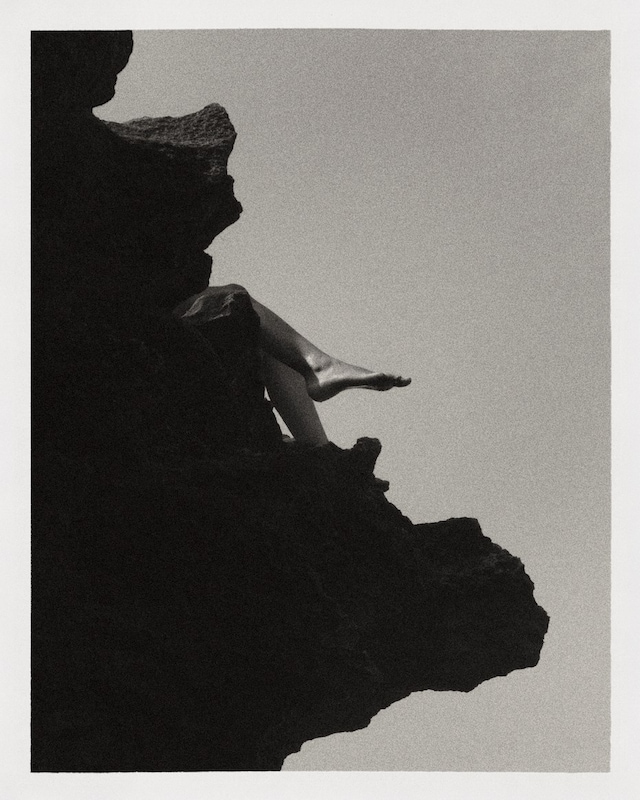
The choice of black and white, for a photographer who is known for her vibrant use of colour – particularly strong reds – in her commercial work, was a part of the process of stripping away. “I always thought [black-and-white photography] was a cop out. And I love colour, I find it really invigorating. But maybe it can also be a distraction. If these photographs were in colour they would make way less sense, and I think be less evocative and give less space for imagination. When you have images like this in colour, they can become retro really quickly. And I think it gives people too much information in some cases.”
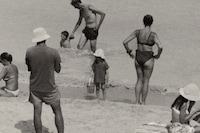
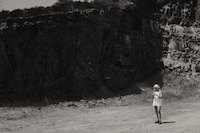
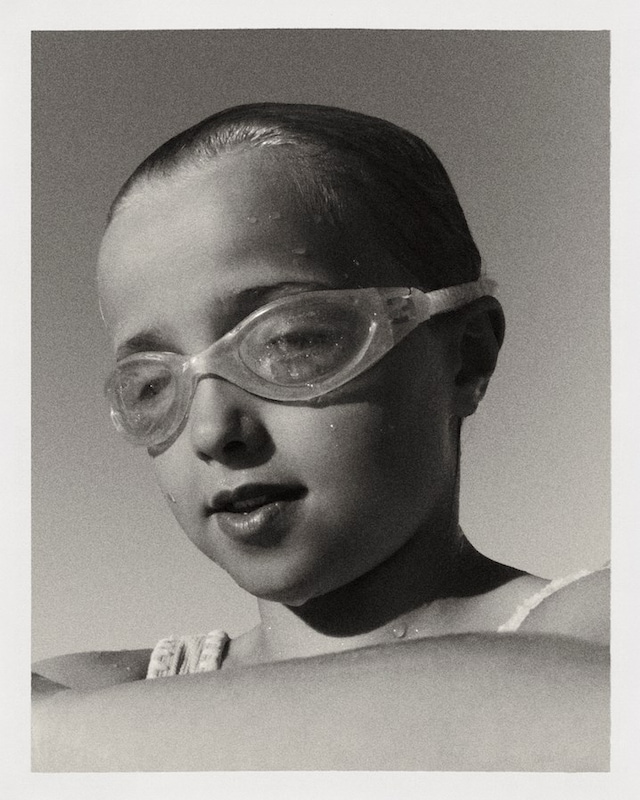
Though she spent one night visiting her sister’s family – the one photo in this body of work with her subject making eye contact is her niece wearing goggles – the rest of the week-long trip was spent entirely solo, with no familiar people to act as buffers in this new environment. Instead, Lloyd-Platt’s gaze became outward looking, people watching from comfortable distances. Even her camera became incidental, choosing a small innocuous point-and-shoot held subtly by her body rather than holding the viewfinder up to her face.
“I really wanted to see with my own eyes rather than through the camera,” she explains. Her ‘photographer’s eye’ really came into play in the editing and sequencing phase. “I found these scenes that I wasn’t watching at the time,” says Lloyd-Platt. “You see loads of joy and you see loads of connection that is kind of everywhere.” The approach removed any ego from the process, allowing the photographer to just be in the world and later explore and discover again in the process of looking at her shots afterwards.

It’s a distinctly opposite approach to the kind of public photography of strangers in the male-dominated field of ‘street photography’. Lloyd-Platt’s approach, which prioritises presence, shoots from a respectful distance, and feels more like wistful people watching than intrusive snapping. “I’m not taking photos to make people uncomfortable or feel watched,” she explains. “But we are all looking at each other all the time.”
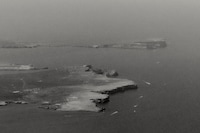
Even the landscapes, devoid of people altogether, take on a feminine presence. Menorca – a feminine word in Spanish – reads as a woman in the work. “There’s a picture of a sun lounger – it’s like a woman on her elbow, leaning up as if she’s at the beach. A lot of people connect with it and describe it as a ‘her’, which I really like,” says Lloyd-Platt. Displayed in her current exhibition, in collaboration with Leyton-based curatorial practice Monument – which specialises in sourcing and styling rare archival design pieces and works of art – that energy informed the selection of pieces shown alongside the work. At one point they considered including a chair titled ‘the thinking man’ but decided against it: “We just can’t.” explains the photographer, “It's just completely not welcome.”
The show Make Me Saline positions photographic work from this project alongside furniture pieces curated by Monument’s Leah Forsyth-Steel and Victoria Spicer, including a Tom Dixon piece named the Biorock Chair. It’s a piece that was made in Miami and then rather than transported back to the UK was put at the bottom of the sea. “All the coral and things are masked on the original piece,” explains Lloyd-Platt, “and that felt quite nice to have something that was extra relevant as well.”

Other items include Niall O’Flynn’s rare ‘Ruffian’ chaise lounge in chain mail and a bespoke glass room divider from Harrod’s in the 1990’s, whilst an archival display case houses a series of found relics. And a soundscape by George Day enables further immersion into the work, capturing Lloyd-Platt’s experience: “I went looking for space and silence – but what I found was loud, messy, chattering love,” she says.
For Lloyd-Platt, the experience was transformative, but it’s no hero’s journey with a satisfyingly neat and triumphant conclusion. Her experience with post-natal depression is something that “still sits in my shadow,” she says. She doesn’t describe it as a trip that ‘healed’ her in six days, but instead a necessary and uncomfortable experience that helped her connect with something inside that gave her hope. “I had a couple of days where I was really antsy, just cried a bunch, and couldn't work out where all the hurt was, really,” explains the photographer, adding that she “wouldn’t want to be the person that I was before that.”
The show, with a name that gestures to the cleansing power of salty seawater and of tears, has resonated with visitors to the space. The photographer says people have messaged her saying they’re still thinking about it hours later, and tears were shed in an artist’s talk held in the space. “We talked about joy and empowerment and stuff like that. And I was like, ‘Yeah, but it’s not that, initially it’s about pain, and the necessity of running away, but also running towards something.’ Someone said to me, ‘Why do I feel stuff?’ And I was like, ‘I don’t know, but that's exactly what I hope for.’”
Agnes Lloyd-Platt’s Make Me Saline is on show at Monument gallery, Unit 9, 6 Argall Ave, London E10 7QE, until 28 May 2026.
