
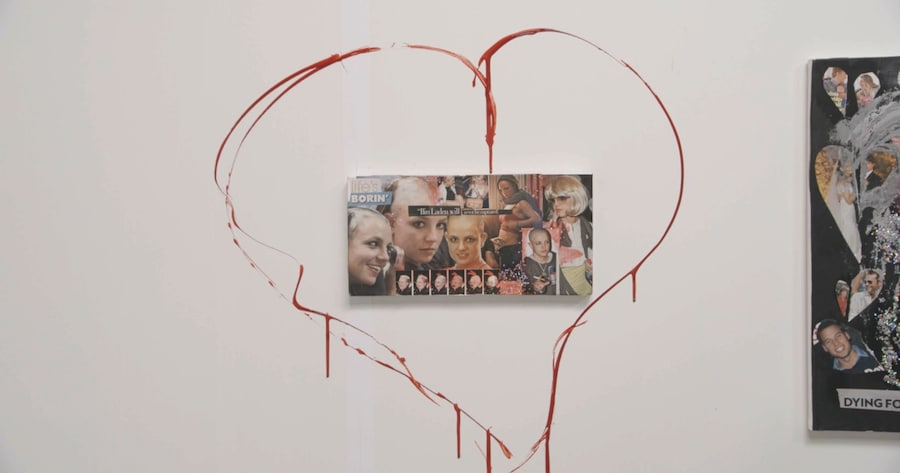
As Genuine Fake Premium Economy featuring work by Jenna Bliss, Buck Ellison and Jasmine Gregory opens at the ICA, curator Nicola Leong explains what it reflects about the art world today and how it changed after the 2008 financial crash
“I’m not sure the exhibition is a diagnosis of the art world’s sickness entirely, but it certainly points out things which don’t and didn’t work,” ICA’s curator Nicola Leong explains of the institute’s new show, Genuine Fake Premium Economy: Jenna Bliss, Buck Ellison, Jasmine Gregory. “It shouldn’t make people nostalgic for the 2007/pre-2008 peak. That was silly money fuelled by greed. It would just be nice for artists to make a living, for galleries to not go bust (and owe artists money) due to rent hikes or overexpansion, and for institutions to pay artists and staff fairly. I hope that’s not too much to hope for.”
The three artists Jenna Bliss, Buck Ellison and Jasmine Gregory all use the visual and material cultures of capitalism, using advertising imagery, reality television, luxury brand aesthetics and the vocabulary of private wealth management in their work. They were all born in the United States in the mid-1980s, and came of age professionally in the aftermath of the 2008 financial crisis. Their artwork is not in rage, exactly. It’s something colder and more effective: appropriation and mimicry. “By heightening the qualities of artifice and imitation,” Leong says, “it makes you see its contradictions and hypocrisies more clearly.”
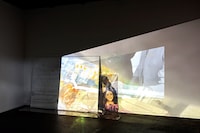
Jenna Bliss opens the show and sets its tone. A video documenting black and white footage of the New York skyline and financial centre shows with scrolling text, declaring: “We survived y2k, but now the real world source code is malfunctioning. The world is flat, the debt is deep and sprawling.” Later in the exhibition, another film titled True Entertainment is formatted as a scripted reality TV episode set inside an art fair booth in 2007, months before the crash. The cast of archetypes (the unstable artist, the predatory collector, the performative art students) are sharp, and the work earns its dramatic irony. We watch art gallerists enthusiastically discussing the opening of their gallery and of going on extravagant holidays and trips abroad, while packing down a booth in a market that is about to collapse.

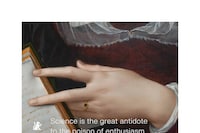
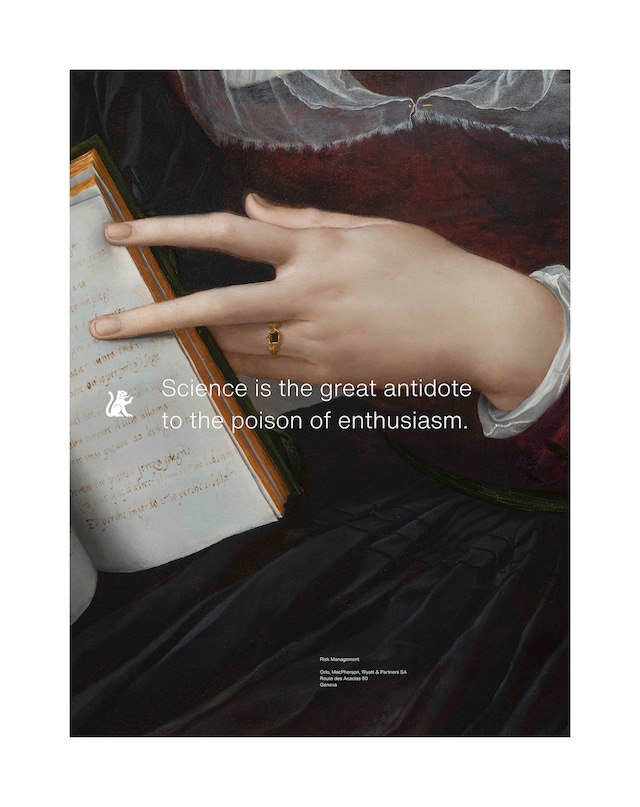
“I hadn’t set out to curate a show on this topic or with this mix of artists,” Leong continues. “I approached each artist separately ... their work stuck with me and I felt there was a common thread.” What she noticed, among artists who had never met, was something that felt less like coincidence than shared generational feeling. Buck Ellison’s work feels like the most forensically constructed. He has invented a multinational private bank called Orlo & Co., creating fictional posters, with its imagery of cropped reproductions of Bronzino and Manet paintings, displayed in walnut-framed lightboxes, with fabricated taglines that mine Adam Smith for copy. ‘Science is the great antidote to the poison of enthusiasm,’ reads one, a warning repurposed to make wealth preservation sound like wisdom. Nearby is Jack’s Office, a glass cabinet containing the material autobiography of a fictitious thirty-something banker. On display is a Choate Rosemary Hall T-shirt reading ‘The World Is Our Campus’, a Le Bristol Paris ruler, Mexican Ritalin, an Oura Ring, a sailing protest flag, and one Bic biro.
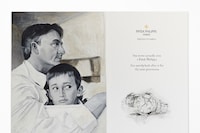
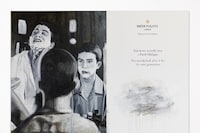
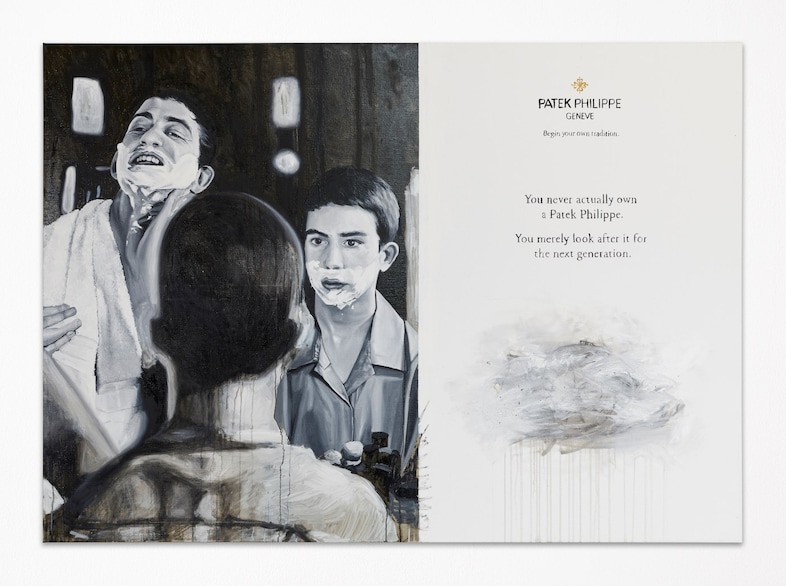
Jasmine Gregory targets a different but adjacent idea. Her Investment Pieces paintings reproduce Patek Philippe advertisements, rendered in greyscale, the watches themselves erased. What remains is the slogan: ‘You never actually own a Patek Philippe. You merely look after it for the next generation.’ Gregory’s greyscale makes the figures look embalmed, which, ideologically speaking, they are. Her sculptural work Conscious Uncoupling (Divorce) brings together an empty wine bottle, gift ribbon, a heart-shaped chocolate box scattered on a plinth. These are the props of a romance, hollowed out. Marriage, as Gregory frames it, is a property arrangement.

Which raises the question the show courts openly: is the ICA itself implicated in the economy these works dissect? Art fairs are sponsored by private banks, institutions rely on corporate money, and artists have to sell work to survive. “I/the ICA don’t want to shy away from our implication hence putting on the show and including those works,” Leong says. “Is there a world where we aren’t reliant on what rich people or rich companies want to give their money to? Maybe, but it would probably restrict you quite significantly.” And where does the art world go from here? “It is really tough for artists and I’m not sure there’s any way round it because the cost of living is so high ... the amount of time you have to now spend working those jobs to earn enough to cover your basic needs is so much more than in the past, that it leaves you very little time to then spend on your art.” The show is clear-eyed, formally sharp, drily funny, and free of self-pity on how the systems that shape our lives actually work. And as one visitor called it, “very refreshing”.
Genuine Fake Premium Economy: Jenna Bliss, Buck Ellison, Jasmine Gregory is on show at the Institute of Contemporary Arts in London until 5 July 2026.
