
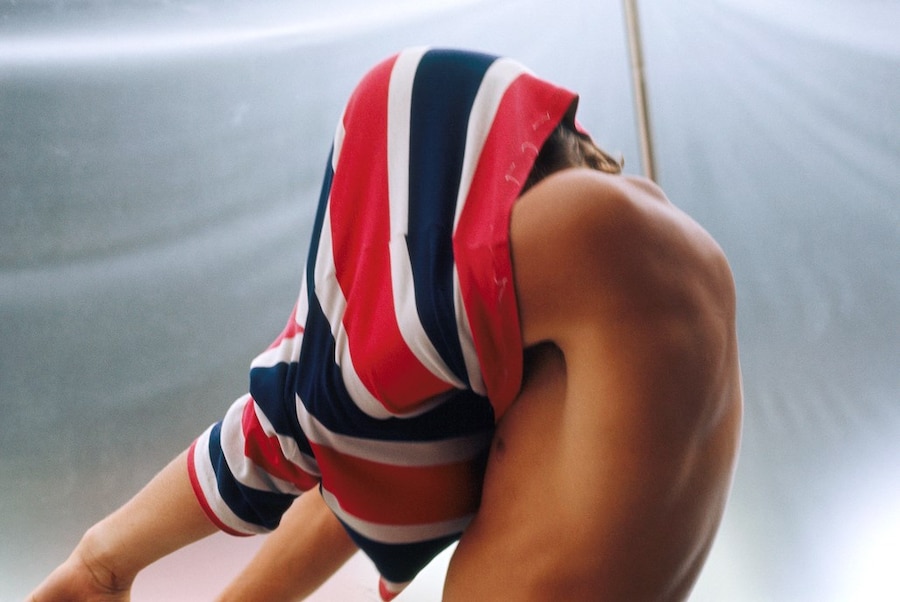
As the octogenarian artist’s new exhibition opens at Pinacoteca Agnelli in Turin, we speak to him about Dada and what makes a fashion image
It’s not until towards the very end of Walter Pfeiffer. In Good Company – the octogenarian artist’s new exhibition at Turin’s Pinacoteca Agnelli – that fashion photography, in a formal sense, is introduced. When it is, it is in the form of a triptych, three vividly colour-saturated portraits of the model Eva Herzigová, sequinned garments sparkling in Pfeiffer’s camera flash. In the centre image, a goldfish in a plastic bag hangs from her wrist beside a garish, gilded purse.



Tracing six decades of astounding prolificacy, Pfeiffer’s first large-scale presentation in Europe outside his native Switzerland makes no distinction between the personal and the commercial in its curation, and although the pictures of Herzagová, taken for his first editorial for Vogue France when he was already in his 60s, are the most recognisably ‘fashion’, there isn’t really a single image amongst the 100 or so on display that wouldn’t sit happily within the pages of an indie fashion magazine in 2026.
What is a fashion photograph? “Does it have to have clothes in it? Some, maybe … maybe a bikini?” Pfeiffer tells AnOther, giggling. No, for him it’s more about creating an atmosphere than a literal depiction of garments. Where clothes do appear they rarely take centre stage. Often they are in the process of being removed, revealing the body beneath, or they are part of a witty visual joke: two pairs of stockinged legs appearing from beneath an 18th-century painting, or the Breton stripes of a man’s long-sleeve T-shirt echoing the slats of the Venetian blind he’s caught peeking through. But even the images which eschew clothing – eschew people even – seem to pre-empt the texture and eclecticism of modern fashion art direction. One of the six rooms of the retrospective takes ‘accumulation’ as its theme: see, a tangle of blushing shell-on king prawns; humble potatoes, onions and bottled water on a kitchen work-top; or a Bacchanalian scene of sculptures which look like they’ve frozen mid-conversation, à la Toy Story. Curators Simon Castets and Nicola Trezzi’s exhibition text describes this as “an encounter between spontaneity and idealisation, between storytelling and celebratory anti-heroism” – which they attribute to the image democratisation of social media. True enough, but for Pfeiffer, it’s just Dada.

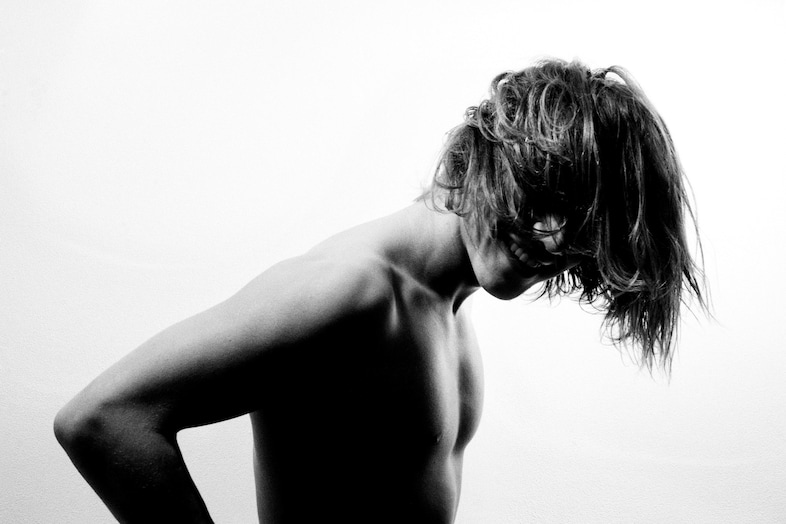
“I went to the School of Arts and Crafts in Zurich during the Swinging 60s, when everything was about young, young, young,” says Pfeiffer, in between mouthfuls of chocolate mousse. “But I was more interested in learning about what came before.” The legacy of Dada, which originated in that same city during World War One and took a hunter-gatherer, non-hierarchical approach to image-making, struck a chord with the young Pfeiffer. Before committing to photography, he tried his hand at graphic design, at window dressing, illustration, even styling for shopping catalogues. In Good Company opens with scans from years of scrapbooking which show beautiful cut-and-stick layouts of photos next to hand-scrawled blocks of text. He’s almost a one-man fashion magazine-maker in his own right, but, he tells me, “I have no time to read magazines anymore! The older you get, the quicker time goes. Maybe a quick look at Instagram, but otherwise I’m too busy working.”
Working constantly, and yet he still thinks of himself as a dilettante. Pfeiffer spent many years working under ‘outsider’ conditions before the establishment came flocking, but even when they did he maintained, in his view at least, amateur status. “In Switzerland there is this tendency to think quite narrowly about these things: if you’re an artist you must be spotless and stay in your lane. But I always wanted to do different things. I didn’t want to be a one-hit-wonder. As long as it’s interesting, I’ll make it.”

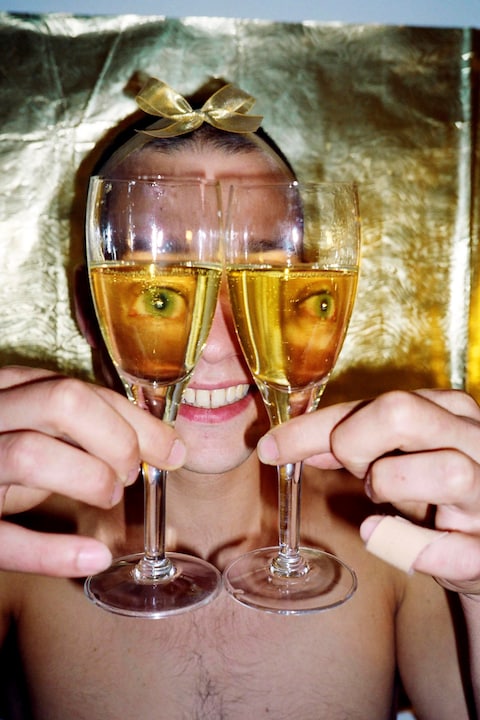
Now, that distinctly liberated visual language of juxtaposition and the elevated banal (and that ubiquitous flash) can be seen far and wide across fashion – from the works of fellow Germanic photographers Juergen Teller and Wolfgang Tillmans, to Pfeiffer’s own editorials and collaborations with luxury brands, including Helmut Lang and Bottega Veneta. “I started working with Bottega Veneta because someone had told me that when they interviewed creative director Daniel Lee, he’d had all my photo books on the shelf behind him in his home,” Pfeiffer recalls, considering what it takes for him to be seduced by a fashion brand. “So I thought – well, I want to make a portrait of him. And that started a relationship that became photos, drawings, books, an exhibition. It was a good collaboration, because he wasn’t just interested in boring models and neither am I.”
“I felt I always looked horrible. I remember going to Milan and seeing all the beautiful people buying shoes, and I just looked like a bum. But buying fabulous clothes – that made me feel better.” Aged 80, Pfeiffer still has a certain stylish panache about him – for the private reception of the Pinacoteca Agnelli show he’s wearing head-to-toe blue with a slightly limp daisy stuck through the zip of his polo shirt. This small gesture is a neat summary of In Good Company’s premise: here is an artist who never chased discipline, only beauty, and imperfect beauty at that.
Walter Pfeiffer. In Good Company is on show at Pinacoteca Agnelli in Turin until 13 September 2026.
