
A new exhibition in Germany is the most comprehensive presentation of Pettibon’s album cover art to date, including work made for Sonic Youth, Black Flag and more
Most of us, I’m sure, have worn a band T-shirt without listening to a single song. You like the image. It makes you feel cool, perhaps even part of something, even if you’re not entirely sure what that something is. The devoted go further, indelibly etching these designs onto their skin: the prism of The Dark Side of the Moon by Pink Floyd, a barbed Guns N’ Roses logo, or Nirvana’s smiley face. Artists distil bands into images that travel beyond the audiences who pack out their gigs and into a wider visual culture.
The four black bars of Black Flag, the Los Angeles punk band, has become one of the most recognisable symbols to emerge from the late 1970s hardcore scene. Its author is Raymond Pettibon. At that point, the Los Angeles-based artist had no formal relationship to the art world as it’s now understood. This was before he was represented by blue-chip gallerists David Zwirner and Sadie Coles HQ, a relationship that has since led to numerous solo exhibitions around the world. His ink drawings, which pair stark, graphic imagery with handwritten text, drawing on sources from literature and comics to politics and popular culture to expose the violence, contradictions and myths underpinning American life, had yet to receive sustained international attention.
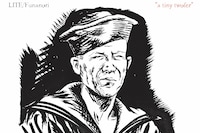
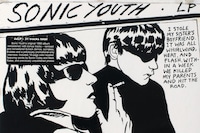
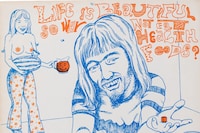
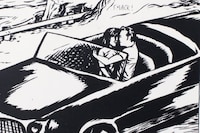
Rather, this was the late 70s, when Pettibon was embedded in the Southern California punk scene. His brother, Greg Ginn, had formed Black Flag in 1976. Pettiborn was making ink drawings populated with drug-addled figures, mushroom clouds, and explicit imagery, which bands on Ginn’s label, SST Records, such as Hüsker Dü, Meat Puppets, and Dinosaur Jr, would select to use for their flyers and 7” singles. “They’d go through two hundred drawings and take the worst one possible. The one I did as a joke or something,” Pettibon recalled in his 2016 book Homo Americanus. “But then, you know, punk rock is music, it’s not art.”
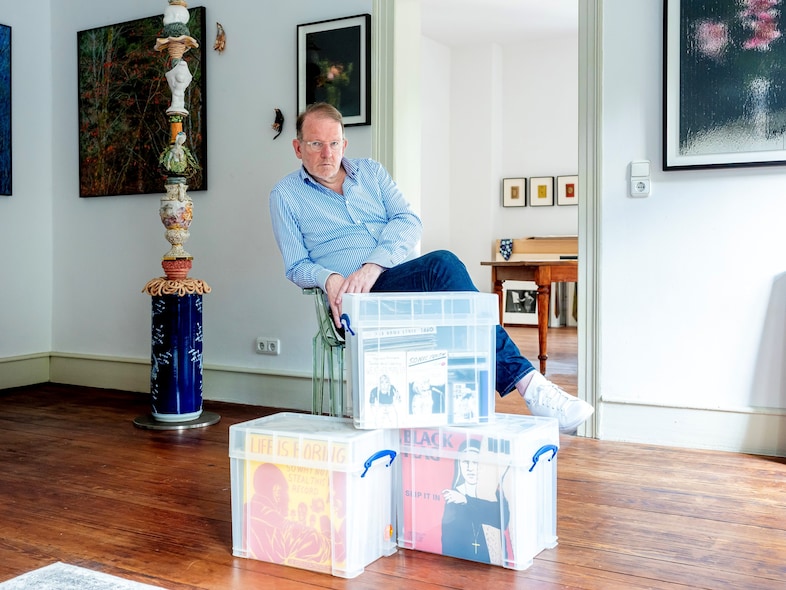
This aspect of Pettibon’s work, first encountered on record sleeves and flyers, is brought together in the new exhibition Nervous Breakdown at the Wilhelm-Hack-Museum in Ludwigshafen, Germany. Drawn from more than 200 works in the collection of Stefan Thull, the exhibition is the first to assemble Pettibon’s record, CD, and cassette covers from 1979 to the present, and is accompanied by an illustrated catalogue published by the museum and David Zwirner Books. Before turning to Pettibon, Thull had already amassed a collection of more than 3,000 record covers by artists and photographers, many of them signed. “As a collector, I always look for the complete set,” he tells me. By that measure, he has come close: this is the most comprehensive presentation of Pettibon’s album cover work to date (albeit he’s still on the hunt for two original Black Flag album covers).

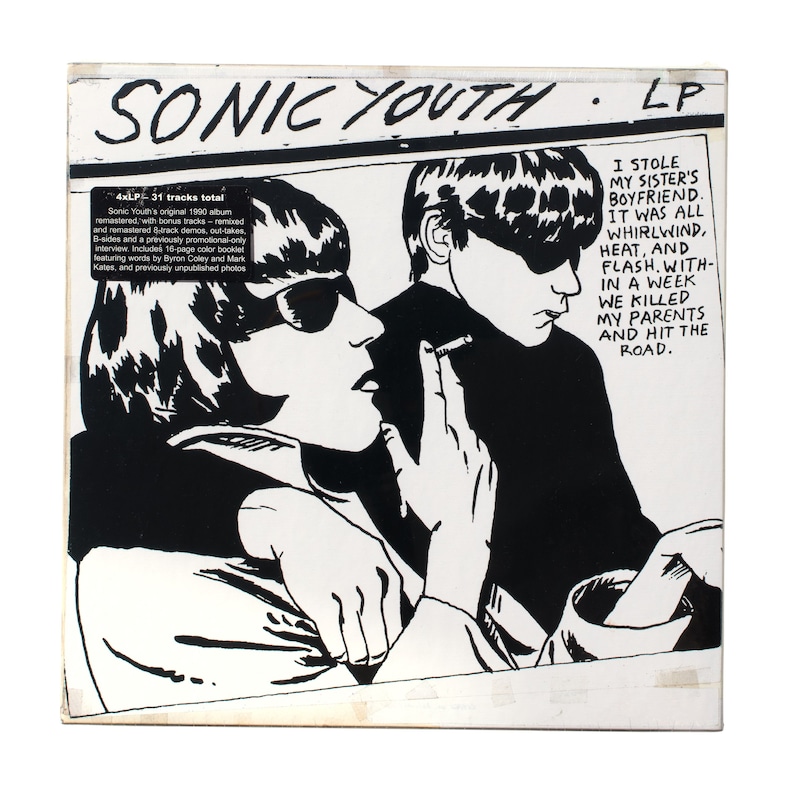
Included in the exhibition is Pettibon’s cover for the 1990 album Goo, the major-label debut of the New York alternative rock band Sonic Youth, now one of the most recognisable images in alternative rock. Kim Gordon, then bassist and singer for the band, first encountered Pettibon at a house party in Hermosa Beach in the early 80s. “He was already sort of mythical in our minds,” she wrote. “There was always a pile of drawings spilling over a tabletop … They were way beyond illustrative.”
The artwork is based on a 1966 press photograph of Maureen Hindley and David Smith, taken in connection with the Moors murders, one of Britain’s most notorious criminal cases. Reworked in black ink and Pettibon’s graphic line, the image draws on influences ranging from Goya and William Blake to the visual language of political cartoons and comic strips, its simplified line and crop recalling the pop art idiom of In the Car (1963) by Roy Lichtenstein. The text is sometimes self-generated; other fragments are drawn from the books that filled Pettibon’s parents’ house, ranging from a few words to longer passages – snatches from John Ruskin, the Bible, or, more recently, material encountered online.

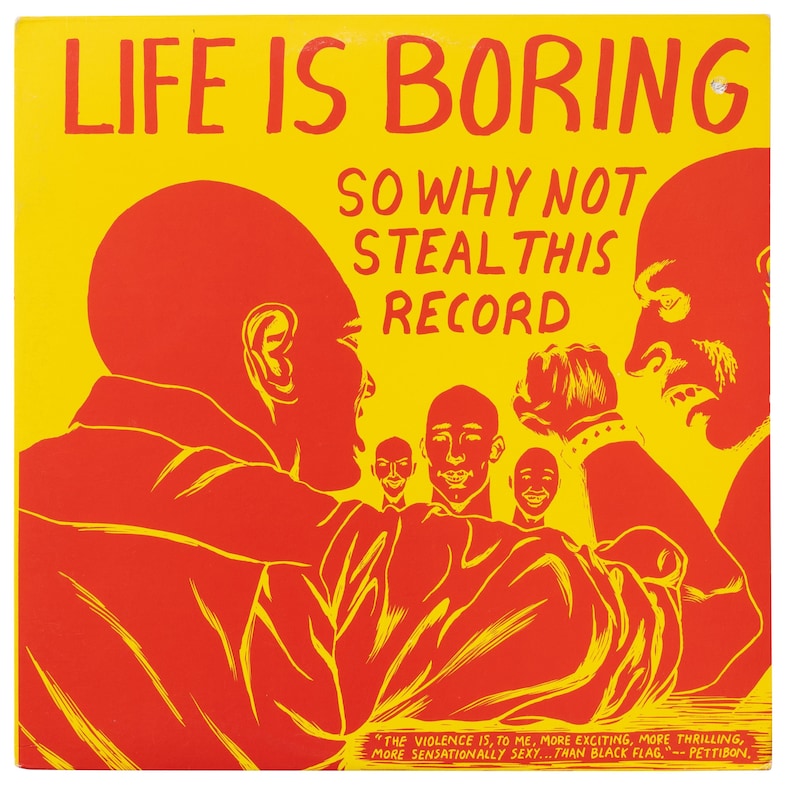
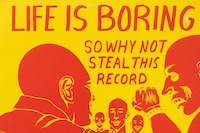
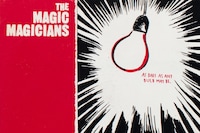
Other works in the exhibition show Pettibon’s foray into colour, such as the red and mustard yellow cover of the 1983 LA punk compilation, Life Is Boring So Why Not Steal This Record (1983). His more oblique humour surfaces elsewhere on the cover for The Magic Magicians, where a single lightbulb hovers within a comic book-style burst. Beneath it, Pettibon’s hand runs the line “As bare as any bulb may be … wishing what I write may be read by their light ” The image has recently been reused for the cover of Rolling Stone Germany’s April 2026 issue, the same magazine that, in 2014, ranked his brother among its “100 Greatest Guitarists of All Time.”
But if Greg Ginn can be credited with giving the band its sound, Raymond Pettibon gave it a visual identity that fixed Black Flag, and many of its contemporaries, in the public imagination. Removed from the punk scene they once sustained, the images stand tall on their own: their abrasive, sharply drawn aesthetic, coupled with explosive anti-authoritarian text, was powerful long before they were pulled from a box and set loose on album covers around the world. “As a collector, the music itself wasn’t important,” says Thull. “Rather, it was the drawings – the motifs, the style, the attention to detail – that mattered to me.”
Nervous Breakdown by Raymond Pettibon is on show at the Wilhelm-Hack-Museum in Ludwigshafen until 20 September 2026.
