
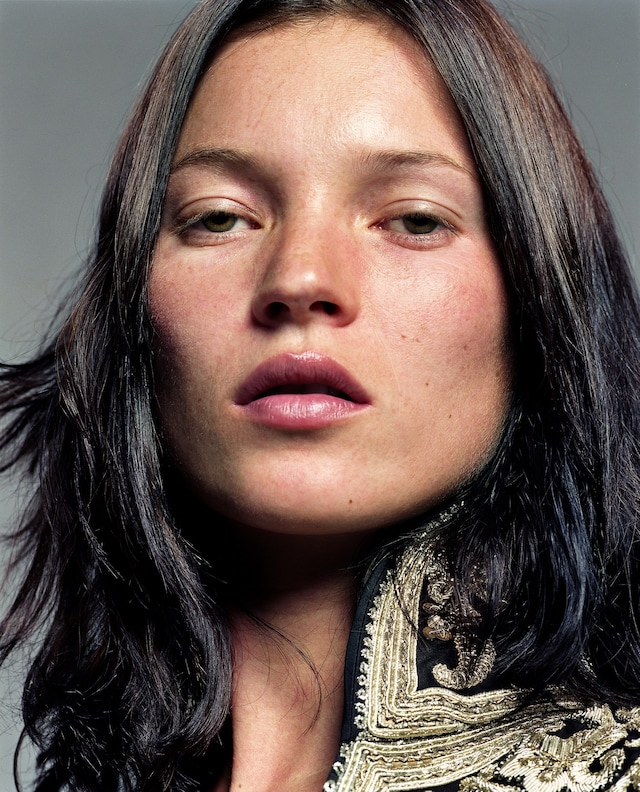
The pioneering Dutch photographers discuss the making of their 40-year retrospective at the Kunstmuseum Den Haag, a celebration of creativity collaboration, attention and love
The Dutch photographers Inez van Lamsweerde and Vinoodh Matadin met in the early 1980s, as students at the Fashion Academy Vogue in Amsterdam. Their first collaboration took place in 1986, when Matadin commissioned Van Lamsweerde to photograph a fashion show for his short-lived clothing line, Lawina. Six years later, the duo fell in love, their romantic relationship taking shape alongside their already-burgeoning artistic partnership. And they haven’t looked back.






Four decades on, Inez and Vinoodh are considered two of the most important image-makers of our time, widely celebrated for their early adoption of digital manipulation, their key role in shifting the dominant grunge aesthetic of the 90s towards something much more glamorous, energetic and uncanny, their longstanding creative collaborations with everyone from Kate Moss to Lady Gaga to M/M (Paris), and above all, their ongoing quest to push at the boundaries of photography.
Whether creating art, fashion editorials, ad campaigns, music videos or portraits, their aesthetic and intellectual objectives remain the same: an enquiry into “the instability of photographic truth, the performance of gender, the politics of beauty and the transformative power of the image,” to quote Margriet Schavemaker, general director of Kunstmuseum Den Haag, where a major retrospective of the duo’s work has just opened.
, 2010)
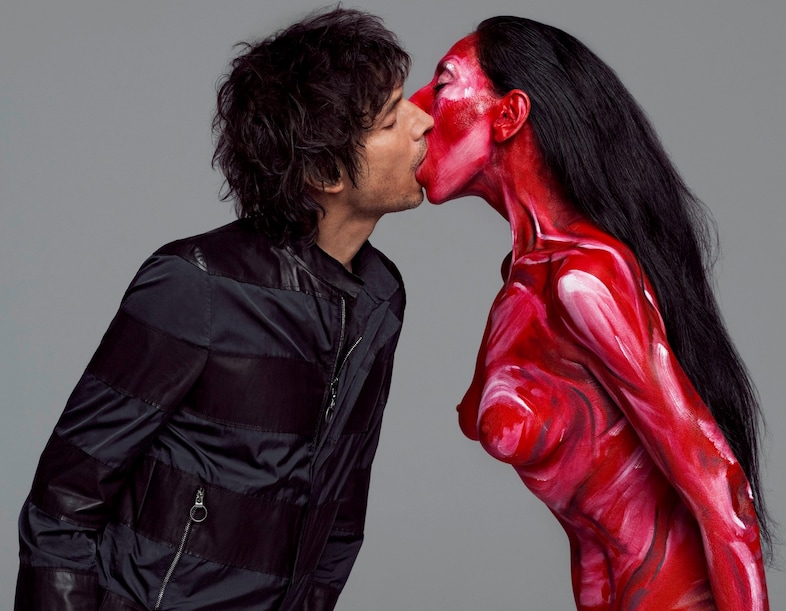
“The museum approached us two years ago, and we said, ‘OK, let’s do it for our 40th anniversary,” Van Lamsweerde tells AnOther via video call. She and Matadin visited the museum shortly after and were captivated by the architecture, which they quickly decided would dictate the format of the show. “It was built in the 30s by HP Berlage, a Dutch Bauhaus-inspired architect,” Van Lamsweerde says, “and his vision was that visitors should feel as if they’re walking through a forest with small, denser areas and larger spaces like open clearings.”
Titled Can Love Be a Photograph?, the exhibition takes place across 16 rooms and is presented thematically, under titles like ‘(Un)Real’ and ‘The Psychomorphic Phenomenon’, in a way that corresponds to the intimate or expansive nature of each space. In all but two rooms – brimming with the duo’s editorial work for magazines like AnOther, Vogue and The Face, and their fashion campaigns (for YSL, Chanel, Balenciaga et al) – the work is displayed non-chronologically. “Arranging the show in this way took time out of the exhibition,” Matadin explains. “You’ll find something from 40 years ago hanging by something that was made like this year, and you couldn’t see the difference.” And it’s true, namely because Inez and Vinoodh have been always been ahead of the curve.

In the 90s, for instance, they began using Quantel Paintbox (a precursor to Photoshop) and other computer tools to make digital interventions within their work, preempting everything from the rise of unrealistic social-media-fuelled beauty standards to the subversion of the gender binary. In Thank You Thigh Master (1993), they removed women’s nipples and genitalia, rendering the subjects’ forms smooth and Barbie-like, while The Forest series sees reclining men in pale yellow polo shirts sporting superimposed female features, including hair, lips and neatly manicured hands.
“We questioned truth and time in photography from day one. We were always excited about being able to disrupt time by going in after the shoot, on the computer, and toying with this idea of reality versus surrealism,” the pair explains. “We were never that interested in the concept of photography as a purveyor of truth, because we think that the moment you point your camera at something, you’re already manipulating the viewer through your framing.”
While the artists were of course inherently aware of the dominant concepts at play within their work, dividing 40 years of image-making into 16 distinct themes was both enlightening and galvanising. “It’s a very beautiful experience to study your own practice for two years, and boil it down to the most pivotal works and ideas,” says Van Lamsweerde. “Every work in the show holds clues for other opportunities for us to make more work in the future – we’re calling it a future-spective, not a retrospective.”


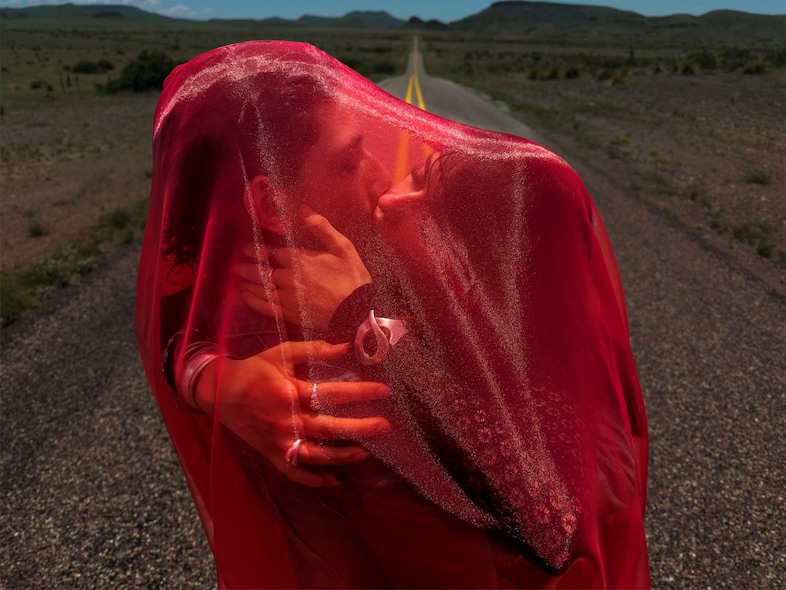
The curation process also emphasised something they already knew: that people, and the connections they forge with them, are the driving inspiration behind their work – whether they’re making music videos for Rihanna, album covers for Björk, or capturing portraits of celebrities, their loved ones (their son, Charles, and his partner, Natalie Brumley, are the stars of their latest series, Think Love) or each other. “It’s about really focusing on the person in front of our lens, about establishing trust, care and love for them – that act of attention is what makes us tick. It’s like Simone Weil’s quote: ‘Attention is the purest and rarest form of generosity.’ That’s how we experience our working life. That’s why we’ve been able to do it for 40 years. There’s always something intriguing to find, whether it’s in someone’s mind or just the way their eyelashes frame their eyes.”
Indeed, Van Lamsweerde and Matadin hope that the exhibition, an ode to both their own unifying love and their love of people in general, will encourage visitors to pay a little more attention to one another. “That’s really the thing,” Van Lamsweerde concludes. “There’s something like 1.5 trillion selfies made a year, which is someone saying 1.5 trillion times, ‘Look at me. I exist. I need your attention. I need your love.’ For us, the title Can Love Be a Photograph? is a statement, not a question.”
Can Love Be a Photograph? by Inez & Vinoodh is on show at Kunstmuseum Den Haag in the Hague until 6 September 2026.
