, 2026)
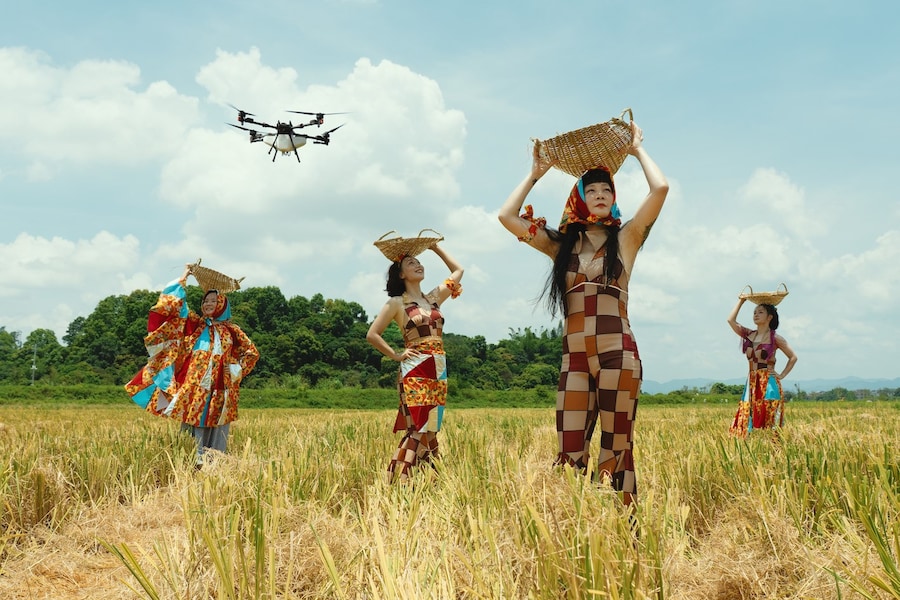
A major new exhibition at Fondazione Prada in Milan is the result of three years of fieldwork looking at smart agriculture across China and Southeast Asia
“Technology is both the remedy and the poison,” artist Cao Fei quotes Bernard Stiegler in the catalogue for Dash, her major new exhibition at Fondazione Prada. The title refers to the high-frequency whirr of a drone in flight: the speeding buzz of intense precision of an autonomous machine edging out of human grasp. That tension is the subject of Dash, with a new film of the same title, a virtual reality game, installations and an archive produced as the result of three years of Fei’s fieldwork across China and Southeast Asia with the agricultural-drone company XAG.

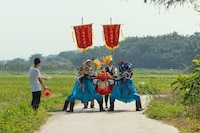
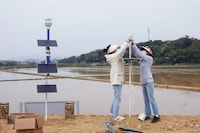
Technological revolutions have always arrived with suspicion. The printing press gave rise to concerns around the risk of misinformation and propaganda, and the invention of electricity unsettled the rhythms of day and night. But what distinguishes the present technological revolution, which is shaped by AI, is the intimacy of what is being displaced. Agriculture is humanity’s oldest practice and today, China’s agricultural drone market has expanded exponentially. In 2024, Chinese agricultural drones completed work that covered more than 173 million hectares, generating a market worth about 13 billion yuan (approximately $1.8 billion) in a shift driven by rural ageing, climate instability, and the extreme labour demands of cotton and rice cultivation. XAG’s drones can spray a field in minutes, cutting water use and chemical inputs while opening agricultural work to younger, digitally fluent labour and to women previously excluded by the physical toll of fieldwork. The efficiency is undeniable, but so is the disruption. Dash does not contest the benefits of smart agriculture, though it does refuse to let efficiency be its only metric.
The ground floor of the exhibition is a hybrid landscape of a grain warehouse, a farmer-training station, and a banana plantation, and most strikingly, a temple stitched from fertiliser bags. Inside, videos show farmers across Southeast Asia offering flowers and incense to their drones. This is not ironic. In regions where harvests mean survival, any entity involved in that survival acquires a kind of sacred weight. The discarded packaging of industrial agriculture materials that make up the temple make the point precisely, that the sacred and the industrial now occupy the same space.
, 2026)
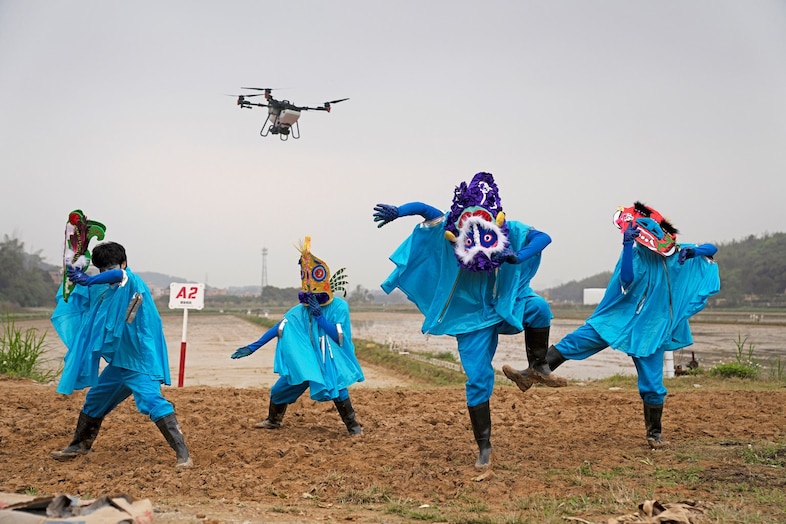
Drones are suspended in the exhibition, hovering still overhead, whilst others are displayed on plinths. Their mechanical casings have been transformed into sculptures. Screens display iPhone recordings and operator interfaces. A tap of the finger guides machines capable of fertilising hectares in minutes. Here, the exhibition’s core focus surfaces. The knowledge that drones acquire, including the spatial feel for a field, the pattern-recognition of where and how much to spray, once lived in farmers’ bodies and intuition, information that accumulated over lifetimes. When that knowledge migrates into the algorithm, it changes form. The farmer who once held that knowledge now inputs data into a system that holds it for them. The efficiency rises, but so too does its dependency. If technology absorbs the knowledge that the farmer once held on to, in what sense does that knowledge remain human?
In one corner, visitors can interact with Dash-180c, a VR installation which places participants in the perspective of a discarded agricultural drone. Inside this new world, you drift over banana fields, over algorithmically generated palm trees and past ruined temples accompanied by a cartoon monkey. In a moment saturated with fear of human obsolescence, Fei makes us inhabit technological obsolescence, a feeling disconcertingly close to home. China has the world’s largest rural-to-urban migration, and smart agriculture compensates for that migration, potentially deepening the economic logic that makes rural life untenable. The field becomes more productive and less inhabited. Whether this is progress or loss depends entirely on what one believes agriculture is for.
, 2026)
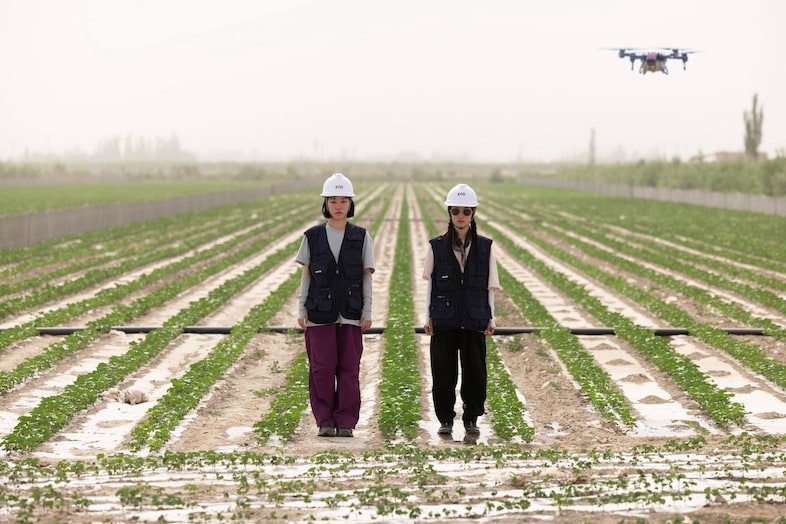
Upstairs, archival agricultural materials and historical documents, even vinyls of Chinese folk records titled Busy Farming from the decades following the founding of the People’s Republic of China (1949-1980s), situate Fei’s investigation within a broader historical and ideological context. The room begins with Fei’s own conceptual diagram, titled CHT Triad: Cosmos, Human, Technics which proposes a non-hierarchical relationship in which technology is a co-author of human becoming, and a force that shapes rather than serves. This is both an ancient cosmological idea and an urgently contemporary one, given that today’s tools increasingly make decisions on their own. It becomes a political question. Neither the drone nor the algorithm is neutral. Nor are the institutions that fund, train and deploy them.
Dash insightfully maps a rural transformation unfolding faster than our interpretive frameworks can keep up with. And what lingers is a discomfort that the relationship between humans and land, a relationship that has held ritual, knowledge and survival for millennia, is being reconfigured at speed and largely without cultural reckoning. The drone overhead executes its programme, while the farmer still works the field. Dash asks us to remain inside that gap where technology and labour diverge. We need land and we need agriculture. The work leaves us with an unsettling question: whether we would even notice if we lost what it displaces. The farmer praying to a drone is not confused about what technology is. The question is whether the urban population, more insulated by supply chains and supermarkets, are paying close enough attention to know what is being transferred, and to whom, and on what terms.
Dash by Cao Fei is on show at Fondazione Prada in Milan until 28 September 2026.
