
British-Nepalese photographer Tirtha Rabin Lawati and stylist Sam Thapa explore youth subcultures and style in Kathmandu and beyond
Romanticising our own histories and the lore of our personal origins is part of the natural self-mythologising that happens within families and communities. Stories grow like vines around shared memories of previous generations and the places intimately connected with our family history. But, having spent his childhood in East Nepal before moving to Britain, photographer and filmmaker Tirtha Rabin Lawati consciously resisted allowing nostalgia or his own memories to permeate his pictures when he returned to Nepal with stylist Sam Thapa to document the country’s changing youth culture. “I was very conscious of working from a diasporic perspective,” he tells AnOther. “I wanted to restrain myself from building my own narrative. It is important to allow people to present themselves in their own terms. What I was doing was simply recording how [youth culture] was evolving.”


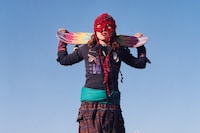
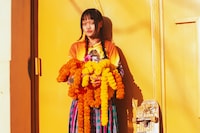

Thapa adds, “As someone of Nepalese descent but having grown up predominantly in the UK, I’ve always wanted to understand and connect with what the youth were up to over there.” With this guiding principle, in 2025, the pair travelled to the country of their births, creating Where We Meet, a body of work comprised of two series of photos (recently on display at Solar Beam Kingdom in an exhibition curated by Skylar Kang and Jeremy Chen) – Girls Skate Nepal, documenting young girls redefining skate culture in Kathmandu, and Jamkabhet, a study of Nepalese underground music gatherings and youth communities.
Before the trip, Thapa reached out to Girls Skate Nepal on Instagram and arranged to meet. It had been a decade since he’d last visited Nepal and, from social media, he’d got the impression that the country’s young people were “making a lot of changes to old ideologies that surround Nepalese culture”. Inspired by Sareena Rai, an iconic figure from the Nepalese punk scene of the early 2000s, Thapa brought a suitcase of clothes by British Nepalese designers (including Sushila Pun & Shakila Thebe) to style the skaters with, along with clothes he’d made himself and pieces he’d selected from his archive, mixing in items he sourced from local markets and local designers (such as Sweta Limbu).

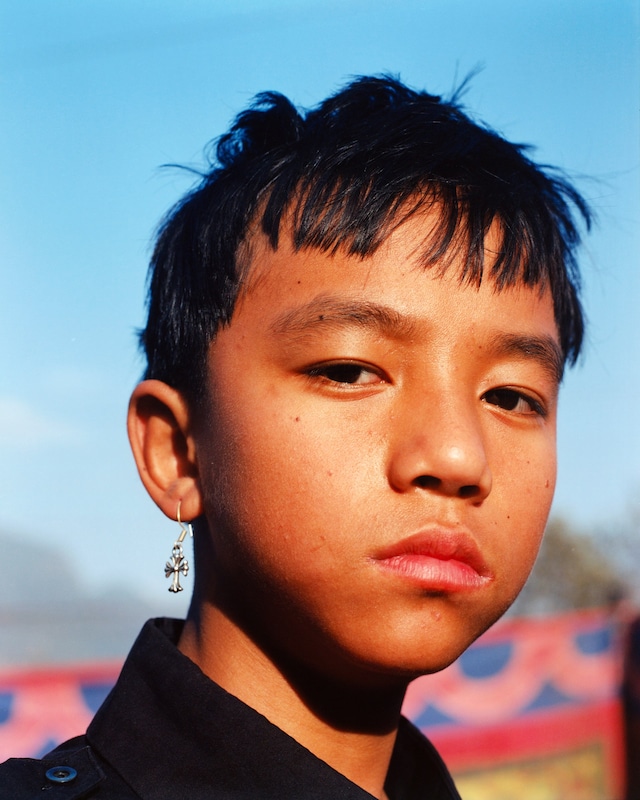
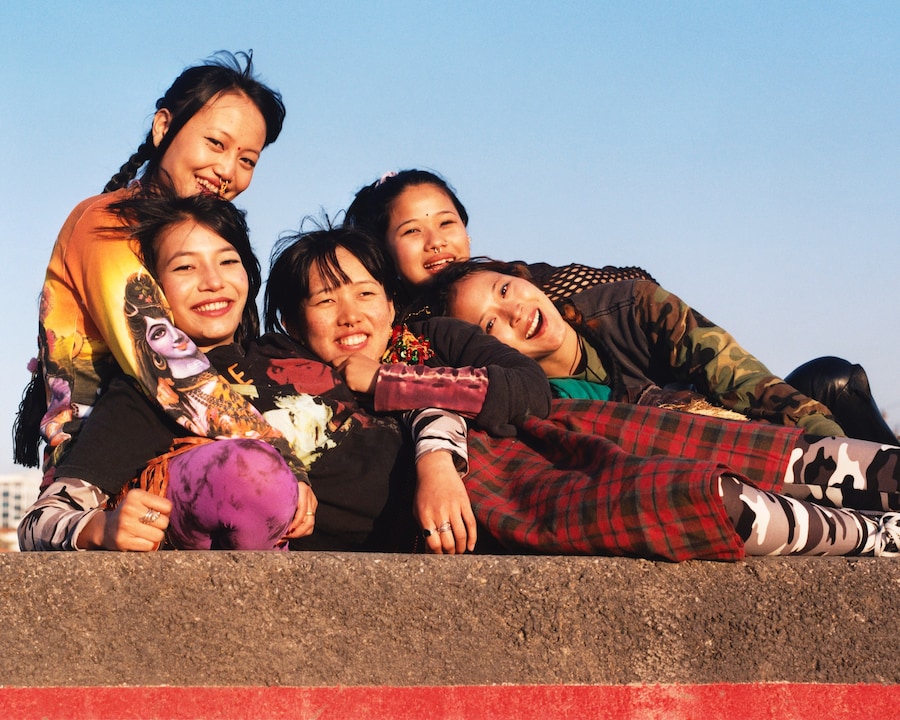
The ensuing portraits of Kathmandu’s girl skaters convey a sense of shared joy, deep friendship and rebellion. Yet, despite their anarchic undertones, Thapa discerned a continued reverence for some traditions. He recalls, “The girls brought their own traditional jewellery and head pieces, and they all knew how to wear them, so it was evident that young people had not lost a sense of tradition. They had their own individual styles stemming from their interests, whether it was skateboarding, music, anime, or new internet subcultures. And they weaved in elements of Nepalese heritage really well by wearing jewellery that had been passed down by their mothers, or wearing Lacha Dori, which is a traditional Nepalese hair accessory.”
It was also important to Lawati that the project encompass their worlds outside of skating. “I spent my last few weeks in Nepal recording the skater girls in their daily lives in Kathmandu and at home,” he says. “I wanted to include something of themselves beyond the skate scene; in the comfort of their own space, with all their achievements, and ask what identifies them.”

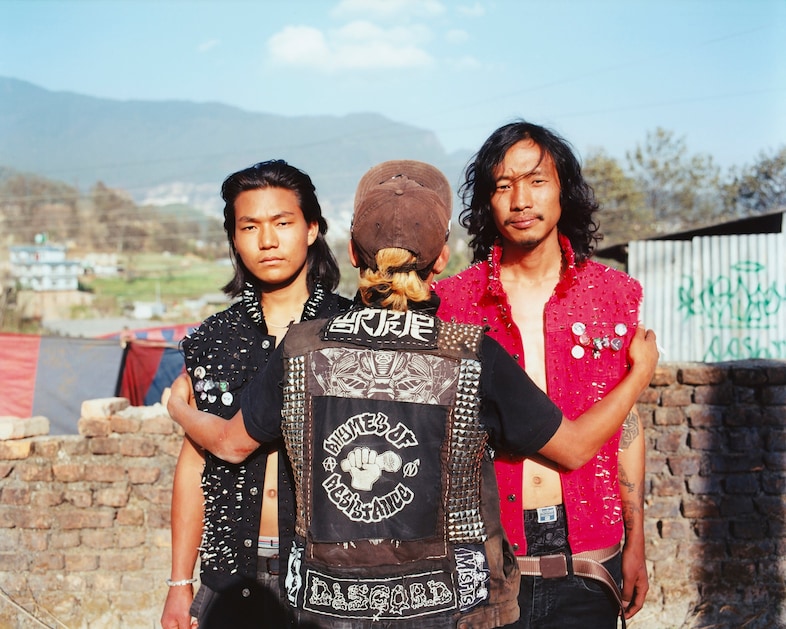
Through the skaters, Lawati and Thapa were introduced to an annual festival called Jamkhabet featuring hardcore Nepalese punk bands. “We’re big fans of punk rock, and we realised this scene was thriving amongst the youth. The members of Girls Skate Nepal were attending all of these guerrilla-style punk rock gigs in forests and warehouses.” Attending the three-day festival, the pair began to glimpse the breadth of subcultures orbiting the punk scene – from skateboarders and BMXers to B-Boy dance battlers, tight-rope walkers, rap battlers, and aunties and grandmothers selling food. “They were all congregated in a space where they could exist harmoniously and without prejudice,” Thapa tells us. “With the Jamkhabet series, we aimed to capture this melting pot of cultures and generations.”
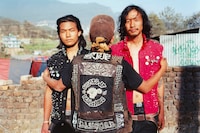
For Lawati, one of the images from the show which most encapsulates the spirit of Nepalese youth culture they encountered is the shot of three young men wearing studded denim vests made by Thapa. “Initially, the plan was to shoot just the two boys, but then the lead singer of the group Youth Unite stepped into the frame with an embrace. That was such a touching moment of unexpected intimacy and says so much about unity and solidarity among the youth.” For Thapa, the image most emblematic of the project is the group shot of skaters huddling together in a skate park. “For me, it represents a new generation with forward-thinking ideas, seeking to make a positive change through youth communities. It makes me think about the idea of a new Nepal.”
