
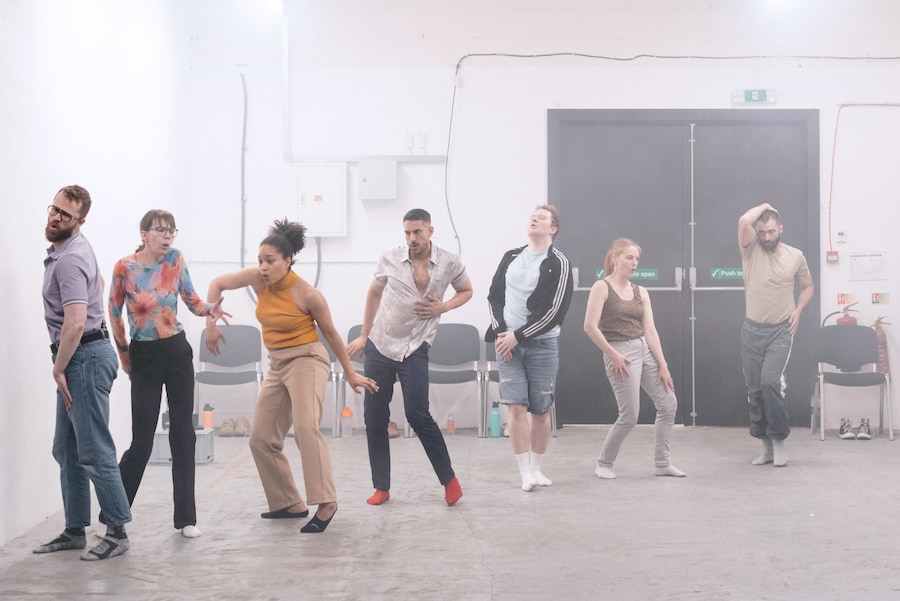
Edward Thomasson’s The Whole Routine is inspired by our persistent attempts – and failures – to connect with one another
Performance is the prism through which London-based artist Edward Thomasson understands the world. Rather than perceiving the act of performing as an affectation, he feels that “we present and conceal parts of ourselves depending on what feels bearable or possible. Then we devise ways, through performance – sex or otherwise – to reveal ourselves again”.
This is the key to Thomasson’s practice in general and, more particularly, his latest work, The Whole Routine – a musical performance about “control and longing”. The mesmeric work consists of a series of song and dance sequences and a poem performed by Thomasson and six others with gradually escalating urgency. “The sequences describe attempts at breaking the numbing repetitions of conventional interaction and the sometimes-alarming awkwardness of trying to feel things differently,” he says. “Harmonies falter, gestures fall flat, and routines fall out of time, but the group keeps trying, and imperfect connections form. The resulting work is situated somewhere between the desire to sing and dance and the fear of total humiliation.”

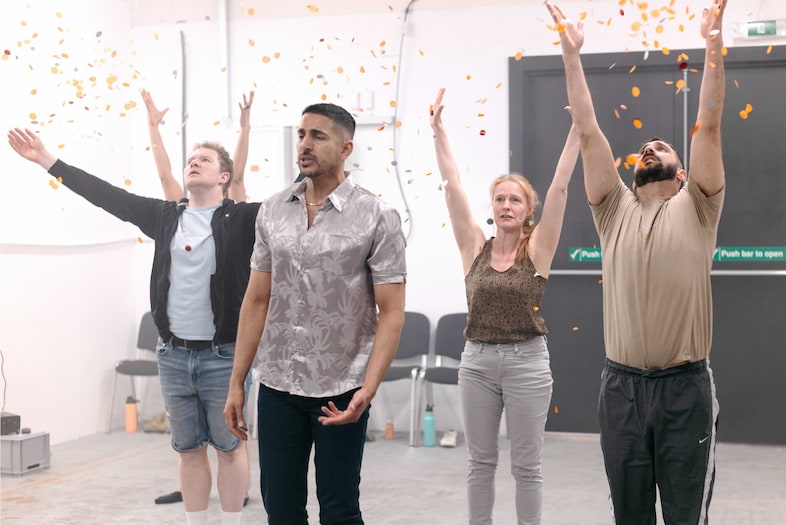
The Whole Routine is composed of five songs, each created closely with Robbie Ellen, a songwriter who works under the name Personnel, and Charlotte Harding, a composer who makes music for performance. Developed in part through improvisation and workshops, the performance brings together trained and non-trained actors and singers in an ordinary, plain environment – the only props or equipment needed are a standard smoke machine, confetti, and a laptop to play the music. “What unites us is a shared desire to make performance an ongoing part of our lives,” he says. “The encounter with an audience is central to the work. Throughout, the enquiry has been about testing how useful song and dance can be as a way of describing difficult interpersonal feelings.”
The act of witnessing a performance can be discomfiting. It can often feel challenging to watch people on a stage when, for so many people, their lives are guided by the desire to avoid embarrassment. I wonder, to what extent this discomfort is something Thomasson wants to confront? “Singing and dancing are ordinary capacities of the body, and yet it often feels embarrassing to move and use our voices in these ways,” he explains. “I sometimes feel ashamed sharing myself like this in public, concerned about appearing ungraceful. My work starts from this moment of shame; I’m attempting to find ways to move with it. I’m interested in what happens when virtuosity isn’t there – not to create awkwardness for its own sake, but because it might allow something else to emerge, something wobblier and more various, a different kind of grace.”
The inherent fallibility of human interactions – our frustrations and endeavours to connect with one another – is essentially what fascinates Thomasson as an artist. Through the irresistible repetition and undulating intensity of lyrics, faltering melodies and movement, at times awkward, sometimes sublime, The Whole Routine gets to the heart of our dogged aspirations to create genuine interactions and break through the countless barriers of reserve that isolate us. “I’m obsessed by our attempts – and fails – to encounter each other, and keep trying anyway; socially, sexually, artistically, trying to experiment, follow one’s desire and have adventures despite rejection and difficulty. This sort of persistence is very graceful.”
The Whole Routine is on show at London Performance Studios on 29 and 30 May, at Glasgow’s Tramway on 18 April, the Nottingham Contemporary in July with more dates to be confirmed. The score of the performance will be published by Montez Press in May.
