
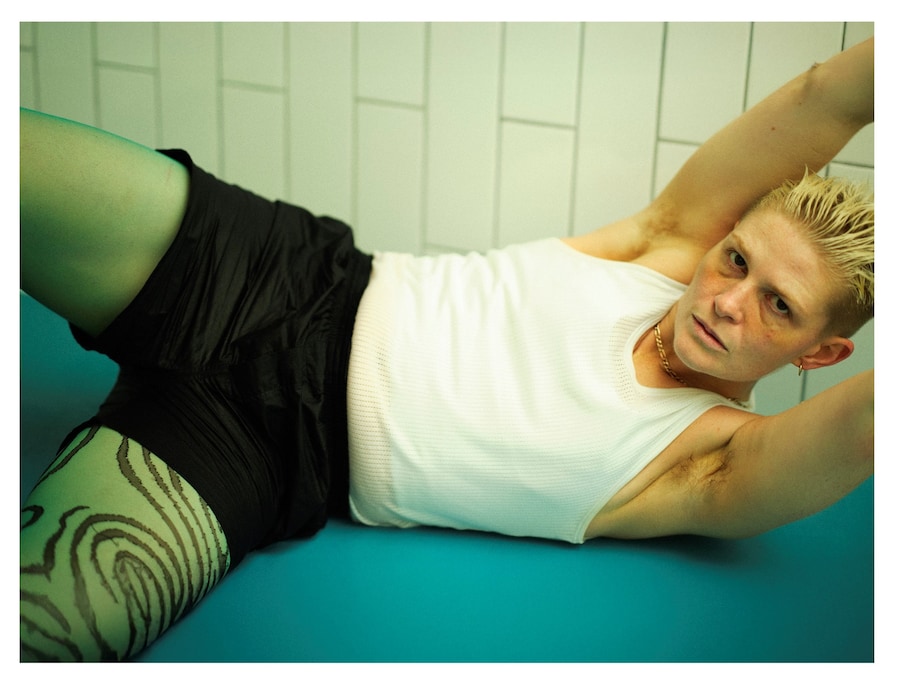
Emily Lipson discusses the concepts and collaborators that make up her inaugural photo book, Dykes, a celebration of both her community and the inevitability of change
Shortly after conducting an interview with US photographer Emily Lipson – about her debut photo book, Dykes – I received a follow-up email from the image-maker, returning to a point she’d been reflecting on during our call. “I think it’s a radical thing to change your mind,” she wrote. “[That] it’s important to always be OK to change your viewpoint on something. That’s really it.”
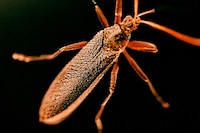
Change is a key theme in the book – perhaps the key theme, alongside its titular concept. Featuring portraits of around 50 subjects, alongside still lifes of bugs and tampons (both vessels of transformation, it could be argued), the project embodies transcience in a number of ways. First, it reflects Lipson’s own evolution as an artist, and a person, over the last five years: the photographs have been compiled from her personal and professional archive, and range from intimate snapshots of exes and close friends to imagery made for fashion editorials or commercial shoots.
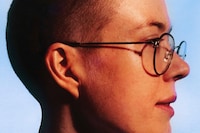
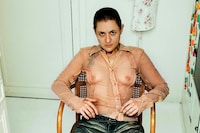

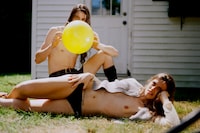
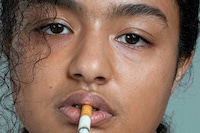
All of Dykes’ subjects are people with whom Lipson shares a personal connection, and an affinity with the term “dyke” – a word she says she was once afraid of, but now wears with pride. “It’s when you find people whose life story you really have a kinship with,” she says of those who made their way onto Dykes’ pages, and whom she views as collaborators as much as subjects. “Initially, I didn’t know I was making a book, so there was a lot of reaching back out to people years later and saying, ‘Hey, I’m doing this project with this work. It’s called Dykes. This is why I’m calling it that. Do you identify with the word? And if you do, would you want to be in it?’ Almost everyone said yes.”
As such, the publication presents a refreshingly broad, albeit microcosmic, spectrum of dyke identity – one that resists monolithic interpretation. “‘Dyke’ is not a singular thing,” Lipson’s artist statement reads. “This community is not narrow or unified or clean. It includes cis lesbians, transmasculine men, transfeminine women, nonbinary people, people of colour, white people – people who love each other, people who don’t, people who will never agree.” And this was something she actively sought to showcase.

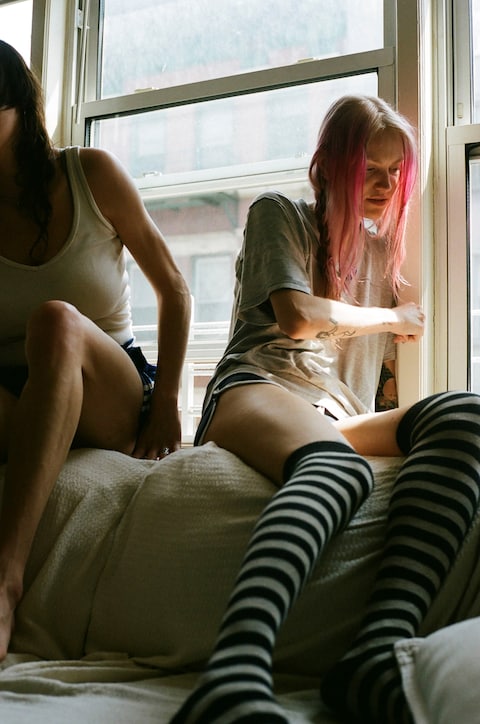
With the book’s unifying concept in place, Lipson left herself deliberately free to play with different formats and aesthetics. Dykes features analogue and digital photography, from fashion stories to striking close-ups of faces and body parts to scenic group shots that convey Lipson’s appreciation for the raw, candid approach of Nan Goldin and early Wolfgang Tillmans. It features AI intervention (the photographer asked AI to give a number of her subjects “lesbian hairstyles”, resulting in mohawks, short crops and more surprising, avant-garde interpretations), collage and Sharpie scrawls, and prints painted with colourful dyes: intervention as a form of change, if you will.
Lipson also gave herself the time and space to change her mind, a luxury that is rarely, if ever, afforded in the realm of fashion photography. “Often, we get commissioned to do shoots and the edit is due two days later, with the finals due a week or two after that,” she explains. “It’s such a tight, abbreviated timeline for the way most artists need to work.” With Dykes – which was designed and produced in collaboration with AnOther Magazine’s art director, SJ Todd – the aim was to keep returning to the work, “to age with it,” in Lipson’s words. “Any decision I made, like making an edit, I would go back a week, two weeks later and be like, ‘OK, now I feel differently. Now my eye is seeing something else,’ I knew I would love the outcome if, by the final edit, I’d seen a picture ten months out of the year, and decided to keep it in.”
The book itself invites slow engagement, its imagery nuanced and leaving room for interpretation. “This is not a feminine person, but she’s wearing pink underwear,” Lipson says, pointing to a photograph of a topless figure, sprawled nonchalantly on the grass in cotton underwear. “This person is wearing heels with men’s work shorts and a basketball uniform on top,” she says, directing my gaze to an atmospheric shot of a model, standing tall and imposing in profile in Lipson’s apartment (pose is frequently the starting point for Lipson’s portraiture, reflecting her early work as a choreographer). “I wanted to document modern butch and femme aesthetics as I see them,” she explains – another response to the fashion world, and its more binary approach to androgyny.

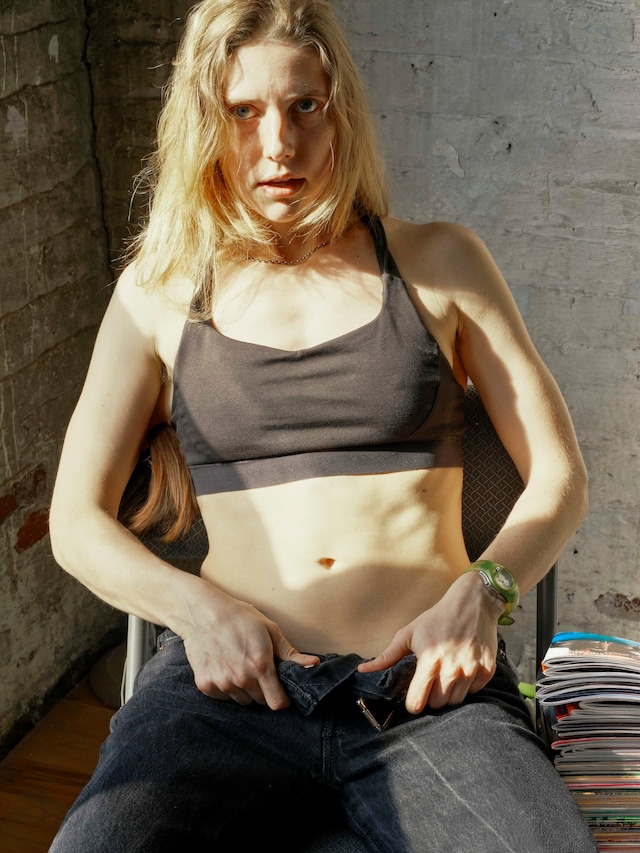
Much of what Lipson is hoping to highlight with Dykes and its rich, beautifully rendered portraits is that humans are in a state of flux almost all of the time. Sometimes we try to resist this, to commit ourselves to a specific methodology, perhaps – initially, Lipson was interested in incorporating AI into her practice, she tells me by way of example, but has now decided to stop using it for environmental reasons – or, more problematically, to a set ideology or identity.
But change is, of course, life’s only certainty, and there is joy and liberation in accepting it. As Lipson concludes in her artist statement: “In looking at this book, I’m asking you to see identity not as a fixed state, and pictures as impermanent but important markers of our constantly transient states. The dyke community is an expansive and ever-shifting group. For many of us, gender isn’t one or the other, nor some tidy combination – it is evolving, unresolved, without a final resting place.”
Dykes by Emily Lipson is published by Antenne Books and is out now. A book signing and talk will take place at Mast Books in New York from 6-8 pm on 26 March.
