
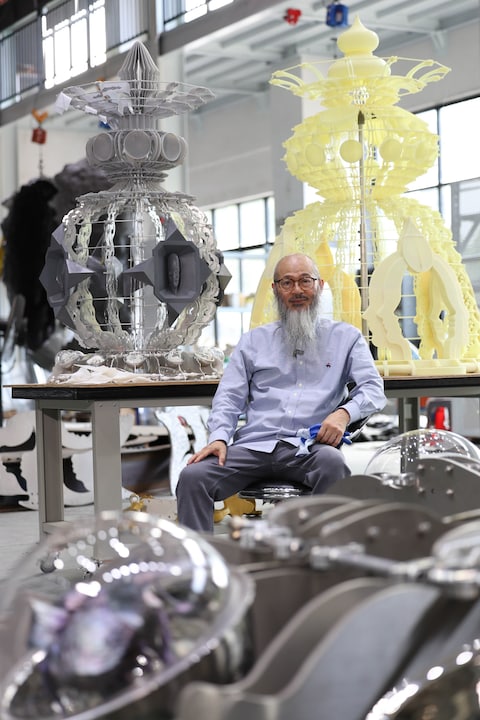
Opening in Venice and Shanghai, the eminent artist’s dual-site exhibition, Vessels of Other Worlds, will present the “shimmering presence” of his ornate sculptures
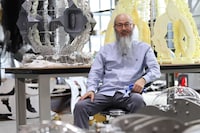
The Long MuseumVisitors to the Chapel of Santa Maria della Pietà in Venice this year will witness something extraordinary and unexpected in its sacred, elegantly frescoed interior. During this period, the church will be home to Vessels of Other Worlds (sponsored by the Long Museum, Shanghai), three magnificent sculptures surrounded by suspended titanium forms. Their creator is Wallace Chan, the eminent Hong Kong-based artist and jewellery master known for his illusionary carving Wallace Cut (1987), and material innovations such as the use of titanium in jewelry and the Wallace Chan Porcelain (2018). His works are now in the permanent collection of seven major museums, including the British Museum, the V&A Museum, and the Boston Museum of Fine Arts. Chan describes the sensation of entering the chapel as “an encounter with scale and space”.
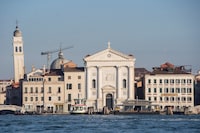
Situated beside the grandeur of Vivaldi’s church, the Pietà Chapel is a rather more humble, narrow space. “Its scale and proportion encouraged restraint,” Chan explains. “The verticality of the architecture shaped the suspended forms, while the intimacy of the space invites quiet engagement.” With its many figures and symbolic motifs, the work draws inspiration from Hieronymus Bosch’s The Garden of Earthly Delights, a timeless triptych which, for Chan, “suggests an entire universe of human experience. Its scale of imagination and structural complexity continue to move me”.
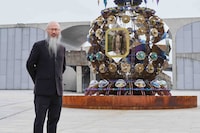
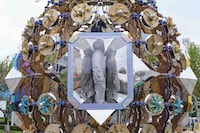
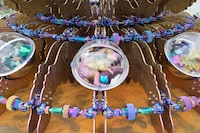
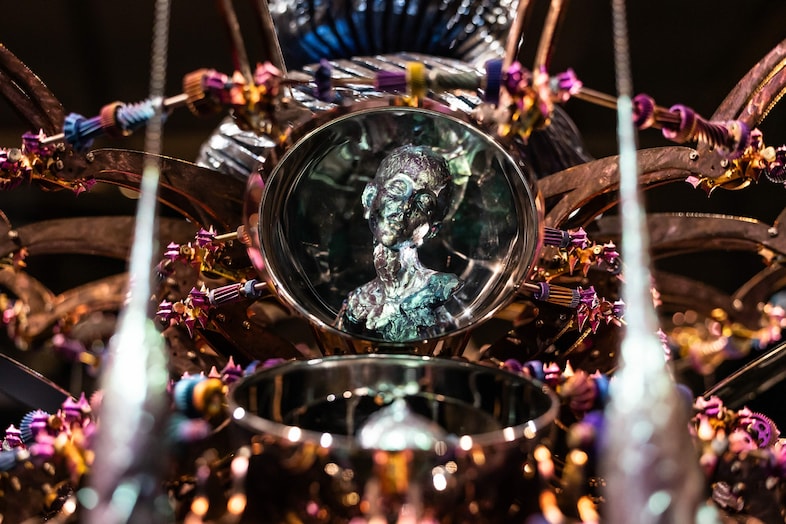
The trio of sculptures, or “vessels”, possess what Chan describes as “shimmering presence” Like his exquisite but minute gemstone artworks, these towering sculptures require close examination. “Their surfaces contain human figures and symbolic motifs that unfold gradually upon closer viewing,” he tells AnOther, reflecting on the intricacies of this detailed work on such a large scale. “The exhibition invites a slower engagement; a vessel alone is put together with more than 20,000 screws. As one moves around the sculptures, perspectives shift. Light, structure and reflection become active components of the encounter. The work speaks through material and proportion.”
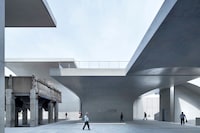
Opening to coincide with the 61st International Art Exhibition of La Biennale di Venezia, Vessels of Other Worlds is a dual-site exhibition. The second, parallel presentation will open at the Long Museum, Shanghai, on 18 July 2026. Existing in dialogue across these two distant cities, and in two such different architectural sites, Vessels of Other Worlds provokes questions about proximity and absence, as well as the contrast between modernity and antiquity.
“I am always attentive to the character of a site. Architecture influences proportion, rhythm and movement. A space carries its own atmosphere, and I try to respond to that rather than impose upon it,” Chan says. “Cities also influence the work. Venice carries centuries of history and layered memory. Shanghai reflects momentum and expansion. These environments shape how the sculptures inhabit their surroundings. Also, both Shanghai and Venice are closely related to water. Water – its transformation, humility and fluidity – has always been an important inspiration to my art.”

In response to the proportions of the Long Museum, Chan’s monumental titanium sculptures will reach seven, eight and ten metres in height – one of these vessels even allows visitors to enter its interior. “The two sites inform one another through presence and distance,” says the artist. “In Venice, live transmissions from China extend the reality of the sculptures beyond the chapel. In Shanghai, the Venice presentations are understood as part of a larger system. Together they form a single project unfolding in two locations.”
The exhibition, also coinciding with the artist’s 70th birthday, will be his fourth participation in the Venice Biennale. He sees each body of work as part of a “constellation”, each of which “stand in relation to one another like stars that form a pattern when viewed together”, rather than a continuum or progression. Previous exhibitions have explored themes as far-reaching as spatial immersion, mythology, spirituality, astronomy, and more of what he describes as “grand human pursuits”. He elaborates: “Vessels of Other Worlds gathers these strands within the framework of birth, growth and rebirth. In doing so, it reflects on continuity and transformation, and on the larger structures that shape existence.”
Chan describes the guiding principles of his work as “structure, transformation and continuity”. He’s interested in the interplay between the materiality of his work as a configuration of component parts and how these “systems” hold together over time. “The vessels are constructed from interlocking human figures and symbolic elements that operate as structural frameworks rather than illustrative forms,” he says. “Another principle was material integrity. Titanium has its own character and limitations. I work with its strength and lightness rather than forcing it into shapes that contradict its nature.” The third and perhaps most crucial element of his practice relates to the inexorable nature of change: “Finally, the work is grounded in the understanding that transformation is constant. Energy changes form. Structure reorganises itself. The sculptures reflect this continuity.”

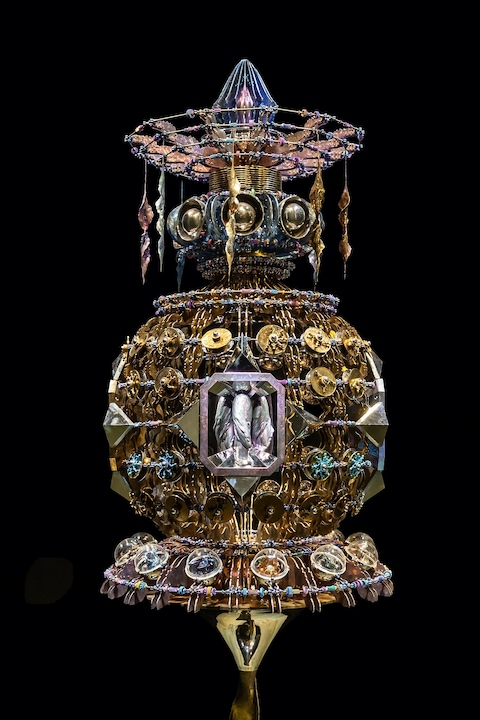
Transformation notwithstanding, the property of titanium that appealed most to Chan was its capacity to endure. “I create my works with the hope that they will outlive me,” he says. “I was drawn to titanium because it is strong, stable and resistant to corrosion. To me, it is the material closest to eternity.”
Vessels of Other Worlds by Wallace Chan (supported by the Long Museum, Shanghai) opens on 8 May 2026 at the Chapel of Santa Maria della Pietà, coinciding with the 61st International Art Exhibition of La Biennale di Venezia and runs until 18 October 2026. The second and parallel exhibition at the Long Museum, Shanghai, runs from 18 July to 25 October 2026.


