
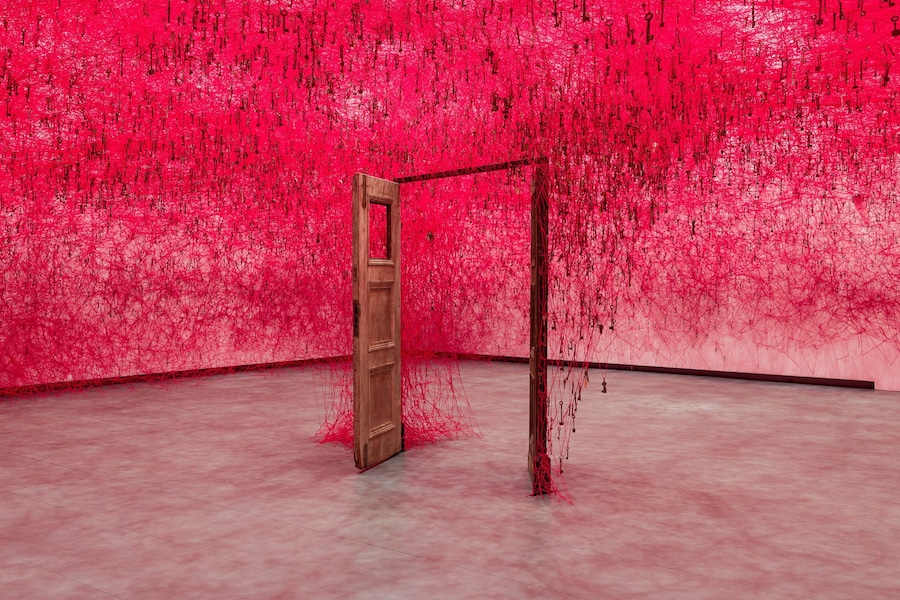
Inspired by the Japanese Red String Theory, the artist’s enchanting London exhibition makes visible the invisible connections that tether us to one another
I’ve placed Chiharu Shiota in an impossible position. Known most for her large-scale artworks created from vast, intricate networks of thread, she developed her unique practice to make tangible the endless speculative configurations of human connections – something to be experienced rather than defined. But by asking her to describe her new exhibition, Threads of Life at the Hayward Gallery, I’m dragging her back into a reductive world of language. “If I wanted to express myself in words, if I could explain in words, I’d rather write,” she says. “So I want to build visually, and I want to create visually. What I want to describe is beyond words.”
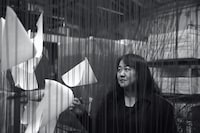

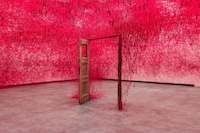
The renowned performance and installation artist has lived in Berlin since 1996, but was born and spent her formative years in Japan. Exploring memory, co-existence, the body and consciousness, her monumental installations draw on the Red String Theory (or Akai Ito), a common concept in Japan which suggests our most meaningful encounters are inevitable because we’re connected by threads that may tangle but never break. Shiota’s work envisions these mystical threads as something more omnipresent but nonetheless magical, engulfing everyone and everything. “If you live in a society, you have to be connected with someone – it’s unavoidable,” she says. “There’s always a connection. I just wanted to show the connection; I wanted to make it visible.”
“I was studying art and painting, but whatever I painted, I felt like I was copying somebody; they all looked like somebody else’s work. I hit a block. At this time, I had a dream in which I went inside a painting – actually inside it, I remember the smell of oil – and I was thinking, ‘How can I make this painting better? How can my movement make this painting better?’” Waking, she began adorning her body with red paint, which would lead her to search for materials to move beyond the flat surface of the canvas. This sense of “drawing in space” is palpable; her installations feel like stepping inside enormous geometric designs or, at other times, monstrous, massive scribbles.
Moving through the upper gallery spaces of the Hayward, the first of Shiota’s works occupies the room from the ceiling, encroaching from above like a monolithic red web from which hundreds of miscellaneous keys are suspended. Shiota began collecting keys back in 2015. “I was six months pregnant, then I had a miscarriage, sadly. Three months after that, my father died, so I was quite depressed, and I really wanted to hold on to something small, something precious to me. That’s when I started to collect keys,” she recalls. Though they are everyday objects, keys hold deep symbolism and meaning. Here, in Shiota’s installation, they are transfigured by a sense of magic; each key has a story and a history.
, 2025)
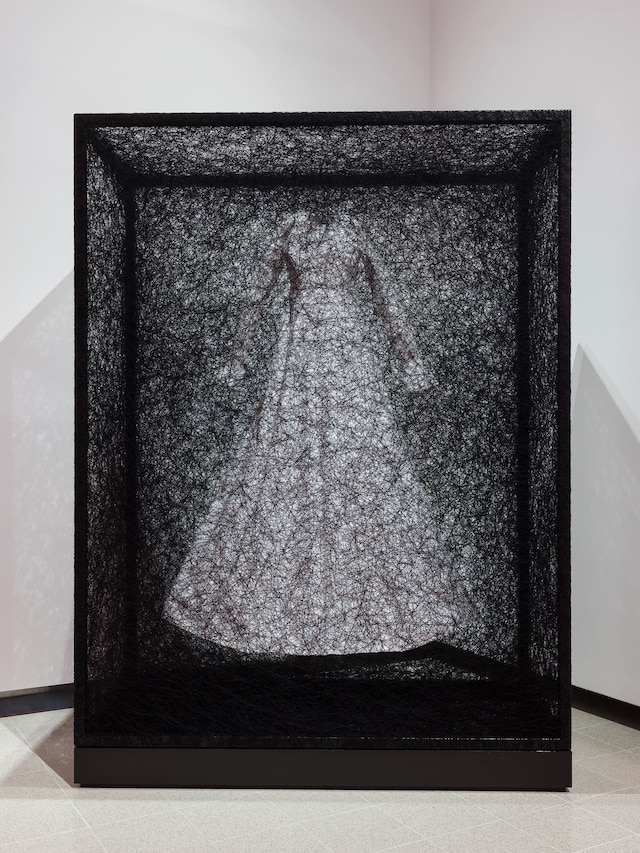
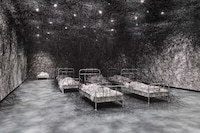
Letters of Thanks suspends hundreds of gratitude letters, written by the public, in cascading threads which form an enchanted path to the third large installation in Threads of Life. During Sleep features a series of austere, metal-framed beds engulfed in chaotic black thread. The effect is eerie, the shadow self of a fairy tale or a bad dream. This piece is connected to Shiota’s early experiments with thread. She describes the period when she first moved from Japan to Germany, and felt disoriented after moving house nine times within the first three years. “I literally didn’t know where I was when I woke up sometimes in the morning. I started to put threads on my bed to create some sort of physical space. I wanted to create that boundary, or non-boundary, between dream and reality.” Though sleep recalls a kind of death for the artist (“because when you’re sleeping, you don’t have particular memory or recognition”), the threads became a way to tether her to life, and to a recognisable waking reality.
I can’t help but try once again to press Shiota for tighter definitions of this sprawling, all-encompassing idea she’s physically grappling with. Can she tell me one significant time when she’s experienced this feeling of connection? Has she ever felt a sense of uncanny recognition with a stranger – a sense of déjà vu – that their encounter is fated? I need there to be a tale, but she remains enigmatic. She will secure endless threads, but she won’t spin a yarn. “I feel that in my everyday life, this concept of red thread, of connection destiny, is a common phrase in Japanese. We use it a lot. It could be a partner, or people I work with in my studio. I feel it in everyday life, I feel it everywhere.”
Chiharu Shiota: Threads of Life is on show at the Hayward Gallery in London until 3 May 2026.
