
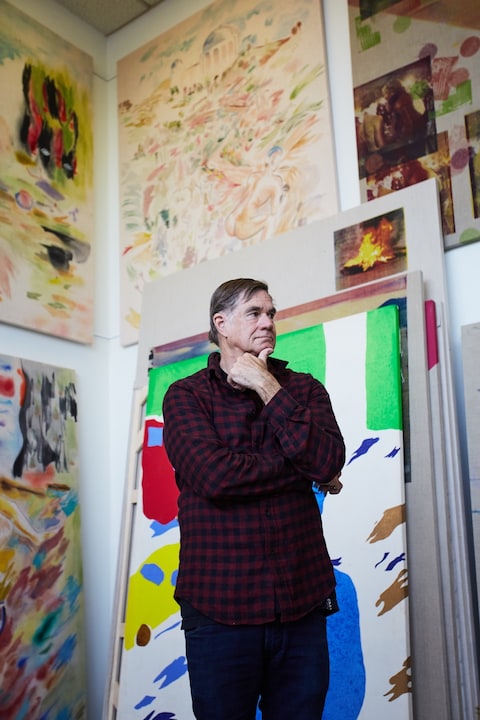
A new book offers an eye-opening look into the American auteur’s practice as an artist. Here, he discusses his adventures in paint, from childhood through today
There are few contemporary filmmakers as adventurous as Gus Van Sant. Just when you think you know what to expect from the American auteur, he doubles back or ambles sideways – a Hollywood hit here (Good Will Hunting, Milk), a bold homage there (he famously reimagined Hitchcock’s Psycho frame by frame). Not to mention all of the strikingly experimental works that have helped shape the landscape of American indie cinema, from his near-silent survival drama, Gerry (2002), to his extraordinary blend of Shakespeare and street hustlers for My Own Private Idaho (1991), a film whose lyrical, fragmented mode of storytelling feels as radical today as it did 35 years ago. This applies equally to Van Sant’s prowess as a painter, a skill he developed in childhood, honed at art school and has picked back up in the past 15 years with renewed vigour and a familiar thirst for discovery.
“When I was a kid, I was painting, as a few of my classmates were, because my teacher was a painter,” Van Sant tells AnOther, speaking from his Los Angeles home ahead of the release of Gus Van Sant: Paintings, a new publication of his painted works from 2011 to now. “We were making paintings and different things as well – silkscreens for dances or basketball games, mobiles … It was around 1963, so a lot of different types of artistic endeavours were happening, which played into what he was teaching us. That was kind of where I started.”
Much like his near-contemporary David Lynch, Van Sant enrolled in university to study painting, and in the process, found film. “I went to Rhode Island School of Design, and there was a film department there,” he recalls. “I started to spend a lot of time there, because the painters in the painting department were very good, and because I’d done painting for so long that cinema was much more mysterious and challenging to me.” This was, Van Sant explains, a period when many painters, from Andy Warhol to Stan Brakhage, were turning their hand to experimental filmmaking, so it felt like a logical leap. “I [started off] scratching on film, I was drawing on film, I was animating during that period. But there were also artist filmmakers, like Ron Rice and Jonas Mekas, who were making films with dialogue and scenes, so there was a crossover.”
Soon, Van Sant’s mind turned to more traditional Hollywood filmmaking, inspired by the success of modern avant-garde filmmakers: Fellini, Godard, the French and German New Wave, John Waters. “It started to become a reality, the idea that you could play into the Hollywood system,” the artist explains. But although the young Van Sant would shortly switch his paintbrush for a Super-8 camera, he never abandoned his fine-art roots entirely, often painting works for actors in his films as gifts, and, where necessary, drawing up storyboards. “My first film [Mala Noche, 1986] was entirely storyboarded – there were four volumes of storyboards and I used them every day,” he says. “But they went by way of bigger budgets, except for things like action sequences – I still use them for those.”
, 2018–19)
It wasn’t until 2011, however, when James Franco was set to screen a cut of My Own Private Idaho as part of an exhibition at Gagosian’s Los Angeles space, that Van Sant saw an opportunity to throw himself back into painting properly. He set about creating deftly rendered, close-up portraits of young men – who could’ve been lifted straight from the world of My Own Private Idaho, but were actually inspired by a Hedi Slimane shoot – to hang on the surrounding walls, and Franco’s solo venture became a joint show, titled Unfinished.
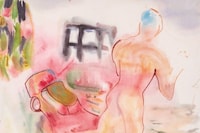
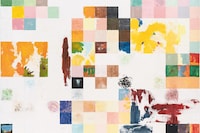
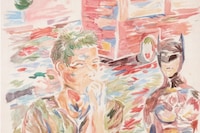
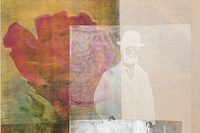
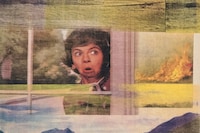
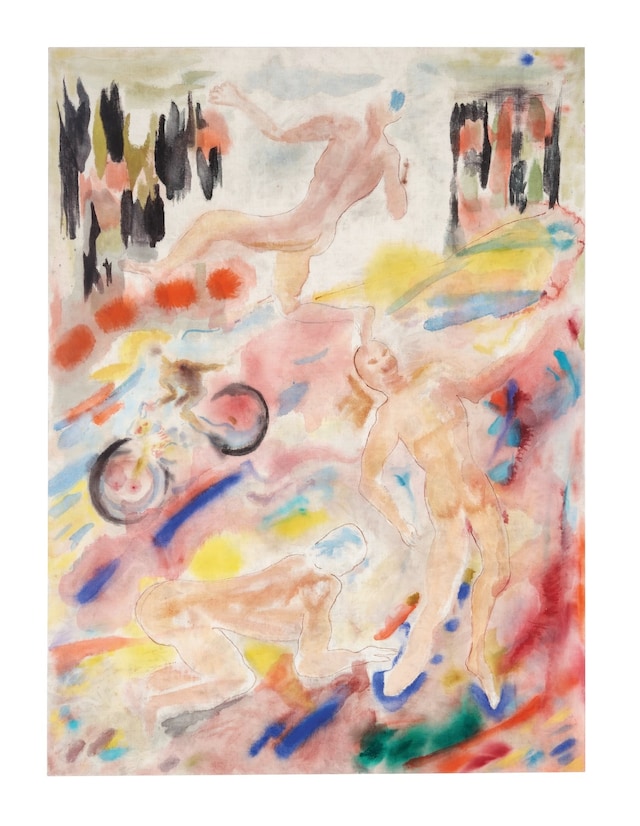
What followed was a flurry of remarkable investigations in paint, conducted either in Van Sant’s dedicated LA studio, or in his garage – “[that way] I can just wake up and start painting rather than get up and drive to the studio. By the time I get to the studio, I’m already worn out!” A flick through Gus Van Sant: Paintings prompts encounters with the 2011 portraits; dreamy figurative watercolours on linen canvases; various Mona Lisas in pixelated squares of pencil crayon; Matisse-like “shape studies” in bright colours; resin paintings on giant sheets of aluminium, and oil and silkscreen works on linen featuring “quotes” from found photographs.
Such different types of work may sound incongruous, and yet they make perfect sense in the context of their creator. In the words of the book’s editor Leah Gudmundson, “Stylistically Gus’s paintings are varied, but the essence of him as an artist ties them together; they are experimental. They function as a place to contemplate an idea, play with technique, and muse on characters imperative to his creative world.”

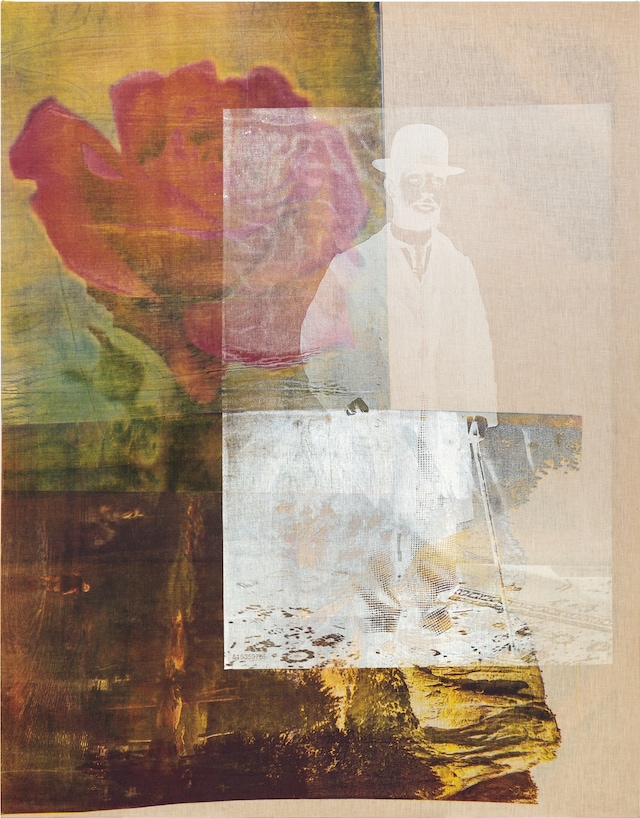
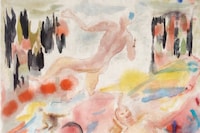
Indeed, in Van Sant’s oneiric watercolours of Hollywood Boulevard (which showed at Vito Schnabel gallery in New York in 2019), nude male figures in Chagall-esque hues drift languidly among cars, buses and Hollywood landmarks with the same sense of isolation and rugged romanticism so quintessential to Van Sant’s films. In both his silkscreen-and-oil and his resin-on-aluminium works, the photographic references – often newspaper pictures of war, protest and violence – are abstracted and stylised, engaging with the realities of contemporary culture in a way that is somehow detached, just as Van Sant’s films turn an alternate, outsider lens on American systems (capitalism, masculinity, success), allowing any critique of such structures to emerge quietly. It’s even tempting to draw a line between his recreation of Psycho – the almost obsessive dissection of a ubiquitous artwork – and his many iterations of the Mona Lisa (which seared itself onto his childhood imagination when he saw it first in person and then again on the cover of a 400-piece LEGO set).
For Van Sant however, who allowed Gudmundson to take charge of the book and its elegant sequencing, any similarity between his paintings and films appears almost inconsequential – something for others to ponder as he embarks upon his next creation. “I guess in some cases there are definitely connections, but I haven’t really heard a statement about it. There are themes that are similar to some of the films. All these things look like My Own Private Idaho, except maybe the Mona Lisa,” he adds with a chuckle. “To me, it’s so different in the sense that the art piece is like an object and a film is more like watching a dream on a wall or something,” he says, drawing our conversation to a fittingly poetic close.
Gus Van Sant: Paintings is published by Blue Moon Press and is available for pre-order now.
